Results by title
3258 books match the query 'Performing Arts' and 166 start with d
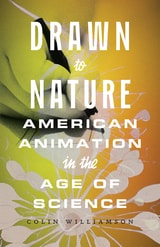
Drawn to Nature
American Animation in the Age of ScienceColin Williamson
University of Minnesota Press, 2025
How twentieth-century developments in science influenced the aesthetics of the burgeoning American cartoon
What do technical renderings of plant cells in trees have to do with Disney’s animated opus Fantasia? Quite a bit, as it turns out: such emergent scientific models and ideas about nature were an important inspiration for Disney’s groundbreaking animated realism. In Drawn to Nature, Colin Williamson presents a vivid portrait of how developments in biology, physics, and geology between 1900 and the long 1960s influenced not just Disney but the American cartoon industry as a whole.
Drawing on original research on the scientific appetites of animators and studios such as Winsor McCay, the Fleischer Brothers, Walt Disney, and United Productions of America, Williamson opens new avenues for understanding the history and aesthetics of cartoons. Interrogating the differences between art and science and reconsidering the realms of dream, magic, and fantasy as they pertain to pop culture, he yields novel proposals for bridging longstanding divides between animation, live-action cinema, and the history of science.
Drawn to Nature not only illuminates the extent to which animators have drawn on scientific insights, it also considers seriously how commercial animations themselves participate in scientific discourse. It revises and revitalizes our existing narratives about the history of American animation to uncover the many ways science informs our collective cultural imagination.

Dream Factories of a Former Colony
American Fantasies, Philippine CinemaJosé B. Capino
University of Minnesota Press, 2010
By tracking American fantasies in Philippine movies from the postindependence period to the present, José B. Capino offers an innovative account of cinema's cultural work in decolonization and globalization. Capino examines how a third world nation's daydreams both articulate empire and mobilize against it, provide imaginary maps and fables of identity for its migrant workers and diasporan subjects, pose challenges to the alibis of patriarchy and nationalism, and open up paths for participating in the cultures of globality.
Through close readings of more than twenty Philippine movies, Capino demonstrates the postcolonial imagination's vital role in generating pragmatic and utopian visions of living with empire. Illuminating an important but understudied cinema, he creates a model for understanding the U.S. image in the third world.
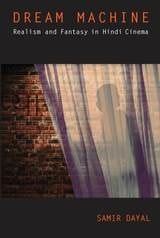
Dream Machine
Realism and Fantasy in Hindi CinemaSamir Dayal
Temple University Press, 2015
Popular Hindi films offer varied cinematic representations ranging from realistic portraits of patriotic heroes to complex fantasies that go beyond escapism. In Dream Machine, Samir Dayal provides a history of Hindi cinema starting with films made after India’s independence in 1947. He constructs a decade-by-decade consideration of Hindi cinema’s role as a site for the construction of “Indianness.”
Dayal suggests that Hindi cinema functions as both mirror and lamp, reflecting and illuminating new and possible representations of national and personal identity, beginning with early postcolonial films including Awaara and Mother India, a classic of the Golden Age. More recent films address critical social issues, such as My Name is Khan and Fire, which concern terrorism and sexuality, respectively. Dayalalso chronicles changes in the industry and in audience reception, and the influence of globalization, considering such films as Slumdog Millionaire.
Dream Machine analyzes the social and aesthetic realism of these films concerning poverty and work, the emergence of the middle class, crime, violence, and the law while arguing for their sustained and critical attention to forms of fantasy.
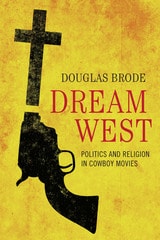
Dream West
Politics and Religion in Cowboy MoviesBy Douglas Brode
University of Texas Press, 2013
While political liberals celebrated the end of “cowboy politics” with the election of Barack Obama to the presidency, political conservatives in the Tea Party and other like-minded groups still vociferously support “cowboy” values such as small government, low taxes, free-market capitalism, and the right to bear arms. Yet, as Douglas Brode argues in this paradigm-shifting book, these supposedly cowboy or “Old West” values hail not so much from the actual American frontier of the nineteenth century as from Hollywood’s portrayal of it in the twentieth century. And a close reading of Western films and TV shows reveals a much more complex picture than the romanticized, simplistic vision espoused by the conservative right.
Examining dozens of Westerns, including Gunfight at the O.K. Corral, Red River, 3:10 to Yuma (old and new), The Wild Ones, High Noon, My Darling Clementine, The Alamo, and No Country for Old Men, Brode demonstrates that the genre (with notable exceptions that he fully covers) was the product of Hollywood liberals who used it to project a progressive agenda on issues such as gun control, environmental protection, respect for non-Christian belief systems, and community cohesion versus rugged individualism. Challenging us to rethink everything we thought we knew about the genre, Brode argues that the Western stands for precisely the opposite of what most people today—whether they love it or hate it—believe to be the essential premise of “the only truly, authentically, and uniquely American narrative form.”
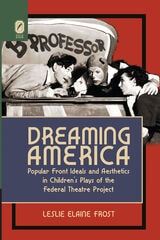
Dreaming America
Popular Front Ideals and Aesthetics in Children's Plays of the Federal Theatre ProjectLeslie Elaine Frost
The Ohio State University Press, 2013
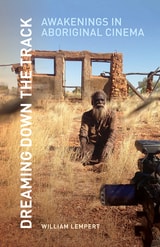
Dreaming Down the Track
Awakenings in Aboriginal CinemaWilliam Lempert
University of Minnesota Press, 2025
What can Aboriginal filmmaking reveal about Indigenous presence and futures?
The product of years of embedded fieldwork within Indigenous film crews in Northwestern Australia, Dreaming Down the Track delves deeply into Aboriginal cinema as a transformative community process. It follows the social lives of projects throughout their production cycles, from planning and editing to screening, broadcasting, and after-images. Across its narrative sweep, this ethnography engages the film career of Kukatja elder Mark Moora to demonstrate the impact of filmmaking on how Aboriginal futures are collectively imagined and called forth.
William Lempert highlights a series of awakenings through which Moora ultimately came to view cinema as a process for catalyzing his family’s return to their home country of Mangkayi. This biographical media journey paints an intimate portrait of the inspiring possibilities and sobering limitations of Indigenous envisioning within settler states. Lempert traces how Moora’s life and films convey a multiplicity of Aboriginal experiences across time and space, from colonial contact to contemporary life in communities like Balgo, including the continued governmental attempts to undermine them.
Amid ongoing negotiations to establish the first treaties between Indigenous nations and Australian states, Dreaming Down the Track illustrates what is at stake in how Aboriginal–State relations are represented and understood, both within communities and for the broader public. Lempert stays true to Moora’s insight that film can preserve community stories for generations to come, toward the aim of enacting sovereign futures.
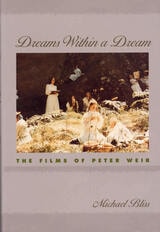
Dreams Within a Dream
The Films of Peter WeirMichael Bliss
Southern Illinois University Press, 2000
"What we see, and what we seem, are but a dream, a dream within a dream." Michael Bliss views Miranda's voice-over at the beginning of Picnic at Hanging Rock as so pivotal in explaining the films of Peter Weir that he borrows her words to create the title of his own study of the Australian filmmaker's work.
Bliss views Weir as an artist whose values are rooted in the realm of the dream, of the unconscious. Surrealistic in technique, Weir avoids the pedestrian assurances of a material realm in favor of an irresolution that, while potentially frustrating, is nonetheless for him a more truthful representation of what he considers reality. For Weir, as for Plato, Bliss demonstrates, "empirical reality is nothing more than a shadow of what is real."
Bliss also considers Weir's heritage. Australian cinema, Bliss explains, is characterized by melodramatic narratives born of a desire to see good and evil portrayed in striking opposition. Weir, for example, dramatizes the contradictory forces of light versus darkness, reason versus mystery, and rationality versus magic in such films as Picnic at Hanging Rock and The Last Wave. This melodramatic emphasis is evident as well in the polarized characterizations in such films as Witness, Dead Poets Society, and The Truman Show.
Bliss also discusses Weir's use of another staple of Australian cinema— "mateship," the celebration of the bond between male companions. But by making self-knowledge dependent on action involving one's friends, Weir gives mateship a new meaning. Moreover, like other Australian filmmakers, Weir emphasizes the starkness of the Australian landscape, which functions either as a hazard or a deadly challenge, at least until American mythology caused him to see nature in a more positive light. Also prominent in Weir's films is an Australian spirit of rebellion coupled with the Aussie ambivalence toward all aspects of British culture.
To help explain Weir's films, Bliss looks to Freud and Jung, whom Weir has studied, and also to two other prominent purveyors of myth and archetype, Northrop Frye and Joseph Campbell. Virtually all Weir characters struggle toward a new mode of awareness, a psychological awareness based on archetypal truths. Many of his films involve archetypal journeys heading through conflict to spiritual unity. Weir's quest is to find out what we really know and how we know what we know.
Dreams of Difference, Songs of the Same
The Musical Moment in FilmAmy Herzog
University of Minnesota Press, 2009
Musical spectacles are excessive and abstract, reconfiguring time and space and creating intense bodily responses. Amy Herzog's engaging work examines those instances where music and movement erupt from within more linear narrative frameworks. The representational strategies found in these films are often formulaic, repeating familiar story lines and stereotypical depictions of race, gender, and class. Yet she finds the musical moment contains a powerful disruptive potential.
Dreams of Difference, Songs of the Same investigates the tension and the fusion of difference and repetition in films to ask, How does the musical moment work? Herzog looks at an eclectic mix of works, including the Soundie and Scopitone jukebox films, the musicals of French director Jacques Demy, the synchronized swimming spectacles of Esther Williams, and an apocalyptic musical by Taiwanese director Tsai Ming-liang. Several refrains circulate among these texts: their reliance on clichés, their rewriting of cultural narratives, and their hallucinatory treatment of memory and history.
Drawing on the philosophical work of Gilles Deleuze, she explores all of these dissonances as productive forces, and in doing so demonstrates the transformative power of the unexpected.
Driven to Darkness
Jewish Emigre Directors and the Rise of Film NoirBrook, Vincent
Rutgers University Press, 2009
Driven to Darkness explores the influence of Jewish TmigrT directors and the development of this genre. While filmmakers such as Fritz Lang, Billy Wilder, Otto Preminger, and Edward G. Ulmer have been acknowledged as crucial to the noir canon, the impact of their Jewishness on their work has remained largely unexamined until now. Through lively and original analyses of key films, Vincent Brook penetrates the darkness, shedding new light on this popular film form and the artists who helped create it.
Driving Visions
Exploring the Road MovieBy David Laderman
University of Texas Press, 2002
From the visionary rebellion of Easy Rider to the reinvention of home in The Straight Story, the road movie has emerged as a significant film genre since the late 1960s, able to cut across a wide variety of film styles and contexts. Yet, within the variety, a certain generic core remains constant: the journey as cultural critique, as exploration beyond society and within oneself.
This book traces the generic evolution of the road movie with respect to its diverse presentations, emphasizing it as an "independent genre" that attempts to incorporate marginality and subversion on many levels. David Laderman begins by identifying the road movie's defining features and by establishing the literary, classical Hollywood, and 1950s highway culture antecedents that formatively influenced it. He then traces the historical and aesthetic evolution of the road movie decade by decade through detailed and lively discussions of key films. Laderman concludes with a look at the European road movie, from the late 1950s auteurs through Godard and Wenders, and at compelling feminist road movies of the 1980s and 1990s.
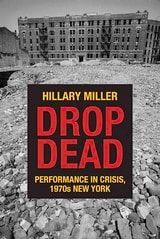
Drop Dead
Performance in Crisis, 1970s New YorkHillary Miller
Northwestern University Press, 2016
Winner, 2017 American Theater and Drama Society John W. Frick Book Award
Winner, 2017 ASTR Barnard Hewitt Award for Outstanding Research in Theater History
Hillary Miller’s Drop Dead: Performance in Crisis, 1970s New York offers a fascinating and comprehensive exploration of how the city’s financial crisis shaped theater and performance practices in this turbulent decade and beyond.
New York City’s performing arts community suffered greatly from a severe reduction in grants in the mid-1970s. A scholar and playwright, Miller skillfully synthesizes economics, urban planning, tourism, and immigration to create a map of the interconnected urban landscape and to contextualize the struggle for resources. She reviews how numerous theater professionals, including Ellen Stewart of La MaMa E.T.C. and Julie Bovasso, Vinnette Carroll, and Joseph Papp of The Public Theater, developed innovative responses to survive the crisis.
Combining theater history and close readings of productions, each of Miller’s chapters is a case study focusing on a company, a production, or an element of New York’s theater infrastructure. Her expansive survey visits Broadway, Off-, Off-Off-, Coney Island, the Brooklyn Academy of Music, community theater, and other locations to bring into focus the large-scale changes wrought by the financial realignments of the day.
Nuanced, multifaceted, and engaging, Miller’s lively account of the financial crisis and resulting transformation of the performing arts community offers an essential chronicle of the decade and demonstrates its importance in understanding our present moment.
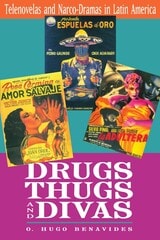
Drugs, Thugs, and Divas
Telenovelas and Narco-Dramas in Latin AmericaBy O. Hugo Benavides
University of Texas Press, 2008
Soap opera speaks a universal language, presenting characters and plots that resonate far beyond the culture that creates them. Latin American soap operas—telenovelas—have found enthusiastic audiences throughout the Americas and Europe, as well as in Egypt, Russia, and China, while Mexican narco-dramas have become highly popular among Latinos in the United States. In this first comprehensive analysis of telenovelas and narco-dramas, Hugo Benavides assesses the dynamic role of melodrama in creating meaningful cultural images to explain why these genres have become so successful while more elite cultural productions are declining in popularity.
Benavides offers close readings of the Colombian telenovelas Betty la fea (along with its Mexican and U.S. reincarnations La fea más bella and Ugly Betty), Adrián está de visita, and Pasión de gavilanes; the Brazilian historical telenovela Xica; and a variety of Mexican narco-drama films. Situating these melodramas within concrete historical developments in Latin America, he shows how telenovelas and narco-dramas serve to unite peoples of various countries and provide a voice of rebellion against often-oppressive governmental systems. Indeed, Benavides concludes that as one of the most effective and lucrative industries in Latin America, telenovelas and narco-dramas play a key role in the ongoing reconfiguration of social identities and popular culture.
Dubious Spectacle
Extremities of Theater, 1976-2000Herbert Blau
University of Minnesota Press, 2002
Spanning a quarter of a century, the essays in this book rehearse, in the movement of memory and cross-reflection, an extensive career in theater. The work of Herbert Blau-his directing, writing, and criticism-has been a determining force during this period as theater encounters theory.
Blau’s struggle to bring a critical intelligence to the American stage goes back half a century, to the quiescent postwar years (which he has eloquently described in The Impossible Theater: A Manifesto). His innovations in performance began with early productions of now-canonical plays that were hardly known at that time (works by Brecht, Beckett, Genet, Pinter, Duerrenmatt, and others). His experience is as distinctive as his versatile habits of mind and conceptual urgency of style.
If the impossible takes a little time (as the title of one essay states), Blau’s struggle now continues in a theoretical vein. Performance-and his own compelling writing- has moved across other genres and disciplines into fashion, politics, sexuality, and theory. His diversity of thought is demonstrated here in commentaries about the newer modes of performance (including conceptual and body art), various American playwrights, Renaissance drama, new music and theater, voice, the senses and the baroque, and the photographic image. As the essays reflect upon each other, a kind of cultural history, with inflections of autobiography, develops-which is what readers of Blau’s previous books have come to expect.
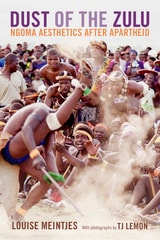
Dust of the Zulu
Ngoma Aesthetics after ApartheidLouise Meintjes
Duke University Press, 2017
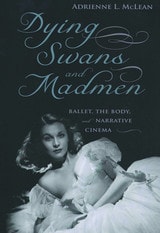
Dying Swans and Madmen
Ballet, the Body, and Narrative CinemaMcLean, Adrienne L
Rutgers University Press, 2008
Drawing on examples that range from musicals to tragic melodramas, she shows how commercial films have produced an image of ballet and its artists that is associated both with joy, fulfillment, fame, and power and with sexual and mental perversity, melancholy, and death. Although ballet is still received by many with a lack of interest or outright suspicion, McLean argues that these attitudes as well as ballet's popularity and its acceptability as a way of life and a profession have often depended on what audiences first learned about it from the movies.
Dying in Full Detail
Mortality and Digital DocumentaryJennifer Malkowski
Duke University Press, 2017