Results by title
28164 books match the query 'History' and 908 start with d
Delimiting Anthropology
Occasional Inquiries and ReflectionsGeorge W. Stocking, Jr.
University of Wisconsin Press, 2001
The first quartet focuses on the work of Franz Boas and the emergence of "Boasian Culturalism." In the second set of essays Stocking addresses the careers of three British "evolutionaries"—Lord Kames; Sir E. B. Tylor; and Sir James G. Frazer—tracking the development of cultural evolutionary thought from its origins in the Scottish Enlightenment through its early twentieth-century afterglow in Frazer's The Golden Bough.
The third group of essays looks at institutions and national traditions, including British ethnography exemplified in the fieldwork manual Notes and Queries; the humanistic Parisian Société d'Ethnographie; the early tension at the Laboratory of Anthropology in Santa Fe between aspiring local amateur anthropologists and professionals from Eastern universities; and the history of ethnographic museums in the European tradition. In closing, Stocking offers reflections on major tendencies in anthropology from the eighteenth century to the present.
"George Stocking is without rival as an historian of modern anthropology. He is trained as an historian, and he knows anthropologists from having lived among them. This collection is indispensable for any one or place concerned with the subject."—Dell Hymes, editor of Reinventing Anthropology
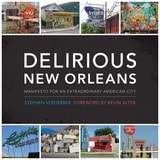
Delirious New Orleans
Manifesto for an Extraordinary American CityBy Stephen Verderber
University of Texas Press, 2008
Winner, Abbott Lowell Cummings Prize, Vernacular Architecture Forum, 2010
From iconic neighborhoods such as the French Quarter and the Garden District to more economically modest but no less culturally vibrant areas, architecture is a key element that makes New Orleans an extraordinary American city. Delirious New Orleans began as a documentary project to capture the idiosyncratic vernacular architecture and artifacts—vintage mom-and-pop businesses, roadside motels, live music clubs, neon signs, wall murals, fast-food joints, and so on—that helped give the city's various neighborhoods their unique character. But because so many of these places and artifacts were devastated by Hurricane Katrina, Delirious New Orleans has become both a historical record of what existed in the past and a blueprint for what must be rebuilt and restored to retain the city's unique multicultural landscape.
Stephen Verderber starts with the premise that New Orleans's often-overlooked neighborhoods imbue the city with deep authenticity as a place. He opens Delirious New Orleans with a photo-essay that vividly presents this vernacular architecture and its artifacts, both before Katrina and in its immediate aftermath. In the following sections of the book, which are also heavily illustrated, Verderber takes us on a tour of the city's commercial vernacular architecture, as well as the expressive folk architecture of its African American neighborhoods. He discusses how the built environment was profoundly shaped by New Orleans's history of race and class inequities and political maneuvering, along with its peculiar, below-sea-level geography. Verderber also considers the aftermath of Katrina and the armada of faceless FEMA trailers that have, at least temporarily and by default, transformed this urban landscape.

Delirio—The Fantastic, the Demonic, and the Réel
The Buried History of Nuevo LeónBy Marie Theresa Hernández
University of Texas Press, 2002
Striking, inexplicable stories circulate among the people of Nuevo León in northern Mexico. Stories of conversos (converted Jews) who fled the Inquisition in Spain and became fabulously wealthy in Mexico. Stories of women and children buried in walls and under houses. Stories of an entire, secret city hidden under modern-day Monterrey. All these stories have no place or corroboration in the official histories of Nuevo León.
In this pioneering ethnography, Marie Theresa Hernández explores how the folktales of Nuevo León encode aspects of Nuevolenese identity that have been lost, repressed, or fetishized in "legitimate" histories of the region. She focuses particularly on stories regarding three groups: the Sephardic Jews said to be the "original" settlers of the region, the "disappeared" indigenous population, and the supposed "barbaric" society that persists in modern Nuevo León. Hernández's explorations into these stories uncover the region's complicated history, as well as the problematic and often fascinating relationship between history and folklore, between officially accepted "facts" and "fictions" that many Nuevoleneses believe as truth.

Delirium and Resistance
Activist Art and the Crisis of CapitalismGregory Sholette
Pluto Press, 2017
In this follow-up to his influential 2010 book, Dark Matter: Art and Politics in the Age of Enterprise Culture, Sholette engages in critical dialogue with artists’ collectives, counter-institutions, and activist groups to offer an insightful firsthand account of the relationship between politics and art in neoliberal society. Sholette lays out clear examples of art’s deep involvement in capitalism: the dizzying prices achieved by artists who pander to the financial elite, the proliferation of museums that contribute to global competition between cities in order to attract capital, and the strange relationship between art and rampant gentrification that restructures the urban landscape.
With a preface by noted author Lucy R. Lippard and an introduction by theorist Kim Charnley, Delirium and Resistance draws on over thirty years of critical debates and practices both in and beyond the art world to historicize and advocate for the art activist tradition that radically—and, at times, deliriously—entangles the visual arts with political struggles.

Deluge
Tropical Storm Irene, Vermont’s Flash Floods, and How One Small State Saved ItselfPeggy Shinn
University Press of New England, 2013

Demanding Child Care
Women's Activism and the Politics of Welfare, 1940-1971Natalie M. Fousekis
University of Illinois Press, 2013
During World War II, as women stepped in to fill jobs vacated by men in the armed services, the federal government established public child care centers in local communities for the first time. When the government announced plans to withdraw funding and terminate its child care services at the end of the war, women in California protested and lobbied to keep their centers open, even as these services rapidly vanished in other states.
Analyzing the informal networks of cross-class and cross-race reformers, policymakers, and educators, Demanding Child Care: Women's Activism and the Politics of Welfare, 1940–1971 traces the rapidly changing alliances among these groups. During the early stages of the childcare movement, feminists, Communists, and labor activists banded together, only to have these alliances dissolve by the 1950s as the movement welcomed new leadership composed of working-class mothers and early childhood educators. In the 1960s, when federal policymakers earmarked child care funds for children of women on welfare and children described as culturally deprived, it expanded child care services available to these groups but eventually eliminated public child care for the working poor.
Deftly exploring the possibilities for partnership as well as the limitations among these key parties, Fousekis helps to explain the barriers to a publically funded comprehensive child care program in the United States.
Demanding Images
Democracy, Mediation, and the Image-Event in IndonesiaKaren Strassler
Duke University Press, 2019

Demanding Justice and Security
Indigenous Women and Legal Pluralities in Latin AmericaSieder, Rachel
Rutgers University Press, 2017
Featuring chapters on Bolivia, Colombia, Ecuador, Guatemala, and Mexico, the contributors to Demanding Justice and Security include both leading researchers and community activists. From Kichwa women in Ecuador lobbying for the inclusion of specific clauses in the national constitution that guarantee their rights to equality and protection within indigenous community law, to Me’phaa women from Guerrero, Mexico, battling to secure justice within the Inter-American Court of Human Rights for violations committed in the context of militarizing their home state, this book is a must-have for anyone who wants to understand the struggle of indigenous women in Latin America.

Demilitarization in the Contemporary World
Edited by Peter N. Stearns
University of Illinois Press, 2013
In nine insightful chapters, this volume's contributors outline each nation's demilitarization choices and how they were made. They investigate factors such as military defeat, border security risks, economic pressures, and the development of strong peace cultures among citizenry. Also at center stage is the influence of the United States, which fills a paradoxical role as both an enabler of demilitarization and a leader in steadily accelerating militarization.
Bookended by Peter N. Stearns' thought-provoking historical introduction and forward-looking conclusion, the chapters in this volume explore what true demilitarization means and how it impacts a society at all levels, military and civilian, political and private. The examples chosen reveal that successful demilitarization must go beyond mere troop demobilization or arms reduction to generate significant political and even psychological shifts in the culture at large. Exemplifying the political difficulties of demilitarization in both its failures and successes, Demilitarization in the Contemporary World provides a possible roadmap for future policies and practices.
Democracy Ancient and Modern
Finley, M. I.
Rutgers University Press, 1985
The two new essays, "Athenian Dialogues" and "Censorship in Classical Antiquity" combine with "Leaders and Followers," "Democracy, Consensus, and the National Interest," "Socrates and After" to make this book an unusual inquiry. Few contemporary writers are able to bring to the subject the depth of learning and the persuasive power of language that Sir M. I. Finley brings.
Democracy Ancient and Modern
Finley, M. I.
Rutgers University Press, 2019
This classic study of democratic principles is thus now more relevant than ever. A renowned historian of antiquity and political philosophy, Sir M.I. Finley offers a comparative analysis of Greek and modern conceptions of democracy. As he puts the ancient Greeks in dialogue with their contemporary counterparts, Finley tackles some of the most pressing issues of our day, including public apathy, partisanship, consensus politics, distrust of professional politicians, and the limits of free speech.
Including three lectures that Finley delivered at Rutgers University, plus two additional essays that further illuminate his thinking, Democracy Ancient and Modern explores the dramatic differences between the close-knit civil society of the ancient Greeks and our own atomized mass societies. By mapping out democracy’s past and its present manifestations, this book helps us plot a course for democracy’s future.

Democracy Fatigue
An East European EpidemyCarlos García-Rivero
Central European University Press, 2023
Over the early 21st century, democracy worldwide has deteriorated significantly. At the same time, new populist forces have appeared that challenge democracies through legal reforms. The stark contrast between Eastern and Western Europe in this respect is the focus of this collection of essays.
The authors consider the 2008-2012 economic crisis to be at the root of the success of the populist parties and the rise of cultural backlash against liberal values. In turn, European governments’ responses to the crisis—mainly austerity measures demanded by IMF and the EU— help explain desenchantment with the European Union. These policies made the wider public feel that they were being left out of politics, and populist parties promised to return power to them.
The contributors argue that polarization of the electorate can set in motion a radicalization that strengthens authoritarians at the expense of democrats. They also demonstrate that Eastern and Western Europe differ in their attitudes to the decline in quality of democracy. The studies consider how satisfied people are with the political changes they witness, and argue that seemingly more authoritarian attitudes in the East explain why people feel more satisfied with a defective democracy that empowers the populist-authoritarian political actors that they support.

Democracy Moving
Bill T. Jones, Contemporary American Performance, and the Racial PastAriel Nereson
University of Michigan Press, 2022
The project addresses how different communities choose to commemorate historical figures, events, and places through art—whether performance, oratory, song, statuary, or portraiture—and in particular, Black US American counter-memorial practices that address histories of slavery. Advancing the theory of oscillation as Black aesthetic praxis, author Ariel Nereson celebrates Bill T. Jones as a public intellectual whose practice has contributed to the project of understanding America’s relationship to its troubled past. The book features materials from Bill T. Jones/Arnie Zane Company’s largely unexplored archive, interviews with artists, and photos that document this critical stage of Jones’s career as it explores how aesthetics, as ideas in action, can imagine more just and equitable social formations.
Democracy against Development
Lower-Caste Politics and Political Modernity in Postcolonial IndiaJeffrey Witsoe
University of Chicago Press, 2013
Witsoe looks at the history of colonialism in India and its role in both shaping modern caste identities and linking locally powerful caste groups to state institutions, which has effectively created a postcolonial patronage state. He then looks at the rise of lower-caste politics in one of India’s poorest and most populous states, Bihar, showing how this increase in democratic participation has radically threatened the patronage state by systematically weakening its institutions and disrupting its development projects. By depicting democracy and development as they truly are in India—in tension—Witsoe reveals crucial new empirical and theoretical insights about the long-term trajectory of democratization in the larger postcolonial world.
Democracy and Development in Mali
R. James Bingen
Michigan State University Press, 2000
During the past twenty-five years, the scholarly research and applied development work of Michigan State University faculty and students in Mali represents the most significant combined, long-term, and continuing contribution of any group of university faculty in the United States or Europe to the study of Malian society, economy, and politics. The applied nature of much of this work has resulted in a significant number of working papers, reports, and conference presentations. This volume represents a coherent and connected set of essays from one American university with a widely known and highly respected role in African development. While the essays identify and review Mali's unique historical and contemporary path to democracy and development, they also contribute to the advancement of theoretical knowledge about African development.
Democracy and the Culture of Skepticism
The Politics of Trust in Argentina and MexicoMatthew R. Cleary
Russell Sage Foundation, 2006

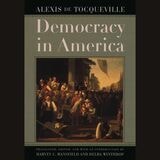
Democracy in America
Alexis de Tocqueville
University of Chicago Press, 2000
Alexis de Tocqueville (1805-59) came to America in 1831 to see what a great republic was like. What struck him most was the country's equality of conditions, its democracy. The book he wrote on his return to France, Democracy in America, is both the best ever written on democracy and the best ever written on America. It remains the most often quoted book about the United States, not only because it has something to interest and please everyone, but also because it has something to teach everyone.
Democracy in America
Alexis de Tocqueville
University of Chicago Press, 2000
This is an auto-narrated audiobook edition of this book.
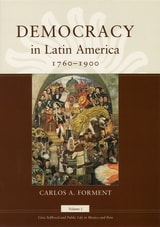
Democracy in Latin America, 1760-1900
Volume 1, Civic Selfhood and Public Life in Mexico and PeruCarlos A. Forment
University of Chicago Press, 2003
This first volume of Democracy in Latin America considers the development of democratic life in Mexico and Peru from independence to the late 1890s. Forment traces the emergence of hundreds of political, economic, and civic associations run by citizens in both nations and shows how these organizations became models of and for democracy in the face of dictatorship and immense economic hardship. His is the first book to show the presence in Latin America of civic democracy, something that gave men and women in that region an alternative to market- and state-centered forms of life.
In looking beneath institutions of government to uncover local and civil organizations in public life, Forment ultimately uncovers a tradition of edification and inculcation that shaped democratic practices in Latin America profoundly. This tradition, he reveals, was stronger in Mexico than in Peru, but its basic outlines were similar in both nations and included a unique form of what Forment calls Civic Catholicism in order to distinguish itself from civic republicanism, the dominant political model throughout the rest of the Western world.

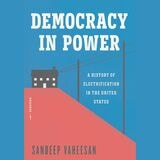
Democracy in Power
A History of Electrification in the United StatesSandeep Vaheesan
University of Chicago Press, 2024
Private money, public good, and the original fight for control of America’s energy industry.
Until the 1930s, financial interests dominated electrical power in the United States. That changed with President Franklin D. Roosevelt’s New Deal, which restructured the industry. The government expanded public ownership, famously through the Tennessee Valley Authority, and promoted a new kind of utility: the rural electric cooperative that brought light and power to millions in the countryside. Since then, public and cooperative utilities have persisted as an alternative to shareholder control. Democracy in Power traces the rise of publicly governed utilities in the twentieth-century electrification of America.
Sandeep Vaheesan shows that the path to accountability in America’s power sector was beset by bureaucratic challenges and fierce private resistance. Through a detailed and critical examination of this evolution, Vaheesan offers a blueprint for a publicly led and managed path to decarbonization. Democracy in Power is at once an essential history, a deeply relevant accounting of successes and failures, and a guide on how to avoid repeating past mistakes.
Democracy in Power
A History of Electrification in the United StatesSandeep Vaheesan
University of Chicago Press, 2024
This is an auto-narrated audiobook version of this book.
Private money, public good, and the original fight for control of America’s energy industry.
Until the 1930s, financial interests dominated electrical power in the United States. That changed with President Franklin D. Roosevelt’s New Deal which restructured the industry. The government expanded public ownership, famously through the Tennessee Valley Authority, and promoted a new kind of utility: the rural electric cooperative that brought light and power to millions in the countryside. Since then, public and cooperative utilities have persisted as an alternative to shareholder control. Democracy in Power traces the rise of publicly governed utilities in the twentieth-century electrification of America.
Sandeep Vaheesan shows that the path to accountability in America’s power sector was beset by bureaucratic challenges and fierce private resistance. Through a detailed and critical examination of this evolution, Vaheesan offers a blueprint for a publicly led and managed path to decarbonization. Democracy in Power is at once an essential history, a deeply relevant accounting of successes and failures, and a guide on how to avoid repeating past mistakes.
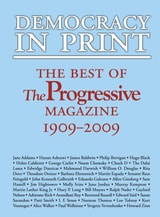
Democracy in Print
The Best of The Progressive Magazine, 1909–2009Edited by Matthew Rothschild
University of Wisconsin Press, 2009
Readers will discover the vision of the magazine’s founder, Robert “Fighting Bob” La Follette, and his suffragist wife, Belle Case La Follette. They’ll find historic gems from the likes of Jane Addams, Carl Sandburg, Huey Long, and John Kenneth Galbraith, and profound essays by Theodore Dreiser, Barbara Ehrenreich, Noam Chomsky, Upton Sinclair, Arundhati Roy, James Baldwin, Edwidge Danticat, and Edward Said. The collection is leavened with humor from Kate Clinton, Will Durst, Michael Feldman, and Molly Ivins, and graced by poems from such writers as Mahmoud Darwish, Rita Dove, Martín Espada, Maxine Kumin, Adrienne Rich, and Sandra Cisneros. Fascinating interviews bring readers into conversations with prominent cultural figures, including Chuck D, the Dalai Lama, Allen Ginsberg, Amy Goodman, Harold Pinter, Patti Smith, Susan Sarandon, and Yevgeny Yevtushenko.
Eminently browsable, this book is for anyone concerned with American democracy, the global community, and the perils of the planet. With contributions by actors and Supreme Court justices, comedians and Nobel Prize-winners, Democracy in Print offers all readers nourishing food for thought.
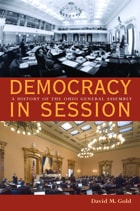
Democracy in Session
A History of the Ohio General AssemblyDavid M. Gold
Ohio University Press, 2009
For more than 200 years no institution has been more important to the development of the American democratic polity than the state legislature, yet no political institution has been so neglected by historians. Although more lawmaking takes place in the state capitals than in Washington D.C., scholars have lavished their attention on Congress, producing only a handful of histories of state legislatures. Most of those histories have focused on discrete legislative acts rather than on legislative process, and all have slighted key aspects of the legislative environment: the parliamentary rules of play, the employees who make the game possible, the physical setting—the arena—in which the people’s representatives engage in conflict and compromise to create public policy.
This book relates in fascinating detail the history of the Ohio General Assembly from its eighteenth-century origins in the Northwest Territory to its twenty-first-century incarnation as a full-time professional legislature. Democracy in Session explains the constitutional context within which the General Assembly functions, examines the evolution of legislative committees, and explores the impact of technology on political contests and legislative procedure. It sheds new light on the operations of the House and Senate clerks’ offices and on such legislative rituals as seat selection, opening prayers, and the Pledge of Allegiance. Partisan issues and public policy receive their due, but so do ethics and decorum, the election of African American and female legislators, the statehouse, and the social life of the members. Democracy in Session is, in short, the most comprehensive history of a state legislature written to date and an important contribution to the story of American democracy.

Democracy on a Tightrope
Politics and Bureaucracy in BrazilPedro Abramovay
Central European University Press, 2026
Democracy's Body
Judson Dance Theatre, 1962–1964Sally Banes
Duke University Press, 1993

Democracy's Rebirth
The View from ChicagoDick Simpson. Foreword by Lori Lightfoot
University of Illinois Press, 2022
With a foreword by Mayor Lori E. Lightfoot.
Democracy, Dialogue, and Community Action
Truth and Reconciliation in GreensboroSpoma Jovanovic
University of Arkansas Press, 2012

Democracy, Militarism, and Nationalism in Argentina, 1930–1966
An InterpretationBy Marvin Goldwert
University of Texas Press, 1972
Until 1930, Argentina was one of the great hopes for stable democracy in Latin America. Argentines themselves believed in the destiny of their nation to become the leading Latin American country in wealth, power, and culture. But the revolution of 1930 unleashed the scourges of modern militarism and chronic instability in the land. Between 1930 and 1966, the Argentine armed forces, or factions of the armed forces, overthrew the government five times.
For several decades, militarism was the central problem in Argentine political life. In this study, Marvin Goldwert interprets the rise, growth, and development of militarism in Argentina from 1930 to 1966. The tortuous course of Argentine militarism is explained through an integrating hypothesis. The army is viewed as a “power factor,” torn by a permanent dichotomy of values, which rendered it incapable of bringing modernization to Argentina. Caught between conflicting drives for social order and modernization, the army was an ambivalent force for change. First frustrated by incompetent politicians (1916–1943), the army was later driven by Colonel Juan D. Perón into an uneasy alliance with labor (1943–1955). Peronism initially represented the means by which army officers could have their cake—nationalistic modernization—and still eat it in peace, with the masses organized in captive unions tied to an authoritarian state.
After 1955, when Perón was overthrown, a deeply divided army struggled to contain the remnants of its own dictatorial creation. In 1966, the army, dedicated to staunch anti-Peronism, again seized the state and revived the dream of reconciling social order and modernization through military rule.
Although militarism has been a central problem in Argentine political life, it is also the fever that suggests deeper maladies in the body politic. Marvin Goldwert seeks to relate developments in the military to the larger political, social, and economic developments in Argentine history. The army and its factions are viewed as integral parts of the whole political spectrum during the period under study.
Democratic Art
The New Deal's Influence on American CultureSharon Ann Musher
University of Chicago Press, 2015
In Democratic Art, Sharon Musher explores these questions and uses them as a springboard for an examination of the role art can and should play in contemporary society. Drawing on close readings of government-funded architecture, murals, plays, writing, and photographs, Democratic Art examines the New Deal’s diverse cultural initiatives and outlines five perspectives on art that were prominent at the time: art as grandeur, enrichment, weapon, experience, and subversion. Musher argues that those engaged in New Deal art were part of an explicitly cultural agenda that sought not just to create art but to democratize and Americanize it as well. By tracing a range of aesthetic visions that flourished during the 1930s, this highly original book outlines the successes, shortcomings, and lessons of the golden age of government funding for the arts.

Democratic Discourses
The Radical Abolition Movement and Antebellum American LiteratureBennett, Michael
Rutgers University Press, 2005
Ever since the hallowed statement, "All men are created equal," was penned in the Declaration of Independence, it has become a historical tenet that freedom and equality were brought to American shores by the so-called Founding Fathers.
In this path-breaking study, Michael Bennett departs from tradition to argue that the democratic ideal of equality and the actual ways in which it has been practiced are grounded less in the fledgling government documents written by a handful of white men than in the actions and writings of the radical abolitionists of the nineteenth century. Bringing together key texts of both African American and European American authors, Democratic Discourses shows the important ways that abolitionist writing shaped a powerful counterculture within a slave-holding society. Bennett offers fresh new analysis through unusual pairings of authors, including Frederick Douglass with Henry David Thoreau, Frances Ellen Watkins Harper with Walt Whitman, and Margaret Fuller with Sojourner Truth. These rereadings avoid the tendency to view antebellum writing as a product primarily of either European American or African American influences and, instead, illustrate the interconnections of white and black literature in the creation and practice of democracy.
Drawing on discourses about race, the body, gender, economics, and aesthetics, this unique study encourages readers to reconsider the reality and roots of freedoms experienced in the United States today.
Democratic Law in Classical Athens
By Michael Gagarin
University of Texas Press, 2020
The democratic legal system created by the Athenians was completely controlled by ordinary citizens, with no judges, lawyers, or jurists involved. It placed great importance on the litigants’ rhetorical performances. Did this make it nothing more than a rhetorical contest judged by largely uneducated citizens that had nothing to do with law, a criticism that some, including Plato, have made?
Michael Gagarin argues to the contrary, contending that the Athenians both controlled litigants’ performances and incorporated many other unusual features into their legal system, including rules for interrogating slaves and swearing an oath. The Athenians, Gagarin shows, adhered to the law as they understood it, which was a set of principles more flexible than our current understanding allows. The Athenians also insisted that their legal system serve the ends of justice and benefit the city and its people. In this way, the law ultimately satisfied most Athenians and probably produced just results as often as modern legal systems do. Comprehensive and wide-ranging, Democratic Law in Classical Athens offers a new perspective for viewing a legal system that was democratic in a way only the Athenians could achieve.
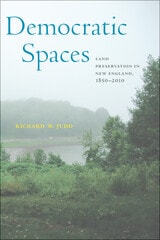
Democratic Spaces
Land Preservation in New England, 1850–2010Richard W. Judd
University of Massachusetts Press, 2023
Winner of the 2024 Forest History Society Charles A. Weyerhaeuser Book Award
A contemporary map of New England, scaled to the township level, brings to light a dense pattern of protected areas ringing almost every town and city in the region. Big and small, rural and urban, these green spaces represent more than a century of preservation efforts on the part of philanthropic foundations, planning professionals, state agencies, and most importantly, community-based conservation organizations. Taken together, they highlight one of the most significant advances in land stewardship in US history.
Democratic Spaces explains how these protected places came into being and what they represent for New Englanders and the nation at large. While early New Englanders worked to save local fish, timber, and game resources from outside exploitation, no land-stewardship organizations existed before the founding of the Trustees of Public Reservations in Boston in 1891. Across a century of dramatic change, New England preservationists through this and other, smaller community-based land trusts preserved open spaces for an ever-widening circle of citizens.

Democratic Sports
Men's and Women's College Athletics during the Great DepressionBrad Austin
University of Arkansas Press, 2015
University leaders used their athletic programs to combat this crisis and to preserve “traditional” American values and institutions, prescribing different models for men and women. Educators emphasized the competitive nature of men’s athletics, seeking to inculcate male college athletes (and their audiences) with individualistic, masculine values in order to reinforce the existing American political and economic systems.
In stark contrast, the prevailing model of women’s college athletics taught a communal form of democracy. Strongly supported by almost all female athletic leaders, this “a girl for every game, and a game for every girl” model had replaced the more competitive model that had been popular until the 1920s. The new programs denied women individual attention and high-level competition, and they promoted the development of what was considered proper femininity.
Whatever larger purposes these programs were intended to serve, they could not have survived without vocal supporters. Democratic Sports tells the important story of how men’s and women’s college athletic programs survived, and even thrived, during the most challenging decade of the twentieth century.
Democratic Swarms
Ancient Comedy and the Politics of the PeoplePage duBois
University of Chicago Press, 2022
With Democratic Swarms, Page duBois revisits the role of Greek comedy in ancient politics, considering how it has been overlooked as a political medium by modern theorists and critics. Moving beyond the popular readings of ancient Greece through the lens of tragedy, she calls for a revitalized look at Greek comedy. Rather than revisiting the sufferings of Oedipus and his family or tragedy’s relationship to questions of sovereignty, this book calls for comedy—its laughter, its free speech, its wild swarming animal choruses, and its rebellious women—to inform another model of democracy.
Ancient comedy has been underplayed in the study of Greek drama. Yet, with the irrepressible energy of the comic swarm, it provides a unique perspective on everyday life, gender and sexuality, and the utopian politics of the classical period of Athenian democracy. Using the concepts of swarm intelligence and nomadic theory, duBois augments tragic thought with the resistant, utopian, libidinous, and often joyous communal legacy of comedy, and she connects the lively anti-authoritarianism of the ancient comic chorus with the social justice movements of today.
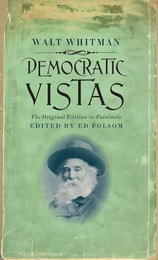
Democratic Vistas
The Original Edition in FacsimileWhitman, Walt
University of Iowa Press, 2010
Written in the aftermath of the American Civil War during the ferment of national Reconstruction, Walt Whitman’s Democratic Vistas remains one of the most penetrating analyses of democracy ever written. Diagnosing democracy’s failures as well as laying out its vast possibilities, Whitman offers an unflinching assessment of the ongoing social experiment known as the United States. Now available for the first time in a facsimile of the original 1870–1871 edition, with an introduction and annotations by noted Whitman scholar Ed Folsom that illuminate the essay’s historical and cultural context, this searing analysis of American culture offers readers today the opportunity to argue with Whitman over the nature of democracy and the future of the nation.
Living in Washington, D.C., where Congress granted male African Americans the right to vote nearly five years before the fifteenth amendment extended that right across the nation, and working for the office charged with enforcing the new civil rights amendments to the Constitution, Whitman was at the volatile center of his nation’s massive attempt to reconstruct and redefine itself after the tumultuous years of civil war. In the enduring cultural document that Democratic Vistas has become, the great poet of democracy analyzes the role that literature plays in the development of a culture, the inevitable tensions between the “democratic individual” and the “democratic nationality,” and the corrosive effects of materialism on the democratic spirit.
His own conflicting racial biases notwithstanding, Whitman in Democratic Vistas offers his most eloquent and extended articulation of the beckoning American democratic future. At a time when the nation has elected a president whom Whitman could never have imagined, his controversial and provocative book is a timely reminder of those occasions when we experience the expansion of America’s democratic dream.

Democratising History
Modern British History Inside and OutEdited by Laura Carter, Freddy Foks, and Philip Harling
University of London Press, 2025
Democratising History inspects how democracy has reshaped modern Britain and how its history is taught, providing a new perspective on the evolving relationship between historical scholarship and education. Collectively, this volume responds to the scholarly and professional contributions of Peter Mandler, whose sensitive readings of cultural discourses and their social reach have inspired a generation of modern British historians. Through nine research-led chapters, the book explores the development of democratic ideals from the early nineteenth century to the present, addressing themes such as empire and culture. These historical investigations are interwoven with six stimulating interludes that critically assess the state of UK higher education and the professional field of modern British history, elucidating the shifting forces shaping historical research and policy today.
The authors examine in detail how democratic ideals have shaped British society in both expected and surprising ways—whether through museum collections, the art world, mass observation, or the study of race relations. Integrating historical analysis with reflections on contemporary academic practice, this work subverts traditional narratives and opens new avenues for understanding Britain’s past and its implications for the present.

Democratization in the Nordic World
David Delfs Erbo Andersen
University of Wisconsin Press, 2024
Rather, Scandinavia’s peaceful process of democratization owed itself to the development of a penetrative bureaucracy in the early modern period and the activism of cooperative associations, first of farmers in the early nineteenth century and then of industrialized workers in the late nineteenth and early twentieth centuries. Thanks to the gradual, relatively consensual adoption of political reforms and social norms, the history of “Nordic democratic exceptionalism” today helps account for the ongoing stability of the Scandinavian countries.
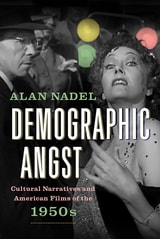
Demographic Angst
Cultural Narratives and American Films of the 1950sNadel, Alan
Rutgers University Press, 2017
Demographic Angst argues that mandated normativity—as a political agenda and a social ethic—precluded explicit expression of the anxiety produced by America’s radically reconfigured postwar population. Alan Nadel explores influential non-fiction books, magazine articles, and public documents in conjunction with films such as Singin’ in the Rain, On the Waterfront, Sunset Boulevard, and Sayonara, to examine how these films worked through fresh anxieties that emerged during the 1950s.
Demographic Avant-Garde
Jews in Bohemia between the Enlightenment and the ShoahJana Vobecká
Central European University Press, 2013

Demography and Nation
Social Legislation and Population Policy in BulgariaSvetla Baloutzova
Central European University Press, 2011
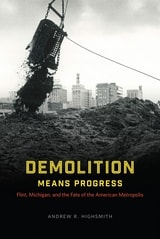
Demolition Means Progress
Flint, Michigan, and the Fate of the American MetropolisAndrew R. Highsmith
University of Chicago Press, 2015
In one of the most comprehensive works yet written on the history of inequality and metropolitan development in modern America, Andrew R. Highsmith uses the case of Flint to explain how the perennial quest for urban renewal—even more than white flight, corporate abandonment, and other forces—contributed to mass suburbanization, racial and economic division, deindustrialization, and political fragmentation. Challenging much of the conventional wisdom about structural inequality and the roots of the nation’s “urban crisis,” Demolition Means Progress shows in vivid detail how public policies and programs designed to revitalize the Flint area ultimately led to the hardening of social divisions.

Demon Lovers
Witchcraft, Sex, and the Crisis of BeliefWalter Stephens
University of Chicago Press, 2002
As Walter Stephens demonstrates in Demon Lovers, it was not Hausmännin or other so-called witches who were obsessive about sex with demons—instead, a number of devout Christians, including trained theologians, displayed an uncanny preoccupation with the topic during the centuries of the "witch craze." Why? To find out, Stephens conducts a detailed investigation of the first and most influential treatises on witchcraft (written between 1430 and 1530), including the infamous Malleus Maleficarum (Hammer of Witches).
Far from being credulous fools or mindless misogynists, early writers on witchcraft emerge in Stephens's account as rational but reluctant skeptics, trying desperately to resolve contradictions in Christian thought on God, spirits, and sacraments that had bedeviled theologians for centuries. Proof of the physical existence of demons—for instance, through evidence of their intercourse with mortal witches—would provide strong evidence for the reality of the supernatural, the truth of the Bible, and the existence of God. Early modern witchcraft theory reflected a crisis of belief—a crisis that continues to be expressed today in popular debates over angels, Satanic ritual child abuse, and alien abduction.

Demon of the Lost Cause
Sherman and Civil War HistoryWesley Moody
University of Missouri Press, 2011

Demonic Grounds
Black Women And The Cartographies Of StruggleKatherine McKittrick
University of Minnesota Press, 2006
Demonic Grounds moves between past and present, archives and fiction, theory and everyday, to focus on places negotiated by black women during and after the transatlantic slave trade. Specifically, the author addresses the geographic implications of slave auction blocks, Harriet Jacobs’s attic, black Canada and New France, as well as the conceptual spaces of feminism and Sylvia Wynter’s philosophies.
Central to McKittrick’s argument are the ways in which black women are not passive recipients of their surroundings and how a sense of place relates to the struggle against domination. Ultimately, McKittrick argues, these complex black geographies are alterable and may provide the opportunity for social and cultural change.
Katherine McKittrick is assistant professor of women’s studies at Queen’s University.
Demos Assembled
Democracy and the International Origins of the Modern State, 1840–1880Stephen W. Sawyer
University of Chicago Press, 2018
Previous studies have covered in great detail how the modern state slowly emerged from the early Renaissance through the seventeenth century, but we know relatively little about the next great act: the birth and transformation of the modern democratic state. And in an era where our democratic institutions are rife with conflict, it’s more important now than ever to understand how our institutions came into being.
Stephen W. Sawyer’s Demos Assembled provides us with a fresh, transatlantic understanding of that political order’s genesis. While the French influence on American political development is well understood, Sawyer sheds new light on the subsequent reciprocal influence that American thinkers and politicians had on the establishment of post-revolutionary regimes in France. He argues that the emergence of the stable Third Republic (1870–1940), which is typically said to have been driven by idiosyncratic internal factors, was in fact a deeply transnational, dynamic phenomenon. Sawyer’s findings reach beyond their historical moment, speaking broadly to conceptions of state formation: how contingent claims to authority, whether grounded in violence or appeals to reason and common cause, take form as stateness.
Demos Rising
Democracy and the Popular Construction of Public Power in France, 1800–1850Stephen W. Sawyer
University of Chicago Press, 2025
In his previous book, Demos Assembled, historian Stephen W. Sawyer offered a transatlantic account of the birth and transformation of the modern democratic state. In Demos Rising, he presents readers of political history with a prequel whose ambitious claim is that a genuine demos became possible in France only with the development of government regulation and administration. Focusing on democracy as a form of administration rather than as a form of sovereignty allows Sawyer to explore urban planning, work and private enterprise, health administration, and much more as cornerstones of a self-governing society of equals.
Examining the period between 1800 and 1850, Sawyer studies a set of thinkers who debated at length over the material problems of everyday life, sparking calls for political action and social reform in the face of conflict wreaked by deforestation, urbanization, health crises, labor relations, industrial capitalism, religious tensions, and imperial expansion. The solutions to these problems, Sawyer argues, were sought—and sometimes found—not through elections, as one might assume, but rather through the “care for all” promised by modern administrative power, regulatory intervention, and social welfare programs. By studying this profound transformation in governance, the book wagers, we can better understand the origin and meaning of democracy—even when events in our own time have thrown the concept into doubt.
Dena'inaq' Huch'ulyeshi
The Dena'ina Way of LivingEdited by Suzi Jones, James Fall, and Aaron Leggett
University of Alaska Press, 2013
Lavishly illustrated with more than six hundred photographs, maps, and drawings, Dena’inaq’ Huch’ulyeshi contains 469 entries on Dena’ina objects in European and American collections. It is enriched with examples of traditional Dena’ina narratives, first-person accounts, and interviews. Thirteen essays on the history and culture of the Athabascan people put the pieces into a larger historical context. This catalog is a comprehensive reference that will also accompany a large-scale exhibition running September 2013 through January 2014 at the Anchorage Museum.

Denial and Repression of Anti-Semitism
Post-Communist Rehabilitation of the Serbian Bishop Nikolaj VelimirovicJovan Byford
Central European University Press, 2008

Denver In Slices
A Historical Guide to the CityLouisa Ward Arps
Ohio University Press, 1983
The Old West has been viewed from many perspectives, from the scornful to the uncritically romantic. But seldom has it been treated with the honest nostalgia of the wonderful accounts and pictures gathered in Denver in Slices.
Ohio University Press/Swallow Press is proud to reissue this Western classic, which includes a brief survey of all Denver history, some slices depicting the most fascinating places and characters. The City Ditch, Cherry Creek, River Front Park, the Denver Mint, the Tabors, the Windsor Hotel, the Baron of Montclair, Overland Park, Buffalo Bill, Elitch's Gardens, and Eugene Field—they're all here. Illustrating these stories is an array of nearly one hundred pictures of the people, buildings, and street scenes: a fascinating panorama of the gold rush camp that became the Rocky Mountain metropolis.
With a new foreword by renowned Denver historian Thomas J. Noel, this classic will once again help preserve Denver's lively past.

Denver Inside and Out
Jeanne E. Colorado Historical Society
University Press of Colorado, 2011
In Denver Inside and Out, eleven authors illustrate how pioneers built enduring educational, medical, and transportation systems; how Denver's social and political climate contributed to the elevation of women; how Denver residents wrestled with-and exploited-the city's natural features; and how diverse cultural groups became an essential part of the city's fabric. By showing how the city rose far above its humble roots, the authors illuminate the many ways that Denver residents have never stopped imagining a great city.
Published in time for the opening of the new History Colorado Center in Denver in 2012, Denver Inside and Out hints at some of the social, economic, legal, and environmental issues that Denverites will have to consider over the next 150 years. Finalist for the 2012 Colorado Book Awards