Results by title
22279 books match the query 'Social Science' and 859 start with d
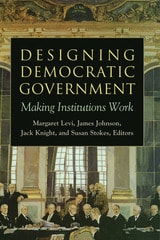
Designing Democratic Government
Making Institutions WorkMargaret Levi
Russell Sage Foundation, 2008
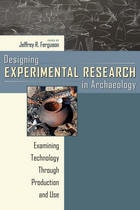
Designing Experimental Research in Archaeology
Examining Technology through Production and UseJeffrey R. Ferguson
University Press of Colorado, 2010
Each chapter addresses a particular classification of material culture-ceramics, stone tools, perishable materials, composite hunting technology, butchering practices and bone tools, and experimental zooarchaeology-detailing issues that must be considered in the development of experimental archaeology projects and discussing potential pitfalls. The experiments follow coherent and consistent research designs and procedures and are placed in a theoretical context, and contributors outline methods that will serve as a guide in future experiments. This degree of standardization is uncommon in traditional archaeological research but is essential to experimental archaeology.
The field has long been in need of a guide that focuses on methodology and design. This book fills that need not only for undergraduate and graduate students but for any archaeologist looking to begin an experimental research project.
Designing Experiments in Education and the Social Sciences
Larry V. Hedges
Russell Sage Foundation, 2026
Randomized experiments—often referred to as the gold standard of research design—are generally accepted as the type of studies that provide the strongest evidence about cause and effect. There has been a wide adoption of experimental methods in agriculture, medicine, industrial design, and laboratory social sciences, such as experimental psychology, where conditions can be controlled. Since then, there has been an increase in the use of field experiments to provide evidence of cause and effect beyond the laboratory. However, the social settings in which these studies take place complicate the design and evaluation of experiments because their social contexts must be taken into account in order for the experiment to provide useful and unambiguous results. In Designing Experiments in Education and the Social Sciences, statistician Larry V. Hedges details how to design educational and social science field experiments that are sensitive enough to provide clear-cut evidence on the effects of social interventions.
Hedges draws on one hundred years of statistical theory and classic experimental design in Designing Experiments in Education and the Social Sciences. Highlighting the social-structural information embedded in field experiments, he links this history with contemporary statistical methods in the social sciences to explain how to design social experiments that are adequately sensitive to determine the influence of an intervention. He covers the four basic research designs—and 39 elaborations of those designs—that are used most often in social experiments while also introducing additional, more complex, designs. He brings together, in the same notation, work on experimental design, design sensitivity, and optimal design of experiments for the most frequently used research designs in education and the social sciences, emphasizing their conceptual consistency. Hedges also discusses the practical problems of how to recruit and maintain a sample throughout the duration of an experiment.
Designing Experiments in Education and the Social Sciences is an essential resource for researchers planning educational and social field experiments and graduate students.

Designing Human Practices
An Experiment with Synthetic BiologyPaul Rabinow and Gaymon Bennett
University of Chicago Press, 2012
In 2006 anthropologists Paul Rabinow and Gaymon Bennett set out to rethink the role that human sciences play in biological research, creating the Human Practices division of the Synthetic Biology Engineering Research Center—a facility established to create design standards for the engineering of new enzymes, genetic circuits, cells, and other biological entities—to formulate a new approach to the ethical, security, and philosophical considerations of controversial biological work. They sought not simply to act as watchdogs but to integrate the biosciences with their own discipline in a more fundamentally interdependent way, inventing a new, dynamic, and experimental anthropology that they could bring to bear on the center’s biological research.
Designing Human Practices is a detailed account of this anthropological experiment and, ultimately, its rejection. It provides new insights into the possibilities and limitations of collaboration, and diagnoses the micro-politics which effectively constrained the potential for mutual scientific flourishing. Synthesizing multiple disciplines, including biology, genetics, anthropology, and philosophy, alongside a thorough examination of funding entities such as the National Science Foundation, Designing Human Practices pushes the social study of science into new and provocative territory, utilizing a real-world experience as a springboard for timely reflections on how the human and life sciences can and should transform each other.
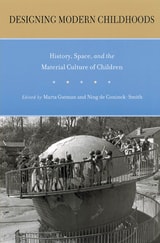
Designing Modern Childhoods
History, Space, and the Material Culture of ChildrenGutman, Marta
Rutgers University Press, 2008
In Designing Modern Childhoods, architectural historians, social historians, social scientists, and architects examine the history and design of places and objects such as schools, hospitals, playgrounds, houses, cell phones, snowboards, and even the McDonald's Happy Meal. Special attention is given to how children use and interpret the spaces, buildings, and objects that are part of their lives, becoming themselves creators and carriers of culture. The authors extract common threads in children's understandings of their material worlds, but they also show how the experience of modernity varies for young people across time, through space, and according to age, gender, social class, race, and culture.
Designing for Diversity
Gender, Race, and Ethnicity in the Architectural ProfessionKathryn H. Anthony
University of Illinois Press, 2000
A powerful statement about the repercussions of discrimination and the benefits of diversity in architecture
Providing hard data for trends that many perceive only vaguely and some deny altogether, Designing for Diversity reveals a profession rife with gender and racial discrimination and examines the aspects of architectural practice that hinder or support the full participation of women and persons of color.
Drawing on interviews and surveys of hundreds of architects, Kathryn H. Anthony outlines some of the forms of discrimination that recur most frequently in architecture: being offered added responsibility without a commensurate rise in position, salary, or credit; not being allowed to engage in client contact, field experience, or construction supervision; and being confined to certain kinds of positions, typically interior design for women, government work for African Americans, and computer-aided design for Asian American architects.
Anthony discusses the profession's attitude toward flexible schedules, part-time contracts, and the demands of family and identifies strategies that have helped underrepresented individuals advance in the profession, especially establishing a strong relationship with a mentor. She also observes a strong tendency for underrepresented architects to leave mainstream practice, either establishing their own firms, going into government or corporate work, or abandoning the field altogether.
Given the traditional mismatch between diverse consumers and predominantly white male producers of the built environment, plus the shifting population balance toward communities of color, Anthony contends that the architectural profession staves off true diversity at its own peril. Designing for Diversity argues convincingly that improving the climate for nontraditional architects will do much to strengthen architecture as a profession. Practicing architects, managers of firms, and educators will learn how to create conditions more welcoming to a diversity of users as well as designers of the built environment.
Designing the Creative Child
Playthings and Places in Midcentury AmericaAmy F. Ogata
University of Minnesota Press, 2013
The postwar American stereotypes of suburban sameness, traditional gender roles, and educational conservatism have masked an alternate self-image tailor-made for the Cold War. The creative child, an idealized future citizen, was the darling of baby boom parents, psychologists, marketers, and designers who saw in the next generation promise that appeared to answer the most pressing worries of the age.
Designing the Creative Child reveals how a postwar cult of childhood creativity developed and continues to this day. Exploring how the idea of children as imaginative and naturally creative was constructed, disseminated, and consumed in the United States after World War II, Amy F. Ogata argues that educational toys, playgrounds, small middle-class houses, new schools, and children’s museums were designed to cultivate imagination in a growing cohort of baby boom children. Enthusiasm for encouraging creativity in children countered Cold War fears of failing competitiveness and the postwar critique of social conformity, making creativity an emblem of national revitalization.
Ogata describes how a historically rooted belief in children’s capacity for independent thinking was transformed from an elite concern of the interwar years to a fully consumable and aspirational ideal that persists today. From building blocks to Gumby, playhouses to Playskool trains, Creative Playthings to the Eames House of Cards, Crayola fingerpaint to children’s museums, material goods and spaces shaped a popular understanding of creativity, and Designing the Creative Child demonstrates how this notion has been woven into the fabric of American culture.

Designing the Teenage Girl
The Debut of a Popular CharacterMary Celeste Kearney
University of Texas Press, 2026
Explores the forgotten first wave of American teen-girl entertainment from the late 1920s through the early 1950s.
During the mid-twentieth century, American entertainment featuring teenage girls blossomed. From short stories to plays, films, comics, radio programs, and television shows, writers and other creative professionals developed a new character type that helped to define midcentury girlhood and teen culture. Designing the Teenage Girl uncovers the largely forgotten first wave of US teen-girl entertainment, tracing its emergence in the 1920s through a thirty-year production cycle that spanned all sectors of American popular culture.
Beginning with short stories such as Sally Benson’s Junior Miss and following their adaptations, Kearney reveals how teen-girl narratives circulated across industries. Drawing on archival research and analysis of visual, narrative, and sound design, Kearney situates these texts within the identity politics of the period. While midcentury teen-girl entertainment privileged white, middle-class femininity, it also contained alternative visions of girlhood that complicated heteronormative and patriarchal expectations. This study reframes the origins of teen-girl entertainment and demonstrates how its aesthetic strategies and industrial practices continue to shape representations of girlhood today.
Designs for an Anthropology of the Contemporary
Paul Rabinow, George E. Marcus with James D. Faubion and Tobias Rees
Duke University Press, 2008
Both Rabinow and Marcus participated in the milestone collection Writing Culture: The Poetics and Politics of Ethnography. Published in 1986, Writing Culture catalyzed a reassessment of how ethnographers encountered, studied, and wrote about their subjects. In the opening conversations of Designs for an Anthropology of the Contemporary, Rabinow and Marcus take stock of anthropology’s recent past by discussing the intellectual scene in which Writing Culture intervened, the book’s contributions, and its conceptual limitations. Considering how the field has developed since the publication of that volume, they address topics including ethnography’s self-reflexive turn, scholars’ increased focus on questions of identity, the Public Culture project, science and technology studies, and the changing interests and goals of students. Designs for an Anthropology of the Contemporary allows readers to eavesdrop on lively conversations between anthropologists who have helped to shape their field’s recent past and are deeply invested in its future.
Designs for the Pluriverse
Radical Interdependence, Autonomy, and the Making of WorldsArturo Escobar
Duke University Press, 2018
Designs on the Contemporary
Anthropological TestsPaul Rabinow and Anthony Stavrianakis
University of Chicago Press, 2014
The authors continue their prior explorations of the contemporary in past works: How to conceptualize, test, and give form to breakdowns of truth and conduct, as well as how to open up possibilities for the remediation of such breakdowns. They offer a surprising and contrasting pair of case studies of two figures who engaged with contemporary breakdowns: Salman Rushdie and Gerhard Richter. Approaching Richter’s artistic struggles with form and technique in the long wake of modernism and Rushdie’s struggles to find a narrative form—as well as a form for living—to respond to the Iranian fatwa issued against him, they show how both men formulated different new approaches to anthropology for the twenty-first century.
Desire Work
Ex-Gay and Pentecostal Masculinity in South AfricaMelissa Hackman
Duke University Press, 2018

Desire and Disaster in New Orleans
Tourism, Race, and Historical MemoryLynnell L. Thomas
Duke University Press, 2014

Desired States
Sex, Gender, and Political Culture in ChileLessie Jo Frazier
Rutgers University Press, 2020

Desiring Arabs
Joseph A. Massad
University of Chicago Press, 2007
Desiring China
Experiments in Neoliberalism, Sexuality, and Public CultureLisa Rofel
Duke University Press, 2007
Drawing on her research over the past two decades among urban residents and rural migrants in Hangzhou and Beijing, Rofel analyzes the meanings that individuals attach to various public cultural phenomena and what their interpretations say about their understandings of post-socialist China and their roles within it. She locates the first broad-based public debate about post-Mao social changes in the passionate dialogues about the popular 1991 television soap opera Yearnings. She describes how the emergence of gay identities and practices in China reveals connections to a transnational network of lesbians and gay men at the same time that it brings urban/rural and class divisions to the fore. The 1999–2001 negotiations over China’s entry into the World Trade Organization; a controversial women’s museum; the ways that young single women portray their longings in relation to the privations they imagine their mothers experienced; adjudications of the limits of self-interest in court cases related to homoerotic desire, intellectual property, and consumer fraud—Rofel reveals all of these as sites where desiring subjects come into being.

Desiring Disability
Queer Theory Meets Disability Studies, Volume 9Robert McRuer and Abby L. Wilkerson, eds.
Duke University Press, 0
Topics include the study of "crip theory" and queer/disabled performance artists; the historical emergence of normalcy and parallel notions of military fitness that require both the production and the containment of queerness and disability; and butch identity, transgressive sexual practices, and rheumatoid arthritis.
Contributors. Sarah E. Chinn, Eli Clare, Naomi Finkelstein, Catherine Lord, Cris Mayo, Robert McRuer, Todd Ramlow, Jo Rendell, Ellen Samuels, Carrie Sandahl, David Serlin, Patrick White

Desis In The House
Indian American Youth Culture In NycSunaina Maira
Temple University Press, 2002
New York City, long the destination for immigrants and migrants, today is home to the largest Indian American population in the United States. Coming of age in a city remarkable for its diversity and cultural innovation, Indian American and other South Asian youth draw on their ethnic traditions and the city's resources to create a vibrant subculture. Some of the city's hottest clubs host regular bhangra parties, weekly events where young South Asians congregate to dance to music that mixes rap beats with Hindi film music, bhangra (North Indian and Pakistani in origin), reggae, techno, and other popular styles. Many of these young people also are active in community and campus organizations that stage performances of "ethnic cultures."
In this book Sunaina Maira explores the world of second-generation Indian American youth to learn how they manage the contradictions of gender roles and sexuality, how they handle their "model minority" status and expectations for class mobility in a society that still racializes everyone in terms of black or white. Maira's deft analysis illuminates the ways in which these young people bridge ethnic authenticity and American "cool."
Destination Detroit
Discourses on the Refugee in a Post-Industrial CityRashmi Luthra
University of Michigan Press, 2024
Few U.S. locations provide a more vivid case study of this fight than Metro Detroit, where competing interest groups are waging war over the meaning of the figure of the refugee. This book dives deeply into the discourse on refugees occurring among various institutions in Metro Detroit. The way in which local institutions talk about refugees gives us vital clues as to how they are negotiating competing pressures and how the city overall is negotiating competing imperatives. Indeed, this local discourse gives us a crucial glimpse into how U.S. cities are defining and redefining themselves today. The figure of the refugee becomes a slate on which groups with varied interests write their stories, aspirations, and fears. Consequently, we can figure out from local refugee discourses the ongoing question of what it means to be a Metro Detroiter—and by extension, what it means to be a revitalizing U.S. city in this age.
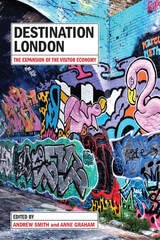
Destination London
The Expansion of the Visitor EconomyAndrew Smith and Anne Graham
University of Westminster Press, 2019
“A welcome addition to the field of urban tourism research... its content could prove useful not only to students and academic, but also to policymakers interested in better understanding the implications of tourism development and the expansion of the visitor economy in large cities.” - https://www.sciencedirect.com/science/article/abs/pii/S0261517719301785
London is one of the world’s most popular destinations and visitors contribute approximately £14.9 billion of expenditure to the city every year. Its tourism and events sectors are growing and over the last few years London has received more visitors than ever before. However, detailed accounts of the city’s visitor economy are conspicuously absent.
This book analyses how the capital is developing as a destination through the expansion of tourism and events into new urban spaces. The book outlines how parts of London not previously regarded as tourist territory are now subject to the visitor gaze with tourism spreading beyond established central zones into peripheral, suburban and residential areas – in part propelled by a big rise in peer to peer accommodation use. Simultaneously, London’s airports and sports stadiums and their surrounds are becoming destinations in their own right. New vantage points have been created, allowing tourists to explore the city: from above, at night-time or through tours given by the homeless; via the opening up of the River Thames; or through the transformation of local parks into eventscapes.
The book explores these trends and shows how urban destinations expand. In doing so, it enhances our understanding of London and highlights the growing significance of tourism and events in global cities.
Destined for Greatness
Passions, Dreams, and Aspirations in a College Music TownRamirez, Michael
Rutgers University Press, 2018
In Destined for Greatness, sociologist Michael Ramirez examines the lives of forty-eight independent rock musicians who seek out such non-normative choices in a college town renowned for its music scene. He explores the rich life course trajectories of women and men to explore the extent to which pathways are structured to allow some, but not all, individuals to fashion careers in music worlds. Ramirez suggests a more nuanced understanding of factors that enable the pursuit of musical livelihoods well into adulthood.

Destinies of the Disadvantaged
The Politics of Teen ChildbearingFrank F. Furstenberg
Russell Sage Foundation, 2007
Destroy Them Gradually
Displacement as AtrocityAndrew R. Basso
Rutgers University Press, 2024
Destructive Desires
Rhythm and Blues Culture and the Politics of Racial EqualityRobert J. Patterson
Rutgers University Press, 2019

Destructive Sublime
World War II in American Film and MediaAllison, Tanine
Rutgers University Press, 2018
Destructive Sublime traces a new aesthetic history of the World War II combat genre by looking back at it through the lens of contemporary video games like Call of Duty. Allison locates some of video games’ glorification of violence, disruptive audiovisual style, and bodily sensation in even the most canonical and seemingly conservative films of the genre. In a series of case studies spanning more than seventy years—from wartime documentaries like The Battle of San Pietro to fictional reenactments like The Longest Day and Saving Private Ryan to combat video games like Medal of Honor—this book reveals how the genre’s aesthetic forms reflect (and influence) how American culture conceives of war, nation, and representation itself.

Detachment from Place
Beyond an Archaeology of Settlement AbandonmentMaxime Lamoureux-St-Hilaire
University Press of Colorado, 2019
Detachment from Place is the first comparative and interdisciplinary volume on the archaeology of settlement abandonment, with contributions focusing on materiality, ideology, the environment, and social construction of space. The volume sheds new light on an important but underexamined aspect of settlement abandonment wherein sedentary groups undergoing the process of abandonment leave behind many meaningful elements of their inhabited landscape. The process of detaching from place—which could last centuries—transformed inhabitants into migrants and transformed settled, constructed, and agricultural landscapes into imagined ones that continued to figure significantly in the identities of migrant groups.
Drawing on case studies from the Americas, Africa, and Asia, the volume explores how relationships between ancient peoples and the places they lived were transformed as they migrated elsewhere. Contributors focus on social structure, ecology, and ideology to study how people and places both disentangled from each other and remained tied together during this process. From Huron-Wendat villages and Classic Maya palaces to historical villages in Togo and the great Southeast Asian Medieval capital of Bagan, specific cultural, historical, and environmental factors led ancient peoples to detach from their homes and embark on migrations that altered social memory and cultural identity—as evidenced in the archaeological record.
Detachment from Place provides new insights into transfigurations of community identity, political organization, social and economic relations, religion, warfare, and agricultural practices and will be of interest to landscape archaeologists as well as researchers focused on collective memory, population movement, migratory patterns, and interaction.
Contributors:
Tomas Q. Barrientos, Jennifer Birch, Eduardo José Bustamante Luna, Catherine M. Cameron, Marcello A. Canuto, Jeffrey H. Cohen, Michael D. Danti, Phillip de Barros, Pete Demarte, Donna M. Glowacki, Gyles Iannone, Louis Lesage, Patricia A. McAnany, Asa R. Randall, Kenneth E. Sassaman

Detained
Immigration Laws & Expanding Ins Jail ComplexMichael Welch
Temple University Press, 2002

Dethroning the Deceitful Pork Chop
Rethinking African American Foodways from Slavery to ObamaJennifer Jensen Wallach
University of Arkansas Press, 2015
2017 Association for the Study of Food and Society Award, best edited collection.
The fifteen essays collected in Dethroning the Deceitful Pork Chop utilize a wide variety of methodological perspectives to explore African American food expressions from slavery up through the present. The volume offers fresh insights into a growing field beginning to reach maturity. The contributors demonstrate that throughout time black people have used food practices as a means of overtly resisting white oppression—through techniques like poison, theft, deception, and magic—or more subtly as a way of asserting humanity and ingenuity, revealing both cultural continuity and improvisational finesse. Collectively, the authors complicate generalizations that conflate African American food culture with southern-derived soul food and challenge the tenacious hold that stereotypical black cooks like Aunt Jemima and the depersonalized Mammy have on the American imagination. They survey the abundant but still understudied archives of black food history and establish an ongoing research agenda that should animate American food culture scholarship for years to come.
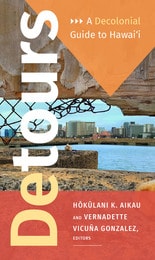
Detours
A Decolonial Guide to Hawai'iHokulani K. Aikau and Vernadetta Vicuña Gonzalez, editors
Duke University Press, 2019
Contributors. Hōkūlani K. Aikau, Malia Akutagawa, Adele Balderston, Kamanamaikalani Beamer, Ellen-Rae Cachola, Emily Cadiz, Iokepa Casumbal-Salazar, David A. Chang, Lianne Marie Leda Charlie, Greg Chun, Joy Lehuanani Enomoto, S. Joe Estores, Nicholas Kawelakai Farrant, Jessica Ka‘ui Fu, Candace Fujikane, Linda H. L. Furuto, Sonny Ganaden, Cheryl Geslani, Vernadette Vicuña Gonzalez, Noelani Goodyear-Ka‘ōpua, Tina Grandinetti, Craig Howes, Aurora Kagawa-Viviani, Noelle M. K. Y. Kahanu, Haley Kailiehu, Kyle Kajihiro, Halena Kapuni-Reynolds, Terrilee N. Kekoolani-Raymond, Kekuewa Kikiloi, William Kinney, Francesca Koethe, Karen K. Kosasa, N. Trisha Lagaso Goldberg, Kapulani Landgraf, Laura E. Lyons, David Uahikeaikalei‘ohu Maile, Brandy Nālani McDougall, Davianna Pōmaika‘i McGregor, Laurel Mei-Singh, P. Kalawai‘a Moore, Summer Kaimalia Mullins-Ibrahim, Jordan Muratsuchi, Hanohano Naehu, Malia Nobrega-Olivera, Katrina-Ann R. Kapā‘anaokalāokeola Nākoa Oliveira, Jamaica Heolimelekalani Osorio, No‘eau Peralto, No‘u Revilla, Kalaniua Ritte, Maya L. Kawailanaokeawaiki Saffery, Dean Itsuji Saranillio, Noenoe K. Silva, Ty P. Kāwika Tengan, Stephanie Nohelani Teves, Stan Tomita, Mehana Blaich Vaughan, Wendy Mapuana Waipā, Julie Warech
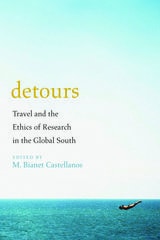
Detours
Travel and the Ethics of Research in the Global SouthEdited by M. Bianet Castellanos
University of Arizona Press, 2019
Influenced by the works of anthropologists Ruth Behar and Renato Rosaldo, the scholars and journalists in this volume consider how first encounters—those initial, awkward attempts to learn about a culture and a people—evolved into enduring and critical engagements. Contemplating the ethics and racial politics of traveling and doing research abroad, they call attention to the power and privilege that permit researchers to enter people’s lives, ask intimate questions, and publish those disclosures. Focusing on Latin America and the Caribbean, they ask, Why this place? What keeps us coming back? And what role do we play in producing narratives of inequality, uneven development, and global spectacle?
The book examines the “politics of return”—the experiences made possible by revisiting a field site over extended periods of time—of scholars and journalists who have spent decades working in and writing about Latin America and the Caribbean. Contributors aren’t telling a story of enlightenment and goodwill; they focus instead on the slippages and conundrums that marked them and raised questions of their own intentions and intellectual commitments.
Speaking from the intersection of race, class, and gender, the contributors explore the hubris and nostalgia that motivate returning again and again to a particular place. Through personal stories, they examine their changing ideas of Latin America and the Caribbean and how those places have shaped the people they’ve become, as writers, as teachers, and as activists.

Detroit Divided
Reynolds Farley
Russell Sage Foundation, 2000

Detroit Lives
Robert Mast
Temple University Press, 1994

Detroit Remains
Archaeology and Community Histories of Six Legendary PlacesKrysta Ryzewski
University of Alabama Press, 2021
WINNER OF THE UNIVERSITY OF MARY WASHINGTON CENTER FOR HISTORIC PRESERVATION BOOK PRIZE, THE JAMES DEETZ BOOK AWARD, AND THE JOAN GERO BOOK AWARD
An interdisciplinary study of urban archaeology, community heritage, and social justice in modern Detroit.
The city of Detroit has endured periods of unprecedented industrial growth, decline, and revitalization between the late nineteenth century and the present. In Detroit Remains: Archaeology and Community Histories of Six Legendary Places, Krysta Ryzewski presents six archaeological case studies of legendary Detroit institutions—Little Harry speakeasy, the Ransom Gillis house, the Blue Bird Inn, Gordon Park, the Grande Ballroom, and the Halleck Street log cabin—that trace the contours of the city’s underrepresented communities and their relationship to local currents of capitalism and social justice. Through a combination of rigorous historical archaeological research and narrative storytelling, Ryzewski deftly contextualizes the cases within the city’s current struggles, including recovery from bankruptcy, and future-oriented recovery efforts.
This is the first historical archaeology book focused on Detroit and one of the few to foreground the archaeology of the Great Migration era (ca. 1915–1970). The archaeological scholarship is rooted in collaborative, community-involved, and public-facing initiatives. The case studies examine how power is and has been exercised in Detroit’s communities over the past century: how it was stripped from the city’s twentieth- and twenty-first-century residents, but also how they acquired alternative sources of agency by establishing creative and illicit economies, most of which still operated within the city’s capitalist framework.
Throughout this book, connections run deep between archaeology, heritage, politics, historic preservation, and storytelling. Detroit Remains demonstrates how the city’s past, present, and future lie not in ruins but in the tangible archaeological traces of the everyday lives of Detroiters and their legacies.
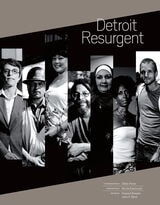
Detroit Resurgent
Howard Bossen
Michigan State University Press, 2014

Detroit's First American Decade
1796 to 1805F. Clever Bald
University of Michigan Press, 1948
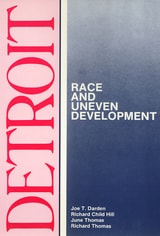
Detroit
Race and Uneven DevelopmentJoe T. Darden, Richard Child Hill, June Thomas and Richard Thomas
Temple University Press, 1990
Hub of the American auto industry and site of the celebrated Riverfront Renaissance, Detroit is also a city of extraordinary poverty, unemployment, and racial segregation. This duality in one of the mightiest industrial metropolises of twentieth-century North America is the focus of this study. Viewing the Motor City in light of sociology, geography, history, and planning, the authors examine the genesis of modern Detroit. They argue that the current situation of metropolitan Detroit—economic decentralization, chronic racial and class segregation, regional political fragmentation—is a logical result of trends that have gradually escalated throughout the post-World War II era. Examining its recent redevelopment policies and the ensuing political conflicts, Darden, Hill, Thomas, and Thomas, discuss where Detroit has been and where it is going.
In the series Comparative American Cities, edited by Joe T. Darden.
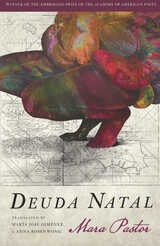
Deuda Natal
Mara Pastor, Translated by María José Giménez and Anna Rosenwong
University of Arizona Press, 2021
The poems in Deuda Natal reckon with the stark environmental degradation in Puerto Rico and the larger impacts of global climate change as they navigate our changing world through a feminist lens. Pastor’s work asserts a feminist objection to our society’s obsession with production and the accumulation of wealth, offering readers an opportunity for collective vulnerability within these pages. For this remarkable work, Pastor has found unique allies in María José Giménez and Anna Rosenwong, the translators of Deuda Natal. Winner of the 2020 Ambroggio Prize of the Academy of American Poets, this collection showcases masterfully crafted and translated poems that are politically urgent and emotionally striking.

Developing Dialogues
Indigenous and Ethnic Community Broadcasting in AustraliaSusan Forde, Kerrie Foxwell, and Michael Meadows
Intellect Books, 2009
The traditional audience/producer boundary has collapsed in indigenous and ethnic community broadcasting, and this is the first comprehensive study of this homegrown media sector. Based on firsthand research of radio and television audiences in Australia, the authors argue that community radio and television worldwide performs an essential service for indigenous and ethnic audiences, empowering them at various levels, fostering active citizenry, and enhancing democracy. Developing Dialogues offers international researchers a new perspective on Australian community broadcasting and presents evidence of global trends in the media industry.
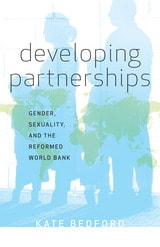
Developing Partnerships
Gender, Sexuality, and the Reformed World BankKate Bedford
University of Minnesota Press, 2009
A nuanced critique of how the World Bank encourages gender norms through its policies, Developing Partnerships argues that financial institutions are key players in the global enforcement of gender and family expectations.
By combining analysis of documents produced and sponsored by the World Bank with interviews of World Bank staffers and case studies, Kate Bedford presents a detailed examination of gender and sexuality in the policies of the world's largest and most influential development institution. Looking concurrently at economic and gender policy, Bedford connects reform of markets to reform of masculinities, loan agreements for export promotion to pamphlets for indigenous adolescents advising daily genital bathing, and attempts to strengthen institutions after the Washington Consensus to efforts to promote loving couplehood in response to economic crisis. In doing so, she reveals the shifting relationships between development and sexuality and the ways in which gender policy impacts debates about the future of neoliberalism.
Providing a multilayered account of how gender-aware policies are conceived and implemented by the World Bank, Developing Partnerships demonstrates as well how institutional practices shape development.
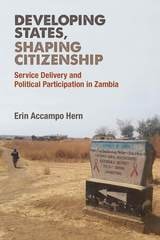
Developing States, Shaping Citizenship
Service Delivery and Political Participation in ZambiaErin Accampo Hern
University of Michigan Press, 2019
Erin Accampo Hern draws on original data from an original large-N survey, interviews, Afrobarometer data, and archival materials collected over 12 months in Zambia. The theory underlying this book’s framework is that of policy feedback, which argues that policies, once in place, influence the subsequent political participation of the affected population. This theory has predominantly been applied to advanced industrial democracies, and this book is the first explicit effort to adapt the theory to the developing country context.
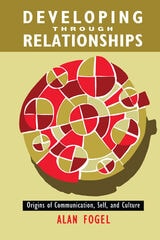
Developing Through Relationships
Alan Fogel
University of Chicago Press, 1993
Fogel explores the origins of communication, personal identity, and cultural participation and argues that from birth communication, self, and culture are inseparable. He shows that the ability to participate as a human being in the world does not come about only with the acquisition of language, as many scholars have thought, but begins during an infant's earliest nonverbal period. According to Fogel, the human mind and sense of self start to develop at birth through communication and relationships between individuals.
Fogel weaves together theory and research from a variety of disciplines, including psychology, biology, linguistics, philosophy, anthropology, and cognitive science. He rejects the objectivist perspective on development in favor of a relational perspective: to treat the mind as an objective, mechanical thing, Fogel contends, is to ignore the interactive character of thinking. He argues that the life of the mind is a dialogue between imagined points of view, like a dialogue between two different people, and he uses this view to explain his relational theory of human development.
Developing through Relationships makes a substantial contribution not only to developmental psychology but also to the fields of communication, cognitive science, linguistics, and biology.
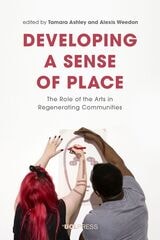
Developing a Sense of Place
The Role of the Arts in Regenerating CommunitiesEdited by Tamara Ashley and Alexis Weedon
University College London, 2020
Developing a Sense of Place offers a range of viewpoints, including those of the arts strategist, the academic, the practice-researcher, and the artist. Through its innovative models, from performing arts to architectural design, the book serves diverse interests, such as the arts and cultural policy managers, master planners, and arts workers, as well as students of human geography, cultural planning, business and the creative industries, and arts administration, at the undergraduate and postgraduate levels.
Developing the City
Community Development, Power, and Urban Democracy in U.S. CitiesEdited by Ashley E. Nickels and Zachary D. Wood
Temple University Press, 2027
Developing the City investigates the forms, levels, and spaces of power (visible, hidden, and invisible) involved in community development ecosystems. The editors and contributors, a mix of embedded activists, academics, and community leaders, provide a series of diverse case studies that evaluate the local dynamics that shape urban policy.
Chapters address racialized power dynamics in Cleveland, OH, community development funding in Memphis, TN, economic growth and inclusion in Newark, NJ, housing policies in Denver and Colorado Springs, CO, and participatory governance in Reno, NV among other topics. They reflect the unique manifestations of power within each local context, shaped by distinctive histories and sociopolitical dynamics.
In addition to exploring how various dimensions of power influence decision-making, resource allocation, democratic engagement, and civic participation, Developing the City provides a systematic framework for understanding and questioning these power dynamics, and advocates for a power-conscious approach to foster more equitable and democratic urban futures with respect to economic, racial, social, and environmental justice.
Contributors: Nakeefa Cilicia Bernard, Prentiss A. Dantzler, Caraline Feairheller, Austin Harrison, Brad A. M. Johnson, Katherine Lambert-Pennington, Eric Stokan, Robert Stoker, Jill Yordy, and the editors

Development Detoothed
Ugandan Girls and the Making and Unmaking of a Global NGO CampaignErin V. Moore
University of Chicago Press, 0
An in-depth examination and critique of girls’ empowerment campaigns in Uganda.
In Kampala, Uganda’s capital and largest city, to “detooth” is to take a man’s money with promises of sex and intimacy. In this highly engaging book, anthropologist Erin V. Moore uses detoothing as a metaphor to capture the ways that many in Uganda, where unemployment rates are staggering, get access to resources from prosperous international NGOs.
Based on over a decade of ethnographic research in Uganda, Canada, Ethiopia, Tanzania, the United Kingdom, the United States, and at the United Nations, Development Detoothed focuses on the world’s largest campaign to “empower” adolescent girls in the global south, which aimed to reach hundreds of millions of girls. Moore follows the campaign’s money and messages around the world, through what she calls the “development supply chain,” from NGO headquarters to staff training workshops, UN offices, government agencies, and community-based organizations.
From this uniquely multisited perspective, she explains how billions of aid dollars earmarked for girls ended up in the hands of men who ran these organizations. Rather than merely document ironic outcomes, however, Moore shows how people inventively navigated the development industry’s many injustices, arguing that as young Ugandan women pull development’s “teeth” they effectively challenge broader ideas about power, money, and masculinity.

Development of Arab-American Identity
Ernest McCarus, Editor
University of Michigan Press, 1994

Developments in Russian Politics 10
Henry E. Hale, Juliet Johnson, and Tomila V. Lankina, editors
Duke University Press, 0
Developments in the Economics of Aging
Edited by David A. Wise
University of Chicago Press, 2009
The number of Americans eligible to receive Social Security benefits will increase from forty-five million to nearly eighty million in the next twenty years. Retirement systems must therefore adapt to meet the demands of the largest aging population in our nation’s history. In Developments in the Economics of Aging, David A. Wise and a distinguished group of analysts examine the economic issues that will confront policy makers as they seek to design policies to protect the economic and physical health of these older Americans.
The volume looks at such topics as factors influencing work and retirement decisions at older ages, changes in life satisfaction associated with retirement, and the shift in responsibility for managing retirement assets from professional money managers of traditional pension plans to individual account holders of 401(k)s. Developments in the Economics of Aging also addresses the complicated relationship between health and economic status, including why health behaviors vary across populations and how socioeconomic measures correlate with health outcomes.

Deviance and Medicalization
From Badness to SicknessPeter Conrad and Joseph W. Schneider
Temple University Press, 1992

Deviant and Useful Citizens
The Cultural Production of the Female Body in Eighteenth-Century PeruMariselle Melendez
Vanderbilt University Press, 2011
The book focuses on the different ways male authorities, as well as female subjects, conceived the female body as deeply connected to notions of what constituted a useful or deviant citizen within the Viceroyalty. Using eighteenth-century legal documents, illustrated chronicles, religious texts, and newspapers, Meléndez explores in depth the representation of the female body in periods of political, economic, and religious transformation to determine how it was conceived within certain contexts.
Deviant and Useful Citizens presents a highly complex society that relied on representations of utility and productivity to understand the female body, as it reveals the surprisingly large stake that colonial authorities had in defining the status of women during a crucial time in South American history.

Deviations
A Gayle Rubin ReaderGayle S. Rubin
Duke University Press, 2012