475 books match the query 'Catholic' and 12 start with e

cover of Early Letters to the Crown and Council of the Indies, 1516-1531: Primeras cartas para Las Indias

Early Letters to the Crown and Council of the Indies, 1516-1531

Primeras cartas para Las Indias

Bartolome de la Casas

Catholic University of America Press, 2026
Bartolomé de las Casas began his transatlantic career in 1502. Experiences of conquest and penitential discipline led him to renounce his Indian slaves and holdings. He dedicated his life to reforming Spain’s colonial project, eventually joining the Dominicans, and later serving as bishop. His works are foundational for our understanding of early colonialism. This volume’s seven letters—all but one in English for the first time—span the initial stage of his long career as “Protector of the Indians.” Las Casas harangues corrupt officials, denounces perverse incentives, and lays out detailed plans for Spain’s presence in the Americas. He calls for direct crown control with moral oversight by mendicant bishops, proposes alternatives to Indian labor, and demands restitution for stolen property. These letters led to legal changes in the Indies, influencing later Jesuit reducciones in the Río de la Plata and Franciscan missions in California. They also reveal an entrepreneurial Las Casas with moral reflection on early global trade and commerce. The watershed “Carta al Consejo”—a critical source for Latin American theology— concentrates all the force of his later writings into a figuratively rich, biblically saturated, theologically and philosophically sophisticated call to repentance and reform. His web of biblical allusions and dialogue with the Iberian Thomist renaissance are abundantly annotated. A lively introduction and copious notes carefully situate Las Casas within broader trends, including Europe’s nascent religious reformations. These letters also bridge his dramatic entry into the Dominican Order, documenting his transformation from temporal reformer to eschatological prophet. Students of law, theology, Christian mission, human rights, cultural and colonial history, and commerce, will find here rhetorical and theological treasures. While Las Casas is known chiefly for his polemical Brief Account of the Destruction of the Indies, these earliest letters suggest a far broader intellectual biography.
[more]
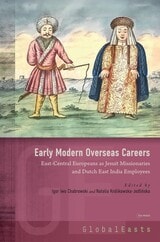
cover of Early Modern Overseas Careers: East-Central Europeans as Jesuit Missionaries and Dutch East India Employees

Early Modern Overseas Careers

East-Central Europeans as Jesuit Missionaries and Dutch East India Employees

Igor Chabrowski

Central European University Press, 2026

In the early modern period, two European networks, the Society of Jesus and the Dutch East India Company (VOC) spanned the globe and contributed to its multifaceted globalization. This book focuses on the members of the former, Jesuit missionaries, and the employees of the VOC originating from Central and Eastern Europe. The well-chosen case studies examine the group characteristics, career influences, and narratives of these Central Eastern Europeans. They explore the question of why subjects of Polish kings, Transylvanian princes, or Habsburg emperors dreamed of venturing overseas with the colonial merchants or aspired to work as missionaries in China and Japan.

The book examines the complexities of this early modern globalization: its scope, limits, importance, social, ethnic, and political ramifications. It researches how these networks reached out to the region of Central and Eastern Europe. The authors argue that the region was hardly considered peripheral from the perspective of Rome (and the Jesuits) or the Netherlands (and the colonial traders). They do, however, explore whether there were "glass ceilings," or limits of reach within the two networks for individuals from the Polish-Lithuanian Commonwealth or the former Kingdom of Hungary.
[more]
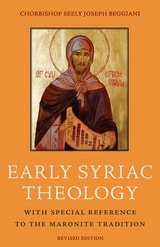
cover of Early Syriac Theology

Early Syriac Theology

Chorbishop Seely Joseph Beggiani

Catholic University of America Press, 2014
Presents the insights of St. Ephrem and Jacob of Serugh, two of the earliest representatives of the theological world-view of the Syriac church.
[more]
cover of Ecclesiology

Ecclesiology

Guy Mansini, OSB

Catholic University of America Press, 2021
The first part of the book explains the antecedent probability both of revelation and of God’s institution of a church. It is ecclesiology in the mode of fundamental theology. The second part rounds up what Scripture and Tradition teach about the Church under the heads of the People of God, the Temple of the Holy Spirit, the Bride of Christ, and the Body of Christ. The chapters present this thematic material under each head as a unified whole, across the Testaments, with each chapter keyed to one of the “marks” of the Church: the catholicity of the people of God, the apostolicity of the ministers of the messianic temple, the holiness of the Bride of Christ, and the unity of the Body of Christ. This already organizes things in a proto-systematic frame. The third part of the book gives systematic exploration, in reverse order, to the unity of the Church, with attention to non-Catholic ecclesial communities and churches, to the holiness of the Church, objective and subjective, to the apostolicity of the Church and her mediation of revealed truth and grace, and to the catholicity of the Church, with attention to non-Christian religions. The center of the book, on the definition of the Church as the sacrament of communion, renders recent French Dominican ecclesiology in a form more accessible to undergraduates and seminarians, rooting it in the New Testament teachings on communion and mysterion. The book concludes with a strenuous argument for the necessity of the Church and her mission of evangelization. Thus, the trajectory of the book is from the naturally knowable antecedent probability of the Church to its revealed necessity.
[more]
cover of Embracing Age: How Catholic Nuns Became Models of Aging Well

Embracing Age

How Catholic Nuns Became Models of Aging Well

Anna I. Corwin

Rutgers University Press, 2021

Embracing Age: How Catholic Nuns Became Models of Aging Well examines a community of individuals whose aging trajectories contrast mainstream American experiences. In mainstream American society, aging is presented as a “problem,” a state to be avoided as long as possible, a state that threatens one’s ability to maintain independence, autonomy, control over one’s surroundings. Aging “well” (or avoiding aging) has become a twenty-first century American preoccupation. Embracing Age provides a window into the everyday lives of American Catholic nuns who experience longevity and remarkable health and well-being at the end of life. Catholic nuns aren’t only healthier in older age, they are healthier because they practice a culture of acceptance and grace around aging. Embracing Age demonstrates how aging in the convent becomes understood by the nuns to be a natural part of the life course, not one to be feared or avoided. Anna I. Corwin shows readers how Catholic nuns create a cultural community that provides a model for how to grow old, decline, and die that is both embedded in American culture and quite distinct from other American models.

Instructor's Guide is available at no cost (https://www.rutgersuniversitypress.org/media/wysiwyg/documents/corwin_instructor_guide_final.pdf).

Open access edition funded by the National Endowment for the Humanities.

The text of this book is licensed under a Creative Commons Attribution NonCommercial-NoDerivatives 4.0 International License: https://creativecommons.org/licenses/by-nc-nd/4.0/ 

Download open access ebook here (https://www.rutgersuniversitypress.org/media/wysiwyg/documents/embracing_age_open_access.pdf).
 

[more]
cover of Encyclical Letter Magnifica Humanitas: On Safeguarding the Human Person in the Time of Artificial Intelligence

Encyclical Letter Magnifica Humanitas

On Safeguarding the Human Person in the Time of Artificial Intelligence

Pope Leo XIV

Catholic University of America Press, 2026
"Humanity, created by God in all its grandeur, is today facing a pivotal choice: either to construct a new Tower of Babel or to build the city in which God and humanity dwell together. Each generation inherits the task of shaping its own era, of guiding history to become a place where the dignity of every person is safeguarded, justice is promoted and fraternity is made possible." Thus begins the first encyclical of the first pope from the United States, written during the country's 250th anniversary and addressing a topic - artificial intelligence - whose industry is centered in the United States. Yet Pope Leo's message is for everyone of good will throughout the world, to remind them of the principles of Catholic social teaching, the grandeur of being human, and the dignity of work as signposts in navigating the challenges and opportunities of an economy shaped by AI. This handsome paperback version from The Catholic University of America Press, the publishers of the pope's doctoral thesis, will spark reflection and action upon Pope Leo's words.
[more]
cover of Errand into the Wilderness of Mirrors: Religion and the History of the CIA

Errand into the Wilderness of Mirrors

Religion and the History of the CIA

Michael Graziano

University of Chicago Press, 2021

Reveals the previous underexplored influence of religious thought in building the foundations of the CIA.

Michael Graziano’s intriguing book fuses two landmark titles in American history: Perry Miller’s Errand into the Wilderness (1956), about the religious worldview of the early Massachusetts colonists, and David Martin’s Wilderness of Mirrors (1980), about the dangers and delusions inherent to the Central Intelligence Agency. Fittingly, Errand into the Wilderness of Mirrors investigates the dangers and delusions that ensued from the religious worldview of the early molders of the Central Intelligence Agency. Graziano argues that the religious approach to intelligence by key OSS and CIA figures like “Wild” Bill Donovan and Edward Lansdale was an essential, and overlooked, factor in establishing the agency’s concerns, methods, and understandings of the world. In a practical sense, this was because the Roman Catholic Church already had global networks of people and safe places that American agents could use to their advantage. But more tellingly, Graziano shows, American intelligence officers were overly inclined to view powerful religions and religious figures through the frameworks of Catholicism. As Graziano makes clear, these misconceptions often led to tragedy and disaster on an international scale. By braiding the development of the modern intelligence agency with the story of postwar American religion, Errand into the Wilderness of Mirrors delivers a provocative new look at a secret driver of one of the major engines of American power.
[more]
cover of Ethics and Its Sources in Nature and Revelation

Ethics and Its Sources in Nature and Revelation

Karol Wojtyla

Catholic University of America Press, 2026
The Catholic University of America Press is honored to publish the English Critical Edition of the Works of Karol Wojtyła/John Paul II. Prepared under the auspices of the John Paul II Institute in Washington DC, the English Critical Edition will comprise more than 20 volumes, covering all of John Paul II’s writings in the years before his papacy and a thematic selection of his papal writings. The third volume of the series presents various ethical and anthropological works by Karol Wojtyła. In addition to multiple essays, this volume features his larger works such as Ethics: Its Concept and Methodology, A Primer of Ethics, Considerations on the Essence of Man, and On the Knowability and Knowledge of God. It also contains Wojtyła’s reviews of books, master’s theses, and doctoral dissertations, written chiefly while he lectured at the Catholic University of Lublin. As was the case with previous volumes, Volume 3 also relies on the original manuscripts and typescripts of Wojtyła’s works. These original texts were compared with the Polish published editions, and all significant differences between them have been marked in the scholarly apparatus. Some of the essays in this volume have not been previously published in English, while some others have never been published before.
[more]
cover of Exegetical Epistles

Exegetical Epistles

Thomas P. Jerome

Catholic University of America Press, 2023
The Nicene and Post-Nicene Fathers series of the 19th century rendered into English many of Jerome’s treatises and letters while bypassing his biblical commentaries as well as some of his most important exegetical letters. This omission, which was not helpful to scholarship, was probably due to the great length of these works. Although the problem was partly remedied by some new English translations of the 20th century, the present volume fills a significant lacuna by translating into English the Scriptural exegesis that Jerome conveyed in his relatively unknown epistles, many of which were composed in response to queries he had received from various correspondents. Many of these letters are presented here for the first time in English. Based on the Hilberg edition, this volume contains new translations, introduced and annotated, of Jerome’s Epistles 18-21, 25-30, 34-37, 42, 53, 55-56, 59, 64-65, 72-74, 78, 85, 106, 112, 119-121, 129, 130, and 140. Two newly translated letters from the famous exchange with Augustine over the meaning of Galatians 2:11-14 are included (Epp. 56 and 112), as well as a new rendering of Ep. 130 to Demetrias (which technically is not an “exegetical” letter but does present important information about the Pelagian controversy). Overall, this collection hopes to serve as a useful introduction to Jerome’s approach to biblical interpretation, of both the Old and the New Testament. Some letters focus on the historical meaning of Pauline and Gospel texts, while others contain allegorical expositions of Old Testament passages. Jerome’s competence as a Hebrew scholar will become evident to the reader of this volume as well as his thorough acquaintance with the antecedent Greek and Latin Christian exegetical traditions.
[more]
cover of Exegetical Epistles, Volume 2

Exegetical Epistles, Volume 2

Thomas P. St. Jerome

Catholic University of America Press, 2024
This is the second of a two-volume set that includes Thomas Scheck’s new translations of several of St. Jerome’s previously untranslated exegetical letters. Epistle 85 to St. Paulinus of Nola contains Jerome’s answers to two questions: how Exodus 7.13 and Romans 9.16 can be reconciled with free will, and what 1 Corinthians 7.14 means. Epistle 106 to Sunnias and Fretela, which deals with textual criticism of the Septuagint, consists of a meticulous defense of Jerome’s new translation of the Latin Psalter. Epistle 112 is a response to three letters from St. Augustine: Ep. 56 (contained in the previous volume), Ep. 67, and Ep 104. In the face of Augustine’s criticisms, Jerome defends his own endeavor to translate the Old Testament directly from the Hebrew text. He also vindicates his own ecclesiastical interpretation of Galatians 2.4-11, as he had set this forth in his Commentary on Galatians, and along the way he accuses Augustine of advocating the heresy of Judaizing. Epistle 119 to Minervius and Alexander contains Jerome’s answers to some eschatological questions regarding the interpretation of 1 Corinthians 15.51 and 1 Thessalonians 4.17. In Epistle 120 to Hedibia, Jerome tackles twelve exegetical questions that focus on reconciling the discrepant Resurrection accounts in the Gospels, as well as questions about Romans 9.14-29, 2 Corinthians 2.16, and 1 Thessalonians 5.23. In Epistle 121 to Algasia, Jerome clarifies eleven exegetical questions dealing with passages in the Gospels and Paul’s letters (Romans 5.7; 7.7-25; 9.3-5; Colossians 2.18-19; 2 Thessalonians 2.3). This letter also contains an exposition of the parable of the unjust steward (Luke 16.1-10), in which Jerome translates material from a commentary attributed to Theophilus of Antioch. In Epistle 129 to Dardanus, Jerome interprets “the promised land” and discusses the alleged crimes of the Jews. Epistle 130 to Demetrias is not an exegetical letter but an exhortation to the newly consecrated virgin on how to live out her vocation. In this letter Jerome reflects on Origenism and Pelagianism. Finally, in Epistle 140 to Cyprian the presbyter, Jerome expounds Psalm 90.
[more]
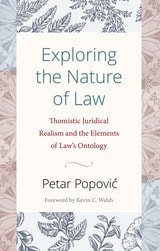
cover of Exploring the Nature of Law: Thomistic Juridical Realism and the Elements of Law's Ontology

Exploring the Nature of Law

Thomistic Juridical Realism and the Elements of Law's Ontology

Petar Popovic

Catholic University of America Press, 2025
This is a book about the nature of the reality or the phenomenon referred to as “law” by lawyers and legal officials, but also by members of communities living under law, to the extent that they conceptualize the realm of “law” as something sufficiently distinguishable from other different or broader realities and phenomena. The book belongs to the legal-philosophical field dedicated to the study of the very nature of law, that is, to the most basic or abstract part of the philosophy of law, which is sometimes referred to as “the philosophy of philosophy of law” or “general jurisprudence.” The scope of the book is to explore the essential features of law’s nature, namely, all those realities that pertain to law’s essence, the properties that make law into what it is. Despite the fact of plurality of legal-philosophical conceptions of law circulating in legal theory today, the book is optimistic about the very prospect of exploring the nature of law. It maintains that law has an essence and that it is possible to explore and describe this unique essence in an intelligible and reasonably detailed fashion, by identifying the basic elements of law’s ontology. The book advances the claim that Aquinas’s account of legal ontology denotes the most accurate understanding of the phenomenon that we call “law”—which the Angelic Doctor referred to as ius, constituted as such on the basis of the various manifestations of lex. Aquinas’s approach to understanding law’s nature that can be labeled “Thomistic juridical realism” and it may be categorized as a version of a natural-law theory of law. The book argues that a contemporary reading of Aquinas may indeed fruitfully contribute to an improved understanding of our present-day legal-philosophical analyses and discussions on the nature of law.
[more]
cover of Exposition of the Apocalypse

Exposition of the Apocalypse

Tyconius Tyconius of Carthage

Catholic University of America Press, 2017

The Exposition of the Apocalypse by Tyconius of Carthage (fl. 380) was pivotal in the history of interpretation of the Book of Revelation. While expositors of the second and third centuries viewed the Apocalypse of John, or Book of Revelation, as mainly about the time of Antichrist and the end of the world, in the late fourth century Tyconius interpreted John’s visions as figurative of the struggles facing the Church throughout the entire period between the Incarnation and the Second Coming of Christ. Tyconius’s “ecclesiastical” reading of the Apocalypse was highly regarded by early medieval commentators like Caesarius of Arles, Primasius of Hadrumetum, Bede, and Beatus of Liebana, who often quoted from Tyconius’s Exposition in their own Apocalypse commentaries. Unfortunately no complete manuscript of the Exposition by Tyconius has survived. A number of recent scholars, however, believed that a large portion of his Exposition could be reconstructed from citations of it in the aforementioned early medieval writers; and this task was undertaken by Monsignor Roger Gryson. Gryson’s edition, a reconstruction of the Expositio Apocalypseos of Tyconius, was published in 2011 in Corpus Christianorum Series Latina. The present translation of that reconstructed text, with introduction and notes, exhibits Tyconius’s unique non-apocalyptic approach to the Book of Revelation. It also shows that throughout the Exposition Tyconius made use of interpretive rules that he had laid out in an earlier work on hermeneutics, the Book of Rules, strongly suggesting that Tyconius wrote his Exposition as a companion to his Book of Rules. Thus, the Exposition served as an exemplar of how those rules would apply to interpretation of even the most intriguing of biblical texts, the Apocalypse.
[more]