Results by title
233 books match the query 'Cold War' and 9 start with e
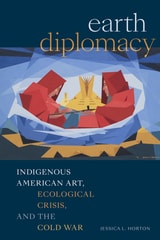
Earth Diplomacy
Indigenous American Art, Ecological Crisis, and the Cold WarJessica L. Horton
Duke University Press, 2024
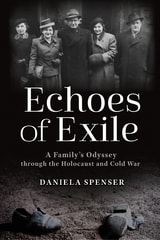
Echoes of Exile
A Family’s Odyssey through the Holocaust and Cold WarDaniela Spenser
University of Alabama Press, 2025
A sweeping exploration of survival, resilience, and the fate of one family amid Europe’s most turbulent century.
Echoes of Exile reveals the seismic disruptions of twentieth-century European history through the intimate lens of one family’s struggle to survive. Setting out to record the life of her mother, Ruth, Daniela Spenser unearthed personal facts and stories that additionally illuminate the shared traumas and experiences of millions of Czech, Polish, and German Jews who died in the Holocaust, as well as the stories of those who survived and lived under Communism and the Cold War. Her resulting work is a fascinating hybrid that combines family letters and interviews with deeply researched political history spanning from the collapse of the Austro-Hungarian Empire to the fall of the Berlin Wall.
Spenser’s fascinating work reveals the difficult choices her mother and family faced, the tests to their loves and loyalties, and the lingering scars of exile. More than a family history, it weaves personal and historical narratives with mundane and momentous threads to create a fresh, distinctive fabric. Spenser recovers fragments of the past that contribute to a map of the present and possibilities for the future. An engrossing account of survival, resilience, and the enduring human spirit amid the maelstrom of Europe’s savage twentieth century, Echoes of Exile will interest readers who value firsthand accounts of significant events and who seek to understand the complexities of survival, identity, and political change through intimate, lived experiences.
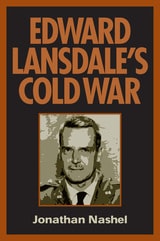
Edward Lansdale's Cold War
Jonathan Nashel
University of Massachusetts Press, 2005
The man widely believed to have been the model for Alden Pyle in Graham Greene's The Quiet American, Edward G. Lansdale (1908–1987) was a Cold War celebrity. A former advertising executive turned undercover CIA agent, he was credited during the 1950s with almost single-handedly preventing a communist takeover of the Philippines and with helping to install Ngo Dinh Diem as president of the American-backed government of South Vietnam. Adding to his notoriety, during the Kennedy administration Lansdale was put in charge of Operation Mongoose, the covert plot to overthrow the government of Cuba's Fidel Castro by assassination or other means.
In this book, Jonathan Nashel reexamines Lansdale's role as an agent of American Cold War foreign policy and takes into account both his actual activities and the myths that grew to surround him. In contrast to previous portraits, which tend to depict Lansdale either as the incarnation of U.S. imperialist ambitions or as a farsighted patriot dedicated to the spread of democracy abroad, Nashel offers a more complex and nuanced interpretation. At times we see Lansdale as the arrogant “ugly American,” full of confidence that he has every right to make the world in his own image and utterly blind to his own cultural condescension. This is the Lansdale who would use any conceivable gimmick to serve U.S. aims, from rigging elections to sugaring communist gas tanks. Elsewhere, however, he seems genuinely respectful of the cultures he encounters, open to differences and new possibilities, and willing to tailor American interests to Third World needs.
Rather than attempting to reconcile these apparently contradictory images of Lansdale, Nashel explores the ways in which they reflected a broader tension within the culture of Cold War America. The result is less a conventional biography than an analysis of the world in which Lansdale operated and the particular historical forces that shaped him—from the imperatives of anticommunist ideology and the assumptions of modernization theory to the techniques of advertising and the insights of anthropology.
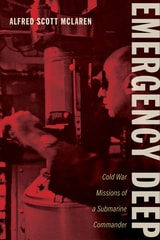
Emergency Deep
Cold War Missions of a Submarine CommanderAlfred Scott McLaren
University of Alabama Press, 2021
A compelling naval memoir of Arctic submarine duty—operations, engineering realities, and split‑second leadership choices in Emergency Deep.
Captain Alfred Scott McLaren served as commander of the USS Queenfish (SSN 651) from September 1969 to May 1973, the very height of the Cold War. As commander, McLaren led at least six major clandestine operations, including the first-ever exploration of the entire Siberian Continental Shelf: a perilous voyage detailed in his previous book Unknown Waters.
Emergency Deep: Cold War Missions of a Submarine Commander conveys the entire spectrum of Captain McLaren’s experiences commanding the USS Queenfish, mainly in the waters of the Russian Far East and also off Vietnam. McLaren offers a riveting and deeply human story that illuminates the intensity and pressures of commanding a nuclear attack submarine in some of the most difficult circumstances imaginable.
Relying on his own notes and records, as well as discussions with former officers and shipmates, McLaren focuses on operational matters both great and small. He recounts his unique perspectives on attack-submarine tactics and exploratory techniques in high-risk or uncharted areas, matters of leadership and team-building and the morale of his crews, and the innumerable and often unforeseen ways his philosophy of command played out on a day-to-day basis, with consequences that ran the gamut from the mundane to the dire and life-threatening.
Readers are also treated to significant new information and insight on submarine strategy, maneuvers, and culture. Such details illuminate and bring to life, with both great humor and gravitas, the intensity and pressures on those engaged in covert missions on nuclear attack submarines.
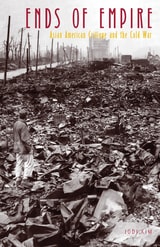
Ends of Empire
Asian American Critique and the Cold WarJodi Kim
University of Minnesota Press, 2010
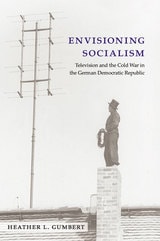
Envisioning Socialism
Television and the Cold War in the German Democratic RepublicHeather L. Gumbert
University of Michigan Press, 2014
Envisioning Socialism examines television and the power it exercised to define the East Germans’ view of socialism during the first decades of the German Democratic Republic. In the first book in English to examine this topic, Heather L. Gumbert traces how television became a medium prized for its communicative and entertainment value. She explores the difficulties GDR authorities had defining and executing a clear vision of the society they hoped to establish, and she explains how television helped to stabilize GDR society in a way that ultimately worked against the utopian vision the authorities thought they were cultivating.
Gumbert challenges those who would dismiss East German television as a tool of repression that couldn’t compete with the West or capture the imagination of East Germans. Instead, she shows how, by the early 1960s, television was a model of the kind of socialist realist art that could appeal to authorities and audiences. Ultimately, this socialist vision was overcome by the challenges that the international market in media products and technologies posed to nation-building in the postwar period.
A history of ideas and perceptions examining both real and mediated historical conditions, Envisioning Socialism considers television as a technology, an institution, and a medium of social relations and cultural knowledge. The book will be welcomed in undergraduate and graduate courses in German and media history, the history of postwar Socialism, and the history of science and technologies.
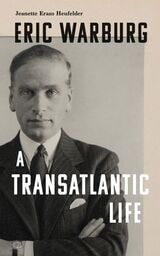
Eric Warburg
A Transatlantic LifeJeanette Erazo Heufelder
Haus Publishing, 2025
In Eric Warburg, Jeanette Erazo Heufelder tells the story of the nephew of the art historian Aby Warburg, whose world-famous library Eric saved from the Nazis. He was a Jew, a banker, a helper of escapees, an intelligence officer in the US Army, a transatlantic bridge builder, and a Cold Warrior. With the help of the cooperation channels he set up, West German and US social groups were aligned with the West amidst the turmoil of postwar Europe.
The history of the transatlantic partnership has become highly topical; since the Russian invasion of Ukraine on February 24, 2022, it has been invoked in Europe as a key reassurance. Eric Warburg’s life, and that of Aby Warburg’s library, tells the story of Europe's twentieth century, the legacy of which continues to inform and inspire the transatlantic partnership today.
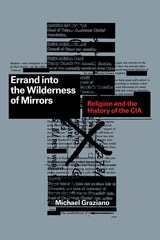
Errand into the Wilderness of Mirrors
Religion and the History of the CIAMichael Graziano
University of Chicago Press, 2021
Michael Graziano’s intriguing book fuses two landmark titles in American history: Perry Miller’s Errand into the Wilderness (1956), about the religious worldview of the early Massachusetts colonists, and David Martin’s Wilderness of Mirrors (1980), about the dangers and delusions inherent to the Central Intelligence Agency. Fittingly, Errand into the Wilderness of Mirrors investigates the dangers and delusions that ensued from the religious worldview of the early molders of the Central Intelligence Agency. Graziano argues that the religious approach to intelligence by key OSS and CIA figures like “Wild” Bill Donovan and Edward Lansdale was an essential, and overlooked, factor in establishing the agency’s concerns, methods, and understandings of the world. In a practical sense, this was because the Roman Catholic Church already had global networks of people and safe places that American agents could use to their advantage. But more tellingly, Graziano shows, American intelligence officers were overly inclined to view powerful religions and religious figures through the frameworks of Catholicism. As Graziano makes clear, these misconceptions often led to tragedy and disaster on an international scale. By braiding the development of the modern intelligence agency with the story of postwar American religion, Errand into the Wilderness of Mirrors delivers a provocative new look at a secret driver of one of the major engines of American power.
Every Home a Fortress
Cold War Fatherhood and the Family Fallout ShelterThomas Bishop
University of Massachusetts Press, 2020