Results by title
55 books match the query 'Creating' and 2 start with e
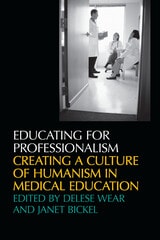
Educating For Professionalism
Creating A Culture Of Humanism In Medical EducationDelese Wear
University of Iowa Press, 2000
The thirteen essays in Educating for Professionalism examine the often conflicting ethical, social, emotional, and intellectual messages that medical institutions send to students about what it means to be a doctor. Because this disconnection between what medical educators profess and what students experience is partly to blame for the current crisis in medical professionalism, the authors offer timely, reflective analyses of the work and opportunities facing medical education if doctors are to win public trust.
In their drive to improve medical professionalism within the world of academic medicine, editors Delese Wear and Janet Bickel have assembled thought-provoking essays that elucidate the many facets of teaching, valuing, and maintaining medical professionalism in the middle of the myriad challenges facing medicine at the dawn of the twenty-first century.
The collection traces how the values of altruism and service can influence not only mission statements and admission policies but also the content of medical school ethics courses, student-led task forces, and mentoring programs, along with larger environmental issues in medical schools and the communities they serve.
Stanley Joel Reiser
Jack Coulehan
Peter C. Williams
Frederic W. Hafferty
Richard Martinez
Judith Andre
Jake Foglio
Howard Brody
Sheila Woods
Sue Fosson
Lois Margaret Nora
Mary Anne C. Johnston
Tana A. Grady-Weliky
Cynthia N. Kettyle
Edward M. Hundert
Norma E. Wagoner
Frederick A. Miller
William D. Mellon
Howard Waitzkin
Donald Wasylenki
Niall Byrne
Barbara McRobb
Edward J. Eckenfels
Lucy Wolf Tuton
Claudia H. Siegel
Timothy B. Campbell
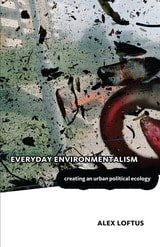
Everyday Environmentalism
Creating an Urban Political EcologyAlex Loftus
University of Minnesota Press, 2012
Everyday Environmentalism develops a conversation between marxist theories of everyday life and recent work in urban political ecology, arguing for a philosophy of praxis in relation to the politics of urban environments. Grounding its theoretical debate in empirical studies of struggles to obtain water in the informal settlements of Durban, South Africa, as well as in the creative acts of insurgent art activists in London, Alex Loftus builds on the work of key marxist thinkers to redefine “environmental politics.”
A marxist philosophy of praxis—that world-changing ideas emerge from the acts of everyday people—undergirds the book. Our daily reality, writes Loftus, is woven out of the entanglements of social and natural relations, and as such a kind of environmental politics is automatically incorporated into our lives. Nevertheless, one effect of the public recognition of global environmental change, asserts Loftus, has been a resurgence of dualistic understandings of the world: for example, that nature is inflicting revenge on arrogant human societies.
This ambitious work reformulates—with the assistance of such philosophers as Lukács, Gramsci, Lefebvre, and others—a politics of the environment in which everyday subjectivity is at the heart of a revolutionary politics.