Results by title
114 books match the query 'Decision Making' and 5 start with e
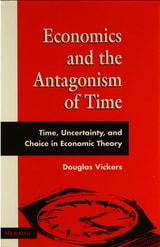
Economics and the Antagonism of Time
Time, Uncertainty, and Choice in Economic TheoryDouglas Vickers
University of Michigan Press, 1994
Educating Intuition
Robin M. Hogarth
University of Chicago Press, 2001
In Educating Intuition, Robin M. Hogarth lays bare this mysterious process so fundamental to daily life by offering the first comprehensive overview of what the science of psychology can tell us about intuition—where it comes from, how it works, whether we can trust it. From this literature and his own research, Hogarth finds that intuition is a normal and important component of thought that has its roots in processes of tacit learning. Environment, attention, experience, expertise, and the success of the scientific method all form part of Hogarth's perspective on intuition, leading him to the surprising—but natural—conclusion that we can educate our sixth sense. To this end he offers concrete suggestions and exercises to help readers develop their intuitive skills and habits for learning the "right" lessons from experience.
Artfully and accessibly combining cognitive science, the latest research in psychology, and Hogarth's own observations, Educating Intuition eschews the vague approach to the topic that has become commonplace and provides instead a wholly engaging and practical guide to enhancing our intuitive skills.
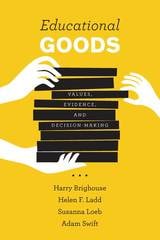
Educational Goods
Values, Evidence, and Decision-MakingHarry Brighouse, Helen F. Ladd, Susanna Loeb, and Adam Swift
University of Chicago Press, 2018
In Educational Goods, two philosophers and two social scientists address this very question. They begin by broadening the language for talking about educational policy: “educational goods” are the knowledge, skills, and attitudes that children develop for their own benefit and that of others; “childhood goods” are the valuable experiences and freedoms that make childhood a distinct phase of life. Balancing those, and understanding that not all of them can be measured through traditional methods, is a key first step. From there, they show how to think clearly about how those goods are distributed and propose a method for combining values and evidence to reach decisions. They conclude by showing the method in action, offering detailed accounts of how it might be applied in school finance, accountability, and choice. The result is a reimagining of our decision making about schools, one that will sharpen our thinking on familiar debates and push us toward better outcomes.

Environmentality
Technologies of Government and the Making of SubjectsArun Agrawal
Duke University Press, 2005
Agrawal brings environment and development studies, new institutional economics, and Foucauldian theories of power and subjectivity to bear on his ethnographical and historical research. He visited nearly forty villages in Kumaon, where he assessed the state of village forests, interviewed hundreds of Kumaonis, and examined local records. Drawing on his extensive fieldwork and archival research, he shows how decentralization strategies change relations between states and localities, community decision makers and common residents, and individuals and the environment. In exploring these changes and their significance, Agrawal establishes that theories of environmental politics are enriched by attention to the interconnections between power, knowledge, institutions, and subjectivities.
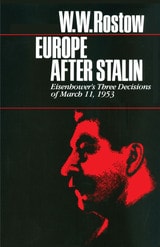
Europe after Stalin
Eisenhower's Three Decisions of March 11, 1953By W.W. Rostow
University of Texas Press, 1982
Stalin's death on March 6, 1953, reopened the debate within the Eisenhower administration over whether or not the United States should propose and actively promote the reunification of Germany at a summit conference. Written by an insider, this is the only published firsthand account of this foreign policy decision—a decision that illuminated the dilemmas of the Cold War at an important moment.
W. W. Rostow examines the origins of Eisenhower's "peace speech" of April 16, 1953, and of the National Security Council's debate on the German question between John Foster Dulles and presidential adviser C. D. Jackson. Jackson proposed immediate high-level diplomatic contact with the Soviet Union and the countries of Western Europe to discuss German reunification, as well as proposals for the general control of armaments and special security arrangements for Europe. Dulles, however, argued for a more reserved posture, which ruled out summitry and immediate negotiation with the Soviets. Dulles prevailed, but Eisenhower made his famous "peace speech."
In his concluding chapter, Rostow explores the question of whether or not anything was lost by this outcome. Was an opportunity for a united Germany forfeited when Eisenhower rejected Churchill's suggestion for a prompt summit meeting and backed Dulles against Jackson in the National Security Council meeting of March 11?
This is the third in a series of volumes by the author that probe the relationship between ideas and action in the making of major policy decisions. In this series, Rostow examines historic decision making from an insider's point of view while exploiting fully the rich documentary evidence.