Results by title
126 books match the query 'Decolonization' and 4 start with e
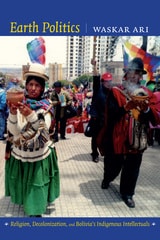
Earth Politics
Religion, Decolonization, and Bolivia's Indigenous IntellectualsWaskar Ari
Duke University Press, 2014
Earth Politics focuses on the lives of four indigenous activist-intellectuals in Bolivia, key leaders in the Alcaldes Mayores Particulares (AMP), a movement established to claim rights for indigenous education and reclaim indigenous lands from hacienda owners. The AMP leaders invented a discourse of decolonization, rooted in part in native religion, and used it to counter structures of internal colonialism, including the existing racial systems. Waskar Ari calls their social movement, practices, and discourse earth politics, both because the AMP emphasized the idea of the earth and the place of Indians on it, and because of the political meaning that the AMP gave to the worship of the Aymara gods. Depicting the social worlds and life work of the activists, Ari traverses Bolivia's political and social landscape from the 1920s into the early 1970s. He reveals the AMP 's extensive geographic reach, genuine grassroots quality, and vibrant regional diversity. Ari had access to the private archives of indigenous families, and he collected oral histories, speaking with men and women who knew the AMP leaders. The resulting examination of Bolivian indigenous activism is one of unparalleled nuance and depth.
[more]
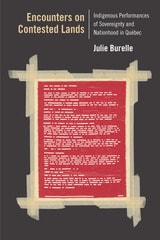
Encounters on Contested Lands
Indigenous Performances of Sovereignty and Nationhood in QuébecJulie Burelle
Northwestern University Press, 2019
Winner, 2019 John W. Frick Book Award
Winner, 2020 Ann Saddlemyer Award
Finalist, ATHE Outstanding Book Award for 2020
Mention Spéciale, Société québécoise d'études théâtrale
In Encounters on Contested Lands, Julie Burelle employs a performance studies lens to examine how instances of Indigenous self-representation in Québec challenge the national and identity discourses of the French Québécois de souche—the French-speaking descendants of white European settlers who understand themselves to be settlers no more but rather colonized and rightfully belonging to the territory of Québec.
Analyzing a wide variety of performances, Burelle brings together the theater of Alexis Martin and the film L'Empreinte, which repositions the French Québécois de souche as métis, with protest marches led by Innu activists; the Indigenous company Ondinnok's theater of repatriation; the films of Yves Sioui Durand, Alanis Obomsawin, and the Wapikoni Mobile project; and the visual work of Nadia Myre. These performances, Burelle argues, challenge received definitions of sovereignty and articulate new ones while proposing to the province and, more specifically, to the French Québécois de souche, that there are alternative ways to imagine Québec's future and remember its past.
The performances insist on Québec's contested nature and reframe it as animated by competing sovereignties. Together they reveal how the "colonial present tense" and "tense colonial present" operate in conjunction as they work to imagine an alternative future predicated on decolonization. Encounters on Contested Lands engages with theater and performance studies while making unique and needed contributions to Québec and Canadian studies, as well as to Indigenous and settler-colonial studies.
[more]
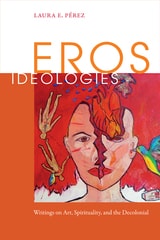
Eros Ideologies
Writings on Art, Spirituality, and the DecolonialLaura E. Pérez
Duke University Press, 2018
In Eros Ideologies Laura E. Pérez explores the decolonial through Western and non-Western thought concerning personal and social well-being. Drawing upon Jungian, people-of-color, and spiritual psychology alongside non-Western spiritual philosophies of the interdependence of all life-forms, she writes of the decolonial as an ongoing project rooted in love as an ideology to frame respectful coexistence of social and cultural diversity. In readings of art that includes self-portraits by Frida Kahlo, Ana Mendieta, and Yreina D. Cervántez, the drawings and paintings of Chilean American artist Liliana Wilson, and Favianna Rodriguez's screen-printed images, Pérez identifies art as one of the most valuable laboratories for creating, imagining, and experiencing new forms of decolonial thought. Such art expresses what Pérez calls eros ideologies: understandings of social and natural reality that foreground the centrality of respect and care of self and others as the basis for a more democratic and responsible present and future. Employing a range of writing styles and voices—from the poetic to the scholarly—Pérez shows how art can point to more just and loving ways of being.
[more]
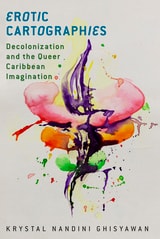
Erotic Cartographies
Decolonization and the Queer Caribbean ImaginationKrystal Nandini Ghisyawan
Rutgers University Press, 2022
Erotic Cartographies uses subjective mapping, a participatory data collection technique, to demonstrate how Trinidadian same-sex-loving women use their gender performance, erotic autonomy, and space-making practices to reinforce and resist colonial ascriptions on subject bodies. The women strategically embody their sexual identities to challenge imposed subject categories and to contest their invisibility and exclusion from discourses of belonging. Erotic Cartographies refers to the processes of mapping territories of self-knowing and self-expression, both cognitively in the imagination and on paper during the mapping exercise, exploring how meaning is given to space, and how it is transformed. Using the women’s quotes and maps, the book focuses on the false binary of public-private, the practices of home and family, and religious nationalism and spiritual self-seeking, to demonstrate the women’s challenges to the structural, symbolic, and interpersonal violence of colonial discourses and practices related to gender, knowledge, and power in Trinidadian society.
[more]