Results by title

6 books match the query 'Myanmar'
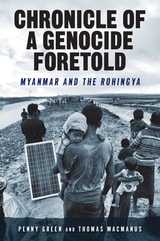
cover of Chronicle of a Genocide Foretold: Myanmar and the Rohingya

Chronicle of a Genocide Foretold

Myanmar and the Rohingya

Penny Green

Rutgers University Press, 2027

Chronicle of a Genocide Foretold is a powerful account of one of the most devastating human crises of the 21st century. Drawing on firsthand research conducted in Burma (Myanmar) and neighboring countries, the book uncovers how the Rohingya Muslims have been systematically isolated, impoverished, and targeted in a state-led genocidal campaign. Through more than 150 interviews with survivors, local officials, religious leaders, and international actors, the authors reveal how discrimination, mass displacement, and organized brutality have created conditions that meet the legal, criminological, and moral definition of genocide. The book also challenges the silence and complicity of the international community. Accessible and grounded in rigorous research, this book speaks to scholars, activists, policymakers, and anyone concerned with justice, human rights, and the global failure to prevent genocide.
[more]
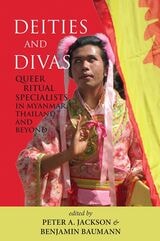
cover of Deities and Divas: Queer Ritual Specialists in Myanmar, Thailand and Beyond

Deities and Divas

Queer Ritual Specialists in Myanmar, Thailand and Beyond

Edited by Peter A. Jackson and Benjamin Baumann

National University of Singapore Press, 2022
Across the Buddhist societies of mainland Southeast Asia, local queer cultures are at the centre of a recent proliferation of professional spirit mediumship. Drawing on detailed ethnographies and extensive comparative research, Deities and Divas captures this variety and ferment.
[more]
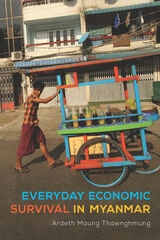
cover of Everyday Economic Survival in Myanmar

Everyday Economic Survival in Myanmar

Ardeth Maung Thawnghmung

University of Wisconsin Press, 2022

Reforms in Myanmar (formerly Burma) have eased restrictions on citizens' political activities. Yet for most Burmese, Ardeth Maung Thawnghmung shows, eking out a living from day to day leaves little time for civic engagement. Citizens have coped with extreme hardship through great resourcefulness. But by making bad situations more tolerable in the short term, these coping strategies may hinder the emergence of the democratic values needed to sustain the country's transition to a more open political environment.

Thawnghmung conducted in-depth interviews and surveys of 372 individuals from all walks of life and across geographical locations in Myanmar between 2008 and 2015. To frame her analysis, she provides context from countries with comparable political and economic situations. Her findings will be welcomed by political scientists and policy analysts, as well by journalists and humanitarian activists looking for substantive, reliable information about everyday life in a country that remains largely in the shadows.

[more]
cover of Repossessing Shanland: Myanmar, Thailand, and a Nation-State Deferred

Repossessing Shanland

Myanmar, Thailand, and a Nation-State Deferred

Jane M. Ferguson

University of Wisconsin Press, 2022

Around five million people across Southeast Asia identify as Shan. Though the Shan people were promised an independent state in the 1947 Union of Burma constitution, successive military governments blocked their liberation. From 1958 onward, insurgency movements, including the Shan United Revolution Army, have fought for independence from Myanmar. Refugees numbering in the hundreds of thousands fled to Thailand to escape the conflict, despite struggling against oppressive citizenship laws there. Several decades of continuous rebellion have created a vacuum in which literati and politicians have constructed a virtual Shan state that lives on in popular media, rock music, and Buddhist ritual.

Based on close readings of Shan-language media and years of ethnographic research in a community of soldiers and their families, Jane M. Ferguson details the origins of these movements and tells the story of the Shan in their own voices. She shows how the Shan have forged a homeland and identity during great upheaval by using state building as an ongoing project of resistance, resilience, and accommodation within both countries. In avoiding a good/bad moral binary and illuminating cultural complexities, Repossessing Shanland offers a fresh perspective on identity formation, transformation, and how people understand and experience borderlands today.
[more]
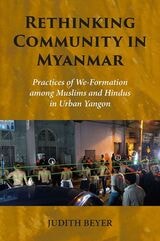
cover of Rethinking Community in Myanmar: Practices of We-Formation among Muslims and Hindus in Urban Yangon

Rethinking Community in Myanmar

Practices of We-Formation among Muslims and Hindus in Urban Yangon

Judith Beyer

National University of Singapore Press, 2023
Striking new insights into understanding community in Myanmar In this first anthropological study of Muslim and Hindu lives in urban Myanmar today, Beyer develops the concept of ‘we-formation’ to demonstrate that individuals are always more than members of wider groups. ‘We-formation’ complements her rich political, legal and historical analysis of ‘community’, a term used by Beyer’s interlocutors themselves, even as it reinforces ethno-religious stereotypes and their own minority status. The book also offers an interpretation of the dynamics of resistance to the attempted military coup of 2021.
[more]
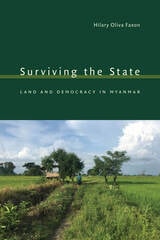
cover of Surviving the State: Land and Democracy in Myanmar

Surviving the State

Land and Democracy in Myanmar

Hilary Oliva Faxon

Duke University Press, 2026

In Myanmar’s Kalay Valley, a rice-growing region near the Indian border, farmers have long been subject to violence and neglect. Surviving the State considers how these farmers’ everyday, land-based practices enable them to endure successive authoritarian regimes. Through robust ethnography, Hilary Oliva Faxon describes how Burman and Chin smallholders treat land not only as a source of food, but also as a living thing entwined with the families it supports. She considers the centrality of land both to state efforts at control and to inhabitants’ ability to articulate claims, looking at how locals evade, obfuscate, and reinvent legal boundaries in the face of seizures, redistribution, and revolution. Providing a feminist ethnography of land politics, Surviving the State is a testament to the daily work of survival in the face of political violence.
[more]