Results by title
10 books match the query 'Absurdist'
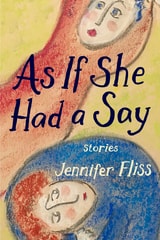
As If She Had a Say
StoriesJennifer Fliss
Northwestern University Press, 2023
Who has a right to tell us how to experience our grief? How to perform—or not perform—the roles society prescribes to us based on our various points of identity?
As If She Had a Say, the second story collection from Jennifer Fliss, uses an absurdist lens to showcase characters—predominantly women—plumbing their resources as they navigate misogyny, abuse, and grief. In these stories, a woman melts in the face of her husband’s cruelty; a seven-tablespoons-long woman lives inside a refrigerator and engages in an affair with the man of the house; a balloon-animal artist attends a funeral to discover he was invited as more than entertainment; and a man loses all his nouns.
Fans of Karen Russell and Carmen Maria Machado will appreciate how As If She Had a Say’s inventive narratives expose inequities by taking us on imaginative romps through domesticity and patriarchal expectations. Each story functions as a magnifying glass through which we might examine our own lives and see ourselves more clearly.
Compulsory Happiness
Norman Manea
Northwestern University Press, 1994
Dialogues in Paradise
Can Xue
Northwestern University Press, 1989
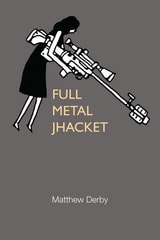
Full Metal Jhacket
Matthew Derby
University of Michigan Press, 2014
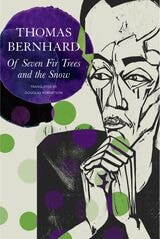
Of Seven Fir Trees and the Snow
Early StoriesThomas Bernhard
Seagull Books, 2025
Before Thomas Bernhard became one of the most provocative voices in modern literature, he was a young writer testing the limits of form and subject. Of Seven Fir Trees and the Snow offers an unprecedented look at his evolution, from his earliest published work at nineteen to the emergence of his unmistakable voice. Translated into English for the first time, in these stories, Bernhard moves from stark naturalism to fairy-tale simplicity to the eerie, stripped-down surrealism reminiscent of science fiction. At the same time, he grapples with the fundamental ethical questions that would define his career: how does one navigate personal autonomy in a world fractured by the upheavals of the twentieth century?
Selected and arranged in chronological order by Douglas Robertson, this collection traces Bernhard’s transformation from an ambitious chronicler of Austrian rural life to a writer in dialogue with the broader currents of world literature. A rare glimpse into the making of a literary icon, this volume is essential reading for both longtime admirers and those discovering Bernhard’s singular genius for the first time.
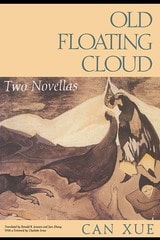
Old Floating Cloud
Two NovellasCan Xue
Northwestern University Press, 1991
Yellow Mud Street tells of a street, its people, and a strange event that happens there. The street is dilapidated, though it once saw better times. The “S” Machinery Factory, which used to run day and night, is rusty and decaying, though people still deceive themselves into thinking this factory is a fine place, the envy of “foreign devils” and an important connection with “the authorities.” One day, “a thing” appears. No one is sure if it is a person, a flash of light, or a cloud of will-o'-the-wisp. It prompts rumor, superstition, political slogans, and an investigation by the authorities. A chorus of paranoid preoccupations wind up and down Yellow Mud Street, in a series of muttered refrains that build to a screaming frenzy.
Old Floating Cloud is the ruthlessly unsentimental story of a man who has an affair with his neighbor's wife. Can Xue describes the damage people do to each other, their obsessions, their lack of connection, and their attempts to exert power over one another. Lovers are not the only targets of Can Xue’s biting humor. Resentment flares between parents and children, in-laws spy, and employees abase themselves before their bosses. Like Yellow Mud Street, this novella teems with insects, excrement, and distorted bodies—visceral reminders of our earthbound state.
TRIAL OF EBENEZER SCROOGE
Bruce Bueno de Mesquita
The Ohio State University Press, 2001
What happened to Ebenezer Scrooge after the night he was visited by the three spirits?
When we left Ebenezer Scrooge at the end of A Christmas Carol, he appeared to be a man transformed. But did he sincerely repent and earn admission to heaven? The Trial of Ebenezer Scrooge, written in Dickensian style and with tongue firmly lodged in cheek, follows Scrooge through the Court of Heavenly Justice, where his soul’s fate is to be determined. In this courtroom drama, using frequent flashbacks, the author uncovers startling evidence, much of it directly from Dickens’s classic, that reveals Scrooge to have lived a saintly life before being confronted by three Christmas ghosts. Evidence mounts that Mr. Scrooge struck a Faustian bargain with the Ghost of Christmas Yet to Come, a deal to extend his own mortality in exchange for yielding his soul as a tool for the forces of darkness to infiltrate heaven. Readers will enjoy the remaking of some of Dickens’s best-known characters. Tiny Tim emerges as a villain, while little Eppie, borrowed from George Eliot’s Silas Marner, is Scrooge’s protector and source of salvation. This new novel provides the much-needed redemption of Ebenezer Scrooge’s reputation and offers a welcome departure from the standard saccharine fare at Christmastime. Dickens buffs will have a merry time trying to find where Dickens’s voice ends and the author’s begins. All readers will puzzle over how we could have so misjudged Ebenezer Scrooge, or whether we judged Scrooge aright from the start.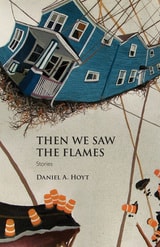
Then We Saw the Flames
StoriesDaniel A. Hoyt
University of Massachusetts Press, 2009
In this freewheeling debut collection, Daniel A. Hoyt takes us from the swamps of Florida to the streets of Dresden, to the skies above America, to the tourist hotels of Acapulco, to the southwest corner of Nebraska. Along the way, we encounter a remarkable group of characters all struggling to find their footing in an unsettling world.
Sometimes magical, sometimes realistic, sometimes absurd, these stories reveal people teetering on the dangerous edge of their lives. In “Amar,” a Turkish restaurant owner deals with skinheads and the specter of violence that haunts his family. In “Boy, Sea, Boy,” a shipwrecked sailor receives a surreal visitor, a version of himself as a child. In “The Collection,” a father and son squander a trove of bizarre and fanciful objects. And in “The Kids,” a suburban couple grasp for meaning after discovering children eating from their trash.
In each of these stories, characters find themselves challenged by the political, cultural, and spiritual forces that define their lives. With a clear eye and a steady hand, Hoyt explores a fragile balance: the flames—fueled by love, loss, hope, and family—shed new light on us. Sometimes we feel warmth, and sometimes we simply burn.
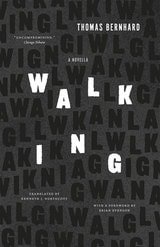
Walking
A NovellaThomas Bernhard
University of Chicago Press, 2003
Thomas Bernhard is “one of the masters of contemporary European fiction” (George Steiner); “one of the century’s most gifted writers” (Newsday); “a virtuoso of rancor and rage” (Bookforum). And although he is favorably compared with Franz Kafka, Samuel Beckett, and Robert Musil, it is only in recent years that he has gained a devoted cult following in America.
A powerful, compact novella, Walking provides a perfect introduction to the absurd, dark, and uncommonly comic world of Bernhard, showing a preoccupation with themes—illness and madness, isolation, tragic friendships—that would obsess Bernhard throughout his career. Walking records the conversations of the unnamed narrator and his friend Oehler while they walk, discussing anything that comes to mind but always circling back to their mutual friend Karrer, who has gone irrevocably mad. Perhaps the most overtly philosophical work in Bernhard’s highly philosophical oeuvre, Walking provides a penetrating meditation on the impossibility of truly thinking.
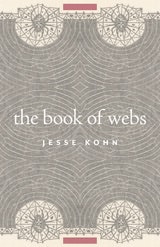
the book of webs
Jesse Kohn
University of Massachusetts Press, 2023
Honorable Mention, 2023 Big Other Readers’ Choice Award
Word spreads from one recovering self-inflicted eye surgery patient to the next of a mystical book capable of overturning the Burlingtonian empire.
Captivating and devious, the book of webs is constructed out of misremembered fragments, conflicting histories, and secrets whispered in the darkness. The insurgents tell of an enemy so powerful it owns the air, dictates reality, and has even managed to co-opt their thoughts. Their only hope is to conspire with the uprisings of their bodies: slips of the tongue, excretions, tics, bad hair days, and, most importantly, their dreams.
In this darkly comic and inventive debut novel, Jesse Kohn introduces a network of shape-shifters and misfits. A militant priestess broods over orphaned angel eggs. A post-punk band animates a messianic homunculus made of belly button lint. A failed dream journalist goes on a terrible first date to heaven. Each misadventure is a chapter in a book devised to oppose the despotic order of their enemy—the book of webs.