Results by title
141 books match the query 'Developing countries' and 9 start with e

EMPIRE REVOLUTION
THE UNITED STATES AND THE THIRD WORLD SIPETER L. & MARY ANN HAHN & HEISS
The Ohio State University Press, 2000
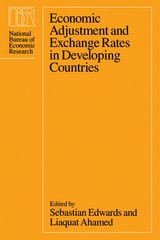
Economic Adjustment and Exchange Rates in Developing Countries
Edited by Sebastian Edwards and Liaquat Ahamed
University of Chicago Press, 1986
The volume, divided into four main sections, addresses: the role of exchange rates in stabilization programs and the adjustment process; the importance of exchange rate policy during liberalization reform in developing countries; exchange rate problems relevant and unique to developing countries, illustrated by case studies; and the problems defining, measuring, and identifying determinants of real exchange rates. Authors of individual papers examine the relation between commercial policies and exchange rates, the role of exchange rate policy in stabilization programs, the effectiveness of devaluations as a policy tool, and the interaction between exchange rate terms of trade an capital flow. This research will not only prove crucial to our understanding of the role of exchange rates in developing countries, but will clearly set the standard for future work in the field.
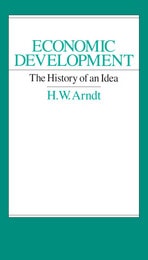
Economic Development
The History of an IdeaH. W. Arndt
University of Chicago Press, 1989
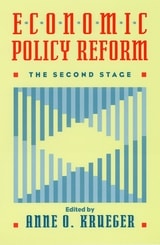
Economic Policy Reform
The Second StageEdited by Anne O. Krueger
University of Chicago Press, 2000
Economic Policy Reform: The Second Stage provides an incisive overview of the context of these crucial second-stage reforms with a thorough examination of the issues confronting the policymakers involved. Edited by Anne O. Krueger, it features studies from distinguished experts in various fields of economics. Each chapter of this book addresses a key issue in economic policy, examines the progress of reforms in the markets considered, and then explores what research might further aid leaders as they embark on fundamental changes.
Both a handbook for economists and practitioners and a theoretical exploration of the most significant challenges currently facing the economic world, this new book will be indispensable to anyone involved in the global economic scene.
Contributors:
Vittorio Corbo
Cimon Cowan
Sebastian Edwards
Stephan Haggard
Michael Kremer
Steven Matusz
Frederic S. Mishkin
Jonathan Morduch
Roger G. Noll
Miguel A. Savastano
T. Paul Shultz
Mary M. Shirley
T.N. Srinivasan
Joseph E. Stiglitz
Vito Tanzi
David Tarr
Aaron Tornell
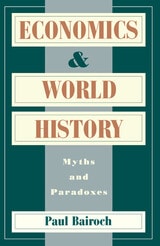
Economics and World History
Myths and ParadoxesPaul Bairoch
University of Chicago Press, 1993
In Economics and World History, Paul Bairoch clearly and succinctly debunks a number of commonly held beliefs about economic history and the causes and consequences of important events around the world. Taking on twenty commonly held misconceptions, including that free trade and population growth have historically led to periods of economic growth; that a move away from free trade caused the Great Depression; and that colonial powers in the nineteenth and early twentieth centuries became rich through the exploitation of the Third World, Bairoch shows in each case where the mistaken belief originated and why deeper knowledge of economics shows it to b wrong. The resulting book is a treasury for free thinkers, a book that will simultaneously clear up mistakes and help readers avoid making new ones.
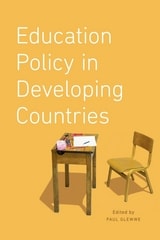
Education Policy in Developing Countries
Edited by Paul Glewwe
University of Chicago Press, 2013
Surveying many aspects of education—from administrative structures to the availability of health care to parent and student incentives—the contributors synthesize an impressive diversity of data, paying special attention to the gross imbalances in educational achievement that still exist between developed and developing countries. They draw out clear implications for governmental policy at a variety of levels, conscious of economic realities such as budget constraints, and point to crucial areas where future research is needed. Offering a wealth of insights into one of the best investments a nation can make, Education Policy in Developing Countries is an essential contribution to this most urgent field.

Eradicating Extreme Poverty
Democracy, Globalisation and Human RightsEdited by Xavier Godinot
Pluto Press, 2012
The failure of attempts to tackle global poverty have bred cynicism and 'compassion fatigue'. Eradicating Extreme Poverty provides an urgently needed fresh approach which will re-energise action on this issue.
Rejecting traditional 'top-down' approaches, Xavier Godinot and his colleagues start from the experiences, capabilities and strategies of the poor themselves. They argue that the first step is a close connection with poor communities followed by a commitment to take action alongside them. Life-stories from Burkina Faso, France, Peru and the Philippines are used to show that the poor must be involved in their own liberation.
After decades of failed development policies, this book outlines a radical new approach which will enliven debate amongst policy-makers, researchers, students and academics.
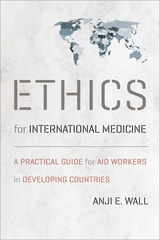
Ethics for International Medicine
A Practical Guide for Aid Workers in Developing CountriesAnji E. Wall
Dartmouth College Press, 2012
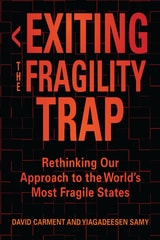
Exiting the Fragility Trap
Rethinking Our Approach to the World’s Most Fragile StatesDavid Carment
Ohio University Press, 2019
State fragility is a much-debated yet underinvestigated concept in the development and international security worlds. Based on years of research as part of the Country Indicators for Foreign Policy project at Carleton University, Exiting the Fragility Trap marks a major step toward remedying the lack of research into the so-called fragility trap. In examining the nature and dynamics of state transitions in fragile contexts, with a special emphasis on states that are trapped in fragility, David Carment and Yiagadeesen Samy ask three questions: Why do some states remain stuck in a fragility trap? What lessons can we learn from those states that have successfully transitioned from fragility to stability and resilience? And how can third-party interventions support fragile state transitions toward resilience?
Carment and Samy consider fragility’s evolution in three state types: countries that are trapped, countries that move in and out of fragility, and countries that have exited fragility. Large-sample empirical analysis and six comparative case studies—Pakistan and Yemen (trapped countries), Mali and Laos (in-and-out countries), and Bangladesh and Mozambique (exited countries)—drive their investigation, which breaks ground toward a new understanding of why some countries fail to see sustained progress over time.