126 books match the query 'Early modern, 1500-1700' and 9 start with e
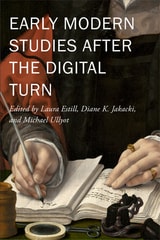
cover of Early Modern Studies after the Digital Turn

Early Modern Studies after the Digital Turn

Edited by Laura Estill, Diane K. Jakacki, Michael Ullyot

Iter Press, 2016
The essays collected in this volume address the digital humanities’ core tensions: fast and slow; surficial and nuanced; quantitative and qualitative. Scholars design algorithms and projects to process, aggregate, encode, and regularize historical texts and artifacts in order to position them for new and further interpretations. Every essay in this book is concerned with the human-machine dynamic, as it bears on early modern research objects and methods. The interpretive work in these pages and in the online projects discussed orients us toward the extensible future of early modern scholarship after the digital turn.
[more]
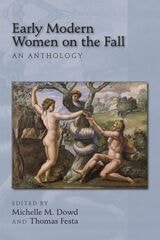
cover of Early Modern Women on the Fall: An Anthology

Early Modern Women on the Fall

An Anthology

Michelle M. Dowd

Arizona Center for Medieval and Renaissance Studies, 2012
[more]
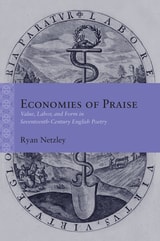
cover of Economies of Praise: Value, Labor, and Form in Seventeenth-Century English Poetry

Economies of Praise

Value, Labor, and Form in Seventeenth-Century English Poetry

Ryan Netzley

Northwestern University Press, 2024

Reevaluates early modern poems of praise as, paradoxically, challenging an artistic economy that values exchange and productivity
 
Early modern poems of praise typically insist that they do not have a purpose or enact real labor beyond their effortless listing of laudable qualities. And yet the poets discussed in this study, including Ben Jonson, Andrew Marvell, Anne Bradstreet, Lucy Hutchinson, and John Milton, hint at an alternative aesthetic economy at work in their verse. Poetic praise, it turns out, might show us a social world outside the organizing principle of exchange.
 
In Economies of Praise: Value, Labor, and Form in Seventeenth‑Century English Poetry, Ryan Netzley explores how poems of praise imagine alternatives to market and gift economies and point instead to a self-contained aesthetic economy that works against a more expansive and productivist understanding of literary art. By depicting exchange as inconsequential, unproductive, and redundant rather than a necessary constituent of social order, these poems model for modern readers a world without the imperative to create, appraise, and repeatedly demonstrate one’s own value.
[more]
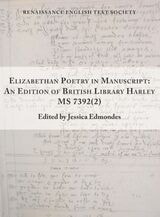
cover of Elizabethan Poetry in Manuscript: An Edition of British Library Harley MS 7392(2)

Elizabethan Poetry in Manuscript

An Edition of British Library Harley MS 7392(2)

Edited by Jessica Edmondes

Iter Press, 2022

This volume presents the first printed edition of a late sixteenth-century poetic miscellany and provides invaluable insight into understanding the literature of the period. Its owner and principal scribe, Humfrey Coningsby, drew on texts circulating in manuscript , predominantly by contemporary writers of the time—including Philip Sidney, Edward Dyer, Arthur Gorges, Walter Ralegh, Elizabeth I, the Earl of Oxford, Nicholas Breton, George Peele, and Thomas Watson. Coningsby also added at least two of his own compositions, along with anonymous poems not found in any other manuscripts or printed books.

This edition preserves the appearance, spelling, and punctuation of the original manuscript while expanding antiquated contractions to provide an easily readable text. Textual notes appear on the page, and in-depth contextual notes and word glosses are provided in the commentary section. The analyses add to our knowledge of early modern manuscript culture and literary manuscript transmission, and a substantial introduction provides context for the compilation of the anthology.
[more]
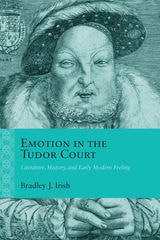
cover of Emotion in the Tudor Court: Literature, History, and Early Modern Feeling

Emotion in the Tudor Court

Literature, History, and Early Modern Feeling

Bradley J. Irish

Northwestern University Press, 2018

Deploying literary analysis, theories of emotion from the sciences and humanities, and an archival account of Tudor history, Emotion in the Tudor Court examines how literature both reflects and constructs the emotional dynamics of life in the Renaissance court. In it, Bradley J. Irish argues that emotionality is a foundational framework through which historical subjects embody and engage their world, and thus can serve as a fundamental lens of social and textual analysis.

Spanning the sixteenth century, Emotion in the Tudor Court explores Cardinal Thomas Wolsey and Henrician satire; Henry Howard, Earl of Surrey, and elegy; Sir Philip Sidney and Elizabethan pageantry; and Robert Devereux, Earl of Essex, and factional literature. It demonstrates how the dynamics of disgust,envy, rejection, and dread, as they are understood in the modern affective sciences, can be seen to guide literary production in the early modern court.

By combining Renaissance concepts of emotion with modern research in the social and natural sciences, Emotion in the Tudor Court takes a transdisciplinary approach to yield fascinating and robust ways to illuminate both literary studies and cultural history. 
[more]
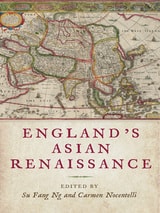
cover of England's Asian Renaissance

England's Asian Renaissance

Su Fang Ng

University of Delaware Press, 2022

England's Asian Renaissance explores how Asian knowledges, narratives, and customs inflected early modern English literature. Just as Asian imports changed England's tastes and enriched the English language, Eastern themes, characters, and motifs helped shape the country's culture and contributed to its national identity. Questioning long-standing dichotomies between East and West and embracing a capacious understanding of translatio as geographic movement, linquistic transformation, and cultural grafting, the collection gives pride of place to convergence, approximation, and hybridity, thus underscoring the radical mobility of early modern culture. In so doing, England's Asian Renaissance also moves away from entrenched narratives of Western cultural sovereignty to think anew England's debts to Asia.

Published by the University of Delaware Press. Distributed worldwide by Rutgers University Press.
[more]
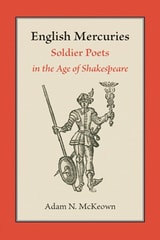
cover of English Mercuries: Soldier Poets in the Age of Shakespeare

English Mercuries

Soldier Poets in the Age of Shakespeare

Adam N. McKeown

Vanderbilt University Press, 2009

English Mercuries examines war and literature through the writings of veterans who came home from their deployments to pursue literary careers. From their often neglected writings emerges a new picture of the Elizabethan world at war. For centuries Elizabethan England has been characterized by booming patriotism and martial energy, and the literature of this period, epitomized in works like Shakespeare's Henry V, has been seen as celebrating a proud and defiant kingdom unified around its wars with Spain. Beneath this patriotic veneer, however, was a country withering under the costs of seemingly endless military commitments and ripped apart by doubts about the purpose of war and mistrust of state officials who advanced their own political interests through war at the expense of the people who had to fight and pay for it.

These misgivings are a powerful undercurrent in much of the literature of the period, even the most ostensibly patriotic works, but it is in the writings on war by soldier poets where they are most clearly pronounced. Fashioning themselves as servants of both Mars and Mercury (the god of war and the god of writing), Elizabethan soldier poets focused their war stories on the gritty realities of military campaigning, the price individuals paid for serving the state, and the difficulties of returning to civilian life. The book reconsiders some familiar writers like John Donne and Ben Jonson in the context of their military experiences and provides comprehensive studies of some important but underappreciated soldier poets like Thomas Churchyard, George Gascoigne, and John Harington.
[more]
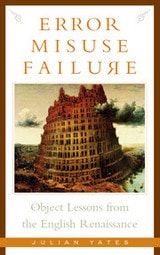
cover of Error, Misuse, Failure: Object Lessons From The English Renaissance

Error, Misuse, Failure

Object Lessons From The English Renaissance

Julian Yates

University of Minnesota Press, 2002
Explores what an object tells us about the culture that created it. If certain objects work well, no one notices them. As with "black boxes," their success may be gauged by their relative invisibility-and this was the indirect goal of the objects that Julian Yates considers here: the portrait miniature, the relic, the privy (flush toilet), the printed text, and the priest-hole (a secret hiding place for Catholic priests in Protestant England). Because each of these contrivances was prone to error, misuse, and sometimes catastrophic failure, they become in Yates's analysis an occasion for recasting the history of the English Renaissance as object lessons-"knowing from the point of view of the known." It is through such lapses-the texts and stories generated to explain away a relic that is too easily faked, a miniature that is too curiously real, the stench of a failing privy, a book that persistently sheds its pages, or the presence of so much "papist trash" in an ostensibly reformed England-that Yates recovers the silent work of "things" in cultural production. Drawing object lessons from failing technological devices, Error, Misuse, Failure plumbs the foundations of Renaissance culture in England, recovering a curious language of mistakes, dirt, and parasitism that associates the failures of these "things" with the figures of Rome, Catholicism, and Sodom. Yates offers a mode of historical inquiry rooted in material culture, sensitive to the way humans induct nonhumans (animals, plants, and manufactured things) into their communities. Historically, the book offers a new set of stories about the rise of printing, the development of domestic architecture, and England's Catholic community-stories that remind readers of the ways in which attending to the history of nonhumans requires a radical rethinking of historical landmarks and boundaries. Julian Yates is associate professor of English at the University of Delaware.
[more]
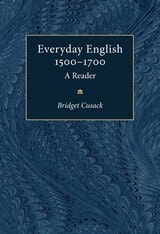
cover of Everyday English 1500-1700: A Reader

Everyday English 1500-1700

A Reader

Bridget Cusack, Editor

University of Michigan Press, 1998

What kind of language did ordinary men and women use in the seventeenth century? Everyday English 1500-1700 addresses this question by bringing together and explaining more than sixty nonliterary texts from the early modern period, ranging from witnesses' depositions to church wardens' accounts, and from letters and journals to constables' presentments and scurrilous abuse shouted in the marketplace.
This unique source book of essential documents designed for courses on Early Modern English is designed as a teaching text with full guidance to each text, including glossary, explanatory and background notes, and suggested topics for linguistic evaluation. Everyday English takes an up-to-the-minute approach by focusing on language as it was used and spoken at the time.
This wide-ranging collection for the first time makes available to students a corpus of examples of the ordinary, nonstandard language of the man and woman in the street, coming from areas as diverse as England, Scotland, and America. The emphasis throughout is on providing as much assistance as possible to the reader to aid understanding and appreciation of both the linguistic features and the everyday lifestyles of the time.
"The only book a really conscientious teacher of the history and structure of Early Modern English would use for source texts." --Roger Lass, University of Cape Town
Bridget Cusack was lecturer in English Language, University of Edinburgh.
[more]