347 books match the query 'Early works to 1800' and 6 start with e
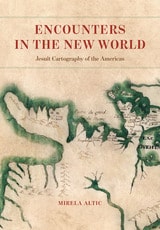
cover of Encounters in the New World: Jesuit Cartography of the Americas

Encounters in the New World

Jesuit Cartography of the Americas

Mirela Altic

University of Chicago Press, 2022

Analyzing more than 150 historical maps, this book traces the Jesuits’ significant contributions to mapping and mapmaking from their arrival in the New World.

In 1540, in the wake of the tumult brought on by the Protestant Reformation, Saint Ignatius of Loyola founded the Society of Jesus, also known as the Jesuits. The Society’s goal was to revitalize the faith of Catholics and to evangelize to non-Catholics through charity, education, and missionary work. By the end of the century, Jesuit missionaries were sent all over the world, including to South America. In addition to performing missionary and humanitarian work, Jesuits also served as cartographers and explorers under the auspices of the Spanish, Portuguese, and French crowns as they ventured into remote areas to find and evangelize to native populations.

In Encounters in the New World, Mirela Altic analyzes more than 150 of their maps, most of which have never previously been published. She traces the Jesuit contribution to mapping and mapmaking from their arrival in the New World into the post-suppression period, placing it in the context of their worldwide undertakings in the fields of science and art. Altic’s analysis also shows the incorporation of indigenous knowledge into the Jesuit maps, effectively making them an expression of cross-cultural communication—even as they were tools of colonial expansion. This ambiguity, she reveals, reflects the complex relationship between missions, knowledge, and empire. Far more than just a physical survey of unknown space, Jesuit mapping of the New World was in fact the most important link to enable an exchange of ideas and cultural concepts between the Old World and the New.
[more]
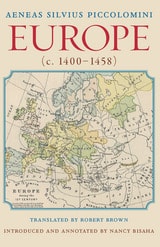
cover of Europe (c.1400-1458)

Europe (c.1400-1458)

Aeneas Silvius Piccolomini

Catholic University of America Press, 2013
This popular text circulated widely in manuscript form and was printed in several editions between the late 15th and the early 18th centuries, in Latin, German, and Italian. The present volume represents the first time this work has been translated into English, bringing its colorful narrative to the attention of a wider audience. This edition also provides extensive footnotes, an appendix of rulers, and a lengthy introduction to Aeneas?s life and the context and relevance of this work.
[more]
cover of Evagrius's Kephalaia Gnostika: A New Translation of the Unreformed Text from the Syriac

Evagrius's Kephalaia Gnostika

A New Translation of the Unreformed Text from the Syriac

Ilaria L.E. Ramelli

SBL Press, 2015

A new English translation for scholars and students of church history

Evagrius exerted a striking impact on the development of spirituality, of Origenism, and of the spiritual interpretation of the Bible in Greek, Syriac, and Latin Christianity. This English translation of the most complete Syriac version of Kephalaia Gnostika makes Evagrius Ponticus's thoughts concerning reality, God, protology, eschatology, anthropology, and allegorical exegesis of Scripture widely available.

Features:

  • English translation of the longer Syriac version discovered by Antoine Guillaumont
  • Commentary provides an integrated analysis of Evagrius's ascetic and philosophical writings
  • Extensive introduction on the importance of Evagrius and the context of his writings
[more]
cover of Exegetical Epistles

Exegetical Epistles

Thomas P. Jerome

Catholic University of America Press, 2023
The Nicene and Post-Nicene Fathers series of the 19th century rendered into English many of Jerome’s treatises and letters while bypassing his biblical commentaries as well as some of his most important exegetical letters. This omission, which was not helpful to scholarship, was probably due to the great length of these works. Although the problem was partly remedied by some new English translations of the 20th century, the present volume fills a significant lacuna by translating into English the Scriptural exegesis that Jerome conveyed in his relatively unknown epistles, many of which were composed in response to queries he had received from various correspondents. Many of these letters are presented here for the first time in English. Based on the Hilberg edition, this volume contains new translations, introduced and annotated, of Jerome’s Epistles 18-21, 25-30, 34-37, 42, 53, 55-56, 59, 64-65, 72-74, 78, 85, 106, 112, 119-121, 129, 130, and 140. Two newly translated letters from the famous exchange with Augustine over the meaning of Galatians 2:11-14 are included (Epp. 56 and 112), as well as a new rendering of Ep. 130 to Demetrias (which technically is not an “exegetical” letter but does present important information about the Pelagian controversy). Overall, this collection hopes to serve as a useful introduction to Jerome’s approach to biblical interpretation, of both the Old and the New Testament. Some letters focus on the historical meaning of Pauline and Gospel texts, while others contain allegorical expositions of Old Testament passages. Jerome’s competence as a Hebrew scholar will become evident to the reader of this volume as well as his thorough acquaintance with the antecedent Greek and Latin Christian exegetical traditions.
[more]
cover of Exhortations to Women and to Others If They Please

Exhortations to Women and to Others If They Please

Lucrezia Marinella

Iter Press, 2012

With this translation of Marinella’s Exhortations to Women and to Others if They Please we can now read another crucial text from her extensive body of work, one that signals a radical ideological shift from her best known text, The Nobility and Excellence of Women; we can thus enjoy a fuller picture of the author and her opinions. Only three copies of Exhortations have been located in any library, and in the absence of a critical edition this translation will prove to be a point of reference for scholars and students alike. Benedetti’s thorough introduction situates Marinella and her works within early seventeenth-century Venetian culture and the Counter-Reformation more broadly, in a way that is profoundly influenced by philology and is also theoretically sound.
—Maria Galli Stampino
Associate Professor of French and Italian
University of Miami
[more]
cover of Exposition of the Apocalypse

Exposition of the Apocalypse

Tyconius Tyconius of Carthage

Catholic University of America Press, 2017

The Exposition of the Apocalypse by Tyconius of Carthage (fl. 380) was pivotal in the history of interpretation of the Book of Revelation. While expositors of the second and third centuries viewed the Apocalypse of John, or Book of Revelation, as mainly about the time of Antichrist and the end of the world, in the late fourth century Tyconius interpreted John’s visions as figurative of the struggles facing the Church throughout the entire period between the Incarnation and the Second Coming of Christ. Tyconius’s “ecclesiastical” reading of the Apocalypse was highly regarded by early medieval commentators like Caesarius of Arles, Primasius of Hadrumetum, Bede, and Beatus of Liebana, who often quoted from Tyconius’s Exposition in their own Apocalypse commentaries. Unfortunately no complete manuscript of the Exposition by Tyconius has survived. A number of recent scholars, however, believed that a large portion of his Exposition could be reconstructed from citations of it in the aforementioned early medieval writers; and this task was undertaken by Monsignor Roger Gryson. Gryson’s edition, a reconstruction of the Expositio Apocalypseos of Tyconius, was published in 2011 in Corpus Christianorum Series Latina. The present translation of that reconstructed text, with introduction and notes, exhibits Tyconius’s unique non-apocalyptic approach to the Book of Revelation. It also shows that throughout the Exposition Tyconius made use of interpretive rules that he had laid out in an earlier work on hermeneutics, the Book of Rules, strongly suggesting that Tyconius wrote his Exposition as a companion to his Book of Rules. Thus, the Exposition served as an exemplar of how those rules would apply to interpretation of even the most intriguing of biblical texts, the Apocalypse.
[more]