Results by title
94 books match the query 'Economy' and 15 start with e
Earth in Our Care
Ecology, Economy, and SustainabilityMaser, Chris
Rutgers University Press, 2009
So writes Chris Maser in this compelling study of three interactive spheres of the ecosystem: atmosphere (air), litho-hydrosphere (rock that comprises the restless continents and the water that surrounds them), and biosphere (all life sandwiched in between).
Rich in detail and insightful analogies, Earth in Our Care addresses key issues including land-use policies, ecological restoration, forest management, local living, and sustainability thinking. Exploring our interconnectedness with the Earth, Maser examines today's problems and, more importantly, provides solutions for the future.

Ecocritique
Contesting the Politics of Nature, Economy, and CultureTimothy W. Luke
University of Minnesota Press, 1997
Ecocriticism, whether coming from “back to nature” conservatives, Nature Conservancy liberals, or Earth First! radicals, is familiar enough. But when we listen do we really hear what these groups are saying? In a book that examines the terms of ecocriticism, Timothy W. Luke exposes how ecological critics, organizations, and movements manipulate our conception of the environment. Turning the tables on the ecocritics, Luke demonstrates how ecocriticism can move beyond its familiar confines to engage larger cultural, economic, and political questions.
Ecocritique rereads ecocriticism to reveal how power and economy, society and culture, community and technology compete over what are now widely regarded as the embattled ecosystems of nature. Luke considers in particular how the meanings and values attached to the environment by various groups—from the Worldwatch Institute, the Nature Conservancy, and Earth First! to proponents of green consumerism, social ecology, and sustainable development—articulate new visions of power and subjectivity for a post-Cold War era.
This accessibly written work opens with deep ecology and concludes with social ecology, along the way reconsidering thinkers with green philosophical leanings, including Herbert Marcuse, Paolo Soleri, and Murray Bookchin. In systematic critiques reexamining the cultural practices and ethical values of contemporary environmentalism, Luke highlights the political dilemmas of biocentrism and anthropocentrism in modern ecological thinking.
With its critical analysis of many contemporary environmental discourses and organizations, Ecocritique makes a major contribution to ongoing debates about the political relationships among nature, culture, and economics in the current global system.
Economy and Interest
A New Presentation of the Fundamental Problems Related to the Economic Role of the Rate of Interest and Their SolutionsMaurice Allais
University of Chicago Press, 2024
The essential work from the Nobel Prize-winning virtuoso of twentieth-century economics, translated to English for the first time.
Few scholars advanced the frontier of economic modeling more than French economist Maurice Allais. Allais’s contributions—beyond his famous Allais’s Paradox—earned him the Nobel Prize and drew comparisons to the works of Paul Samuelson and even some modern mathematical behavioral economists.
Allais’s accomplishments, however, went largely unread by non-Francophone readers due to the challenge of their translation for publishers. The effects of this gap are immeasurable. As Paul Samuelson wrote, “Had Allais's earliest writings been in English, a whole generation of economic theory would have taken a different course.”
Economy and Interest is the milestone translation of Allais's most influential work, one whose staggering findings predate their accepted formulations by other famed economists decades later. In its sweep and technical virtuosity, Economy and Interest is certain to delight and challenge new generations of English-language readers.
Economy and Society in Baroque Portugal, 1668-1703
Carl A. Hanson
University of Minnesota Press, 1981
Economy and Society in Baroque Portugal, 1668–1703 was first published in 1981. Minnesota Archive Editions uses digital technology to make long-unavailable books once again accessible, and are published unaltered from the original University of Minnesota Press editions.
The late seventeenth century in Portugal was a period of apparent calm, and few historians have given it much attention. Portugal's Golden Age of worldwide expansion had made sixteenth-century Lisbon a great commercial center, but other European nations with more advanced economies surpassed Portugal's achievement, and during the seventeenth century agricultural, economic, and political problems all contributed to Portugal's decline. In 1668, at the conclusion of a long war with Spain to restore Portuguese sovereignty, Pedro II began a reign of 38 years, first as regent for a feckless brother ad after 1683 as king. The history of Portugal during his reign is the subject of this book.
Carl A. Hanson looks at this relatively unexamined era and finds, behind the facade of baroque calm, subtle but dramatic shifts in the socio-economic foundations of the age. In an effort to cope with economic depression Pedro's government hearkened to enthusiastic reports of Colbert's mercantile policies in France, and tried to encourage the expansion of domestic manufacturing. Linked to these efforts were attempts to curb the inquisitorial persecution of New Christian merchants. Hanson explores the motives of anti-Semitism, greed and class warfare that underlay the persecution and describes the efforts of an eloquent Jesuit, Father Antonio Vieira, to protect the New Christians from the worst excesses of the Inquisition.
The triumph of the Inquisition, and thus of the established social order, and the failure of Portugal's experiment in mercantilism coincided with a new wave of commodity-borne prosperity. After 1690, increased exports of Brazilian gold, tobacco, hides, and sugar, and of Port wine changed Portugal's economic status. With the signing of the Anglo- Portuguese treaty of Methuen in 1703, Portugal entered a gilded—if not golden—age. Yet, as Hanson makes clear, the new prosperity was deceptive, for Portugal was to slip into increasingly dependent relationships with the more advanced economies — especially England's—which absorbed great quantities of Luso-Atlantic commodities in exchange for its own manufactures. And, at home, the victorious social order, no longer threatened by a mercantile class, was to find security under an increasingly absolutist government. The reign of Pedro II is significant, then, as a period of transition when, for the first time, the foundations of the old order were threatened. The baroque facade survived but the edifice itself had begun to crumble.
Economy and the Future
A Crisis of FaithJean-Pierre Dupuy
Michigan State University Press, 2014
Economy of Words
Communicative Imperatives in Central BanksDouglas R. Holmes
University of Chicago Press, 2013
Holmes examines the New York District Branch of the Federal Reserve, the European Central Bank, Deutsche Bundesbank, and the Bank of England, among others, and shows how officials there have created a new monetary regime that relies on collaboration with the public to achieve the ends of monetary policy. Central bankers, Holmes argues, have shifted the conceptual anchor of monetary affairs away from standards such as gold or fixed exchange rates and toward an evolving relationship with the public, one rooted in sentiments and expectations. Going behind closed doors to reveal the intellectual world of central banks,Economy of Words offers provocative new insights into the way our economic circumstances are conceptualized and ultimately managed.
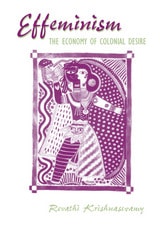
Effeminism
The Economy of Colonial DesireRevathi Krishnaswamy
University of Michigan Press, 2011

Effeminism
The Economy of Colonial DesireRevathi Krishnaswamy
University of Michigan Press, 1999
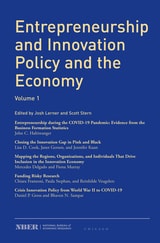
Entrepreneurship and Innovation Policy and the Economy
Volume 1Edited by Josh Lerner and Scott Stern
University of Chicago Press Journals, 2022
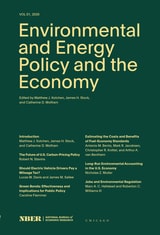
Environmental and Energy Policy and the Economy
Volume 1Edited by Matthew J. Kotchen, James H. Stock, and Catherine D. Wolfram
University of Chicago Press Journals, 2020
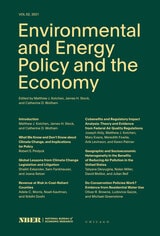
Environmental and Energy Policy and the Economy
Volume 2Edited by Matthew J. Kotchen, James H. Stock, and Catherine D. Wolfram
University of Chicago Press Journals, 2020
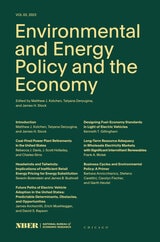
Environmental and Energy Policy and the Economy
Volume 3Edited by Matthew J. Kotchen, Tatyana Deryugina, and James H. Stock
University of Chicago Press Journals, 2022
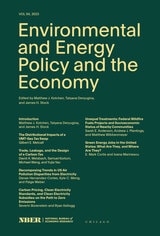
Environmental and Energy Policy and the Economy
Volume 4Edited by Matthew J. Kotchen, Tatyana Deryugina, and James H. Stock
University of Chicago Press Journals, 2023
Environmental and Energy Policy and the Economy focuses on the effective and efficient management of environmental and energy challenges. Research papers offer new evidence on the intended and unintended consequences, the market and nonmarket effects, and the incentive and distributional impacts of policy initiatives and market developments.
This volume presents six new papers on environmental and energy economics and policy. Gilbert Metcalf examines the distributional impacts of substituting a vehicle miles-traveled tax for the existing federal excise tax in the United States. David Weisbach, Samuel Kortum, Michael Wang, and Yujia Yao consider solutions to the leakage problem of climate policy with differential tax policies on the supply and demand for fossil fuels and on domestic production and consumption. Danae Hernandez-Cortes, Kyle Meng, and Paige Weber quantify and decompose recent trends in air pollution disparities in the US electricity sector. Severin Borenstein and Ryan Kellogg provide a comparative analysis of different incentive-based mechanisms to reduce emissions in the electricity sector on a path to zero emissions. Sarah Anderson, Andrew Plantinga, and Matthew Wibbenmeyer document distributional differences in the allocation of US wildfire prevention projects. Finally, Mark Curtis and Ioana Marinescu provide new evidence on the quality and quantity of emerging “green” jobs in the United States.
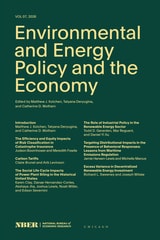
Environmental and Energy Policy and the Economy
Volume 7Edited by Matthew J. Kotchen, Tatyana Deryugina, and Catherine D. Wolfram
University of Chicago Press Journals, 2026
Rigorous, careful, and nonpartisan research with a high policy impact on environmental and energy economics.
Environmental and Energy Policy and the Economy focuses on the effective and efficient management of environmental and energy challenges. Research papers offer new evidence on the intended and unintended consequences, the market and nonmarket effects, and the incentive and distributional impacts of policy initiatives and market developments.
This volume presents six new papers on environmental and energy economics and policy. Judson Boomhower and Meredith Fowlie illustrate the distributional consequences of improving risk pricing efficiency in wildfire insurance markets. Claire Brunel and Arik Levinson develop a conceptual framework for understanding the economic and environmental consequences of taxes on imports of goods based on their carbon content. Karen Clay, Danae Hernandez-Cortes, Akshaya Jha, Joshua Lewis, Noah Miller, and Edson Severnini study the long-run distributional implications of US power plant sitings over more than a century. Todd Gerarden, Mar Reguant, and Daniel Xu provide a comprehensive overview of industrial policy in the renewable energy sector, with comparisons across the US, EU, and China. Jamie Hansen-Lewis and Michelle Marcus show how failure to account for behavioral responses can affect policy predictions regarding maritime emissions. Finally, Richard Sweeney and Joseph Wilske estimate the externalities associated with correlated intermittency in electricity generation from US wind power investments.
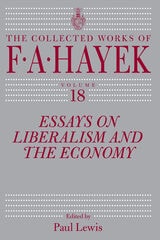
Essays on Liberalism and the Economy, Volume 18
F. A. Hayek
University of Chicago Press, 2022
Across seventeen volumes to date, the University of Chicago Press’s Collected Works of F. A. Hayek series has anthologized the diverse and prolific writings of the Austrian economist synonymous with classical liberalism. Essays on Liberalism and the Economy traces the author’s long and evolving writings on the cluster of beliefs he championed most: liberalism, its core tenets, and how its tradition represents the best hope for Western civilization.
This volume contains material from almost the entire span of Hayek’s career, the earliest from 1931 and the last from 1984. The works were written for a variety of purposes and audiences, and they include—along with conventional academic papers—encyclopedia entries, after-dinner addresses, a lecture for graduate students, a book review, newspaper articles, and letters to the editors of national newspapers. While many are available elsewhere, two have never appeared in print, and two others have not been published in English.
The varied formats collected here are enriched by Hayek’s changing voice at different stages of his life. Some of the pieces resonate as high-minded and noble; some are meant as cuts to “intellectuals” (a pejorative term when used by Hayek) like Keynes and Galbraith. All serve to distill important threads of his worldview.