Results by title
115 books match the query 'Elections' and 11 start with e
EXPRESSIVE POLITICS
ISSUE STRATEGIES OF CONGRESSIONAL CHALLENGERSROBERT G. BOATRIGHT
The Ohio State University Press, 2004
This research makes two types of contributions to existing political science literature. On a theoretical level, it argues for a reconceptualization of the motives of candidates and parties in rational choice analysis. On a practical level, it seeks to enrich our understanding of the role that challengers play in American elections and of the reason why different types of challengers emerge in different types of elections. Boatright argues that the role of challengers in the American electoral process can be understood only if we broaden our theories about rational candidate behavior.
Economics and Elections
The Major Western DemocraciesMichael S. Lewis-Beck
University of Michigan Press, 1990
Economics and Politics
The Calculus of SupportHelmut Norpoth, Michael S. Lewis-Beck, and Jean-Dominique Lafay, Editors
University of Michigan Press, 1991
Elections and Political Order in Russia
Peter Lentini
Central European University Press, 1995
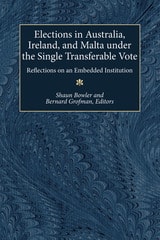
Elections in Australia, Ireland, and Malta under the Single Transferable Vote
Reflections on an Embedded InstitutionShaun Bowler and Bernard Grofman, Editors
University of Michigan Press, 2000
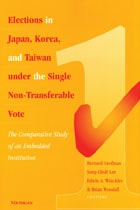
Elections in Japan, Korea, and Taiwan under the Single Non-Transferable Vote
The Comparative Study of an Embedded InstitutionBernard Grofman, Sung-Chull Lee, Edwin A. Winckler, and Brian Woodall, Editors
University of Michigan Press, 1999
Electoral Democracy
Michael B. MacKuen and George Rabinowitz, Editors
University of Michigan Press, 2003
Michael B. MacKuen is Burton Craige Professor of Political Science at the University of North Carolina. George Rabinowitz is Burton Craige Professor of Political Science at the University of North Carolina.
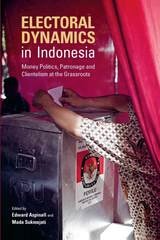
Electoral Dynamics in Indonesia
Money Politics, Patronage and Clientelism at the GrassrootsEdited by Edward Aspinall and Mada Sukmajati
National University of Singapore Press, 2016
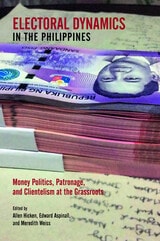
Electoral Dynamics in the Philippines
Money Politics, Patronage and Clientelism at the GrassrootsEdited by Allen Hicken, Edward Aspinall, and Meredith Weiss
National University of Singapore Press, 2019
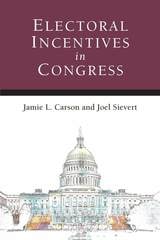
Electoral Incentives in Congress
Jamie L. Carson and Joel Sievert
University of Michigan Press, 2018
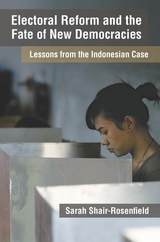
Electoral Reform and the Fate of New Democracies
Lessons from the Indonesian CaseSarah Shair-Rosenfield
University of Michigan Press, 2019
When and why do democratic political actors change the electoral rules, particularly regarding who is included in a country’s political representation? The incidences of these major electoral reforms have been on the rise since 1980.
Electoral Reform and the Fate of New Democracies argues that elite inexperience may constrain self-interest and lead elites to undertake incremental approaches to reform, aiding the process of democratic consolidation. Using a multimethods approach, the book examines three consecutive periods of reform in Indonesia, the world’s largest Muslim majority country and third largest democracy, between 1999 and 2014. Each case study provides an in-depth process tracing of the negotiations leading to new reforms, including key actors in the legislature, domestic civil society, international experts, and government bureaucrats. A series of counterfactual analyses assess the impact the reforms had on actual election outcomes, versus the possible alternative outcomes of different reform options discussed during negotiations. With a comparative analysis of nine cases of iterated reform processes in other new democracies, the book confirms the lessons from the Indonesian case and highlights key lessons for scholars and electoral engineers.