78 books match the query 'Emergence' and 4 start with e

cover of E.B. White: The Emergence of an Essayist

E.B. White

The Emergence of an Essayist

Robert L., Jr. Root

University of Iowa Press, 1999
In E. B. White: The Emergence of an Essayist, Robert Root traces the literary career of the best-known and most widely admired American essayist of the twentieth century.
Root explores the milieu in which White began writing the "Notes and Comments" section of the New Yorker and puts in perspective the influence of popular "colyumists" like Don Marquis and Christopher Morley on the tone and form of White's work as a "paragrapher." He examines White's persistent disaffection with the demands and limitations inherent in his "Comment" pieces for the New Yorker and his experiences as a columnist for Harper's Magazine, where his "One Man's Meat" feature produced his most enduring essay, "Once More to the Lake," and took the segmented column form to new levels of accomplishment. Drawing on White's manuscripts, Root's literary analysis of early drafts demonstrates how unique White's essays were.
E. B. White greatly expanded the limits of literary nonfiction and in the process introduced elements and methods that helped produce the contemporary segmented or disjunctive essay. From Root's research we receive new insights into the process by which White created his essays and how he was influenced—and often constrained—by particular literary forms and by the limitations of the circumstances in which he wrote them. White was famous for his habit of "writing by ear," and he believed in "writing a thing first and thinking about it afterward," work habits that led to some of the most memorable American literary essays of the twentieth century.
E. B. White: The Emergence of an Essayist is the most detailed study to date of White as an essayist and a significant contribution to the literature examining writers at work.
[more]
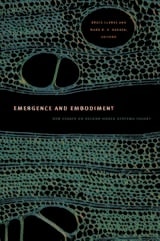
cover of Emergence and Embodiment: New Essays on Second-Order Systems Theory

Emergence and Embodiment

New Essays on Second-Order Systems Theory

Bruce Clarke and Mark B. N. Hansen, eds.

Duke University Press, 2009

Emerging in the 1940s, the first cybernetics—the study of communication and control systems—was mainstreamed under the names artificial intelligence and computer science and taken up by the social sciences, the humanities, and the creative arts. In Emergence and Embodiment, Bruce Clarke and Mark B. N. Hansen focus on cybernetic developments that stem from the second-order turn in the 1970s, when the cyberneticist Heinz von Foerster catalyzed new thinking about the cognitive implications of self-referential systems. The crucial shift he inspired was from first-order cybernetics’ attention to homeostasis as a mode of autonomous self-regulation in mechanical and informatic systems, to second-order concepts of self-organization and autopoiesis in embodied and metabiotic systems. The collection opens with an interview with von Foerster and then traces the lines of neocybernetic thought that have followed from his work.

In response to the apparent dissolution of boundaries at work in the contemporary technosciences of emergence, neocybernetics observes that cognitive systems are operationally bounded, semi-autonomous entities coupled with their environments and other systems. Second-order systems theory stresses the recursive complexities of observation, mediation, and communication. Focused on the neocybernetic contributions of von Foerster, Francisco Varela, and Niklas Luhmann, this collection advances theoretical debates about the cultural, philosophical, and literary uses of their ideas. In addition to the interview with von Foerster, Emergence and Embodiment includes essays by Varela and Luhmann. It engages with Humberto Maturana’s and Varela’s creation of the concept of autopoiesis, Varela’s later work on neurophenomenology, and Luhmann’s adaptations of autopoiesis to social systems theory. Taken together, these essays illuminate the shared commitments uniting the broader discourse of neocybernetics.

Contributors. Linda Brigham, Bruce Clarke, Mark B. N. Hansen, Edgar Landgraf, Ira Livingston, Niklas Luhmann, Hans-Georg Moeller, John Protevi, Michael Schiltz, Evan Thompson, Francisco J. Varela, Cary Wolfe
[more]
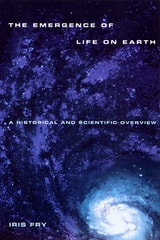
cover of Emergence of Life on Earth: A Historical and Scientific Overview

Emergence of Life on Earth

A Historical and Scientific Overview

Fry, Iris

Rutgers University Press, 2000

How did life emerge on Earth? Is there life on other worlds? These questions, until recently confined to the pages of speculative essays and tabloid headlines, are now the subject of legitimate scientific research. This book presents a unique perspective--a combined historical, scientific, and philosophical analysis, which does justice to the complex nature of the subject. The book's first part offers an overview of the main ideas on the origin of life as they developed from antiquity until the twentieth century. The second, more detailed part of the book examines contemporary theories and major debates within the origin-of-life scientific community.
Topics include:
  • Aristotle and the Greek atomists' conceptions of the organism
  • Alexander Oparin and J.B.S. Haldane's 1920s breakthrough papers
  • Possible life on Mars?
[more]
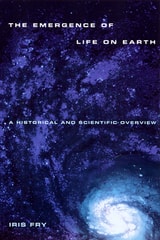
cover of Emergence of Life on Earth: A Historical and Scientific Overview

Emergence of Life on Earth

A Historical and Scientific Overview

Fry, Iris

Rutgers University Press, 2000

"Essential reading for people in disciplines ranging from philosophy to biology. It is simply the best general book that I know on the question of the origin of life."
--Michael Ruse, author of Mystery of Mysteries: Is Evolution a Social Construction?

"Fry has fashioned a masterful account of the history, philosophy, and science of the origin of life and the possibility of extraterrestrial life. Her story weaves profound Western ideas of who we are and where we came from, from Aristotle to Gould, from Kant to NASA."
--Woodruff Sullivan, University of Washington

"A rich source for the specialist and thought-provoking reading for the lay person."
--Gunter Wachtershauser, University of Regensburg, Germany

How did life emerge on Earth? Is there life on other worlds? These questions, until recently confined to the pages of speculative essays and tabloid headlines, are now the subject of legitimate scientific research. This book presents a unique perspective--a combined historical, scientific, and philosophical anaylsis, which does justice to the complex nature of the subject. The book's first part offers an overview of the main ideas on the origin of life as they developed from antiquity until the twentieth century. The second, more detailed part of the book examines contemporary theories and major debates within the origin-of-life scientific community.

Topics include:
- Aristotle and the Greek atomists' conceptions of the organism
- Alexander Oparin and J.B.S. Haldane's 1920s breakthrough papers
- Possible life on Mars?
[more]