Results by title
403 books match the query 'Journalism' and 25 start with a
A Century of Repression
The Espionage Act and Freedom of the PressRalph Engelman and Carey Shenkman
University of Illinois Press, 2022
A Gift of Meaning
Bill Tammeus
University of Missouri Press, 2001
Because of the peculiar momentary nature of journalism, not every column can stand the test of time. But many—even those about events nearly gone from the public consciousness--contain lasting truths. A Gift of Meaning is a collection of those lasting truths from Bill Tammeus, a columnist for the Kansas City Star.
Each piece reveals Tammeus's attempt to wrestle eternal meaning from the events and experiences that sweep us along day by day.
I stopped by a homeless shelter the other day to see someone I know. As I waited, I felt rather conspicuous in my suit and tie. In fact, the friendly man at the information desk asked me if I was a pastor. I chuckled.
But as I sat in the lobby waiting to see the man I came to check on, I was struck again by what may be the most difficult of all human tasks: empathy. That is, the challenge of really putting ourselves in the shoes of others.
In the end, A Gift of Meaning is not just a presentation of found meaning, but also a call to readers to stop and think for themselves. This book is an invitation to breathe deeply and seek out the meaning of what the world heaves at us each day. It is an offering of insights that will provide fresh ways of comprehending things readers thought they already understood.
A History of American Literary Journalism
The Emergence of a Modern Narrative FormJohn C. Hartsock
University of Massachusetts Press, 2000
During the 1960s, such works as Truman Capote's In Cold Blood and Joan Didion's Slouching Towards Bethlehem were cited as examples of the “new journalism.” True stories that read like novels, they combined the journalist's task of factual reporting with the art of fictional narration.
Yet as John C. Hartsock shows in this revealing study, the roots of this distinctive form of writing—whether called new journalism, literary journalism, or creative nonfiction—can be traced at least as far back as the late nineteenth century. In the decades following the American Civil War, Stephen Crane, Lafcadio Hearn, and other journalists challenged the notion, then just emerging, that the reporter's job was to offer a concise statement of the “objective truth.” Drawing on the techniques of the realistic novel, these writers developed a new narrative style of reporting aimed at lessening the distance between observer and observed, subject and object.
By the 1890s, Hartsock argues, literary journalism had achieved critical recognition as a new form of writing, different not only from “objective” reporting but also from the sensationalistic “yellow press” and at times the socially engaged “muckrakers.” In the twentieth century, the form has continued to evolve and maintain its vitality, despite being marginalized by the academic establishment.
A former journalist who covered Capitol Hill for UPI and reported on the collapse of the Soviet Union for the San Francisco Examiner, Hartsock brings a fresh and informed perspective to the issues he examines. The result is a concise introduction to the genesis and development of a significant literary genre.
A Journalism of Humanity
A Candid History of the World's First Journalism SchoolSteve Weinberg
University of Missouri Press, 2008
It might seem unlikely that a midwestern university located far from national media centers would be home to the world’s first journalism school, but the University of Missouri holds that distinction. Now celebrating its centennial, the School of Journalism, founded by a newsman who lacked a college education, is regarded as one of the highest-rated in the world.
Steve Weinberg, an alumnus and investigative reporter who returned to teach at Missouri, now covers—and uncovers—the many-faceted history of its School of Journalism, from the days of Walter Williams through the Dean Mills era. A Journalism of Humanity balances the dynamics of the university that set the school’s course with the external forces that shaped journalism and society. True to journalism, it reveals the school’s flaws as well as its virtues.
Bringing his investigative expertise to bear, Weinberg tells the school’s complex story through thematic chapters. He draws on internal documents and correspondence to uncover the politics of the school from its founding to the present—the struggles over resources as well as the constant battle to balance scholarly ambitions with professional mission. In the course of his chronicle, he depicts an institution ahead of its time in professional education but often lagging in dealing with social issues such as race and gender.
Weinberg’s account embraces faculty and staff members, students and alumni, supporters and detractors, as it covers all professional sequences taught at the school. It captures the freewheeling debate that has been a hallmark of the school and includes the perspectives of women, blacks, and gays, who all too often were marginalized. It also incorporates a wealth of insider detail, from a typical day at the school during the Williams era to tales of the “Missouri Mafia.”
Key players, significant programs, legal and ethical battles—all are covered in a candid history that makes captivating reading for those associated with the school or for anyone interested in the development of journalism education. A Journalism of Humanity is a story as big as its subject that looks back on a trailblazing century and forward toward a continuing dedication to journalistic excellence.
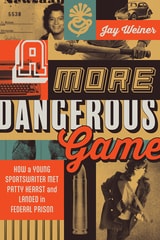
A More Dangerous Game
How a Young Sportswriter Met Patty Hearst and Landed in Federal PrisonJay Weiner
University of Minnesota Press, 2027
From precocious sportswriter to Federal Prisoner #01150-134: The intersection of sports and the revolutionary 1970s, with one ambitious young man caught in the middle
Jay Weiner was an aspiring teenage sportswriter when he met Jack Scott, the charismatic, activist journalist who would become his mentor, immersing him in the political and social issues roiling sports—and so much else—in the late 1960s and 1970s. Weiner became a zealous student of Scott, joining a new tradition of sports journalism that interrogated questions of race, power, and politics alongside the games themselves. But his blind devotion took a treacherous turn when Scott took Weiner, as a surprise for his twentieth birthday, to a secluded Pennsylvania farmhouse where heiress-turned-FBI-most-wanted Patty Hearst was hiding out with her Symbionese Liberation Army kidnappers-turned-comrades.
A More Dangerous Game is Weiner’s story of coming of age in a shocking fashion. A wild mosaic of sports, journalism, betrayal, justice, courage, and redemption, his memoir charts the meeting of sports and the radical left in the 1970s, with Weiner unwittingly caught in the middle and left behind by his mentor. In the engaged, edgy style of a seasoned sportswriter, Weiner describes the fallout after that fateful encounter with the country’s most wanted fugitives: three years of federal subpoenas, impossible decisions, and, ultimately, four months in prison for refusing to testify before a grand jury.
With exhaustive background reporting, Weiner fits together the seemingly disparate pieces of his unlikely journey from young sportswriter to frightened FBI target to emboldened Federal Prisoner #01150-134. From its examination of the life and work of Jack Scott to its surprising angle on the well-chronicled saga of Patty Hearst, A More Dangerous Game is the engrossing story of a time when examining sports as a mirror of society put a writer on the cutting edge of one of the most notorious stories of a generation.
Retail e-book files for this title are screen-reader friendly with images accompanied by short alt text and/or extended descriptions.
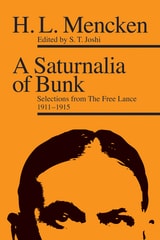
A Saturnalia of Bunk
Selections from The Free Lance, 1911–1915H. L. Mencken
Ohio University Press, 2017
H. L. Mencken’s reputation as a journalist and cultural critic of the twentieth century has endured well into the twenty-first. His early contributions as a writer, however, are not very well known. He began his journalistic career as early as 1899 and in 1910 cofounded the Baltimore Evening Sun. The next year he initiated a column—The Free Lance—that ran six days a week for four and a half years, until the Sun discontinued it, partially in response to Mencken’s controversial defense of Germany during World War One.
In this early forum for his renowned wit, Mencken broached many of the issues to which he would return again and again over his career, establishing himself as a fearless iconoclast willing to tackle the most divisive subjects and apply a heady mix of observation, satire, and repartee to clear away what he regarded as the “saturnalia of bunk” that clouded American thinking. The Free Lance reveals Mencken at his scintillating best as a journalist, polemicist, and satirist.
These columns are collected here for the first time, edited and annotated by Mencken expert and critic S. T. Joshi. This extraordinary collection is an invaluable resource for Mencken scholars and fans and provides an entertaining immersion into the early twentieth-century American zeitgeist.
A Thousand and One Afternoons in Chicago
Ben Hecht
University of Chicago Press, 1992
“The hardboiled audacity and wit that became Hecht’s signature as Hollywood’s most celebrated screen-writer are conspicuous in these vignettes. Most of them are comic and sardonic, some strike muted tragic or somber atmospheric notes. . . . The best are timeless character sketches that have taken on an added interest as shards of social history.”—L. S. Klepp, Voice Literary Supplement
A Thousand and One Afternoons in Chicago
Ben Hecht
University of Chicago Press, 2009
“The hardboiled audacity and wit that became Hecht’s signature as Hollywood’s most celebrated screen-writer are conspicuous in these vignettes. Most of them are comic and sardonic, some strike muted tragic or somber atmospheric notes. . . . The best are timeless character sketches that have taken on an added interest as shards of social history.”—L. S. Klepp, Voice Literary Supplement
A Woman of the Times
Journalism, Feminism, and the Career of Charlotte CurtisMarilyn S. Greenwald
Ohio University Press, 1999
For twenty-five years, Charlotte Curtis was a society/women's reporter and editor and an op-ed editor at the New York Times. As the first woman section editor at the Times, Curtis was a pioneering journalist and one of the first nationwide to change the nature and content of the women's pages from fluffy wedding announcements and recipes to the more newsy, issue-oriented stories that characterize them today. In this riveting biography, Marilyn Greenwald describes how a woman reporter from Columbus, Ohio, broke into the ranks of the male-dominated upper echelon at the New York Times. It documents what she did to succeed and what she had to sacrifice.
Charlotte Curtis paved the way for the journalists who followed her. A Woman of the Times offers a chronicle of her hard-won journey as she invents her own brand of feminism during the 1960s and 1970s. In the telling of this remarkable woman’s life is the story, as well, of a critical era in the nation’s social history.
Abolition and the Press
The Moral Struggle Against SlaveryFord Risley
Northwestern University Press, 2008
This examination of nineteenth-century journalism explores the specific actions and practices of the publications that provided a true picture of slavery to the general public. From Boston's strident <i>Liberator</i> to Frederick Douglass' <i>North Star</i>, the decades before the Civil War saw more than forty newspapers founded with the specific aim of promoting emancipation. Not only did these sheets provide a platform for discourse, but they also gave slavery a face for a wider audience. The reach of the abolitionist press only grew as the fiery publications became objects of controversy and targets of violence in both South and North. These works kept the issue of slavery in the public eye even as mainstream publications took up the call for emancipation, as the nation went to war, up to the end of slavery. Their legacy has endured, as dedicated reform writers and editors continue to view the press as a vital tool in the fight for equality.
Afflicting the Comfortable
Journalism and Politics in West VirginiaThomas F. Stafford
West Virginia University Press, 2011
"Government corruption was not invented in West Virginia. But there are people who contend that West Virginia officials have done more than their share over the years to develop state-of-the-art techniques in vote theft, contract kickbacks, influence peddling and good old-fashioned bribery, extortion, fraud, tax evasion and outright stealing." New York Times
While investigating the Invest Right scandal, Thomas Stafford, a former journalist for the Charleston Gazette, found himself in a very precarious position. As a reporter he felt obligated to tell the whole truth, and he believed in the need to serve the public and those West Virginians who were being abused by a political machine. In Afflicting the Comfortable, Stafford relates such tales of the responsibility of journalism and politics in coordination with scandals that have unsettled the Mountain State over the past few decades. His probing would take him from the halls of Charleston to the center of our nation's ruling elite. Guided by his senses of duty, right, and fairness, he plunged head first into the misdeeds of West Virginia's politicians. His investigations would preface the downfall of a governor and an adminstration that robbed the state and the citizens of West Virginia for many years.
After the Czars and Commissars
Journalism in Authoritarian Post-Soviet Central AsiaEric Freedman
Michigan State University Press, 2011
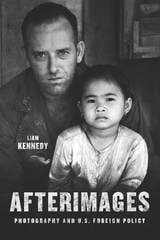
Afterimages
Photography and U.S. Foreign PolicyLiam Kennedy
University of Chicago Press, 2016
Liam Kennedy here maps the evolving relations between the American way of war and photographic coverage of it. Organized in its first section around key US military actions over the last fifty years, the book then moves on to examine how photographers engaged with these conflicts on wider ethical and political grounds, and finally on to the genre of photojournalism itself. Illustrated throughout with examples of the photographs being considered, Afterimages argues that photographs are important means for critical reflection on war, violence, and human rights. It goes on to analyze the high ethical, sociopolitical, and legalistic value we place on the still image’s ability to bear witness and stimulate action.
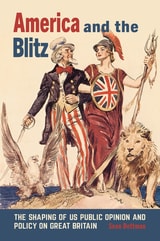
America and the Blitz
The Shaping of US Public Opinion and Policy on Great BritainSean Dettman
University of Missouri Press, 2026
In this work, Sean Dettman traces an observable correlation over the course of late summer 1940 between the bombings of London and other UK cities and the changing attitude of the American people towards adopting a moderate pro-aid position, and argues that these processes were aided by pro-aid US journalists who deployed a positive Blitz narrative centered on themes of resilience, courage, and fortitude. This shift in US public opinion allowed the Roosevelt Administration and pro-aid pressure groups to advance conversations in Washington towards aiding Britain, even at the risk of war.
Dettman also argues that this shift in opinion was caused by fear that a Nazi victory would threaten US national security and the American way of life, rather than an interest in expanding pro-democratic structures and institutions in Britain.
Whereas the vast body of literature examining US public opinion during the ‘Great Debate’ reduces the Blitz narrative to a minor cause, America and the Blitz demonstrates how the Blitz narrative influenced domestic conversations regarding US national security and the American way of life. The author reveals that when the events and themes of the Blitz come into dialogue with conversations about US aid to Britain and national security, the traditional narrative changes.
America and the Blitz offers a new framework for understanding the ‘Great Debate,’ revealing the relationship between US journalists’ Blitz narrative and its effect on US public opinion towards aiding Britain and the ascendancy of American global power.
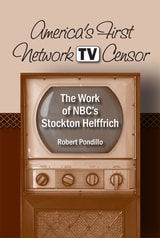
America's First Network TV Censor
The Work of NBC's Stockton HelffrichRobert Pondillo
Southern Illinois University Press, 2010
While other books have cited Helffrich’s reports, none have considered them as a body of work, complemented by the details of Helffrich’s life and the era in which he lived. America’s First Network TV Censor explores the ways in which Helffrich’s personal history and social class influenced his perception of his role as NBC-TV censor and his tendency to ignore certain political and cultural taboos while embracing others.
Author Robert Pondillo considers Helffrich’s life in broadcasting before and after the Second World War, and his censorial work in the context of 1950s American culture and emerging network television. Pondillo discusses the ways that cultural phenomena, including the arrival of the mid-twentieth-century religious boom, McCarthyism, the dawn of the Civil Rights era, and the social upheaval over sex, music, and youth, contributed to a general sense that the country was morally adrift and ripe for communist takeover.
Five often-censored subjects—advertising, language, and depictions of sex, violence, and race—are explored in detail, exposing the surprising complexity and nuance of early media censorship. Questions of whether too many sadistic westerns would coarsen America’s children, how to talk about homosexuality without using the word “homosexuality,” and how best to advertise toilet paper without offending people were on Helffrich’s mind; his answers to these questions helped shape the broadcast media we know today.
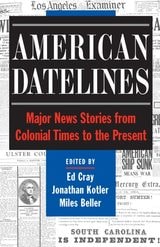
American Datelines
Major News Stories from Colonial Times to the PresentEdited by Ed Cray, Jonathan Kotler, and Miles Beller
University of Illinois Press, 1990
The original articles in this compelling collection are arranged chronologically and appear as they were first published, providing a lively and unique view of the events that have most influenced politics and culture. Readers can experience the thrill and excitement of breaking news from the real story of Jesse James and the capture of Al Capone to a vibrant portrayal of baseball's first professional African American player and a probing look at the shocking New York Armory show where modern art was born. This first paperback edition features an updated introduction by the editors and several newsworthy additions, including the fall of the Berlin Wall, the O. J. Simpson trial, the Clinton impeachment trial, the home run race between Mark McGwire and Sammy Sosa, and Bush v. Gore.
American Intelligence
Small-Town News and Political Culture in Federalist New HampshireBen P. Lafferty
University of Massachusetts Press, 2020
Taking up the New Hampshire newspaper industry as its case study, American Intelligence unpacks the ways in which an unprecedented quantity of printed material was gathered, distributed, marketed, and consumed, as well as the strong influence that it had on the shaping of the American political imagination. Ben P. Lafferty also considers the lives of the printers themselves and asks why so many men chose to pursue such a fraught and turbulent profession. This snapshot resonates with the contemporary media-saturated and politically chaotic age.
American Photojournalism
Motivations and MeaningsClaude Cookman
Northwestern University Press, 2009
Photojournalism has long been the medium of urgency and social change. It has profoundly affected American public opinion, going back at least to Mathew Brady's images from the Civil War. In American Photojournalism: Motivations and Meanings, Claude Cookman explores the history and future of the medium through the work of such exemplary photojournalists as Jacob Riis, Dorothea Lange, Weegee, Margaret Bourke-White, W. Eugene Smith, Gordon Parks, Rich Clarkson, and Carol Guzy, among others. The traditional approach to studying American photojournalism explains the what and who of photojournalism--what events and developments occurred, what notable images were taken, and who took them. Without neglecting these concerns, American Photojournalism emphasizes the why. Cookman argues convincingly that contemporary photojournalism is grounded in the desire to witness and record history, and the embrace of a universal humanism. Unafraid to engage questions of truth and intentionality, American Photojournalism will only become more relevant as the medium evolves.
An Improper Profession
Women, Gender, and Journalism in Late Imperial RussiaBarbara T. Norton and Jehanne M Gheith, eds.
Duke University Press, 2001
In this collection, contributors explore how early women journalists contributed to changing cultural understandings of women’s roles, as well as how class and gender politics meshed in the work of particular individuals. They also examine how female journalists adapted to—or challenged—censorship as political structures in Russia shifted. Over the course of this volume, contributors discuss the attitudes of female Russian journalists toward socialism, Russian nationalism, anti-Semitism, women’s rights, and suffrage. Covering the period from the early 1800s to 1917, this collection includes essays that draw from archival as well as published materials and that range from biography to literary and historical analysis of journalistic diaries.
By disrupting conventional ideas about journalism and gender in late Imperial Russia, An Improper Profession should be of vital interest to scholars of women’s history, journalism, and Russian history.
Contributors. Linda Harriet Edmondson, June Pachuta Farris, Jehanne M Gheith, Adele Lindenmeyr, Carolyn Marks, Barbara T. Norton, Miranda Beaven Remnek, Christine Ruane, Rochelle Ruthchild, Mary Zirin
Anatomy of a Trial
Public Loss, Lessons Learned from The People vs. O.J. SimpsonJerrianne Hayslett
University of Missouri Press, 2008
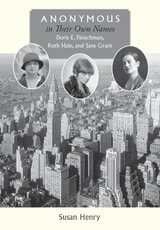
Anonymous in Their Own Names
Doris E. Fleischman, Ruth Hale, and Jane GrantSusan Henry
Vanderbilt University Press, 2012
Yet these women's achievements have been invisible to countless authors who have written about their husbands. This invisibility is especially ironic given that all three were feminists who kept their birth names when they married as a sign of their equality with their husbands, then battled the government and societal norms to retain their names. Hale and Grant so believed in this cause that in 1921 they founded the Lucy Stone League to help other women keep their names, and Grant and Fleischman revived the league in 1950. This was the same year Grant and her second husband, William Harris, founded White Flower Farm, pioneering at that time and today one of the country's most celebrated commercial nurseries.
Despite strikingly different personalities, the three women were friends and lived in overlapping, immensely stimulating New York City circles. Susan Henry explores their pivotal roles in their husbands' extraordinary success and much more, including their problematic marriages and their strategies for overcoming barriers that thwarted many of their contemporaries.
Assault on the Media
The Nixon YearsWilliam E. Porter and Thomas A. Mascaro
University of Michigan Press, 2024
Informed by a half-century of historical analyses and released documents, this expanded edition of William E. Porter’s award-winning Assault on the Media analyzes new documents of significance; synthesizes recent historical analyses; incorporates legal evaluations by journalism scholars; and traces how Nixon-era plans cultivated the divisive state of 21st-century society and amplified assaults on journalism. It also evaluates lasting concerns about the Supreme Court’s Pentagon Papers decision and journalists cited for contempt as a form of prior restraint; the currencies of power and race in protecting confidential sources; and regulatory decisions that hamper effective journalism. Assault on the Media not only documents the incidents and circumstances of governmental intimidation, harassment, and regulation of the news media during the Nixon presidency, but it offers insights into the long-term effects and their relevance today.
Assessing Public Journalism
Edited by Edmund B. Lambeth, Philip Meyer, & Esther Thorson
University of Missouri Press, 1998
In response to increasingly negative attitudes toward journalism and its coverage of public affairs, many newspapers and television stations across the United States have experimented with novel approaches to reporting to better meet the public's demand for news. Known as "civic" or "public" journalism, this new movement seeks to improve the news media's ability to supply the information and insights needed by citizens of a democratic society. Critics of public journalism say it contradicts some principles of traditional reporting. As a result, the new movement has spurred great controversy among journalists. Assessing Public Journalism is the first book to evaluate this movement.
Public journalists use a variety of innovative methods to achieve their goals. To connect more closely with citizens, they may listen to their readers and viewers in neighborhood settings and public forums. To frame stories more accurately, they sometimes conduct focus groups and opinions polls. To maximize the reach of their work, print and electronic journalists have experimented with coordinated coverage of key elections and major public issues. Their goal is a form of journalism that improves the quality of citizen deliberation and participation in public life.
By collecting and focusing a wide range of original research and selected professional commentary, Assessing Public Journalism provides the necessary framework for examining the issues surrounding public journalism and for determining what must be done to enable it to meet its full potential. Scholars, journalists, and concerned citizens will benefit from this vital study.
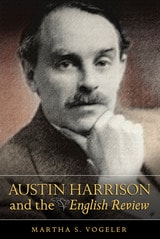
Austin Harrison and the English Review
Martha S. Vogeler
University of Missouri Press, 2008
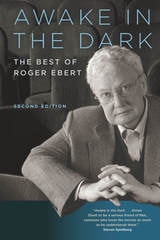
Awake in the Dark
The Best of Roger Ebert: Second EditionRoger Ebert
University of Chicago Press, 2017
Arriving fifty years after Ebert published his first film review in 1967, this second edition of Awake in the Dark collects Ebert’s essential writings into a single, irresistible volume. Featuring new Top Ten Lists and reviews of the years’ finest films through 2012, this edition allows both fans and film buffs to bask in the best of an extraordinary lifetime’s work. Including reviews from The Godfather to GoodFellas and interviews with everyone from Martin Scorsese to Meryl Streep, as well as showcasing some of Ebert’s most admired essays—among them a moving appreciation of John Cassavetes and a loving tribute to the virtues of black-and-white films—Ebert’s Awake in the Dark is a treasure trove not just for fans of this era-defining critic, but for anyone desiring a compulsively readable chronicle of the silver screen.
Stretching from the dramatic rise of rebel Hollywood and the heyday of the auteur to the triumph of blockbuster films such as Star Wars and Raiders of the Lost Ark, to the indie revolution that is still with us today, Awake in the Dark reveals a writer whose exceptional intelligence and daily bursts of insight and enthusiasm helped shape the way we think about the movies. But more than this, Awake in the Dark is a celebration of Ebert’s inimitable voice—a voice still cherished and missed.