Results by title
542 books match the query 'Emigration and immigration' and 18 start with e
E Pluribus Unum?
Contemporary and Historical Perspectives on Immigrant Political IncorporationGary Gerstle
Russell Sage Foundation, 2001
Elusive Histories
Mozambican Migrant Laborers in Rhodesia, ca. 1900-1980Allen F. Isaacman, Joy M. Chadya, and Barbara S. Isaacman
Ohio University Press, 2025
At the heart of Elusive Histories is a long-neglected story of the clandestine journeys of Mozambican migrant laborers and their families to Rhodesia. Drawing from oral histories, court records, archives, newspapers, and popular magazines, the authors chronicle Mozambican migration, work experiences, and settlement in Rhodesia. Thousands of men, women, and children traveled long distances, often on foot, to reach Rhodesia. Starting with a trickle of workers seeking to avoid chibharo, a Mozambican agricultural forced-labor system, the number of migrants peaked in the 1950s.
In 1958, the Rhodesian government passed legislation to bar new Mozambican migrants from entering large cities, redirecting them toward agriculture and mining. When Black Rhodesian laborers began to complain about losing jobs to Mozambicans, the restrictions became an outright ban to prevent further migrants from entering the country.
Contrary to previous assumptions, Mozambican labor in Rhodesia was not contract labor derived from bilateral negotiations between the Mozambican colonial and Rhodesian governments. In fact, many Mozambicans who came to work and live in Rhodesia arrived as illegal migrants. The book also demystifies the widely held notion that all foreign migrant workers in Rhodesia who spoke Nyanja were Nyasalanders. Because Nyanja is widely spoken at the confluence of Malawi, Zambia, and Mozambique, many Mozambicans who came to work in Rhodesia were fluent. Despite the national, racial, and cultural differences and the discrimination in job placement, promotion, and housing, Mozambican migrant laborers creatively adapted and made Rhodesia home for the duration of their lives.

Emotional Landscapes
Love, Gender, and MigrationEdited by Marcelo J. Borges, Sonia Cancian, and Linda Reeder
University of Illinois Press, 2020
Affecting and perceptive, Emotional Landscapes moves from war and transnational families to gender and citizenship to explore the crossroads of migration and the history of emotion.
Contributors: María Bjerg, Marcelo J. Borges, Sonia Cancian, Tyler Carrington, Margarita Dounia, Alexander Freund, Donna R. Gabaccia, A. James Hammerton, Mirjam Milharčič Hladnik, Emily Pope-Obeda, Linda Reeder, Roberta Ricucci, Suzanne M. Sinke, and Elizabeth Zanoni
Encountering American Faultlines
Race, Class, and the Dominican Experience in ProvidenceJose Itzigsohn
Russell Sage Foundation, 2009

Entry Denied
Controlling Sexuality At The BorderEithne Luibheid
University of Minnesota Press, 2002
A revelatory examination of 150 years of sexuality-based discrimination against immigrants to the United States.
Lesbians, prostitutes, women likely to have sex across racial lines, "brought to the United States for immoral purposes," or "arriving in a state of pregnancy"—national threats, one and all. Since the late nineteenth century, immigrant women’s sexuality has been viewed as a threat to national security, to be contained through strict border-monitoring practices. By scrutinizing this policy, its origins, and its application, Eithne Luibhéid shows how the U.S. border became a site not just for controlling female sexuality but also for contesting, constructing, and renegotiating sexual identity.
Initially targeting Chinese women, immigration control based on sexuality rapidly expanded to encompass every woman who sought entry to the United States. The particular cases Luibhéid examines-efforts to differentiate Chinese prostitutes from wives, the 1920s exclusion of Japanese wives to reduce the Japanese-American birthrate, the deportation of a Mexican woman on charges of lesbianism, the role of rape in mediating women’s border crossings today—challenge conventional accounts that attribute exclusion solely to prejudice or lack of information. This innovative work clearly links sexuality-based immigration exclusion to a dominant nationalism premised on sexual, gender, racial, and class hierarchies.
Escaping Hitler
A Jewish Haven in ChileEva Goldschmidt Wyman
University of Alabama Press, 2013
A family’s flight from Nazi terror to an unexpected refuge in Chile.
Escaping Hitler is the personal story of Eva Wyman and her family’s escape from Nazi Germany to Chile in the sociohistorical context of 1930s and 1940s, a time when the Chilean Nazi party had an active presence in the country’s major institutions.
Based primarily on interviews with German Jewish refugees and family correspondence, Eva Goldschmidt Wyman provides an intimate account of Jews in Germany in the 1930s as Nazi controls tightened and family members were taken to Riga concentration camp. Wyman recounts Kristallnacht in Stuttgart, where her father was principal of the Jewish school, his imprisonment in Dachau, and his release and immigration to Great Britain. Escaping Hitler details the family’s escape from Germany and subsequent life in Chile, providing an intimate look at daily life on the steam ship Conte Grande during the voyage from Italy to Chile in 1939, Nazi espionage and anti-Semitic activity in Chile, and the Nazi influence in South America in general.
Recounted in an intimate and personal style, Escaping Hitler immerses the reader in an extraordinary chapter of contemporary Jewish history both inside Germany and South America.
Ethical Borders
NAFTA, Globalization, and Mexican MigrationAuthored by Bill Ong Hing
Temple University Press, 2010
In his topical new book, Ethical Borders, Bill Ong Hing asks, why do undocumented immigrants from Mexico continue to enter the United States and, what would discourage this surreptitious traffic? An expert on immigration law and policy, Hing examines the relationship between NAFTA, globalization, and undocumented migration, and he considers the policy options for controlling immigration. He develops an ethical rationale for opening up the U.S./Mexican border, as well as improving conditions in Mexico so that its citizens would have little incentive to migrate.
In Ethical Borders Hing insists that reforming NAFTA is vital to ameliorating much of the poverty that drives undocumented immigration and he points to the European Union's immigration and economic development policies as a model for North America. Hing considers the world-wide economic crisis and the social problems that attend labor migration into homogenous countries, arguing for a spectrum of changes, including stricter border enforcement and more effective barriers; a path to citizenship for undocumented migrants; or a guest worker program.
Hing also situates NAFTA and its effects in the larger, and rapidly shifting, context of globalization—particularly the recent rise of China as the world's economic giant. Showing how NAFTA’s unforeseen consequences have been detrimental to Mexico, Hing passionately argues that the United States is ethically bound to address the problems in a way that puts prosperity within the grasp of all North Americans.
Ethnic Historians and the Mainstream
Shaping America's Immigration StoryAlan M. Kraut and David A. Gerber
Rutgers University Press, 2013
Do historians “write their biographies” with the subjects they choose to address in their research? In this collection, editors Alan M. Kraut and David A. Gerber compiled eleven original essays by historians whose own ethnic backgrounds shaped the choices they have made about their own research and writing as scholars. These authors, historians of American immigration and ethnicity, revisited family and personal experiences and reflect on how their lives helped shape their later scholarly pursuits, at times inspiring specific questions they asked of the nation’s immigrant past. They address issues of diversity, multiculturalism, and assimilation in academia, in the discipline of history, and in society at large. Most have been pioneers not only in their respective fields, but also in representing their ethnic group within American academia. Some of the women in the group were in the vanguard of gender diversity in the discipline of history as well as on the faculties of the institutions where they have taught.
The authors in this collection represent a wide array of backgrounds, spanning Europe, Africa, Asia, the Middle East, and Latin America. What they have in common is their passionate engagement with the making of social and personal identities and with finding a voice to explain their personal stories in public terms.
Contributors: Theresa Alfaro-Velcamp, John Bodnar, María C. García, David A. Gerber, Violet M. Showers Johnson, Alan M. Kraut, Timothy J. Meagher, Deborah Dash Moore, Dominic A. Pacyga, Barbara M. Posadas, Eileen H. Tamura, Virginia Yans, Judy Yung
Ethnic Pride, American Patriotism
Slovaks And Other New ImiigrantsJune Granatir Alexander
Temple University Press, 2004
Ethnic Solidarity for Economic Survival
Korean Greengrocers in New York CityPyong Gap Min
Russell Sage Foundation, 2008
Ethnicity in Michigan
Issues and PeopleJack Glazier
Michigan State University Press, 2001
As the introductory volume in the series Discovering the Peoples of Michigan, Ethnicity in Michigan outlines the processes of migration, as well as the rich relationship between ethnic groups and the trajectories of historical and social change in Michigan. On both state and local levels, issues of identity, race, politics, and shared history inform community development. Jack Glazier and Arthur Helweg provide a substantive general and theoretical overview of the various ethnic groups in Michigan, and of the ways in which immigrants both respond to and shape Michigan's particular regional character.

Europe in Black and White
Immigration, Race, and Identity in the ‘Old Continent'Edited by Manuela Ribeiro Sanches, Fernando Clara, João Ferreira Duarte, and Leonor Pires Martins
Intellect Books, 2011
The essays in Europe in Black and White offer new critical perspectives on race, immigration, and identity on the Old Continent. In reconsidering the various forms of encounters with difference, such as multiculturalism and hybridity, the contributors address a number of issues, including the cartography of postcolonial Europe, its relation to the production of "difference" and "race," and national and identity politics and their dependence on linguistic practices inherited from imperial times. Featuring scholars from a wide variety of nationalities and disciplinary areas, this collection will speak to an equally wide readership.
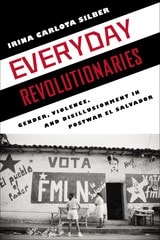
Everyday Revolutionaries
Gender, Violence, and Disillusionment in Postwar El SalvadorIrina Carlota Silber
Rutgers University Press, 2011
Winner of the 2013 International Latino Book Awards in the Best First Book, Nonfiction category
Everyday Revolutionaries provides a longitudinal and rigorous analysis of the legacies of war in a community racked by political violence. By exploring political processes in one of El Salvador's former war zones-a region known for its peasant revolutionary participation-Irina Carlota Silber offers a searing portrait of the entangled aftermaths of confrontation and displacement, aftermaths that have produced continued deception and marginalization.
Silber provides one of the first rubrics for understanding and contextualizing postwar disillusionment, drawing on her ethnographic fieldwork and research on immigration to the United States by former insurgents. With an eye for gendered experiences, she unmasks how community members are asked, contradictorily and in different contexts, to relinquish their identities as "revolutionaries" and to develop a new sense of themselves as productive yet marginal postwar citizens via the same "participation" that fueled their revolutionary action. Beautifully written and offering rich stories of hope and despair, Everyday Revolutionaries contributes to important debates in public anthropology and the ethics of engaged research practices.
Everyday Ruptures
Children, Youth, and Migration in Global PerspectiveCati Coe
Vanderbilt University Press, 2011
The book is organized around four themes:
• how children's agency is affected by institutions, families, and beliefs
• how families and individuals create and maintain kin ties in conditions of rupture
• how emotion and affect are linked to global divisions and flows
• how the actions of states create ruptures and continuities
Exiled Home
Salvadoran Transnational Youth in the Aftermath of ViolenceSusan Bibler Coutin
Duke University Press, 2016
Exiled in the Homeland
Zionism and the Return to Mandate PalestineBy Donna Robinson Divine
University of Texas Press, 2009
Offering a new perspective on Zionism, Exiled in the Homeland draws on memoirs, newspaper accounts, and archival material to examine closely the lives of the men and women who immigrated to Palestine in the early twentieth century. Rather than reducing these historic settlements to a single, unified theme, Donna Robinson Divine's research reveals an extraordinary spectrum of motivations and experiences among these populations.
Though British rule and the yearning for a Jewish national home contributed to a foundation of solidarity, Exiled in the Homeland presents the many ways in which the message of emigration settled into the consciousness of the settlers. Considering the benefits and costs of their Zionist commitments, Divine explores a variety of motivations and outcomes, ranging from those newly arrived immigrants who harnessed their ambition for the goal of radical transformation to those who simply dreamed of living a better life. Also capturing the day-to-day experiences in families that faced scarce resources, as well as the British policies that shaped a variety of personal decisions on the part of the newcomers, Exiled in the Homeland provides new keys to understanding this pivotal chapter in Jewish history.
Exiles in the City
Hannah Arendt and Edward W. Said in CounterpointWilliam V. Spanos
The Ohio State University Press, 2012
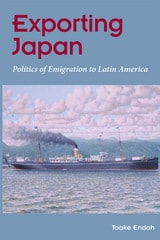
Exporting Japan
Politics of Emigration to Latin AmericaToake Endoh
University of Illinois Press, 2008
Exporting Japan examines the domestic origins of the Japanese government's policies to promote the emigration of approximately three hundred thousand native Japanese citizens to Latin America between the 1890s and the 1960s. This imperialist policy, spanning two world wars and encompassing both the pre-World War II authoritarian government and the postwar conservative regime, reveals strategic efforts by the Japanese state to control its populace while building an expansive nation beyond its territorial borders.
Toake Endoh compellingly argues that Japan's emigration policy embodied the state's anxieties over domestic political stability and its intention to remove marginalized and radicalized social groups by relocating them abroad. Documenting the disproportionate focus of the southwest region of Japan as a source of emigrants, Endoh considers the state's motivations in formulating emigration policies that selected certain elements of the Japanese population for "export." She also recounts the situations migrants encountered once they reached Latin America, where they were often met with distrust and violence in the "yellow scare" of the pre-World War II period.