Results by title
615 books match the query 'England' and 27 start with e

East Lynne
Mitchell, Sally
Rutgers University Press, 1984
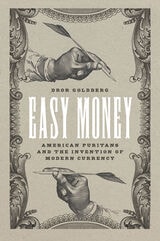
Easy Money
American Puritans and the Invention of Modern CurrencyDror Goldberg
University of Chicago Press, 2023
A sweeping history of the American invention of modern money.
Economists endlessly debate the nature of legal tender monetary systems—coins and bills issued by a government or other authority. Yet the origins of these currencies have received little attention.
Dror Goldberg tells the story of modern money in North America through the Massachusetts colony during the seventeenth century. As the young settlement transitioned to self-governance and its economy grew, the need to formalize a smooth exchange emerged. Printing local money followed.
Easy Money illustrates how colonists invented contemporary currency by shifting its foundation from intrinsically valuable goods—such as silver—to the taxation of the state. Goldberg traces how this structure grew into a worldwide system in which, monetarily, we are all Massachusetts. Weaving economics, law, and American history, Easy Money is a new touchstone in the story of monetary systems.
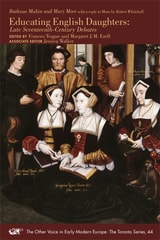
Educating English Daughters
Late Seventeenth-Century DebatesBathsua Makin and Mary More
Iter Press, 2016
This edition offers texts from Bathsua Makin and Mary More, and Robert Whitehall’s response to More’s argument. Makin describes the appropriate education for London merchants’ daughters, arguing that girls should be educated and should aspire to follow learned women in history, and that educated women improve their families and themselves. More argues that women have the right to an education, and that such an education shows that the inequality of married women under English law is a man-made institution. More’s argument drew objections from her Oxford reader, Robert Whitehall, who preserved her manuscript with his own. Makin and More enjoyed a measure of public recognition and esteem, yet after their deaths, they and their texts were largely ignored until the late twentieth century.
Edwardian Stories of Divorce
Janice Hubbard Harris
Rutgers University Press, 1996
Much as abortion in the United States today is a contentious issue used for scripting women's roles and potential into the national agenda, divorce was an issue dividing England in the Edwardian era. According to Janice Harris, anything and everything, from illicit sex and family values to the Garden of Eden, wrath of children, poverty of women, nature of cruelty, scandal of America, threat of Germany, and future of England were part of the debate over divorce. Living under marriage laws far more restrictive than those of their Protestant neighbors, Edwardian women and men campaigned for reform with a barrage of compelling stories. Organizing her analysis around three major sources of narrative on divorce––the Sunday papers, the Report of the Royal Commission on Divorce and Matrimonial causes, and the novel––Harris uncovers a war of words and a competition of tales. In raising questions about the winners, losers, and spoils, Harris expands our understanding of the history of divorce, the wars between the sexes, and the political import of those wars.
In the end, she presents a complex and lively story herself, one that illuminates battles over marriage and divorce taking place in our own era as well. This humane book on a long-neglected subject marks an important contribution to narrative studies and Edwardian history.
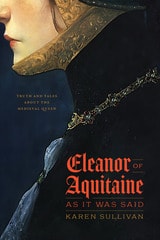
Eleanor of Aquitaine, as It Was Said
Truth and Tales about the Medieval QueenKaren Sullivan
University of Chicago Press, 2023
Much of what we know about Eleanor of Aquitaine, Queen of France and then Queen of England, we know from recorded rumor—gossip often qualified by the curious phrase “it was said,” or the love songs, ballads, and romances that gossip inspired. While we can mine these stories for evidence about the historical Eleanor, Karen Sullivan invites us to consider, instead, what even the most fantastical of these tales reveals about this queen and life as a twelfth-century noblewoman. She reads the Middle Ages, not to impose our current conceptual categories on its culture, but to expose the conceptual categories medieval women used to make sense of their lives. Along the way, Sullivan paints a fresh portrait of this singular medieval queen and the women who shared her world.
Electronic Evidence and Electronic Signatures
Stephen Mason and Daniel Seng
University of London Press, 2021
In this updated edition of a well-established practitioner text, Stephen Mason and Daniel Seng have brought together a team of experts in the field to provide an exhaustive treatment of electronic evidence and electronic signatures. This fifth edition continues to follow the tradition in English evidence textbooks by basing the text on the law of England and Wales, with appropriate citations of relevant case law and legislation from other jurisdictions.
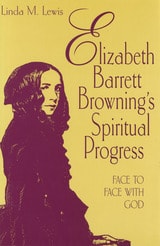
Elizabeth Barrett Browning's Spiritual Progress
Face to Face With GodLinda M. Lewis
University of Missouri Press, 1997
Elizabeth Barrett Browning believed that "Christ's religion is essentially poetry—poetry glorified." In Elizabeth Barrett Browning's Spiritual Progress, Linda M. Lewis studies Browning's religion as poetry, her poetry as religion. The book interprets Browning's literary life as an arduous spiritual quest—the successive stages being a rejection of Promethean pride for Christ-like humility, affirmation of the gospels of suffering and of work, internalization of the doctrine of Apocalypse, and ascent to divine love and truth.
Lewis follows this religious crusade from the poet's childhood to her posthumous Last Poems--including such topics as her Bible reading, her introduction to the Greek church fathers and the English Protestant reformers, the theological debates in which she participated, her quarrel with the theology of Paradise Lost, and her scandalous involvement in mesmerism and Swedenborgianism. Using insights from contemporary feminist thought, Lewis argues that Browning's religious assumptions and insights range from the conventional to the iconoclastic and that women's spirituality is, for Browning as well as for other Victorian women writers, separate from orthodox patriarchy. Lewis demonstrates that Browning's political and social ideology--often labeled inconsistent and illogical—really makes sense in light of this spiritual quest, which leads her to confront her God "face to face."
Elizabeth Barrett Browning's Spiritual Progress examines not only Browning's most admired works, such as Sonnets from the Portuguese and Aurora Leigh, but also her large body of political works and her important early poems—The Seraphim and A Drama of Exile. This intertextual book compares Browning's ideology to that of feminists such as Margaret Fuller, Harriet Martineau, and Florence Nightingale; influential conservatives such as Thomas Carlyle; and those most esteemed of Victorian poets, Alfred Lord Tennyson and Robert Browning.
Concluding with an examination of religion as a central focus of Victorian women poets, Lewis clarifies the ways in which Browning differs from Christina Rossetti, Felicia Hemans, Dora Greenwell, Jean Ingelow, and Mary Howitt. Elizabeth Barrett Browning's Spiritual Progress maintains that Browning's peculiar face-to-face struggle with the patristic and poetic tradition—as well as with God—sets her work apart.
Elizabeth I
Translations, 1544-1589Elizabeth I
University of Chicago Press, 2008
Presenting original and modernized spellings in a facing-page format, these two volumes will answer the call to make all of Elizabeth’s writings available. They include her renderings of epistles of Cicero and Seneca, religious writings of John Calvin and Marguerite de Navarre, and Horace’s Ars poetica, as well as Elizabeth’s Latin Sententiae drawn from diverse sources, on the responsibilities of sovereign rule and her own perspectives on the monarchy. Editors Janel Mueller and Joshua Scodel offer introduction to each of the translated selections, describing the source text, its cultural significance, and the historical context in which Elizabeth translated it. Their annotations identify obscure meanings, biblical and classical references, and Elizabeth’s actual or apparent deviations from her sources.
The translations collected here trace Elizabeth’s steady progression from youthful evangelical piety to more mature reflections on morality, royal responsibility, public and private forms of grief, and the right way to rule. Elizabeth I: Translations is the queen’s personal legacy, an example of the very best that a humanist education can bring to the conduct of sovereign rule.
Elizabeth I
Translations, 1592-1598Elizabeth I
University of Chicago Press, 2009
Presenting original and modernized spellings in a facing-page format, these two volumes will answer the call to make all of Elizabeth’s writings available. They include her renderings of epistles of Cicero and Seneca, religious writings of John Calvin and Marguerite de Navarre, and Horace’s Ars poetica, as well as Elizabeth’s Latin Sententiae drawn from diverse sources, on the responsibilities of sovereign rule and her own perspectives on the monarchy. Editors Janel Mueller and Joshua Scodel offer introduction to each of the translated selections, describing the source text, its cultural significance, and the historical context in which Elizabeth translated it. Their annotations identify obscure meanings, biblical and classical references, and Elizabeth’s actual or apparent deviations from her sources.
The translations collected here trace Elizabeth’s steady progression from youthful evangelical piety to more mature reflections on morality, royal responsibility, public and private forms of grief, and the right way to rule. Elizabeth I: Translations is the queen’s personal legacy, an example of the very best that a humanist education can bring to the conduct of sovereign rule.
Elizabethan Poetry in Manuscript
An Edition of British Library Harley MS 7392(2)Edited by Jessica Edmondes
Iter Press, 2022
This edition preserves the appearance, spelling, and punctuation of the original manuscript while expanding antiquated contractions to provide an easily readable text. Textual notes appear on the page, and in-depth contextual notes and word glosses are provided in the commentary section. The analyses add to our knowledge of early modern manuscript culture and literary manuscript transmission, and a substantial introduction provides context for the compilation of the anthology.
Elizabethan Popular Culture
Leonard R. N. Ashley
University of Wisconsin Press, 1988
Elton's Ecologists
A History of the Bureau of Animal PopulationPeter Crowcroft
University of Chicago Press, 1991
"[This] is a very good account of the work and personal interactions of a group that played an important part in the development of animal ecology in the period 1930-60."—John Krebs, TREE
Emotion in the Tudor Court
Literature, History, and Early Modern FeelingBradley J. Irish
Northwestern University Press, 2018
Spanning the sixteenth century, Emotion in the Tudor Court explores Cardinal Thomas Wolsey and Henrician satire; Henry Howard, Earl of Surrey, and elegy; Sir Philip Sidney and Elizabethan pageantry; and Robert Devereux, Earl of Essex, and factional literature. It demonstrates how the dynamics of disgust,envy, rejection, and dread, as they are understood in the modern affective sciences, can be seen to guide literary production in the early modern court.
By combining Renaissance concepts of emotion with modern research in the social and natural sciences, Emotion in the Tudor Court takes a transdisciplinary approach to yield fascinating and robust ways to illuminate both literary studies and cultural history.
England and the Crusades, 1095-1588
Christopher Tyerman
University of Chicago Press, 1988
Drawing on a wide range of archival, chronicle, and literary evidence, Tyerman brings to life the royal personalities, foreign policy, political intrigue, taxation and fundraising, and the crusading ethos that gripped England for hundreds of years.
"An ambitious task to undertake. . . . Tyerman has done the job not only thoroughly but brilliantly. . . . A highly impressive study, deserving rich praise and wide readership."—Norman Housley, Times Literary Supplement
"Christopher Tyerman has written a wonderful book. . . . [He] manages to confront thorny issues in scholarship and to contribute new perspectives on them."—William Chester Jordan, American Historical Review
"Tyerman provides valuable insights into preaching, recruitment, and the funding and organisation of crusading expeditions. . . . Fascinating new perspectives on English history."—Edward Powell, Sunday Times
"Impressive. . . . Tyerman's research has yielded valuable evidence, and his admirably lucid argument sheds new light on a complex and bloody period in English history."—Virginia Quarterly Review

England in 1819
The Politics of Literary Culture and the Case of Romantic HistoricismJames Chandler
University of Chicago Press, 1998
"1819? At first sight, it might not seem a 'hot date'; but as James Chandler argues in his powerful book, it would be a mistake to overlook a year of such exceptional political conflagration and literary pyrotechnics in British history. Chandler's study is a wide-ranging, enormously ambitious, densely packed, closely argued work."—John Brewer, New Republic
"The book's largest argument, and the source of its considerable revelations, is that late twentieth-century practices of cultural history-writing have their roots in the peculiar Romantic historicism born in post-Waterloo Britain."—Jon Klancher, Times Literary Supplement
"A monumental work of scholarship."—Terry Eagleton, The Independent
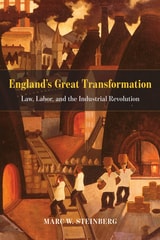
England's Great Transformation
Law, Labor, and the Industrial RevolutionMarc W. Steinberg
University of Chicago Press, 2016
Building his argument on three case studies—the Hanley pottery industry, Hull fisheries, and Redditch needlemakers—Steinberg employs both local and national analyses to emphasize the ways in which these master-servant laws allowed employers to use the criminal prosecutions of workers to maintain control of their labor force. Steinberg provides a fresh perspective on the dynamics of labor control and class power, integrating the complex pathways of Marxism, historical institutionalism, and feminism, and giving readers a subtle yet revelatory new understanding of workplace control and power during England’s Industrial Revolution.
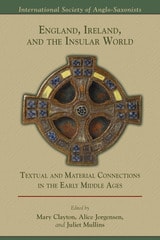
England, Ireland, and the Insular World
Textual and Material Connections in the Early Middle AgesMary Clayton
Arizona Center for Medieval and Renaissance Studies, 2017
ISAS Dublin 2013. England, Ireland and the Insular World: Textual and Material Connections in the Early Middle Ages is a collection of twelve essays related to the theme of the 2013 conference of the International Society of Anglo-Saxonists, ‘Insular Cultures’. Contributors cover a broad range of topics, from early medieval agriculture in Ireland and England, to sculpture, manuscript illumination and script, homilies, hagiography, aristocratic gift-giving, relics, calendars, Beowulf, and Anglo-Saxon perceptions of the Celtic peoples, considering connections, parallels and differences between Anglo-Saxon England and its insular neighbors. The volume will be of interest to all those working on Early Medieval history, literature, archaeology, liturgy, art, and manuscripts.
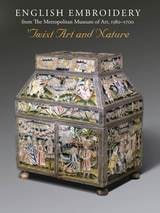
English Embroidery from the Metropolitan Museum of Art, 1580-1700
‘Twixt Art and NatureMelinda Watt
Bard Graduate Center, 2009
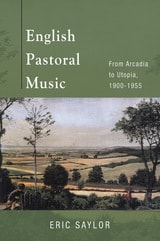
English Pastoral Music
From Arcadia to Utopia, 1900-1955Eric Saylor
University of Illinois Press, 2017
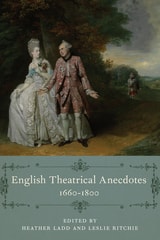
English Theatrical Anecdotes, 1660-1800
Heather Ladd
University of Delaware Press, 2022
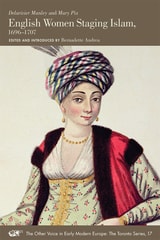
English Women Staging Islam, 1696-1707
Delarivier Manley and Mary Pix
Iter Press, 2012
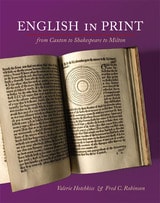
English in Print from Caxton to Shakespeare to Milton
Valerie Hotchkiss and Fred C. Robinson
University of Illinois Press, 2007
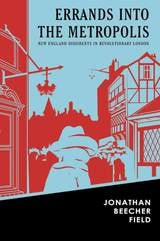
Errands into the Metropolis
New England Dissidents in Revolutionary LondonJonathan Beecher Field
Dartmouth College Press, 2012
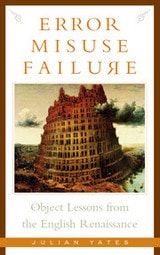
Error, Misuse, Failure
Object Lessons From The English RenaissanceJulian Yates
University of Minnesota Press, 2002
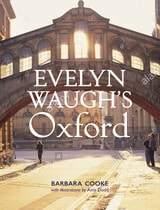
Evelyn Waugh's Oxford
Barbara Cooke
Bodleian Library Publishing, 2018
Following a brief overview of Waugh’s life and work, subsequent chapters examine the prose and graphic art Waugh produced as an undergraduate, together with his portrayal of Oxford in Brideshead Revisited and his memoir, A Little Learning. A specially commissioned, hand-drawn trail around Evelyn Waugh’s Oxford guides the reader around the city Waugh knew and loved through such iconic locations as the Botanic Garden, the Oxford Union, and the Chequers.
A unique literary biography, this book brings to life Waugh’s Oxford, exploring the lasting impression it made on one of the most accomplished literary craftsmen of the twentieth century.
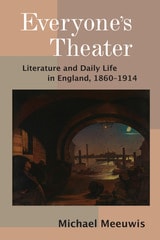
Everyone’s Theater
Literature and Daily Life in England, 1860–1914Michael Meeuwis
University of Michigan Press, 2019
Nearly all residents of England and its colonies between 1860 and 1914 were active theatergoers, and many participated in the amateur theatricals that defined late Victorian life. The Victorian theater was not an abstract figuration of the world as a stage, but a media system enmeshed in mass lived experience that fulfilled in actuality the concept of a theatergoing nation. Everyone’s Theater turns to local history, the words of everyday Victorians found in their diaries and production records, to recover this lost chapter of theater history in which amateur drama domesticates the stage. Professional actors and playwrights struggled to make their productions compatible with ideas and techniques that could be safely reproduced in the home—and in amateur performances from Canada to India. This became the first true English national theater: a society whose myriad classes found common ground in theatrical display. Everyone’s Theater provides new ways to extend Victorian literature into the dimension of voice, sound, and embodiment, and to appreciate the pleasures of Victorian theatricality.
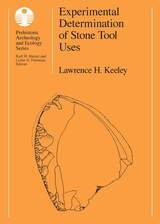
Experimental Determination of Stone Tool Uses
A Microwear AnalysisLawrence H. Keeley
University of Chicago Press, 1980
The most important discovery arising from Keeley's research was that, at magnifications of 100x to 400x, there was a high correlation between the detailed appearance of microwear polishes formed on tool edges and the general category of material worked by that edge. For example, different and distinctive types of microwear polish were formed during use on wood, bone, hide, meat, and soft plant material. These correlations between microwear polish and worked material were independent of the method of use (cutting, sawing, scraping, and so on). In combining evidence of polish type with other traces of use, Keeley was able to make precise reconstructions of tool functions. This book includes the results of a "blind test" of Keeley's functional interpretations which revealed remarkable agreement between the actual and inferred use of the tools tested.
Keeley applied his method of microwear analysis to artifacts from three excavation sites in Britain—Clacton-on-the-sea, Swanscombe, and Hoxne. His research suggests new hypotheses concerning such Paleolithic problems as inter-assemblage variability, the function of Acheulean hand axes, sidescrapers, and chopper-cores and points the way to future research in Stone Age studies.