Results by title
403 books match the query 'Environmental Science' and 40 start with e
Earth in Our Care
Ecology, Economy, and SustainabilityMaser, Chris
Rutgers University Press, 2009
So writes Chris Maser in this compelling study of three interactive spheres of the ecosystem: atmosphere (air), litho-hydrosphere (rock that comprises the restless continents and the water that surrounds them), and biosphere (all life sandwiched in between).
Rich in detail and insightful analogies, Earth in Our Care addresses key issues including land-use policies, ecological restoration, forest management, local living, and sustainability thinking. Exploring our interconnectedness with the Earth, Maser examines today's problems and, more importantly, provides solutions for the future.
Earth, Air, Fire, Water
Humanistic Studies of the EnvironmentJill Ker Conway
University of Massachusetts Press, 1999
Written in a clear, accessible style with a general audience in mind, the essays in this volume offer fresh approaches to thinking about environmental issues. When we consider the forms of environmental decline most urgently in need of attention—eroding soils, shrinking forests, expanding deserts, acid rain, ozone depletion, air pollution, poisoned water supplies, the loss of biological diversity—it may seem logical that scientists should be the people mobilized to tackle these problems. Yet to devise effective solutions for today's environmental threats, we must situate them within their larger historical, societal, and cultural settings. Amelioration does not require exclusively scientific knowledge, but also changes based upon law and public policy, on institutional structures and practices, on habits of consumption, and on countless other facets of daily life. Earth, Air, Fire, Water seeks to redirect our thinking about environmental issues by locating them in the behavior of human beings—in the institutions, beliefs, and practices that mediate between people and that obscure but beautiful nonhuman world we refer to as “nature.” The book opens with a section on the elements and the ways humans have understood them in the past. There follows a section devoted to social institutions and the ways in which we can learn from current and past efforts to study the interaction between people and nature. The concluding section analyzes the culture of modernity and the ways in which the human imagination has changed in response to the arrival of modern technology. In addition to the editors, contributors include Gregory Nagy, Donald Worster, Stephen J. Pyne, John F. Richards, Richard White, Terence Turner, Barbara Epstein, Oleg N. Yanitsky, Bina Agarwal, Anton Struchkov, Yaakov Garb, and Louis Menand.
Eating the Ocean
Elspeth Probyn
Duke University Press, 2016
Eco-pragmatism
Making Sensible Environmental Decisions in an Uncertain WorldDaniel A. Farber
University of Chicago Press, 1999
"A comprehensive well-argued effort to address many of the most difficult issues facing legislators concerned with environmental issues."—Stephen P. Adamian, Boston Book Review
"A timely and well-argued contribution."—Calestous Juma, Nature

Ecocritique
Contesting the Politics of Nature, Economy, and CultureTimothy W. Luke
University of Minnesota Press, 1997
Ecocriticism, whether coming from “back to nature” conservatives, Nature Conservancy liberals, or Earth First! radicals, is familiar enough. But when we listen do we really hear what these groups are saying? In a book that examines the terms of ecocriticism, Timothy W. Luke exposes how ecological critics, organizations, and movements manipulate our conception of the environment. Turning the tables on the ecocritics, Luke demonstrates how ecocriticism can move beyond its familiar confines to engage larger cultural, economic, and political questions.
Ecocritique rereads ecocriticism to reveal how power and economy, society and culture, community and technology compete over what are now widely regarded as the embattled ecosystems of nature. Luke considers in particular how the meanings and values attached to the environment by various groups—from the Worldwatch Institute, the Nature Conservancy, and Earth First! to proponents of green consumerism, social ecology, and sustainable development—articulate new visions of power and subjectivity for a post-Cold War era.
This accessibly written work opens with deep ecology and concludes with social ecology, along the way reconsidering thinkers with green philosophical leanings, including Herbert Marcuse, Paolo Soleri, and Murray Bookchin. In systematic critiques reexamining the cultural practices and ethical values of contemporary environmentalism, Luke highlights the political dilemmas of biocentrism and anthropocentrism in modern ecological thinking.
With its critical analysis of many contemporary environmental discourses and organizations, Ecocritique makes a major contribution to ongoing debates about the political relationships among nature, culture, and economics in the current global system.
Ecological Communication
Niklas Luhmann
University of Chicago Press, 1989
Luhmann extends the concept of "ecology" to refer to any analysis that looks at connections between social systems and the surrounding environment. He traces the development of the notion of "environment" from the medieval idea—which encompasses both human and natural systems—to our modern definition, which separates social systems from the external environment.
In Luhmann's thought, human beings form part of the environment, while social systems consist only of communications. Utilizing this distinctive theoretical perspective, Luhmann presents a comprehensive catalog of society's reactions to environmental problems. He investigates the spheres of the economy, law, science, politics, religion, and education to show how these areas relate to environmental issues.
Ecological Communication is an important work that critically examines claims central to our society—claims to modernity and rationality. It will be of great importance to scholars and students in sociology, political science, philosophy, anthropology, and law.
Ecological Explosions
The History of Biological Invasions and Invasion ScienceDaniel Simberloff
University of Chicago Press, 2025
From the arrival of the naval shipworm in the Black Sea in the first millennium BC to the escape of the Burmese python in Florida in 1992, humans have moved species to new locations, deliberately or inadvertently, for thousands of years. Agricultural and environmental impacts of some invasions were evident early, although whether observers recognized that the cause was an introduced species is uncertain. The history of invasion biology truly begins in the sixteenth through eighteenth centuries, when explorers noticed European species on various distant islands and in North America. In the nineteenth century, biogeographers, studying species distributions across the globe, introduced the first native and non-native species categorizations, and prominent researchers like Charles Darwin began to describe the impacts of introduced species. In the nineteenth and twentieth centuries, as humans moved increasing numbers of species across the globe, the advent of modern ecology deepened our understanding of the scope of the problem.
In Ecological Explosions, invasive species expert Daniel Simberloff provides a thorough overview of the development of invasion science, from early research—including from the perspectives of leading scientists like Aldo Leopold—to the field’s future. Simberloff explores the work of pioneering ecologists like Charles Elton, antecedents of what became today’s invasion biology, before discussing the field’s true emergence in the 1980s, its explosive methodological and theoretical expansion, its integration with other disciplines, and its increasing visibility, not only within the biological literature but also in government policies across the world in the 1990s. Finally, he investigates current controversies, such as the debate over whether the entire science is xenophobic, and asks how ecosystems might adapt to a rapidly globalizing world and ever-increasing numbers of introduced species—including the joro spider, lionfish, spotted lanternfly, common reed, and Asian carp.
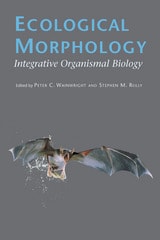
Ecological Morphology
Integrative Organismal BiologyEdited by Peter C. Wainwright and Stephen M. Reilly
University of Chicago Press, 1994
Through this interdisciplinary study, scientists have been able to understand, for instance, how bat wing design affects habitat use and bat diet; how the size of a predator affects its ability to capture and eat certain prey; and how certain mosquitoes have evolved physiologically and morphologically to tolerate salt-water habitats. Ecological Morphology also covers the history of the field, the role of the comparative method in studying adaptation, and the use of data from modern organisms for understanding the ecology of fossil communities.
This book provides an overview of the achievements and potential of ecological morphology for all biologists and students interested in the way animal design, ecology, and evolution interact.
Ecologics
Wind and Power in the AnthropoceneCymene Howe
Duke University Press, 2019
In her volume, Ecologics, Howe narrates how an antidote to the Anthropocene became both failure and success. Tracking the development of what would have been Latin America's largest wind park, Howe documents indigenous people's resistance to the project and the political and corporate climate that derailed its renewable energy potential. Using feminist and more-than-human theories, Howe demonstrates how the dynamics of energy and environment cannot be captured without understanding how human aspirations for energy articulate with nonhuman beings, technomaterial objects, and the geophysical forces that are at the heart of wind and power.
Ecologies of Comparison
An Ethnography of Endangerment in Hong KongTim Choy
Duke University Press, 2011
Ecologists and Environmental Politics
A History of Contemporary EcologyStephen Bocking
West Virginia University Press, 2017
Bocking tells this history through four case studies: the origins and early research of the Nature Conservancy in Great Britain; the development of ecology at the Oak Ridge National Laboratory in Tennessee; the work of the Hubbard Brook Ecosystem Study in New Hampshire; and research in fisheries ecology at the University of Toronto. By comparing these case studies, Bocking demonstrates how the places of contemporary science—laboratories, landscapes, and funding agencies—and science’s purposes, as expressed through the political roles of expertise and specific managerial and regulatory responsibilities, have shaped contemporary ecology and its application to pressing environmental problems.
Ecology and Management of North American Savannas
Guy R. McPherson
University of Arizona Press, 1997
Ecology and the Environment
The Mechanisms, Marrings, and Maintenance of NatureR. J. Berry
Templeton Press, 2011
Ecology and the Environment: The Mechanisms, Marring, and Maintenance of Nature is the ninth title published in the Templeton Science and Religion Series, in which scientists from a wide range of fields distill their experience and knowledge into brief tours of their respective specialties. In this volume, R. J. Berry, a well-known leader in the field of ecology, describes the basic concepts of ecology and seeks to put them into a general context for a reader who lacks any scientific background.
Ecology of the Bay of Quinte
Health, Management and Global ImplicationsC.K. Minns
Michigan State University Press, 2022
Economics of Forestry and Rural Development
An Empirical Introduction from AsiaWilliam F. Hyde and Gregory S. Amacher, and Colleagues
University of Michigan Press, 2000
Ecopoetics
The Language of Nature, the Nature of LanguageScott Knickerbocker
University of Massachusetts Press, 2012
Ecopoetics probes the complex relationship between artifice and the natural world in the work of modern American poets—in particular Wallace Stevens, Elizabeth Bishop, Richard Wilbur, and Sylvia Plath. These poets relate to nature as a deep wellspring of meaning, although they all avoid using language the way most nature writers do, merely to reflect or refer directly to the world. Each of these poets, in his or her own distinct way, employs instead what Knickerbocker terms sensuous poesis, the process of rematerializing language through sound effects and other formal devices as a sophisticated response to nonhuman nature.
Rather than attempt to erase the artifice of their own poems, to make them seem more natural and thus supposedly closer to nature, the poets in this book unapologetically embrace artifice—not for its own sake but in order to perform and enact the natural world. Indeed, for them, artifice is natural. In examining their work, Knickerbocker charts a new direction for ecocriticism.
Ecopopulism
Toxic Waste and the Movement for Environmental JusticeAndrew Szasz
University of Minnesota Press, 1994
Moment by moment the evidence mounts that unchecked modern industry is bringing us ever closer to environmental disaster. How can we move away from the brink of extinction, toward a human society the earth can bear? In the thriving popular politics of hazardous waste, Andrew Szasz finds an answer, a scenario for taking the most pressing environmental issues out of the academy and the boardroom and turning them into everyone's business.
This book reconstructs the growth of a powerful movement around the question of toxic waste. Szasz follows the issue as it moves from the world of "official" policymaking in Washington, onto the nation's television screens and into popular consciousness, and then into America's neighborhoods, spurring the formation of thousands of local, community-based groups. He shows how, in less than a decade, a rich infrastructure of more permanent social organizations emerged from this movement, expanding its focus to include issues like municipal waste, military toxics, and pesticides. In the growth of this movement, we witness the birth of a radical environmental populism. Here Szasz identifies the force that pushed environmental policy away from the traditional approach, pollution removal, toward the superior logic of pollution prevention. He discusses the conflicting official responses to the movement's evolution, revealing that, despite initial resistance, lawmakers eventually sought to appease popular discontent by strengthening toxic waste laws. In its success, Szasz suggests, this movement may even prove to be the vehicle for reinvigorating progressive politics in the United States.
Ecospeak
Rhetoric and Environmental Politics in AmericaM. Jimmie Killingsworth and Jacqueline S. Palmer
Southern Illinois University Press, 1992
In this book, M. Jimmie Killingsworth and Jacqueline S. Palmer have a twofold purpose: to analyze the patterns of rhetoric used in written discourse about environmental politics and to make a practical contribution to the art of rhetorical criticism through the study of rhetoric in use.
The language, professional objectivity, and research programs of scientists insulate these best-informed citizens in enclaves of specialization, limiting access to crucial information and hindering effective reformative action. Science, the authors stress, is not merely a database to rely upon but a view of the world that must be broadened in order to affect social morality. Science-based activism must arise to ensure the care and future of the environment.
Killingsworth and Palmer argue that for grassroots activism to be tied to this globally conscious philosophy, a rhetoric of sustainability must be cultivated.
Ecosystem-Based Management of Laurentian Great Lakes Areas of Concern
Three Decades of U.S. - Canadian Cleanup and RecoveryJohn H. Hartig
Michigan State University Press, 2021

Ecoviews
Snakes, Snails, and Environmental TalesWhit Gibbons and Anne R. Gibbons
University of Alabama Press, 1998
Discover the wonder of nature through stories that connect science, wildlife, and everyday life.
This lively and entertaining book provides a fascinating and thought-provoking look at the ecology of animals, plants, and their habitats and promotes awareness of pressing environmental issues. The eight informative chapters deliver effective environmental messages and supply compelling insight into the natural world and the ecologists who investigate its many mysteries.
From a concerned ecological stance, the authors show that human relationship with other organisms and the environment is always complex and can be exhilarating, inspiring, humorous, and irritating, depending on perspectives and circumstances. Writing truly to inform and delight, they give a captivating variety of examples from the natural world in hopes of making readers of all ages more compassionate, more tolerant, and more sensitive to other living organisms and their interrelationships. The book celebrates the intrinsic worth of all plants and animals in order to motivate people in a unified effort to preserve the Earth's rich array of life forms. The preservation of the integrity of our planet's biodiversity is, the authors illustrate, critical to our own survival.

Edge Effects
Notes From An Oregon ForestChris Anderson
University of Iowa Press, 1993
Eighteenth-Century Environmental Humanities
Jeremy Chow
Bucknell University Press, 2023

Elsewhere
How the US Food System Cultivates, Consumes, and Conceals Its ViolenceStian Rice
West Virginia University Press, 2026
Elsewhere argues that you can make all of the “smart” food choices you want and follow Michael Pollan to the letter, but that won’t end the violence in the food system. Eating is an act of violence. With every life-sustaining meal and food purchase, we shorten the lives of farmers, laborers, animals, the planet, and ourselves. This isn’t a symptom of a broken food system, but a feature of a working one: our capitalist food system doesn’t cause harm accidentally, it does so because it has to. To keep generating wealth, the system moves its violence around, away from privileged producers and consumers and into forgettable elsewheres: reservations, prisons, distant islands, killing floors, inner cities, rural hinterlands, and war-torn countries.
This shell-game is not new. Elsewhere examines the 250-year history of the US food system to uncover how the country used abundance to enrich some and exploit others; how it captured, colonized, and reorganized territory to conceal its harms; and why decades of technological innovation, environmental awareness, and consumer consciousness haven’t staunched these self-inflicted wounds. Elsewhere invites us to ask different questions about the food system: where does its violence come from, where does it go, and how can we nurture a food system that first does no harm.
Emergent Ecologies
Eben Kirksey
Duke University Press, 2015
Energopolitics
Wind and Power in the AnthropoceneDominic Boyer
Duke University Press, 2019
In his volume, Energopolitics, Boyer examines the politics of wind power and how it is shaped by myriad factors, from the legacies of settler colonialism and indigenous resistance to state bureaucracy and corporate investment. Drawing on interviews with activists, campesinos, engineers, bureaucrats, politicians, and bankers, Boyer outlines the fundamental impact of energy and fuel on political power. Boyer also demonstrates how large conceptual frameworks cannot adequately explain the fraught and uniquely complicated conditions on the isthmus, illustrating the need to resist narratives of anthropocenic universalism and to attend to local particularities.
Environment and Society in the Japanese Islands
From Prehistory to the PresentBruce L. Batten
Oregon State University Press, 2015
Environment and Society in the Japanese Islands attempts to answer these questions through a series of case studies by leading Japanese and Western historians, geographers, archaeologists, and climatologists. These essays, on diverse topics from all periods of Japanese history and prehistory, are unified by their focus on the key concepts of “resilience” and “risk mitigation.” Taken as a whole, they place Japan’s experience in global context and call into question the commonly presumed division between pre-modern and modern environmental history.
Primarily intended for scholars and students in fields related to Japan or environmental history, these accessibly-written essays will be valuable to anyone wishing to learn about the historical roots of today’s environmental issues or the complex relationship between human society and the natural environment.

Environment in the Global Arena
Actors, Values, Policies, and FuturesKenneth A. Dahlberg, Marvin S. Soroos, Anne Thompson Feraru, James E. Harf, and B. Thomas Trout
Duke University Press, 1985
The issues in the series are each considered within a systematic framework common to all. Each volume begins with a historical background and then the issues are placed in their contemporary context. Four distinct perspectives are presented: (1) Who are the "global actors" involved in the issue, and what are the linkages among them? (2) What prevailing values are operating, and how have the relevant actors responded to those values? (3) What policies are applied by these actors at the global level, and how are these policies determined? (4) What are the possible results of the values and policies of these global actors?
Environmental Challenges in the MENA Region
The Long Road from Conflict to CooperationHamid Pouran and Hassan Hakimian
Gingko, 2019
Although the region’s fragile environmental state has increasingly preoccupied policymakers in individual countries, there is currently insufficient attention paid to coordinating collaborative action to recognise and address problems relating to its environmental sustainability and climatic change. In the absence of a positive agenda for tackling these issues, recurrent environmental setbacks and rapid depletion of the region’s natural resources continue to pose a major threat to the long-term economic, political, and social stability of the region.
Despite the urgency of these challenges, there is little research dedicated to studying MENA’s environmental sustainability. Environmental Challenges in the MENA Region: The Long Road from Conflict to Cooperation draws from the proceedings of a seminal international conference on the subject at SOAS in October 2016, which was held as a celebration of the SOAS Centenary. This led to a collective contribution by experts and policy-makers concerned with the state of the MENA region’s environmental predicament with the aim of addressing these problems in a constructive and forward-looking approach.
The chapters in this book are predicated upon two critical premises. First, expertise and awareness from a wide range of disciplines is required to understand and address environmental challenges. And, second, to have a real chance of success, MENA countries need to confront these problems as their common threats and to see them as an opportunity for regional cooperation and policy coordination. This book provides the results of an interdisciplinary effort to address the various dimensions of the region’s environmental challenges from across the region and disciplines.
Environmental Change in the Lake Tahoe Basin
A Synthesis of Science and Public PolicyRobert N. Coats
University of Nevada Press, 2025
For over a century, scientific research and management efforts have aimed to mitigate the impacts of logging, mining, pollution, and invasive species while balancing urban development, tourism, and ecological preservation on the Lake. The book explores these challenges through a multidisciplinary lens, integrating environmental science, policy analysis, and case studies of both successful and failed management strategies. Written by experts who have played direct roles in key scientific discoveries and policy decisions, the book also examines the influence of environmental organizations and litigation in shaping conservation efforts.
At its core, the authors argue that the Tahoe Basin serves as a model for science-driven land and water stewardship. The book evaluates long-term monitoring programs, offering actionable recommendations for improving environmental oversight and resource management. Combining scientific analysis with accessible language, Environmental Change in the Lake Tahoe Basin serves as an up-to-date review of the region’s environmental challenges, providing an essential guide for scientists, resource managers, and policymakers.
The authors will donate all royalties from the sale of this volume to the Union of Concerned Scientist, www.ucs.org.
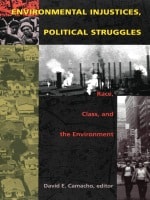
Environmental Injustices, Political Struggles
Race, Class and the EnvironmentDavid E. Camacho, ed.
Duke University Press, 1998
David E. Camacho’s collection of essays examines the value-laden choices behind the public policy that determines placement of commercial environmental hazards, points to the underrepresentation of people of color in the policymaking process, and discusses the lack of public advocates representing low-income neighborhoods and communities. This book combines empirical evidence and case studies—from the failure to provide basic services to the “colonias” in El Paso County, Texas, to the race for water in Nevada—and covers in great detail the environmental dangers posed to minority communities, including the largely unexamined communities of Native Americans. The contributors call for cooperation between national environmental interest groups and local grassroots activism, more effective incentives and disincentives for polluters, and the adoption by policymakers of an alternative, rather than privileged, perspective that is more sensitive to the causes and consequences of environmental inequities.
Environmental Injustices, Political Struggles is a unique collection for those interested in the environment, public policy, and civil rights as well as for students and scholars of political science, race and ethnicity, and urban and regional planning.
Contributors. C. Richard Bath, Kate A. Berry, John G. Bretting, David E. Camacho, Jeanne Nienaber Clarke, Andrea K. Gerlak, Peter I. Longo, Diane-Michele Prindeville, Linda Robyn, Stephen Sandweiss, Janet M. Tanski, Mary M. Timney, Roberto E. Villarreal, Harvey L. White
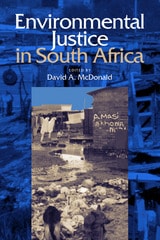
Environmental Justice in South Africa
David A. McDonald
Ohio University Press, 2002
Beginning with a history of the environmental justice movement in the country, the book explores a range of conceptual and practical questions: How does environmental justice relate to issues of marginalization and poverty in South Africa? What are the links between environmental justice and other schools of environmental thought? Is the legal system an appropriate tool for addressing environmental equity? How do race, class, and gender intersect in the South African environmental context?
The second half of the book is a more concrete exploration of environmental (in)justice in the country. These chapters are interspersed with real-life stories of struggles by workers and communities for environmental change. The book is an invaluable resource for South African and international audiences interested in the growing, and increasingly global, environmental justice movement.
Environmental Politics and Policy
Theories and EvidenceJames P. Lester, ed.
Duke University Press, 1995
From reviews of the First Edition:
"All the authors in this collection of essays are well known in the field of environmental policy. Their breadth of knowledge, and diversity of perspectives, permit a rich and comprehensive coverage of the scholarly work in this field."—Daniel McCool, Journal of Politics
"An excellent collection of readings with a strong emphasis on institutional analysis as an approach to environmental policy in the United States."—Robert Paehlke, Natural Resources and Environmental Administration
"No better review of the political science of environmental policy-making has yet been published."—Christopher J. Bailey, Environmental Politics
Contributors. David Colnic, Douglas Costain, John S. Dryzek, Riley E. Dunlap, Helen M. Ingram, Sheldon Kamieniecki, Michael E. Kraft, James P. Lester, Dean E. Mann, Evan J. Ringquist, Walter A. Rosenbaum, Mark E. Rushefsky, Gerald B. Thomas, Lettie M. Wenner

Environmental Program Evaluation
A PrimerEdited by Gerrit Knaap and Tschango John Kim: Foreword by Ravinder K. Jain
University of Illinois Press, 1998
Environmental Security
Simon Dalby
University of Minnesota Press, 2002
A critical look at the relationship between environmental degradation and international relations.
Since the end of the Cold War, environmental matters-especially the international implications of environmental degradation-have figured prominently in debates about rethinking security. But do the assumptions underlying such discussions hold up under close scrutiny? In this first treatment of environmental security from a truly critical perspective, Simon Dalby shows how attempts to explain contemporary insecurity falter over unexamined notions of both environment and security.
Adding environmental history, aboriginal perspectives, and geopolitics to the analysis explicitly suggests that the growing disruptions caused by a carbon-fueled and expanding modernity are at the root of contemporary difficulties. Environmental Security argues that rethinking security means revisiting questions of how we conceive identities as endangered and how we perceive threats to these identities. The book clearly demonstrates that the conceptual basis for critical security studies requires an extended engagement with political theory and with the assumptions of the modern subject as progressive political agent. Viewed thus on a global scale, the environmental security discourse raises profoundly troubling political questions as to who we are and what kind of world we are collectively making in our efforts to be secure.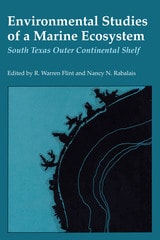
Environmental Studies of a Marine Ecosystem
South Texas Outer Continental ShelfEdited by R. Warren Flint and Nancy N. Rabalais
University of Texas Press, 1981
Environmental Studies of a Marine Ecosystem reports the temporal and spatial variation of both the living and nonliving resources of the south Texas outer continental shelf. As the last major study to have been conducted before the Ixtoc oil spill in 1979, it is of great importance as a record of the baseline conditions and ecosystem characteristics for both biologists and chemists studying the effects of the Campeche disaster on the marine environment. The book is the culmination of three years of field studies conducted for the Bureau of Land Management and contains information on the climatology, hydrology, and sedimentology of the region as well as data on the pelagic and benthic biota, environmental hydrocarbons and trace metals, and the microbiology of the area. In addition to the ecosystem description, the data are integrated to expose ecological relationships that exist and to identify those specific variables which are most important for the assessment and management of environmentally damaging impacts to the area.
Envisioning Nature, Science, and Religion
Jim Proctor
Templeton Press, 2009
Contemporary scholarship has given rise to several modes of understanding biophysical and human nature, each entangled with related notions of science and religion. Envisioning Nature, Science, and Religion represents the culmination of three years of collaboration by an international group of fourteen natural scientists, social scientists, humanists, and theologians. The result is an intellectually stimulating volume that explores how the ideas of nature pertain to science and religion.
Envisioning Nature, Science, and Religion offers a blend of scholarly rigor and readable prose that will be appreciated by anyone engaged in the fields of religion, philosophy, and the natural sciences.
Erosion
American Environments and the Anxiety of DisappearanceGina Caison
Duke University Press, 2024
Escaping Nature
How to Survive Global Climate ChangeOrrin H. Pilkey, Charles O. Pilkey, Linda P. Pilkey-Jarvis, Norma J. Longo, Keith C. Pilkey, Fred B. Dodson, and Hannah L. Hayes
Duke University Press, 2024
Ethnic Diversity and the Control of Natural Resources in Southeast Asia
A. Terry Rambo, Kathleen Gillogly, and Karl L. Hutterrer, Editors
University of Michigan Press, 1988
Everyday Environmentalism
Creating an Urban Political EcologyAlex Loftus
University of Minnesota Press, 2012
Everyday Environmentalism develops a conversation between marxist theories of everyday life and recent work in urban political ecology, arguing for a philosophy of praxis in relation to the politics of urban environments. Grounding its theoretical debate in empirical studies of struggles to obtain water in the informal settlements of Durban, South Africa, as well as in the creative acts of insurgent art activists in London, Alex Loftus builds on the work of key marxist thinkers to redefine “environmental politics.”
A marxist philosophy of praxis—that world-changing ideas emerge from the acts of everyday people—undergirds the book. Our daily reality, writes Loftus, is woven out of the entanglements of social and natural relations, and as such a kind of environmental politics is automatically incorporated into our lives. Nevertheless, one effect of the public recognition of global environmental change, asserts Loftus, has been a resurgence of dualistic understandings of the world: for example, that nature is inflicting revenge on arrogant human societies.
This ambitious work reformulates—with the assistance of such philosophers as Lukács, Gramsci, Lefebvre, and others—a politics of the environment in which everyday subjectivity is at the heart of a revolutionary politics.