Results by title
101 books match the query 'Environmentalism' and 11 start with e

Ecocritique
Contesting the Politics of Nature, Economy, and CultureTimothy W. Luke
University of Minnesota Press, 1997
Ecocriticism, whether coming from “back to nature” conservatives, Nature Conservancy liberals, or Earth First! radicals, is familiar enough. But when we listen do we really hear what these groups are saying? In a book that examines the terms of ecocriticism, Timothy W. Luke exposes how ecological critics, organizations, and movements manipulate our conception of the environment. Turning the tables on the ecocritics, Luke demonstrates how ecocriticism can move beyond its familiar confines to engage larger cultural, economic, and political questions.
Ecocritique rereads ecocriticism to reveal how power and economy, society and culture, community and technology compete over what are now widely regarded as the embattled ecosystems of nature. Luke considers in particular how the meanings and values attached to the environment by various groups—from the Worldwatch Institute, the Nature Conservancy, and Earth First! to proponents of green consumerism, social ecology, and sustainable development—articulate new visions of power and subjectivity for a post-Cold War era.
This accessibly written work opens with deep ecology and concludes with social ecology, along the way reconsidering thinkers with green philosophical leanings, including Herbert Marcuse, Paolo Soleri, and Murray Bookchin. In systematic critiques reexamining the cultural practices and ethical values of contemporary environmentalism, Luke highlights the political dilemmas of biocentrism and anthropocentrism in modern ecological thinking.
With its critical analysis of many contemporary environmental discourses and organizations, Ecocritique makes a major contribution to ongoing debates about the political relationships among nature, culture, and economics in the current global system.
Ecohumanism and the Ecological Culture
The Educational Legacy of Lewis Mumford and Ian McHargWilliam J. Cohen
Temple University Press, 2019
Lewis Mumford, one of the most respected public intellectuals of the twentieth century, speaking at a conference on the future environments of North America, said, “In order to secure human survival we must transition from a technological culture to an ecological culture.” In Ecohumanism and the Ecological Culture, William Cohen shows how Mumford’s conception of an educational philosophy was enacted by Mumford’s mentee, Ian McHarg, the renowned landscape architect and regional planner at the University of Pennsylvania. McHarg advanced a new way to achieve an ecological culture―through an educational curriculum based on fusing ecohumanism to the planning and design disciplines.
Cohen explores Mumford’s important vision of ecohumanism—a synthesis of natural systems ecology with the myriad dimensions of human systems, or human ecology―and how McHarg actually formulated and made that vision happen. He considers the emergence of alternative energy systems and new approaches to planning and community development to achieve these goals.
The ecohumanism graduate curriculum should become the basis to train the next generation of planners and designers to lead us into the ecological culture, thereby securing the educational legacy of both Lewis Mumford and Ian McHarg.
Ecologies of Comparison
An Ethnography of Endangerment in Hong KongTim Choy
Duke University Press, 2011
Ecology and the Environment
The Mechanisms, Marrings, and Maintenance of NatureR. J. Berry
Templeton Press, 2011
Ecology and the Environment: The Mechanisms, Marring, and Maintenance of Nature is the ninth title published in the Templeton Science and Religion Series, in which scientists from a wide range of fields distill their experience and knowledge into brief tours of their respective specialties. In this volume, R. J. Berry, a well-known leader in the field of ecology, describes the basic concepts of ecology and seeks to put them into a general context for a reader who lacks any scientific background.
El Salvador Reborn
Abortion, Environment, and the Politics of Survival in a Postwar NationMellissa Linton-Villafranco
University of Arizona Press, 2026
El Salvador Reborn examines the nation’s efforts to reshape its identity after the Peace Accords amid declining Cold War tensions. The book explores the criminalization of abortion and environmental activism in postwar El Salvador by focusing on two key organizations, Agrupación Ciudadana por la Despenalización del Aborto and Foro del Agua, highlighting their political strategies during a critical moment in El Salvador’s formation.
Author Mellissa Linton-Villafranco critically analyzes the political shift under the right-wing party, which sought to redefine notions of life and sovereignty. Historically associated with death squads, the right repositioned itself as a pro-life force by criminalizing abortion, amending the constitution to declare life begins at conception, and imposing penalties of up to thirty years. These measures marginalized women’s autonomy, creating a repressive legal environment centered on fetal rights. In response, feminist groups mobilized through protests, online campaigns, transnational alliances, and public art, advocating for reproductive justice that encompasses gender-based violence, health, and environmental sustainability.
Linton-Villafranco makes the case for a holistic conception of life that integrates land, body, and community sovereignty, weaving reproductive justice with environmental activism to promote a broader, interconnected understanding of life and rights in El Salvador.
Environmental Activism and the Urban Crisis
Baltimore, St. Louis, ChicagoRobert Gioielli
Temple University Press, 2015
Environmental Activism and the Urban Crisis focuses on the wave of environmental activism and grassroots movements that swept through America's older, industrial cities during the late 1960s and early 1970s. Robert Gioielli offers incisive case studies of Baltimore, St. Louis, and Chicago to show how urban activism developed as an impassioned response to a host of racial, social, and political conflicts. As deindustrialization, urban renewal, and suburbanization caused the decline of the urban environment, residents--primarily African Americans and working-class whites--organized to protect their families and communities from health threats and environmental destruction.
Gioielli examines various groups' activism in response to specific environmental problems caused by the urban crisis in each city. In doing so, he forms concrete connections between environmentalism, the African American freedom struggle, and various urban social movements such as highway protests in Baltimore and air pollution activism in Chicago. Eventually, the efforts of these activists paved the way for the emergence of a new movement-environmental justice.
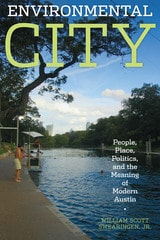
Environmental City
People, Place, Politics, and the Meaning of Modern AustinBy William Scott Swearingen, Jr.
University of Texas Press, 2010
As Austin grew from a college and government town of the 1950s into the sprawling city of 2010, two ideas of Austin as a place came into conflict. Many who promoted the ideology of growth believed Austin would be defined by economic output, money, and wealth. But many others thought Austin was instead defined by its quality of life. Because the natural environment contributed so much to Austin's quality of life, a social movement that wanted to preserve the city's environment became the leading edge of a larger movement that wanted to retain a unique sense of place. The "environmental movement" in Austin became the political and symbolic arm of the more general movement for place.
This is a history of the environmental movement in Austin—how it began; what it did; and how it promoted ideas about the relationships between people, cities, and the environment. It is also about a deeper movement to retain a sense of place that is Austin, and how that deeper movement continues to shape the way Austin is built today. The city it helped to create is now on the forefront of national efforts to rethink how we build our cities, reduce global warming, and find ways that humans and the environment can coexist in a big city.
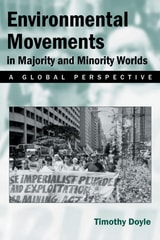
Environmental Movement in Majority and Minority Worlds
A Global PerspectiveDoyle, Timothy
Rutgers University Press, 2004
Environmental movements are among the most vibrant, diverse, and powerful social movements occurring today, across all corners of the globe. They range dramatically from government lobbyists raising campaign funds to save the North American spotted owl; to “Green Warriors” engaging in guerrilla conflict in the mountains of the Philippines; to small landholders and indigenous peoples vowing to die by meeting the waters of the Narmada River in India as it rises due to its damming.
Drawing on his primary fieldwork in six countries, environmental researcher Timothy Doyle argues that there is, in fact, no one global environmental movement; rather, there are many, and the differences among them far outweigh their similarities. Movements in the third world—such as those in India and the Philippines —tend to be oriented around issues of human health, shelter, food security, and survival; while those of the developed world—for example, the United States, England, Germany, and Australia —can afford to focus on post-materialist issues such as wilderness concerns and animal rights. Doyle also demonstrates that the consequences of these campaigns are as wide-ranging as their motives and methods.
Taking a much-needed step beyond the wealth of nation-centered accounts of environmentalism, this book makes an important contribution to studies concerned with global environmental problems and politics.
Environmentalism and Economic Justice
Two Chicano Struggles in the SouthwestLaura Pulido
University of Arizona Press, 1996
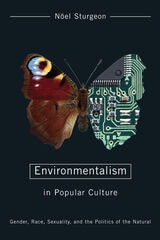
Environmentalism in Popular Culture
Gender, Race, Sexuality, and the Politics of the NaturalNoël Sturgeon
University of Arizona Press, 2009
Although there are other books that examine questions of culture and environment, this is the first book to employ a global feminist environmental justice analysis to focus on how racial inequality, gendered patterns of work, and heteronormative ideas about the family relate to environmental questions. Beginning in the late 1980s and moving to the present day, Sturgeon unpacks a variety of cultural tropes, including ideas about Mother Nature, the purity of the natural, and the allegedly close relationships of indigenous people with the natural world. She investigates the persistence of the “myth of the frontier” and its extension to the frontier of space exploration. She ponders the popularity (and occasional controversy) of penguins (and penguin family values) and questions assumptions about human warfare as “natural.”
The book is intended to provoke debates—among college students and graduate students, among their professors, among environmental activists, and among all citizens who are concerned with issues of environmental quality and social equality.
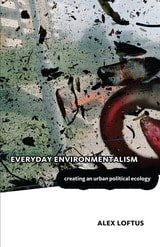
Everyday Environmentalism
Creating an Urban Political EcologyAlex Loftus
University of Minnesota Press, 2012
Everyday Environmentalism develops a conversation between marxist theories of everyday life and recent work in urban political ecology, arguing for a philosophy of praxis in relation to the politics of urban environments. Grounding its theoretical debate in empirical studies of struggles to obtain water in the informal settlements of Durban, South Africa, as well as in the creative acts of insurgent art activists in London, Alex Loftus builds on the work of key marxist thinkers to redefine “environmental politics.”
A marxist philosophy of praxis—that world-changing ideas emerge from the acts of everyday people—undergirds the book. Our daily reality, writes Loftus, is woven out of the entanglements of social and natural relations, and as such a kind of environmental politics is automatically incorporated into our lives. Nevertheless, one effect of the public recognition of global environmental change, asserts Loftus, has been a resurgence of dualistic understandings of the world: for example, that nature is inflicting revenge on arrogant human societies.
This ambitious work reformulates—with the assistance of such philosophers as Lukács, Gramsci, Lefebvre, and others—a politics of the environment in which everyday subjectivity is at the heart of a revolutionary politics.