Results by title
1832 books match the query 'Essays' and 96 start with e

ESSAYS ON MOUNTAINEERING
ARMAND E. SINGER
West Virginia University Press, 1982
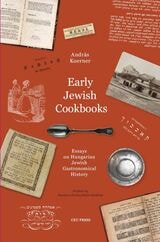
Early Jewish Cookbooks
Essays on Hungarian Jewish Gastronomical HistoryAndrás Koerner
Central European University Press, 2022
Winner of the Association of Jewish Libraries' 2022 Judaica Bibliography Award.
The seven essays in this volume focus such previously unexplored subjects as the world’s first cookbook printed in Hebrew letters, published in 1854, and a wonderful 19th-century Jewish cookbook, which in addition to its Hungarian edition was also published in Dutch in Rotterdam. The author entertainingly reconstructs the history of bólesz, a legendary yeast pastry that was the specialty of a famous, but long defunct Jewish coffeehouse in Pest, and includes the modernized recipe of this distant relative of cinnamon rolls. Koerner also tells the history of the first Jewish bookstore in Hungary (founded as early as in 1765!) and examines the influence of Jewish cuisine on non-Jewish food.
In this volume András Koerner explores key issues of Hungarian Jewish culinary culture in greater detail and more scholarly manner than what space restrictions permitted in his previous work Jewish Cuisine in Hungary: A Cultural History, also published by CEU Press, which received the prestigious National Jewish Book Award in 2020. The current essays confirm the extent to which Hungarian Jewry was part of the Jewish life and culture of the Central European region before their almost total language shift by the turn of the 20th century.
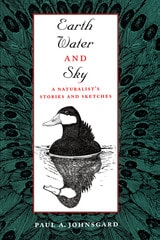
Earth, Water, and Sky
A Naturalist's Stories and SketchesBy Paul A. Johnsgard
University of Texas Press, 1999
"As I write this, I am sitting in a cabin at Cedar Point Biological Station in southwestern Nebraska.... The glorious elemental mixture of earth, water, and sky around me is the home of nearly three hundred species of birds, and comprises one of my favorite places in the world. Here no radio stations blare out the most recent results of meaningless sports events ... no traffic noises confound the senses. Instead the wind is the unquestioned dominating summer influence. The prairie grasses bend willingly and gracefully before it, and the leaves of the cottonwood trees convert its breezes into soft music."
Paul Johnsgard is one of America's most prominent ornithologists and a world authority on waterfowl behavior. In these popularly written, often lyrical essays, he describes some of his most fascinating encounters with birds, from watching the annual mating displays of prairie-chickens on a hilltop in Pawnee County, Nebraska, to attempting to solve some of the mysteries surrounding Australia's nearly flightless musk duck.
Reflecting his worldwide interests and travels, the birds Johnsgard describes inhabit many parts of the globe. Grouping the birds by the element they frequent most—earth, water, or sky—he weaves a wealth of accurate natural history into personal stories drawn from a lifetime of avian observation. And, as a bonus, Johnsgard's lovely pen-and-ink drawings illustrate each species he describes.
Earworm and Event
Music, Daydreams, and Other Imaginary RefrainsEldritch Priest
Duke University Press, 2022
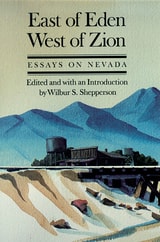
East Of Eden, West Of Zion
Essays On NevadaWilbur S. Shepperson
University of Nevada Press, 1989
A collection of essays in which a dozen historians and novelists present their impressions and concerns about "end of the century Nevada." Human expectations and illusions are seen as a backdrop for today's Nevada as a new human frontier. As an overview of Nevada society, this study deals with culture as well as economics, with tradition as well as rapid population growth. The essayists inquire whether the friction between acquisition and preservation, quick wealth and refined sensitivity, will build a more humane and enlightened society.
Eating Lightbulbs and Other Essays
Steve Fellner
The Ohio State University Press, 2021
Echo's Fugue
Desirae Matherly
The Ohio State University Press, 2019
Through a series of variations on the theme of love—unrequited, polyamorous, monogomous, scandalous, adulterous—Desirae Matherly’s Echo’s Fugue explores love in all its failures and delusions. Patterned on the unfinished The Art of Fugue by Johann Sebastian Bach which has been a mystery for centuries, Echo’s Fugue undertakes Bach’s project in prose—the tantalizing numerical correspondences throughout, the repetition of a single theme, the unfinished final piece.
Matherly’s essays appear as letters, indexes, narrative, or sentence diagrams, each defying the rules of the blank page. Song lyrics, obsession, Greek mythology, psychology, game theory, and human sexuality form a fragmented narrative about loss and unhealthy attachments. Mimicry of Bach’s fugues leads the author to questions about love, sex, desire, the “Bach or Stravinsky” paradigm in game theory, and relationships considered taboo by mainstream standards.
What authority speaks clearest with regard to love, sex, and desire—and is objectivity even possible? The final essay attempts to resolve this question while echoing the puzzle of Bach’s final unfinished fugue.
Economic Women
Essays on Desire and Dispossession in Nineteenth-Century British CultureEdited by Lana L. Dalley and Jill Rappoport
The Ohio State University Press, 2013
Ecopoetics
Essays in the FieldAngela Hume and Gillian Osborne
University of Iowa Press, 2018
Ecopoetics: Essays in the Field makes a formidable intervention into the emerging field of ecopoetics. The volume’s essays model new and provocative methods for reading twentieth and twenty-first century ecological poetry and poetics, drawing on the insights of ecocriticism, contemporary philosophy, gender and sexuality studies, black studies, Native studies, critical race theory, and disability studies, among others.
Contributors offer readings of a diverse range of poets, few of whom have previously been read as nature writers—from midcentury Beat poet Michael McClure, Objectivist poet George Oppen, and African American poets Melvin Tolson and Robert Hayden; to contemporary writers such as Diné poet Sherwin Bitsui, hybrid/ collage poets Claudia Rankine and Evelyn Reilly, emerging QPOC poet Xandria Phillips, and members of the Olimpias disability culture artists’ collective. While addressing preconceptions about the categories of nature writing and ecopoetics, contributors explore, challenge, and reimagine concepts that have been central to environmental discourse, from apocalypse and embodiment to toxicity and sustainability.
This collection of essays makes the compelling argument that ecopoetics should be read as “coextensive with post-1945 poetry and poetics,” rather than as a subgenre or movement within it. It is essential reading for any student or scholar working on contemporary literature or in the environmental humanities today.
Contributors: Joshua Bennett, Rob Halpern, Matt Hooley, Angela Hume, Lynn Keller, Petra Kuppers, Michelle Niemann, Gillian Osborne, Samia Rahimtoola, Joan Retallack, Joshua Schuster, Jonathan Skinner.
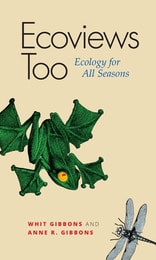
Ecoviews Too
Ecology for All SeasonsWhit Gibbons and Anne R. Gibbons
University of Alabama Press, 2017
Discover the wonders of ecology through the changing seasons of the natural world.
Whit Gibbons and Anne R. Gibbons’s Ecoviews Too: Ecology for All Seasons is based on the popular weekly column “Ecoviews,” published by numerous newspapers for more than thirty years. A follow-up to Ecoviews: Snakes, Snails and Environmental Tales, this lively and entertaining book provides a fascinating and thought-provoking look at the ecology of animals, plants, and their habitats, and promotes awareness of pressing environmental issues.
Because nature, in all its myriad and amazing manifestations, can be enjoyed all year round, this collection is conveniently divided into four sections paralleling the seasons and tracking the adaptations and responses of wildlife to the relentless changes that occur at any location over time. The ecological vignettes focus on seasonal happenings in the cycle of life. The authors not only draw parallels between the natural world and human activities but also highlight unique behaviors of various plant and animal species. They often use humor to get across their message regarding the need to protect our native species and the habitats they depend on for survival.
An intriguing and captivating publication, Ecoviews Too is comprised of fifty informative essays that address ecological topics such as camouflage and mimicry, hibernation and estivation, the human need to encounter scary animals, the mysteries of plant dormancy in winter, the comeback of the wild turkey coinciding with the decline of bobwhites, the chemistry behind the color change in fall leaves, and the top ten environmental problems facing the world today. Educating, entertaining, and delighting a general audience, especially those with an interest in nature, Ecoviews Too provides a useful resource for students and scientists alike.
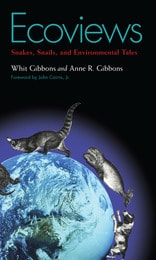
Ecoviews
Snakes, Snails, and Environmental TalesWhit Gibbons and Anne R. Gibbons
University of Alabama Press, 1998
Discover the wonder of nature through stories that connect science, wildlife, and everyday life.
This lively and entertaining book provides a fascinating and thought-provoking look at the ecology of animals, plants, and their habitats and promotes awareness of pressing environmental issues. The eight informative chapters deliver effective environmental messages and supply compelling insight into the natural world and the ecologists who investigate its many mysteries.
From a concerned ecological stance, the authors show that human relationship with other organisms and the environment is always complex and can be exhilarating, inspiring, humorous, and irritating, depending on perspectives and circumstances. Writing truly to inform and delight, they give a captivating variety of examples from the natural world in hopes of making readers of all ages more compassionate, more tolerant, and more sensitive to other living organisms and their interrelationships. The book celebrates the intrinsic worth of all plants and animals in order to motivate people in a unified effort to preserve the Earth's rich array of life forms. The preservation of the integrity of our planet's biodiversity is, the authors illustrate, critical to our own survival.
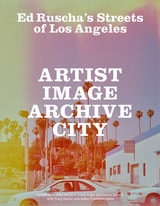
Ed Ruscha's Streets of Los Angeles
Artist, Image, Archive, CityAndrew Perchuk
J. Paul Getty Trust, The, 2025
In 1966, Ed Ruscha drove a car rigged with a motorized camera to capture Los Angeles’ most iconic street: Sunset Boulevard. He created a time capsule of its famed facades, beginning a sixty-year-long commitment to documenting the changing urban landscape of postwar Los Angeles. The Streets of Los Angeles project that comprises these photographs is likely the most comprehensive artistic record of any city, with over 900,000 images of major thoroughfares. Ruscha’s photographs constitute an unparalleled visual chronicle of both iconic and everyday sites in L.A., including popular music venues, neighborhood restaurants, and billboards promoting Hollywood’s latest blockbusters.
In this volume, scholars from disciplines such as urban planning, cultural geography, architecture, art history, and musicology explore the Streets of Los Angeles Archive as a rich repository for analyzing Ruscha’s practice and the city’s visual culture. Using his photographs and new data visualizations, the authors consider what it means to interpret an archive mostly accessible through digital technologies, and they demonstrate how histories of art have been indelibly reshaped since the advent of the information age in the 1960s.
This publication was created using Quire™, a multiformat publishing tool from Getty. The free online edition of this open-access publication is available at www.getty.edu/publications/ruscha/ and includes video, data visualizations, and zoomable illustrations. Free PDF and EPUB downloads of the book are also available.
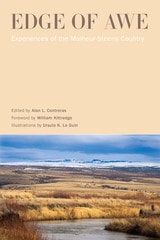
Edge of Awe
Experiences of the Malheur-Steens CountryAlan L. Contreras
Oregon State University Press, 2019
Edge of Awe celebrates the immense variety of human experience in the Malheur-Steens region. This high-desert marsh country has long been a place of human habitation, work, and recreation, but this compendium is weighted toward the writing of visitors over the past one hundred years. It encompasses a wide range of experiences, such as fishing the Blitzen River, attending the Steens Running Camp, leading a mule train on Steens mountain, looking for rare migrant birds, boating on the great marshes, and much more.
Anyone who has visited the awe-inspiring Malheur-Steens country or plans to do so, and anyone with an interest in the region, will find inspiration in this literary companion.
CONTRIBUTORS
Chas Biederman
Charles E. Bendire
Greg Bryant
Sean Burns
Alan L. Contreras
Harry Fuller
Ira N. Gabrielson
Quinton Hallett
Ada Hastings Hedges
David Hedges
Hendrik Herlyn
Meli Hull
William Kittredge
Ursula K. Le Guin
Maitreya
David B. Marshall
John F. Marshall
Tom McAllister
Thomas C. Meinzen
Peter Pearsall
Dallas Lore Sharp
William Stafford
Noah K. Strycker
Peter Walker
Ellen Waterston
C.E.S. Wood
Edith Wharton in Context
Essays on IntertextualityAdeline R. Tintner
University of Alabama Press, 1999
Tintner provides a detailed analysis of the complex interplay between Wharton and James—how they influenced each other and how some of their writings operate as homages or personal jokes. So deeply was James in Wharton’s confidence, Tintner argues, that he provided her with source models for a number of her characters. In addition, Wharton found in his fiction structures for her own, especially for The Age of Innocence.
Tintner also brings her considerable knowledge of art history to bear in her study of art allusions in Wharton’s work. Wharton’s response both to the Italian painters active before Raphael and to the English Pre-Raphaelites of a generation before her own is analyzed here in three essays. These pieces demonstrate Wharton’s sensibility to changes in art tastes and collecting, the inheritance of Rossetti’s revolutionary paintings in the unfinished novel, The Buccaneers, and the importance of home in The Glimpses of the Moon, as demonstrated by Wharton’s use of Tiepolo’s fresco in the church of Scalzi.
Tintner concludes by considering Wharton’s literary legacy and who Wharton has figured in the imaginations of recent writers, including Richard Howard, Louis Auchincloss, and Cathleen Schine. Tintner finds some part of Wharton’s personality or work evoked in a number of contemporary works and argues that this presence signals the beginning of an increasing influence.
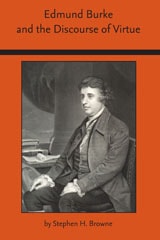
Edmund Burke and the Discourse of Virtue
Stephen Howard Browne
University of Alabama Press, 2007
"A major accomplishment in the study of Burke." —Choice
More than 200 years after his death, Edmund Burke remains among the most influential conservative writers in the Anglophone world. Burke’s relevance has only grown as the nature of what it means to be a conservative has become hotly contested.
And yet Burke is often discussed more than he is read. Worse, his rhetoric is often pressed into the service of other ideologies. In Edmund Burke and the Discourse of Virtue, Stephen Browne of Pennsylvania State University subjects Burke’s work to the close textual analysis it has never received.
The result of Browne's study is to present Burke and his work in a light that was clearly essential to Burke himself, one that illuminates the link between rhetoric and action that is key to understanding Burke, his career, his work, and his influence on contemporary conservatism.
Readers interested in the development of conversative philosophy, politics, and writing from its earliest roots will value this rare and illuminating work.

Education for Democracy
Essays and AddressesJohn Johnston
University of Minnesota Press, 1934
El chico más duro que conocimos
El viejo nuevo Oeste: Una historia personalFrank Bergon
University of Nevada Press, 2027
Del autor aclamado por la crítica Frank Bergon llega una nueva narración personal sobre el Valle de San Joaquín en California. Este libro que acompaña a Two-Buck Chuck & The Marlboro Man nos devuelve a un viejo Oeste que se funde con las realidades del nuevo Oeste, donde el cambio rápido es un rasgo común y los recuerdos son de belleza rural. A pesar de las transformaciones físicas provocadas por la tecnología y la modernidad en el siglo XXI, siguen existiendo elementos de una forma de pensar más antigua, y Bergon rastrea su presencia utilizando experiencias de su propia familia y amigos.
La camaradería comunitaria, el amor por la tierra y sus alimentos, y la alegría por el trabajo duro bien hecho describen las vidas occidentales ignoradas o mal representadas en la mayoría de las historias sobre California y el Oeste. Sin embargo, la nostalgia no impulsa el regreso intelectual de Frank Bergon a ese mundo. También prevalecía una cultura de la lucha, la ignorancia sobre la adicción al alcohol, el trabajo brutal, y una mentalidad feudal que creaba un dolor que era mejor perder y dar por perdido.
A través de todo ello, lo que emerge de sus retratos y ensayos es una revelación de la vida en los pueblos y ranchos rurales del Oeste. Un lugar en el que se acelera la forma americana de extirpar el pasado y alterar violentamente la tierra. Lo que Bergon ha escrito es el retrato de un pasado y unas gentes que dieron forma al país que él llamó hogar.
Electronic Elsewheres
Media, Technology, and the Experience of Social SpaceChris Berry
University of Minnesota Press, 2009
Media do not simply portray places that already exist; they actually produce them. In exploring how world populations experience "place" through media technologies, the essays included here examine how media construct the meanings of home, community, work, nation, and citizenship.
Tracing how media reconfigure the boundaries between public and private-and global and local-to create "electronic elsewheres," the essays investigate such spaces and identities as the avatars that women are creating on Web sites, analyze the role of satellite television in transforming Algerian neighborhoods, inquire into the roles of radio and television in Israel and India, and take a skeptical look at the purported novelty of the "new media home."
Contributors: Asu Aksoy, Istanbul Bilgi U; Charlotte Brunsdon, U of Warwick; Ratiba Hadj-Moussa, York U (Toronto); Tamar Liebes-Plesner, Hebrew U; David Morley, Goldsmiths, U of London; Lisa Nakamura, U of Illinois; Arvind Rajagopal, New York U; Kevin Robins, Goldsmiths, U of London; Jeffrey Sconce, Northwestern U; Marita Sturken, New York U; and Shunya Yoshimi, U of Tokyo.
Elemental Ecocriticism
Thinking with Earth, Air, Water, and FireJeffrey Jerome Cohen
University of Minnesota Press, 2015
For centuries it was believed that all matter was composed of four elements: earth, air, water, and fire in promiscuous combination, bound by love and pulled apart by strife. Elemental theory offered a mode of understanding materiality that did not center the cosmos around the human. Outgrown as a science, the elements are now what we build our houses against. Their renunciation has fostered only estrangement from the material world.
The essays collected in Elemental Ecocriticism show how elemental materiality precipitates new engagements with the ecological. Here the classical elements reveal the vitality of supposedly inert substances (mud, water, earth, air), chemical processes (fire), and natural phenomena, as well as the promise in the abandoned and the unreal (ether, phlogiston, spontaneous generation).
Decentering the human, this volume provides important correctives to the idea of the material world as mere resource. Three response essays meditate on the connections of this collaborative project to the framing of modern-day ecological concerns. A renewed intimacy with the elemental holds the potential of a more dynamic environmental ethics and the possibility of a reinvigorated materialism.
Eloquence and Mere Life
Essays on the Art of PoetryAlan Williamson
University of Michigan Press, 1994
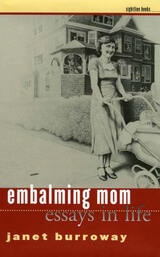
Embalming Mom
Essays in LifeJanet Burroway
University of Iowa Press, 2004
Janet Burroway followed in the footsteps of Sylvia Plath. Like Plath, she was an earlyMademoiselle guest editor in New York, an Ivy League and Cambridge student, an aspiring poet-playwright-novelist in the period before feminism existed, a woman who struggled with her generation's conflicting demands of work and love. Unlike Plath, Janet Burroway survived.
In sixteen essays of wit, rage, and reconciliation, Embalming Mom chronicles loss and renaissance in a life that reaches from Florida to Arizona across to England and home again. Burroway brilliantly weaves her way through the dangers of daily life—divorcing her first husband, raising two boys, establishing a new life, scattering her mother's ashes and sorting the meager possessions of her father. Each new danger and challenge highlight the tenacious will of the body and spirit to heal.
“Ordinary life is more dangerous than war because nobody survives,” Burroway contemplates in the essay “Danger and Domesticity,” yet each of her meditations reminds us that it's our daily rituals and trials that truly keep us alive.
Embers of the Past
Essays in Times of DecolonizationJavier Sanjinés C.
Duke University Press, 2013
Embodying Biodiversity
Sensory Conservation as Refuge and SovereigntyTerese V. Gagnon
University of Arizona Press, 2024
Harnessing a myriad of methodologies and research spanning multiple continents, this volume delves into the power of everyday forms of biodiversity conservation, motivated by sensory and embodied engagement with plants. Through an array of interdisciplinary contributions, the authors argue that the vast majority of biodiversity conservation worldwide is carried out not by large-scale, hierarchical initiatives but by ordinary people who cultivate sensory-motivated, place-based bonds with plants.
Acknowledging the monumental role of everyday champions in tending biodiversity, the contributors write that this caretaking is crucial to countering ecological harm and global injustice stemming from colonial violence and racial capitalism.
Contributors
Mike Anastario
Ally Ang
Antonia Barreau
Julián Caviedes
Chen Chen
Evelyn Flores
Terese V. Gagnon
José Tomás Ibarra
Fred L. Joiner
Gary Nabhan
Virginia D. Nazarea
Shannon A. Novak
Valentina Peveri
Emily Ramsey
Yasuaki Sato
Justin Simpson
David E. Sutton
Emergency
Reading the Popol Vuh in a Time of CrisisEdgar Garcia
University of Chicago Press, 2022
Written during the lockdown in Chicago in the depths of the COVID-19 pandemic, these essays consider the Popol Vuh as a work that was also written during a time of feverish social, political, and epidemiological crisis as Spanish missionaries and colonial military deepened their conquest of indigenous peoples and cultures in Mesoamerica. What separates the Popol Vuh from many other creation texts is the disposition of the gods engaged in creation. Whereas the book of Genesis is declarative in telling the story of the world’s creation, the Popol Vuh is interrogative and analytical: the gods, for example, question whether people actually need to be created, given the many perfect animals they have already placed on earth.
Emergency uses the historical emergency of the Popol Vuh to frame the ongoing emergencies of colonialism that have surfaced all too clearly in the global health crisis of COVID-19. In doing so, these essays reveal how the authors of the Popol Vuh—while implicated in deep social crisis—nonetheless insisted on transforming emergency into scenes of social, political, and intellectual emergence, translating crisis into creativity and world creation.
Empires of Hygiene, Volume 6
Judith Farquhar and Marta E. Hanson, eds.
Duke University Press, 0
Featuring a variety of topics and methods, essays in Empires of Hygiene compare the disease that is physically suffered to that which is scientifically classified and identified as a social problem. Diseases such as leprosy and STDs, which have biomedical identities in Western settings but in Asia emerge as inseparable from certain colonial regimes, are examined. Spermatorrhea—a disease that compromises the male body’s ability to reproduce—is discussed in relation to the disarray of the Chinese Republic during the mid-twentieth century. The collection also addresses imperial themes of prewar Japan in the literary works of Mori Rintaro and Shimazaki Tison.
Contributors. Warwick Anderson, Michael Bourdaghs, Judith Farquhar, Marta Hanson, Thomas LaMarre, Philippa Levine, Hugh Shapiro, Nathan Sivin

Encountering the Past in Nature
Essays in Environmental HistoryTimo Myllyntaus
Ohio University Press, 2000
The essays in Encountering the Past in Nature provide various approaches to the new discipline. Experts with diverse educational backgrounds tackle important issues in environmental history, ranging from the intellectual formation of environmental concepts to case studies of forest history and animal extinction. Most essays in the collection focus on the issue of wilderness and the various uses of forest resources. Encountering the Past in Nature also offers introductory essays on the historiography and methodology of this field of historical study.
Encountering the Past in Nature is a useful addition to the introductory texts currently available in the United States.
Endlings
Fables for the AnthropoceneLydia Pyne
University of Minnesota Press, 2022
Amid the historical decimation of species around the globe, a new way into the language of loss
An endling is the last known individual of a species; when that individual dies, the species becomes extinct. These “last individuals” are poignant characters in the stories that humans tell themselves about today’s Anthropocene. In this evocative work, Lydia Pyne explores how discussion about endlings—how we tell their histories—draws on deep traditions of storytelling across a variety of narrative types that go well beyond the science of these species’ biology or their evolutionary history.
Endlings provides a useful and thoughtful discussion of species concepts: how species start and how (and why) they end, what it means to be a “charismatic” species, the effects of rewilding, and what makes species extinction different in this era. From Benjamin the thylacine to Celia the ibex to Lonesome George the Galápagos tortoise, endlings, Pyne shows, have the power to shape how we think about grief, mourning, and loss amid the world’s sixth mass extinction.
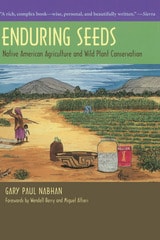
Enduring Seeds
Native American Agriculture and Wild Plant ConservationGary Paul Nabhan; Forewords by Wendell Berry and Miguel Altieri
University of Arizona Press, 2002
Gary Paul Nabhan here reveals the rich diversity of plants found in tropical forests and their contribution to modern crops, then tells how this diversity is being lost to agriculture and lumbering. He then relates "local parables" of Native American agriculture—from wild rice in the Great Lakes region to wild gourds in Florida—that convey the urgency of this situation and demonstrate the need for saving the seeds of endangered plants. Nabhan stresses the need for maintaining a wide gene pool, not only for the survival of these species but also for the preservation of genetic strains that can help scientists breed more resilient varieties of other plants.
Enduring Seeds is a book that no one concerned with our environment can afford to ignore. It clearly shows us that, as agribusiness increasingly limits the food on our table, a richer harvest can be had by preserving ancient ways.
This edition features a new foreword by Miguel Altieri, one of today's leading spokesmen for sustainable agriculture and the preservation of indigenous farming methods.
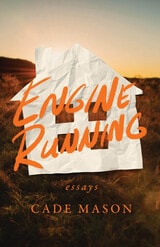
Engine Running
EssaysCade Mason
The Ohio State University Press, 2022
Engine Running explores debut author Cade Mason’s gradual distancing from home and old selves alongside an increasingly fractured family doing the same. Starting at the beginning of his parents’ love and working past its end, he combs through memory to piece together a portrait of a family then and now: of a father, reeling after a blindsiding divorce; of a mother, anxious to move on; of a sister, caught in the crossfire; and of a son, learning to embrace his sexuality even as he fears that his own loves may have deepened the rift between his parents.
Lush and innovative, these essays contemplate childhood memories and family secrets, religion and queerness in the rural South, and the ways rituals and contours of manhood are passed through generations. Most of all, we feel with Mason what it is to grapple with and love a place even as you yearn to leave.
Environment at the Margins
Literary and Environmental Studies in AfricaByron Caminero-Santangelo
Ohio University Press, 2011
Environment at the Margins brings literary and environmental studies into a robust interdisciplinary dialogue, challenging dominant ideas about nature, conservation, and development in Africa and exploring alternative narratives offered by writers and environmental thinkers. The essays bring together scholarship in geography, anthropology, and environmental history with the study of African and colonial literatures and with literary modes of analysis. Contributors analyze writings by colonial administrators and literary authors, as well as by such prominent African activists and writers as Ngugi wa Thiong’o, Mia Couto, Nadine Gordimer, Wangari Maathai, J. M. Coetzee, Zakes Mda, and Ben Okri. These postcolonial ecocritical readings focus on dialogue not only among disciplines but also among different visions of African environments. In the process, Environment at the Margins posits the possibility of an ecocriticism that will challenge and move beyond marginalizing, limiting visions of an imaginary Africa.
Contributors:
Jane Carruthers
Mara Goldman
Amanda Hammar
Jonathan Highfield
David McDermott Hughes
Roderick P. Neumann
Rob Nixon
Anthony Vital
Laura Wright
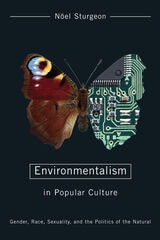
Environmentalism in Popular Culture
Gender, Race, Sexuality, and the Politics of the NaturalNoël Sturgeon
University of Arizona Press, 2009
Although there are other books that examine questions of culture and environment, this is the first book to employ a global feminist environmental justice analysis to focus on how racial inequality, gendered patterns of work, and heteronormative ideas about the family relate to environmental questions. Beginning in the late 1980s and moving to the present day, Sturgeon unpacks a variety of cultural tropes, including ideas about Mother Nature, the purity of the natural, and the allegedly close relationships of indigenous people with the natural world. She investigates the persistence of the “myth of the frontier” and its extension to the frontier of space exploration. She ponders the popularity (and occasional controversy) of penguins (and penguin family values) and questions assumptions about human warfare as “natural.”
The book is intended to provoke debates—among college students and graduate students, among their professors, among environmental activists, and among all citizens who are concerned with issues of environmental quality and social equality.
Envisioning Nature, Science, and Religion
Jim Proctor
Templeton Press, 2009
Contemporary scholarship has given rise to several modes of understanding biophysical and human nature, each entangled with related notions of science and religion. Envisioning Nature, Science, and Religion represents the culmination of three years of collaboration by an international group of fourteen natural scientists, social scientists, humanists, and theologians. The result is an intellectually stimulating volume that explores how the ideas of nature pertain to science and religion.
Envisioning Nature, Science, and Religion offers a blend of scholarly rigor and readable prose that will be appreciated by anyone engaged in the fields of religion, philosophy, and the natural sciences.
Envisioning Scripture
Joseph Smith’s Revelations in Their Early American ContextsColby Townsend
Signature Books, 2022
Contributors include Catherine A. Brekus, William Davis, Elizabeth Fenton, Kathleen Flake, Paul Gutjahr, Jared Hickman, Susan Juster, Seth Perry, Laura Thiemann Scales, and Roberto A. Valdeón.
Eric Voegelin's Late Meditations and Essays
Critical Commentary CompanionsMichael Franz
St. Augustine's Press, 2023
Voegelin’s books gave rise to a vast secondary literature that continues to grow, yet the exceptionally impactful late essays and meditative works have never received the scholarly commentaries they deserve because they were published originally as journal articles or chapters in edited collections. This volume remedies that shortcoming with 14 critical analyses that elucidate the late essays while also addressing their implications for the entirety of Voegelin’s thought. The commentaries will prove invaluable to students and scholars in political science, philosophy, history, theology, and other disciplines, serving as a companion piece to the singularly important Vol. 12 of Voegelin’s Collected Works, Published Essays 1966–1985.
Erotikon
Essays on Eros, Ancient and ModernEdited by Shadi Bartsch and Thomas Bartscherer
University of Chicago Press, 2005
An idea charged with paradox, eros has always defied categorization, and yet it cannot—it will not—be ignored. Erotikon aims to raise the difficult question of what, if anything, unifies the erotic manifold. How is eros in a sculpture like eros in a poem? Does the ancient story of Cupid and Psyche still speak meaningfully to modern readers, and if so, why? Is Plato's eros the same as Freud's? Or Proust's? And what is the erotic dimension in Nietzsche's thought? While each essay takes on a specific issue, together they constitute a wide-ranging conversation in which these broader questions are at play. A compilation of the latest, best efforts to reckon with eros, Erotikon will appeal not just to scholars and educators, but also to artists and critics, to the curious and the disillusioned, to the prurient and the prudent.
Escalante
The Best Kind of NothingText by Brooke Williams; Photographs by Chris Noble
University of Arizona Press, 2006

Essay Film and Narrative Techniques
Screen-writing Non-fictionEdited by Romana Turina and Kiki Tianqi Yu
Intellect Books, 2025
Uniting filmmakers and practice-led researchers, Essay Film and Narrative Techniques: Screen-writing Non-fiction explores the evolving language of essay film through various methods of narration, including production diaries, self-critiques, interviews, and theoretical analyses. Including canonical works and unconventional approaches, this collection emphasizes how essay films blur the lines between personal expression and collective storytelling.
In this volume, renowned scholars and practitioners unpack the conceptual and contextual dimensions of screenwriting for essay film, considering its role as both a cinematic and research tool. Whether reflecting on the personal camera or hybrid creative methodologies, the essays provide invaluable insights into how essay films are written and realized.
With its interdisciplinary scope and innovative approach, this work is a beneficial resource for academics, filmmakers, and students of documentary and experimental cinema, offering a nuanced understanding of how screenwriting shapes nonfiction storytelling.
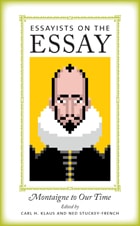
Essayists on the Essay
Montaigne to Our TimeCarl H. Klaus and Ned Stuckey-French
University of Iowa Press, 2012
The first historically and internationally comprehensive collection of its kind, Essayists on the Essay is a path-breaking work that is nothing less than a richly varied sourcebook for anyone interested in the theory, practice, and art of the essay. This unique work includes a selection of fifty distinctive pieces by American, Canadian, English, European, and South American essayists from Montaigne to the present—many of which have not previously been anthologized or translated—as well as a detailed bibliographical and thematic guide to hundreds of additional works about the essay.
From a buoyant introduction that provides a sweeping historical and analytic overview of essayists’ thinking about their genre—a collective poetics of the essay—to the detailed headnotes offering pointed information about both the essayists themselves and the anthologized selections, to the richly detailed bibliographic sections, Essayists on the Essay is essential to anyone who cares about the form.
This collection provides teachers, scholars, essayists, and readers with the materials they need to take a fresh look at this important but often overlooked form that has for too long been relegated to the role of service genre—used primarily to write about other more “literary” genres or to teach young people how to write. Here, in a single celebratory volume, are four centuries of commentary and theory reminding us of the essay’s storied history, its international appeal, and its relationship not just with poetry and fiction but also with radio, film, video, and new media.

Essays and Studies in English and Comparative Literature
Members of the English Department of the University of Michigan
University of Michigan Press, 1935
Essays and Studies in English and Comparative Literature
Members of the English Department of the University of Michigan
University of Michigan Press, 1932
Essays in Ancient Philosophy
Michael Frede
University of Minnesota Press, 1987
Essays in Ancient Philosophy was first published in 1987. Minnesota Archive Editions uses digital technology to make long-unavailable books once again accessible, and are published unaltered from the original University of Minnesota Press editions.
To understand ancient philosophy "in its concrete, complex detail," Michael Frede says, "one has also to look at all the other histories to which it is tied by an intricate web of casual connections which run both ways." Frede's distinctive approach to the history of ancient philosophy is closely tied to his specific interests within the field - the Hellenistic philosophers and those of late antiquity, who are the primary subjects of this book. Long ignored or even maligned, the Stoics and Skeptics, medical philosophers, and grammarians are extremely interesting once their actual views are reconstructed and it is possible to recognize their ties to earlier and later philosophical thought. Refusing to study them as paradigms of achievement, or to seek purely philosophical explanations for their views, Frede draws instead upon those "other histories"—of religion, social structure, law and politics—to illuminate their work and to show how it was interpreted and transformed by succeeding generations.
Essays in Ancient and Modern Historiography
Arnaldo Momigliano
University of Chicago Press, 2012
Essays in French Colonial History
Proceedings of the 21st Annual Meeting of the French Colonial Historical SocietyA.J.B. Johnston
Michigan State University Press, 1997
On 31 May - 3 June 1995, more than 200 participants gathered in Sydney and at Fortress Louisbourg, Nova Scotia, for the 21st annual conference of the French Colonial Historical Society. Essays in French Colonial History contains seventeen of the best articles presented at this meeting. It is a wide-ranging collection that explores many new and innovative facets of the French experience outre mer. The contributors, a mix of established experts and younger scholars, examine French activity in North America, the West Indies, Africa, and South America and focus on issues military, social, cultural, native, and political history.
Among the subject areas explored are: the 16th century French colonies in Brazil and Florida; Victor Hugues and the Reign of Terror on Guadeloupe; commerce and the distinctiveness of Louisbourg; the importance of letter-writing and compagnonnage; unresolved territory of the Creek Nation; case studies in the area of transition patrimonial; French colonial interests and policies in Atlantic Canada, Africa, and South America; attitudes among African Americans in post-French St. Louis; and a research report on the Historical Atlas of Quebec.
Essays in History
Financial, Economic, PersonalCharles P. Kindleberger
University of Michigan Press, 1999
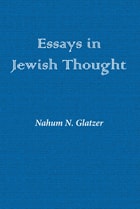
Essays in Jewish Thought
Nahum Glatzer
University of Alabama Press, 2009
An exploration of the ideas that have shaped Jewish faith, culture, and identity.
In Essays in Jewish Thought, renowned scholar Nahum N. Glatzer offers a thoughtful and illuminating exploration of the intellectual, spiritual, and cultural traditions that have shaped Judaism across centuries. Drawing upon his deep knowledge of Jewish history, philosophy, theology, and literature, Glatzer examines the ideas, texts, and personalities that have influenced Jewish religious life and identity from antiquity to the modern era.
Through a collection of insightful essays, readers encounter enduring questions concerning faith, ethics, revelation, community, and the relationship between tradition and modernity. Glatzer's scholarship highlights the richness and diversity of Jewish thought while demonstrating how Jewish thinkers have engaged with changing historical circumstances and universal human concerns. His clear and accessible writing makes complex philosophical and theological concepts approachable without sacrificing intellectual depth.
Essays in Jewish Thought provides a valuable introduction to key themes in Jewish intellectual history and offers fresh perspectives for both newcomers and seasoned students of Judaism. The volume serves as a meaningful resource for understanding the foundations of Jewish belief, practice, and cultural continuity. Ideal for courses in Jewish studies, religious studies, theology, and philosophy, this collection remains an important contribution to the study of one of the world's most enduring religious and intellectual traditions.
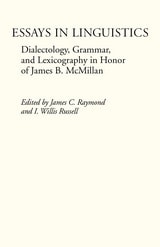
Essays in Linguistics
Dialectology, Grammar, and Lexicography in Honor of James B. McmillanJames C. Raymond
University of Alabama Press, 2004
"Raymond and Russell have fashioned a lively, useful volume. . . . The ability and integrity of the contributors make much of the difference, but the editors have given the book direction by soliciting state of the art essays in three fields . . . dialectology (the articles represent area linguistics at its best), grammar and usage (Algeo on usage shibboleths is particularly fine), and lexicography (a delight)."
—Choice
"These essays are quietly unassuming in tone but highly useful."
—Language in Society
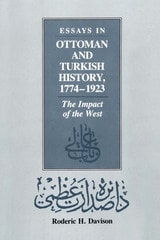
Essays in Ottoman and Turkish History, 1774-1923
The Impact of the WestBy Roderic H. Davison
University of Texas Press, 1990
The effect of Western influence on the later Ottoman Empire and on the development of the modern Turkish nation-state links these twelve essays by a prominent American scholar. Roderic Davison draws from his extensive knowledge of Western diplomatic history and Turkish history to describe a period in which the actions of the Great Powers, incipient and rising nationalisms, and Westernizing reforms shaped the destiny of the Ottoman Empire and the creation of the new Turkish Republic.
Eleven of the essays were previously published in widely scattered journals and multi-authored volumes. The first of these provides a general survey of Turkish and Ottoman history, from early Turkish times to the end of the Empire. The following essays continue chronologically from 1774, detailing some of the changes in the nineteenth-century Empire. Several themes recur. One is the impact of Western ideas and institutions and the resistance to that influence by some elements in the Empire. Another concerns the diplomatic pressure exerted by the Great Powers of Europe on the Empire, which amounted at times to direct intervention in Ottoman domestic affairs. Taken together, the essays portray a confluence of civilizations as well as a clash of cultures.
Professor Davison has written an interpretive introduction that sets out the historical trends running throughout the book. In addition, he includes a previously unpublished article on the advent of the electric telegraph in the Ottoman Empire to show how the adoption of a Western technological advance could affect many areas of life.
Of particular interest to students of Ottoman and Middle East history, these essays will also be valuable for everyone concerned with modernization in developing nations. Davison's interpretations and keen methodological sense also shed new light on several aspects of European diplomatic history.
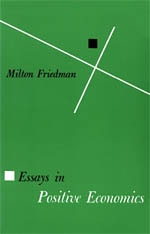
Essays in Positive Economics
Milton Friedman
University of Chicago Press, 1966
"His critical blast blows like a north wind against the more pretentious erections of modern economics. It is however a healthy and invigorating blast, without malice and with a sincere regard for scientific objectivity."—K.E. Boulding, Political Science Quarterly
"Certainly one of the most engrossing volumes that has appeared recently in economic theory."—William J. Baumol, Review of Economics and Statistics
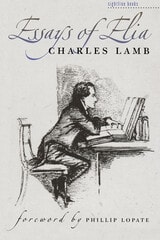
Essays of Elia
Charles Lamb
University of Iowa Press, 2003
Charles Lamb, one of the most engaging personal essayists of all time, began publishing his unforgettable, entertaining Elia essays in the London Magazine in 1820; they were so immediately popular that a book-length collection was published in 1823. Inventing the persona of “Elia” allowed Lamb to be shockingly honest and to gain a playful distance for self-examination. The resulting essays touch upon a wide range of compelling subjects from the deliciously humorous “Dissertation upon Roast Pig” to the poignantly reflective “New Year's Eve.” Yet collectively they also comprise a fascinating personal memoir, veiled under the pseudonymous disguise of Elia. Now back in print with a new foreword by the distinguished personal essayist Phillip Lopate and with useful annotations, Essays of Elia will provide a delicious stylistic treat for all readers.
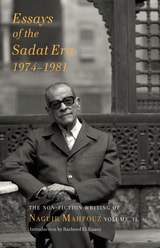
Essays of the Sadat Era
The Non-Fiction of Naguib Mahfouz: Volume IINaguib Mahfouz
Gingko, 2025
In these essays of the Sadat era, published in the state-owned Al-Ahram newspaper, Mahfouz seems an unreliable narrator. The tension between an author who rails against censorship, yet is bound within its confines, runs through this fascinating body of nonfiction writing. Nonetheless, Mahfouz’s own thoughts are unmistakably present. We gain his insight into diverse political topics, such as socioeconomic class, democracy and dictatorship, and Islam and extremism, topics which still seem highly pertinent to the situation in Egypt today.
A vital accompaniment to his literature, this collected work is contemporaneous with Mahfouz’s fictional works such as Karnak Café, The Harafish, and Arabian Nights and Days. Essays of the Sadat Era is the second of four volumes in which Mahfouz’s nonfiction work is translated into English for the first time.