Results by title
187 books match the query 'Essays & Travelogues' and 7 start with e
Ecuador
A Travel JournalHenri Michaux
Northwestern University Press, 2001
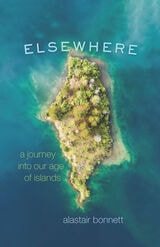
Elsewhere
A Journey into Our Age of IslandsAlastair Bonnett
University of Chicago Press, 2020
There are millions of islands on our planet. New islands are being built at an unprecedented rate, for tourism and territorial ambition. Many are also disappearing, besieged by rising sea levels. The story of our world’s islands is one of the great dramas of our time, and it is playing out around the planet—islands are sprouting or being submerged everywhere from the South China Sea to the Atlantic. Elsewhere is the story of this strange and mesmerizing planetary spectacle.
In this book, explorer and geographer Alastair Bonnett takes us on a thought-provoking tour of the world’s most fascinating islands. He traveled the globe to provide a firsthand look at numerous islands, sketching a vivid likeness of each one he visited. From a “crannog,” an ancient artificial island in a Scottish loch, to the militarized artificial islands China is building; from the disappearing islands that remain the home of native Central Americans to the ritzy new islands of Dubai; from Hong Kong to the Isles of Scilly—all have compelling stories to tell. As we journey around the world with Bonnett, he addresses urgent contemporary issues such as climate change, economic inequality, and the changing balance of world power as reflected in the fates of islands. Along the way, we also learn about the many ways islands rise and fall, the long and little-known history of human island-building and the prospect that the inland hills and valleys will one day be archipelagos.
Featuring Bonnett’s charming hand-drawn maps and 33 full-color photos, Elsewhere is a captivating travel book for any armchair adventurer.
Eothen
Traces of Travel Brought Home from the EastAlexander William Kinglake
Northwestern University Press, 1997
Eothen has the freshness of the immediate and the new. Kinglake kept it free of the details of geography, history, science, politics, religion, and statistics; it is far less about the countries and the cities he passes through that it is about himself. This is what makes Eothen a modern travel book, possibly the first and certainly one of the greatest of its kind.
Escalante
The Best Kind of NothingText by Brooke Williams; Photographs by Chris Noble
University of Arizona Press, 2006
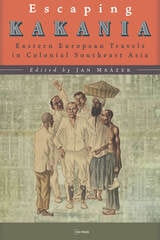
Escaping Kakania
Eastern European Travels in Colonial Southeast AsiaJan Mrázek
Central European University Press, 2024
Escaping Kakania is about fascinating characters—soldiers, doctors, scientists, writers, painters—who traveled from their eastern European homelands to colonial Southeast Asia. Their stories are told by experts on different countries in the two regions, who bring diverse approaches into a conversation that crosses disciplinary and national borders.
The 14 chapters deal with the diverse encounters of eastern Europeans with the many faces of colonial southeast Asia. Some essays directly engage with post-colonial studies, contributing to an ongoing critical re-evaluation of eastern European “semi-peripheral” (non-)involvement in colonialism. Other chapters disclose a range of perspectives and narratives that illuminate the plurality of the travelers’ positions while reflecting on the specificity of the eastern European experience.
The travellers moved—as do the chapter authors—between two regions that are off-centre, in-between, shiftingly “Eastern,” and disorientingly heterogeneous, thus complicating colonial and postcolonial notions of “Europe,” “East,” and East-West distinctions. Both at home and overseas, they navigated among a multiplicity of peoples, “races,” and empires, Occidents and Orients, fantasies of the Self and the Other, adopting/adapting/mimicking/rejecting colonialist identities and ideologies. They saw both eastern Europe and southeast Asia in a distinctive light, as if through each other—and so will the readers of Escaping Kakania.
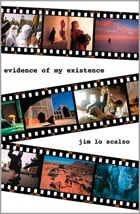
Evidence of My Existence
Jim Lo Scalzo
Ohio University Press, 2007
From a leper colony in India to an American research station on the Antarctic Peninsula, from the back rooms of the White House to the battlefields of Iraq and Afghanistan, Evidence of My Existence tells a unique and riveting story of seventeen years spent racing from one photo assignment to the next. It is also a story of photojournalism and theconsequences of obsessive wanderlust.
When the book opens, Jim Lo Scalzo is a blur to his wife, her remarkable tolerance wearing thin. She is heading to the hospital with her second miscarriage, and Jim is heading to Baghdad to cover the American invasion of Iraq. He hates himself for this—for not giving her a child, for deserting her when she soobviously needs him, for being consumed by his job—but how to stop moving? Sure, there have been some tough trips. He’s been spit on by Mennonites in Missouri, by heroin addicts in Pakistan, and by the KKK in South Carolina. He’s contracted hepatitis on the Navajo Nation, endured two bouts of amoebic dysentery in India and Burma and four cases of giardia in Nepal, Peru, Afghanistan, and Cuba. He’s been shot with rubber bullets in Seattle, knocked to the ground by a water cannon in Quebec, and sprayed with more teargas than he cares to recall. But photojournalism is his career, and travel is his compulsivecraving.
We follow Lo Scalzo through the maze of airports and crowds and countries as he chases the career he has always wanted, struggles with his family problems, and reveals the pleasures of a life singularly focused. For him, as for so many photojournalists, it is always about the going.
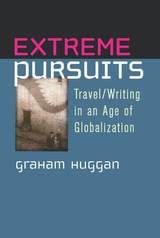
Extreme Pursuits
Travel/Writing in an Age of GlobalizationGraham Huggan
University of Michigan Press, 2009
Recent figures suggest that there will be 1.6 billion arrivals at world airports by the year 2020. Extreme Pursuits looks at the new conditions of global travel and the unease, even paranoia, that underlies them---at the opportunities they offer for alternative identities and their oscillation between remembered and anticipated states. Graham Huggan offers a provocative account of what is happening to travel at a time characterized by extremes of social and political instability in which adrenaline-filled travelers appear correspondingly determined to take risks. It includes discussions of the links between tourism and terrorism, of contemporary modes of disaster tourism, and of the writing that derives from these; but it also confirms the existence of more responsible forms of travel/writing that demonstrate awareness of a chronically endangered world.
Extreme Pursuits is the first study of its kind to link travel writing explicitly with structural changes in the global tourist industry. The book makes clear that travel writing can no longer take refuge in the classic distinctions (traveler versus tourist, foreigner versus native) on which it previously depended. Such distinctions---which were dubious in the first place---no longer make sense in an increasingly globalized world. Huggan argues accordingly that the category "travel writing" must include experimental ethnography and prose fiction; that it should concern itself with other kinds of travel practices, such as those related to Holocaust deportation and migrant labor; and that it should encompass representations of travelers and "traveling cultures" that appear in popular media, especially TV and film.
Graham Huggan is Professor of Commonwealth and Postcolonial Literatures at the University of Leeds. He is the coauthor, with Patrick Holland, of Tourists with Typewriters: Critical Reflections on Contemporary Travel Writing (University of Michigan Press) and coauthor, with Helen Tiffin, of Postcolonial Ecocriticism (Routledge).
Illustration: "Shadow Wall," 2006 © Shaun Tan.