Results by title
60 books match the query 'Evangelicalism' and 8 start with e
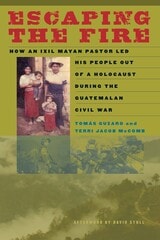
Escaping the Fire
How an Ixil Mayan Pastor Led His People Out of a Holocaust During the Guatemalan Civil WarBy Tomás Guzaro and Terri Jacob McComb
University of Texas Press, 2010
During the height of the Guatemalan civil war, Tomás Guzaro, a Mayan evangelical pastor, led more than two hundred fellow Mayas out of guerrilla-controlled Ixil territory and into the relative safety of the government army's hands. This exodus was one of the factors that caused the guerrillas to lose their grip on the Ixil, thus hastening the return of peace to the area.
In Escaping the Fire, Guzaro relates the hardships common to most Mayas and the resulting unrest that opened the door to civil war. He details the Guatemalan army's atrocities while also describing the Guerrilla Army of the Poor's rise to power in Ixil country, which resulted in limited religious freedom, murdered church leaders, and threatened congregations. His story climaxes with the harrowing vision that induced him to guide his people out of their war-torn homeland.
Guzaro also provides an intimate look at his spiritual pilgrimage through all three of Guatemala's main religions. The son of a Mayan priest, formerly a leader in the Catholic Church, and finally a convert to Protestantism, Guzaro, in detailing his religious life, offers insight into the widespread shift toward Protestantism in Latin America over the past four decades.
Riveting and highly personal, Escaping the Fire ultimately provides a counterpoint to the usual interpretation of indigenous agency during the Guatemalan civil war by documenting the little-studied experiences of Protestants living in guerrilla-held territory.
Evangelical Gotham
Religion and the Making of New York City, 1783–1860Kyle B. Roberts
University of Chicago Press, 2016
Evangelical Identity and Gendered Family Life
Gallagher, Sally K
Rutgers University Press, 2003
Evangelical Identity and Gendered Family Life provides a sociological and historical analysis of gender, family, and work among evangelical Protestants. In this innovative study, Sally Gallagher traces two lines of gender ideals—one of husbands’ authority and leadership, the other of mutuality and partnership in marriage—from the Puritans to the Promise Keepers into the lives of ordinary evangelicals today. Rather than simply reacting against or accommodating themselves to “secular society,” Gallagher argues that both traditional and egalitarian evangelicals draw on longstanding beliefs about gender, human nature, and the person of God.
The author bases her arguments on an analysis of evangelical family advice literature, data from a large national survey and personal interviews with over 300 evangelicals nationwide. No other work in this area draws on such a range of data and methodological resources. Evangelical Identity and Gendered Family Life establishes a standard for future research by locating the sources, strategies, and meaning of gender within evangelical Protestantism.
Evangelical News
Politics, Gender, and Bioethics in Conservative Christian Magazines of the 1970s and 1980sAnja-Maria Bassimir
University of Alabama Press, 2022
A comprehensive study of evangelical magazine discourse during the 1970s and 1980s and how it navigated and sustained religious convictions in a time of dramatic social change
The 1970s and 1980s were a tumultuous period in US history. In tandem with a dramatic political shift to the right, evangelicalism also entered the public discourse as a distinct religious movement and was immediately besieged by cultural appropriations and internal fragmentations. Americans in general and evangelicals in particular grappled with issues and ideas such as feminism, abortion, birth control, and restructuring traditional roles for women and the family. During this time, there was a surge in readership for evangelical periodicals such as Christianity Today, Moody Monthly, Eternity, and Post-Americans/Sojourners as well as the feminist newsletter Daughters of Sarah.
While each of these magazines—and other publications and media—contributed to and participated in the overall dissemination of evangelical ideology, they also had their own outlooks and political leanings concerning hot-button issues. In Evangelical News: Politics, Gender, and Bioethics in Conservative Christian Magazines of the 1970s and 1980s, Anja-Maria Bassimir presents a nuanced view of evangelicalism in the late twentieth century through the lens of the movement’s own media.
Bassimir argues that community can be produced in discourse, especially when shared rhetoric, concepts, and perspectives signal belonging. To accomplish this, Evangelical News traces the emergence of evangelical social and political awareness in the 1970s to the height of its power as a political program. The chapters investigate such topics as how evangelicals reenvisioned gender norms and relations in light of the feminist movement, the use of childhood as a symbol of unspoiled innocence, and the place of evangelicals as political actors.

Evangelicalism
The Coming GenerationJames Davison Hunter
University of Chicago Press, 1987
Evangelicals and Democracy in America
Religion and PoliticsSteven G. Brint
Russell Sage Foundation, 2009
Evangelicals and Democracy in America
Religion and SocietySteven G. Brint
Russell Sage Foundation, 2009
Exhibiting Evangelicalism
Commemoration and Religion’s Presence of the PastDevin C. Manzullo-Thomas
University of Massachusetts Press, 2022
Religion is a subject often overlooked or ignored by public historians. Whether they are worried about inadvertent proselytizing or fearful of contributing to America’s ongoing culture wars, many heritage professionals steer clear of discussing religion’s formative role in the past when they build collections, mount exhibits, and develop educational programming. Yet religious communities have long been active contributors to the nation’s commemorative landscape.
Exhibiting Evangelicalism provides the first account of the growth and development of historical museums created by white evangelical Christians in the United States over the twentieth and twenty-first centuries. Exploring the histories of the Museum of the Bible, the Billy Graham Center Museum, the Billy Sunday Home, and Park Street Church, Devin C. Manzullo-Thomas illustrates how these sites enabled religious leaders to develop a coherent identity for their fractious religious movement and to claim the centrality of evangelicalism to American history. In their zeal to craft a particular vision of the national past, evangelicals engaged with a variety of public history practices and techniques that made them major players in the field—including becoming early adopters of public history’s experiential turn.