Results by title
421 books match the query 'Evolution' and 45 start with e
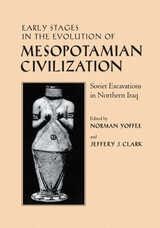
Early Stages in the Evolution of Mesopotamian Civilization
Soviet Excavations in Northern IraqEdited by Norman Yoffee and Jeffery J. Clark
University of Arizona Press, 1993

East African Mammals
An Atlas of Evolution in Africa, Volume 2, Part A: Insectivores and BatsJonathan Kingdon
University of Chicago Press, 1984
Volume IIA of East African Mammals begins a two-part study of East Africa's smallest and least conspicuous mammals. It deals with bats and insectivores, including tenrecs, moles, hedgehogs, and shrews.
In each volume Kingdon combines his text with hundreds of finished drawings and quick sketches, the latter a form of field note that provides an incomparable description of the animal's movements and personality. Kingdom explains his drawings "as a wordless questioning of form. . . . The probing pencil is like the dissecting scalpel, seeking to expose relevant structures that may not be immediately obvious and are certainly hidden from the shadowy world of the camera lens." As an artist, Kingdon's achievement has been compared with Audubon's; as a scientist, his work has made these volumes indispensable to any serious student of East African mammals.
East African Mammals
An Atlas of Evolution in Africa, Volume 2, Part B: Hares and RodentsJonathan Kingdon
University of Chicago Press, 1984
Volume IIB of East African Mammals is a study of some of East Africa's smallest and least conspicuous mammals, hares and rodents.
In each volume Kingdon combines his text with hundreds of finished drawings and quick sketches, the latter a form of field note that provides an incomparable description of the animal's movements and personality. Kingdom explains his drawings "as a wordless questioning of form. . . . The probing pencil is like the dissecting scalpel, seeking to expose relevant structures that may not be immediately obvious and are certainly hidden from the shadowy world of the camera lens." As an artist, Kingdon's achievement has been compared with Audubon's; as a scientist, his work has made these volumes indispensable to any serious student of East African mammals.
East African Mammals
An Atlas of Evolution in Africa, Volume 3, Part A: CarnivoresJonathan Kingdon
University of Chicago Press, 1989
Volume IIIA documents the carnivores of East Africa—lions, cheetahs, jackals, otters, civets, genets, mongooses, hyenas, and such lesser-known species as the zorilla and the aardwolf.
The beauty of the animals, so vivid in these incomparable drawings, is made more poignant by the acknowledgment of their increasingly endangered status. Kingdon discusses the inevitable problems posed by large mammal communities in a developing continent and includes numerous maps indicating their declining ranges and populations.
East African Mammals
An Atlas of Evolution in Africa, Volume 3, Part B: Large MammalsJonathan Kingdon
University of Chicago Press, 1989
Volume IIIB celebrates the large mammals for which the African plains are so famous—elephants, rhinos, zebras, bushpigs, and warthogs, hippopotamuses, camels, chevrotains, giraffes. Kingdon brings his artist's eye to such puzzles as the zebra's stripes and the giraffe's spots, making original observations throughout the seven volumes about the evolutionary and functional significance of coat color, facial expressions, and curious forms and markings.
The beauty of the animals, so vivid in these incomparable drawings, is made more poignant by the acknowledgment of their increasingly endangered status. Kingdon discusses the inevitable problems posed by large mammal communities in a developing continent and includes numerous maps indicating their declining ranges and populations.
East African Mammals
An Atlas of Evolution in Africa, Volume 3, Part C: BovidsJonathan Kingdon
University of Chicago Press, 1989
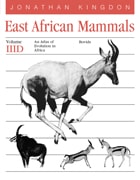
East African Mammals
An Atlas of Evolution in Africa, Volume 3, Part D: BovidsJonathan Kingdon
University of Chicago Press, 1989
Ecology and Evolution in the Tropics
A Herpetological PerspectiveEdited by Maureen A. Donnelly, Brian I. Crother, Craig Guyer, Marvalee H. Wake,
University of Chicago Press, 2005
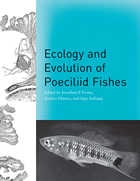
Ecology and Evolution of Poeciliid Fishes
Edited by Jonathan P. Evans, Andrea Pilastro, and Ingo Schlupp
University of Chicago Press, 2011
The history of biology is populated by numerous model species or organisms. But few vertebrate groups have aided evolutionary and ecological research more than the live-bearing fishes of the family Poeciliidae. Found throughout tropical and subtropical waters, poeciliids exhibit a fascinating variety of reproductive specializations, including viviparity, matrotrophy, unisexual reproduction, and alternative mating strategies, making them ideal models for research on patterns and processes in ecology, behavior, and evolution.
Ecology and Evolution of Poeciliid Fishes is a much-needed overview of the scientific potential and understanding of these live-bearing fishes. Chapters by leading researchers take up a wide range of topics, including the evolution of unisexual reproduction, life in extreme environments, life-history evolution, and genetics. Designed to provide a single and highly approachable reference, Ecology and Evolution of Poeciliid Fishes will appeal to students and specialists interested in all aspects of evolutionary ecology.
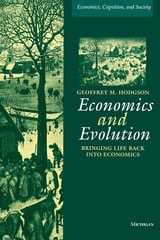
Economics and Evolution
Bringing Life Back into EconomicsGeoffrey M. Hodgson
University of Michigan Press, 1996
This book is about the application to economics of evolutionary ideas from biology. It is not about selfish genes or determination of our behavior by genetic code. The idea that evolution supports a laissez-faire policy is rebutted. The conception of evolution as progress toward greater perfection, along with the competitive individualism sometimes inferred from the notion of the "survival of the fittest," is found to be problematic. Hodgson explores the ambiguities inherent in biology and the problems involved in applying ideas of past economic thinkers--including Malthus, Smith, Marx, Marshall, Veblen, Schumpeter, and Hayek--and argues that the new evolutionary economics can learn much from the many differing conceptions of economic evolution.
"This is a work of enormous perceptivity and subtlety as well as judiciousness of interpretation and critique . . . [that] establish[es] Hodgson as the leading institutional theorist, and as one of the leading evolutionary theorists, of his generation." --Warren J. Samuels
"A daring and successful attempt to expunge the monopoly of reductionist and mechanistic thinking over evolutionary theory . . . a must for anyone who is interested not only in the foundations of economics, but also in the foundations of social theory." --Elias L. Khalil, Ohio State University
Geoffrey M. Hodgson is University Lecturer in Economics, Judge Institute for Management Studies, University of Cambridge.
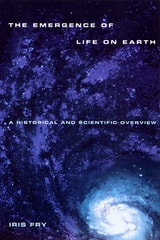
Emergence of Life on Earth
A Historical and Scientific OverviewFry, Iris
Rutgers University Press, 2000
Topics include:
- Aristotle and the Greek atomists' conceptions of the organism
- Alexander Oparin and J.B.S. Haldane's 1920s breakthrough papers
- Possible life on Mars?
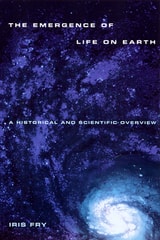
Emergence of Life on Earth
A Historical and Scientific OverviewFry, Iris
Rutgers University Press, 2000
--Michael Ruse, author of Mystery of Mysteries: Is Evolution a Social Construction?
"Fry has fashioned a masterful account of the history, philosophy, and science of the origin of life and the possibility of extraterrestrial life. Her story weaves profound Western ideas of who we are and where we came from, from Aristotle to Gould, from Kant to NASA."
--Woodruff Sullivan, University of Washington
"A rich source for the specialist and thought-provoking reading for the lay person."
--Gunter Wachtershauser, University of Regensburg, Germany
How did life emerge on Earth? Is there life on other worlds? These questions, until recently confined to the pages of speculative essays and tabloid headlines, are now the subject of legitimate scientific research. This book presents a unique perspective--a combined historical, scientific, and philosophical anaylsis, which does justice to the complex nature of the subject. The book's first part offers an overview of the main ideas on the origin of life as they developed from antiquity until the twentieth century. The second, more detailed part of the book examines contemporary theories and major debates within the origin-of-life scientific community.
Topics include:
- Aristotle and the Greek atomists' conceptions of the organism
- Alexander Oparin and J.B.S. Haldane's 1920s breakthrough papers
- Possible life on Mars?
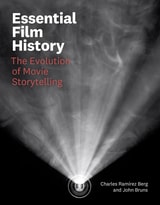
Essential Film History
The Evolution of Movie StorytellingCharles Ramírez Berg and John Bruns
University of Texas Press, 2026
A guide to the fundamentals of understanding film history, filmmaking, and film appreciation.
Film is not just a medium; it is also a language—and a global one at that. Essential Film History describes how this language emerged and how it has matured over the course of more than 125 years. Beginning with the experiments of the late nineteenth century, and tracking the development of cinematic storytelling, commercial distribution, and audience reception into the era of digital recording, Charles Ramírez Berg and John Bruns offer a comprehensive course in both the history and artistry of film.
Essential Film History breaks cinematic language into three core components: image, sound, and narrative. Between the 1890s and 1940s, this audiovisual language both consolidated and spread, becoming comprehensible worldwide. Since then, filmmakers have adapted and extended the language of cinema to suit an ever-growing range of aesthetic and narrative projects, from documentaries and full-length animation to avant-garde and made-for-TV movies. Covering major figures, studios, and events as well as key technological and sociopolitical developments, Essential Film History is an indispensable guide to the evolution of cinematic style.
Evolution As Entropy
Toward a Unified Theory of BiologyDaniel R. Brooks and E. O. Wiley
University of Chicago Press, 1988
"This book is unquestionably mandatory reading not only for every living biologist but for generations of biologists to come."—Jack P. Hailman, Animal Behaviour, review of the first edition
"An important contribution to modern evolutionary thinking. It fortifies the place of Evolutionary Theory among the other well-established natural laws."—R.Gessink,TAXON
Evolution Made to Order
Plant Breeding and Technological Innovation in Twentieth-Century AmericaHelen Anne Curry
University of Chicago Press, 2016
In Evolution Made to Order, Helen Anne Curry traces the history of America’s pursuit of tools that could intervene in evolution. An immersive journey through the scientific and social worlds of midcentury genetics and plant breeding and a compelling exploration of American cultures of innovation, Evolution Made to Order provides vital historical context for current worldwide ethical and policy debates over genetic engineering.
Evolution and Culture
Marshall D. Sahlins and Elman R. Service, Editors
University of Michigan Press, 1960
Evolution and Environment in Tropical America
Edited by Jeremy B. C. Jackson, Ann F. Budd, and Anthony G. Coates
University of Chicago Press, 1996
Recent discoveries show that dramatic changes in climate and ocean circulation can occur very quickly, and that ecological communities respond just as rapidly. Abrupt changes in the composition of fossil assemblages, formerly dismissed as artifacts of a poor fossil record, now are seen as accurate records of swift changes in the composition of ocean communities.
The twenty-four contributors use current work in paleontology, geology, oceanography, anthropology, ecology, and evolution to paint this challenging portrait of rapid environmental and evolutionary change. Their conclusions argue for a revision of existing interpretations of the fossil record and the processes—including invading Eurasian peoples—that have produced it.
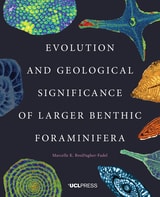
Evolution and Geological Significance of Larger Benthic Foraminifera
Marcelle K. BouDagher-Fadel
University College London, 2018
Marcelle K. BouDagher-Fadel collects and significantly adds to the information already published on the larger benthic foraminifera. New research in the Far East, the Middle East, South Africa, Tibet, and the Americas has provided fresh insights into the evolution and palaeographic significance of these vital reef-forming forms. With the aid of new and precise biostratigraphic dating, she presents revised phylogenies and ranges of the larger foraminifera. The book is illustrated throughout, with examples of different families and groups at the generic levels. Key species are discussed and their biostratigraphic ranges are depicted in comparative charts.
Evolution and the Capacity for Commitment
Randolph Nesse
Russell Sage Foundation, 2001
Evolution and the Genetics of Populations, Volume 1
Genetic and Biometric FoundationsSewall Wright
University of Chicago Press, 1968
Evolution and the Genetics of Populations, Volume 2
Theory of Gene FrequenciesSewall Wright
University of Chicago Press, 1969
Evolution and the Genetics of Populations, Volume 3
Experimental Results and Evolutionary DeductionsSewall Wright
University of Chicago Press, 1977
Evolution and the Genetics of Populations, Volume 4
Variability Within and Among Natural PopulationsSewall Wright
University of Chicago Press, 1978
Evolution and the Machinery of Chance
Philosophy, Probability, and Scientific Practice in BiologyMarshall Abrams
University of Chicago Press, 2023
Natural selection is one of the factors responsible for changes in biological populations. Some traits or organisms are fitter than others, and natural selection occurs when there are changes in the distribution of traits in populations because of fitness differences. Many philosophers of biology insist that a trait’s fitness should be defined as an average of the fitnesses of individual members of the population that have the trait.
Marshall Abrams argues convincingly against this widespread approach. As he shows, it conflicts with the roles that fitness is supposed to play in evolutionary theory and with the ways that evolutionary biologists use fitness concepts in empirical research. The assumption that a causal kind of fitness is fundamentally a property of actual individuals has resulted in unnecessary philosophical puzzles and years of debate. Abrams came to see that the fitnesses of traits that are the basis of natural selection cannot be defined in terms of the fitnesses of actual members of populations, as philosophers of biology often claim. Rather, it is an overall population-environment system—not actual, particular organisms living in particular environmental conditions—that is the basis of trait fitnesses. Abrams argues that by distinguishing different classes of fitness concepts and the roles they play in the practice of evolutionary biology, we can see that evolutionary biologists’ diverse uses of fitness concepts make sense together and are consistent with the idea that fitness differences cause evolution.
Abrams’s insight has broad significance, for it provides a general framework for thinking about the metaphysics of biological evolution and its relations to empirical research. As such, it is a game-changing book for philosophers of biology, biologists who want deeper insight into the nature of evolution, and anyone interested in the applied philosophy of probability.
Evolution of Ceramic Production Organization in a Maya Community
Dean E. Arnold
University Press of Colorado, 2014
Although several kinds of production units developed, households were the most persistent units of production in spite of massive social change and the reorientation of pottery production to the tourist market. Entrepreneurial workshops, government-sponsored workshops, and workshops attached to tourist hotels developed more recently but were short-lived, whereas pottery-making households extended deep into the nineteenth century. Through this continuity and change, intermittent crafting, multi-crafting, and potters' increased management of economic risk also factored into the development of the production organization in Ticul.
Illustrated with more than 100 images of production units, The Evolution of Ceramic Production Organization in a Maya Community is an important contribution to the understanding of ceramic production. Scholars with interests in craft specialization, craft production, and demography, as well as specialists in Mesoamerican archaeology, anthropology, history, and economy, will find this volume especially useful.
Evolution of Desert Biota
Edited by David W. Goodall
University of Texas Press, 1976
Written by specialists in the field, the papers in this volume explore evolution of animals and plants on the deserts of North America, South America, and Australia. Together, the articles constitute a complete survey of the geological history of the deserts of three continents, the evolution of the animals and plants of those deserts, and their adaptations to the environments in which they live.
The first paper, by Otto T. Solbrig, discusses the flora of the South American temperate and semidesert regions, citing numerous genera and reasons that they are found in the different areas. John S. Beard uses the same approach in his discussion of the evolution of Australian desert plants and focuses on western Australian areas. Guillermo Sarmiento appraises the evolution of arid vegetation in tropical America, including the Lesser Antilles and the Coast Range of Venezuela and Colombia. A. R. Main surveys the adaptation of Australian vertebrates to desert conditions and gives examples of how various species of birds, reptiles, and amphibians adapt to their environment in order for the greatest number to survive. James A. MacMahon designates specific communities in the Mojave, Sonoran, and Chihuahuan deserts and discusses the similarity of species of the North American desert mammal faunas found there, while Bobbi S. Low focuses on the evolution of amphibian life histories in the desert and compiles a lengthy table of amphibia comparing egg size, habitat, number of eggs per clutch, and so forth. Finally, W. Frank Blair treats adaptation of anurans to equivalent desert scrub of North and South America and cites various species of frogs and toads that are found in similar areas.
The volume also includes an introduction by the editor and an index. Evolution of Desert Biota is the result of a symposium held during the First International Congress of Systematic and Evolutionary Biology in Boulder, Colorado; in August 1973.

Evolution of Desire
A Life of René GirardCynthia L Haven
Michigan State University Press, 2018
Evolution of Fossil Ecosystems
Paul A. Selden and John R. Nudds
University of Chicago Press, 2005
Beginning with a general introduction to fossil Lagerstätten, Evolution of Fossil Ecosystems goes on, chapter by chapter, to consider each fossil site, detailing its evolutionary position and significance; a brief history of the locality; its background sedimentology, stratigraphy, and paleoenvironment; its biota and paleoecology; and its commonalities with similar Lagerstätten. Considering deposits both marine and terrestrial, the book covers one fossil site from the Precambrian era, five sites from the Paleozoic era, five sites from the Mesozoic era, and three sites from the Cenozoic era.
Illustrated with hundreds of color photographs and drawings, Evolution of Fossil Ecosystems is a sophisticated yet accessible guide to these critical sites. Containing useful appendixes listing important museums, instructions on how to visit the fossil sites, and additional suggested reading, this book will attract students, academics, and professionals in paleontology, evolution, and the earth and life sciences, as well as dedicated amateurs interested in fossils and geology.
Evolution of Vertebrate Design
Leonard B. Radinsky
University of Chicago Press, 1987
"A luminous text is matched by lucid drawings rationally placed. . . . A great teaching monograph, the book will charm lay readers of fossil history. For virtually every college & public collection."—Scitech Book News

Evolution of a Missouri Asylum
Fulton State Hospital, 1851-2006Richard L. Lael, Barbara Brazos, and Margot Ford McMillen
University of Missouri Press, 2007
This institutional history of the hospital traces the debates surrounding its creation (as the State Lunatic Asylum) in a time when mental illness was barely understood. Although the Fulton hospital was initially conceived as a treatment facility, it quickly transformed into a primarily custodial institution. It existed as a self-sufficient establishment until the mid-twentieth century, dependent on patient labor and even producing its own food. But for the most socially disadvantaged and for the severely delusional, life at Fulton was anything but therapeutic.
The book describes not only the lofty goals of professionals dedicated to treating the mentally ill but also an institution once clouded by overcrowding, financial mismanagement, political cronyism, and wrongful confinement. It considers segregation within the hospital, where the first black doctor was hired in 1960 and where racism nevertheless continued to flourish, and it describes how, even after the 1921 Eleemosynary Act, the patronage system continued to plague Fulton for two more decades.
The authors reveal changing attitudes toward new treatments in the mid-twentieth century as psychotherapy and drugs became common, and decisions at Fulton regarding patient care are described within the context of progress in Europe and the eastern United States. The book addresses the complexities facing the physician-superintendents who supervised both medical therapies and administrative matters, depicting ongoing tension between hospital finances and state support and showing the difficulties state institutions faced in a “low tax/low public service” environment.
As Fulton State Hospital enters the twenty-first century, clients have become active in the development of institutional policies—a far cry from the warehousing of patients a hundred years ago. In tracing these seismic shifts in mental health care, this book offers an eye-opening exploration of how one state has sought to care for its citizens.

Evolution of the Agricultural Energy Internet
Modeling, simulation and engineering practiceXueqian Fu
The Institution of Engineering and Technology, 2026
Evolution of the Great Lakes Water Quality Agreement
Lee Botts
Michigan State University Press, 2005
Water quality concerns are not new to the Great Lakes. They emerged early in the 20th century, in 1909, and matured in 1972 and 1978. They remain a prominent part of today’s conflicted politics and advancing industrial growth. The Great Lakes Water Quality Agreement, under the Boundary Waters Treaty of 1909, became a model to the world for environmental management across an international boundary. Evolution of the Great Lakes Water Quality Agreement recounts this historic binational relationship, an agreement intended to protect the fragile Great Lakes.
One strength of the agreement is its flexibility, which includes a requirement for periodic review that allows modification as problems are solved, conditions change, or scientific research reveals new problems. The first progress was made in the 1970s in the area of eutrophication, the process by which lakes gradually age, which normally takes thousands of years to progress, but is accelerated by modern water pollution. The binational agreement led to the successful lowering of phosphorus levels that saved Lake Erie and prevented accelerated eutrophication in the rest of the Great Lakes ecosystem. Another major success at the time was the identification and lowering of the levels of toxic contaminants that cause major threats to human and wildlife health, from accumulating PCBs and other persistent organic pollutants

Evolution
A Scientific American ReaderEdited by Scientific American
University of Chicago Press, 2006
From the Scopes “Monkey Trial” of 1925 to the court ruling against the Dover Area School Board’s proposed intelligent design curriculum in 2005, few scientific topics have engendered as much controversy—or grabbed as many headlines—as evolution. And since the debate shows no signs of abating, there is perhaps no better time to step back and ask: What is evolution? Defined as the gradual process by which something changes into a different and usually more complex and efficient form, evolution explains the formation of the universe, the nature of viruses, and the emergence of humans. A first-rate summary of the actual science of evolution, this Scientific American reader is a timely collection that gives readers an opportunity to consider evolution’s impact in various settings.
Divided into four sections that consider the evolution of the universe, cells, dinosaurs, and humans, Evolution brings together more than thirty articles written by some of the world’s most respected evolutionary scientists. As tour guides through the genesis of the universe and complex cells, P. James E. Peebles examines the evidence in support of an expanding cosmos, while Christian de Duve discusses the birth of eukaryotes. In an article that anticipated his book Full House, Stephen Jay Gould argues that chance and contingency are as important as natural selection for evolutionary change. And Ian Tatersall makes two fascinating contributions, submitting his view that the schematic of human evolution looks less like a ladder and more like a bush.
With the latest on what’s being researched at every level of evolutionary studies, from prospects of life on other planets to the inner working of cells, Evolution offers general readers an opportunity to update their knowledge on this hot topic while giving students an introduction to the problems and methodologies of an entire field of inquiry.
Evolution
Selected PapersSewall Wright
University of Chicago Press, 1986
Wright's shifting-balance theory of evolution, first conceived in 1925, has proved enormously useful in modern evolutionary biology. Wright's international prestige has never been higher than it is currently, and the time is ripe for a rereading of his seminal papers. These papers are not only historically important for understanding the period of the "evolutionary synthesis" of the 1930s and 1940s, but continue to be stimulating and useful to working evolutionary biologists today.

Evolution
The Disguised Friend of Faith?Arthur Peacocke
Templeton Press, 2004
Arthur Peacocke, eminent priest-scientist, has collected thirteen of his essays for this volume. Previously published in various academic journals and edited books, the provocative essays expand upon the theme of the evolution of nature, humanity, and belief. They are grouped into three parts:
- Natural Evolution covers topics ranging from the implications of deterministic chaos; biological evolution and Christian theology; chance, potentiality, and God; complexity, emergence, and divine creativity.
- Humanity Evolving in the Presence of God, articulating God’s presence in and to the world as it is unveiled by the sciences; the chrysalis of the human; the nature and purpose of man in science and Christian theology.
- Theological Evolution—the Reshaping of Belief, dealing with science and the future of theology; public truth in religion; the incarnation of the self-expressive word of God; DNA; and the challenges and possibilities of western theism.
In the epilogue, Dr. Peacocke discusses wisdom in science and education, referring to Robert Grosseteste, a medieval scientist-theologian.
Evolutionary Archaeology
Methodological IssuesPatrice A. Teltser
University of Arizona Press, 1994
Evolutionary archaeologists argue that Darwinian natural selection acts on human behavior, resulting in the persistence of alternative human behaviors and the material products of those behaviors. The contributors address the methodological requirements of evolutionary theory as it may apply to the nature of archaeological data. Several contributors evaluate the methodological implications of basic evolutionary principles, including the structure of explanations, the units of evolution and analysis, and the measurement of information transmission. Others explore the role of specific analytic approaches such as seriation, raw material sourcing, and comparative and engineering analyses. Still others confront the issue of reformulating archaeological problems from the point of view of evolutionary theory.
By focusing on the methodological requirements of evolutionary theory, these essays go far in meeting the challenge of building new archaeological method. The work contributes to a better understanding of cultural evolution and builds toward a new, logical framework to explain variation in the archaeological record.
Evolutionary Dynamics of a Natural Population
The Large Cactus Finch of the GalapagosB. Rosemary Grant and Peter R. Grant
University of Chicago Press, 1989
Evolutionary Innovations
Edited by Matthew H. Nitecki
University of Chicago Press, 1990
The topics covered include the plurality of evolutionary innovations, patterns and processes at different hierarchical levels, evolutionary genetics of adaptations, heterochrony and other mechanisms of radical evolutionary change in early development, developmental mechanisms at the origin of morphological novelty, the evolution of morphological variation patterns, functional design and its punctuated products, plausibility and testability in assessing the consequences of evolutionary innovations, paradigms and pitfalls of studying physiological evolution, polyphyletic constructional breakthroughs in fossil and extant species, ecology of evolutionary innovations in the fossil record.
Evolutionary Paleobiology
Edited by David Jablonski, Douglas H. Erwin, and Jere H. Lipps
University of Chicago Press, 1996
Contributors to this volume—a veritable who's who of eminent researchers—present the results of original research and new theoretical developments, and provide directions for future studies. Individually wide ranging, these papers all share a debt to the work of James W. Valentine, one of the founders of modern evolutionary paleobiology. This volume's unified approach to the study of life on earth will be a major contribution to paleobiology, evolution, and ecology.
Evolutionary Patterns
Growth, Form, and Tempo in the Fossil RecordEdited by Jeremy B. C. Jackson, Scott Lidgard, and Frank K. McKinney
University of Chicago Press, 2001
Evolutionary Patterns demonstrates the rich variety of clues to evolution that can be gleaned from the fossil record. Chief among these are the major trends and anomalies in species development revealed only by "deep time," such as periodic mass extinctions and species that remain unchanged in form for millions of years. Contributors explore modes of development, the tempo of speciation and extinction, and macroevolutionary patterns and trends. The result is an important contribution to paleobiology and evolutionary biology, and a spirited defense of the fossil record as a crucial tool for understanding evolution and development.
The contributors are Ann F. Budd, Efstathia Bura, Leo W. Buss, Mike Foote, Jörn Geister, Stephen Jay Gould, Eckart Hâkansson, Jean-Georges Harmelin, Lee-Ann C. Hayek, Jeremy B. C. Jackson, Kenneth G. Johnson, Nancy Knowlton, Scott Lidgard, Frank K. McKinney, Daniel W. McShea, Ross H. Nehm, Beth Okamura, John M. Pandolfi, Paul D. Taylor, and Erik Thomsen.
Evolutionary Restraints
The Contentious History of Group SelectionMark E. Borrello
University of Chicago Press, 2010
Evolutionary Systems and Society
A General TheoryVilmos Csányi
Duke University Press, 1988
Evolutionary Theory
A Hierarchical PerspectiveEdited by Niles Eldredge, Telmo Pievani, Emanuele Serrelli, and Ilya Temkin
University of Chicago Press, 2016
Coedited by one of the founders of hierarchy theory and featuring a diverse and renowned group of contributors, this volume provides an integrated, comprehensive, cutting-edge introduction to the hierarchy theory of evolution. From sweeping historical reviews to philosophical pieces, theoretical essays, and strictly empirical chapters, it reveals hierarchy theory as a vibrant field of scientific enterprise that holds promise for unification across the life sciences and offers new venues of empirical and theoretical research. Stretching from molecules to the biosphere, hierarchy theory aims to provide an all-encompassing understanding of evolution and—with this first collection devoted entirely to the concept—will help make transparent the fundamental patterns that propel living systems.
Excavations at Santo Domingo Tomaltepec
Evolution of a Formative Community in the Valley of Oaxaca, MexicoMichael E. Whalon
University of Michigan Press, 1981
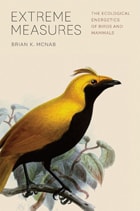
Extreme Measures
The Ecological Energetics of Birds and MammalsBrian K. McNab
University of Chicago Press, 2012
Along with reproduction, balancing energy expenditure with the limits of resource acquisition is essential for both a species and a population to survive. But energy is a limited resource, as we know well, so birds and mammals—the most energy-intensive fauna on the planet—must reduce energy expenditures to maintain this balance, some taking small steps, and others extreme measures.
Here Brian K. McNab draws on his over sixty years in the field to provide a comprehensive account of the energetics of birds and mammals, one fully integrated with their natural history. McNab begins with an overview of thermal rates—much of our own energy is spent maintaining our 98.6?F temperature—and explains how the basal rate of metabolism drives energy use, especially in extreme environments. He then explores those variables that interact with the basal rate of metabolism, like body size and scale and environments, highlighting their influence on behavior, distribution, and even reproductive output. Successive chapters take up energy and population dynamics and evolution. A critical central theme that runs through the book is how the energetic needs of birds and mammals come up against rapid environmental change and how this is hastening the pace of extinction.