Results by title
50 books match the query 'Experiments' and 9 start with e
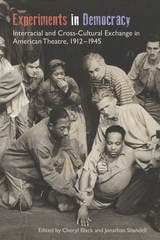
Experiments in Democracy
Interracial and Cross-Cultural Exchange in American Theatre, 1912-1945Edited by Cheryl Black and Jonathan Shandell
Southern Illinois University Press, 2016
In Experiments in Democracy, edited by Cheryl Black and Jonathan Shandell, theatre historians examine a wide range of performances—from Broadway, folk plays and dance productions to scripted political rallies and radio dramas. Contributors look at such diverse groups as the Theatre Union, La Unión Martí-Maceo, and the American Negro Theatre, as well as individual playwrights and their works, including Theodore Browne’s folk opera Natural Man, Josefina Niggli’s Soldadera, and playwright Lynn Riggs’s Cherokee Night and Green Grow the Lilacs (the basis for the musical Oklahoma!). Exploring the ways progressive artists sought to connect isolated racial and cultural groups in pursuit of a more just and democratic society, contributors take into account the blind spots, compromised methods, and unacknowledged biases at play in their practices and strategies. Essays demonstrate how the gap between the ideal of American democracy and its practice—mired in entrenched systems of white privilege, economic inequality, and social prejudice—complicated the work of these artists.
Focusing on questions of race, ethnicity, gender, and sexuality on the stage in the decades preceding the Civil Rights era, Experiments in Democracy fills an important gap in our understanding of the history of the American stage—and sheds light on these still-relevant questions in contemporary American society.
Experiments in Mystical Atheism
Godless Epiphanies from Daoism to Spinoza and BeyondBrook Ziporyn
University of Chicago Press, 2024
Western philosophy is stuck in an irresolvable conflict between two approaches to the spiritual malaise of our times: either we need more God (the “turn to religion”) or less religion (the New Atheism). In this book, Brook Ziporyn proposes an alternative that avoids both totalizing theomania and atomizing reductionism. What we need, he argues, is a deeper, more thoroughgoing, even religious rejection of God: an affirmative atheism without either a creator to provide meaning or finite creatures in need of it—a mystical atheism.
In the legacies of Daoism and Buddhism as well as Spinoza, Nietzsche, and Bataille, Ziporyn discovers a critique of theism that develops into a new, positive sensibility—at once deeply atheist and richly religious. Experiments in Mystical Atheism argues that these “godless epiphanies” hold the key to renewing philosophy today.
Experiments in Skin
Race and Beauty in the Shadows of VietnamThuy Linh Nguyen Tu
Duke University Press, 2021
Experiments in a Jazz Aesthetic
Art, Activism, Academia, and the Austin ProjectEdited by Omi Osun Joni L. Jones, Lisa L. Moore, and Sharon Bridgforth
University of Texas Press, 2010
In Austin, Texas, in 2002, a group of artists, activists, and academics led by performance studies scholar Omi Osun Joni L. Jones formed the Austin Project (tAP), which meets annually in order to provide a space for women of color and their allies to build relationships based on trust, creativity, and commitment to social justice by working together to write and perform work in the jazz aesthetic.
Inspired by this experience, this book is both an anthology of new writing and a sourcebook for those who would like to use creative writing and performance to energize their artistic, scholarly, and activist practices. Theoretical and historical essays by Omi Osun Joni L. Jones describe and define the African American tradition of art-making known as the jazz aesthetic, and explain how her own work in this tradition inspired her to start tAP.
Key artists in the tradition, from Bessie Award–winning choreographer Laurie Carlos and writer/performer Robbie McCauley to playwrights Daniel Alexander Jones and Carl Hancock Rux, worked with the women of tAP as mentors and teachers. This book brings together never-before-published, must-read materials by these nationally known artists and the transformative writing of tAP participants. A handbook for workshop leaders by Lambda Literary Award–winning writer Sharon Bridgforth, tAP's inaugural anchor artist, offers readers the tools for starting similar projects in their own communities. A full-length script of the 2005 tAP performance is an original documentation of the collaborative, breath-based, body work of the jazz aesthetic in theatre, and provides both a script for use by theatre artists and an invaluable documentation of a major transformative movement in contemporary performance.

Experiments in the Dark
Visualizing Capital Art Studio, ZanzibarPamila Gupta
University of Michigan Press, 2027
What kind of history are photographs? Experiments in the Dark explores this question through the lens of a twentieth-century East African Indian Ocean photo studio collection, Capital Arts Studio (CAS), and its proprietors Ranchhod and Rohit Oza in Stone Town, Zanzibar. Pamila Gupta gathers and reads a range of photographs and genres from the studio, exploring how they relate to Zanzibar’s vibrant visual cultures during the Omani sultanate, British colonial, and postrevolution periods. Gupta’s reading of this little-known photographic archive brings the work into a broader historical context of the Indian Ocean in a visual archive that has endured despite the forces of history.
Through a blend of archival reconstruction and curation, personal reflection, and interviews with Rohit Oza, the son of the studio’s founder Ranchhod Oza, Gupta focuses on the construction and curation of the CAS collection and what this archive can tell us about the South Asian and Goan diasporas, the wider Indian Ocean world, African fashion, urban lives, and image making in Zanzibar from 1930 to 2024.
Experiments in the Fading Light
Peck, Steven L.
Signature Books, 2025
Experiments with Body Agent Architecture
The 586-year-old Spiritello in Il Regno DigitaleAlessandro Ayuso
University College London, 2022
Experiments with Body Agent Architecture proposes the notion of body agents: non-ideal, animate, and highly specific figures integrated with design to enact particular notions of embodied subjectivity in architecture. Body agents present opportunities for architects to increase imaginative and empathic qualities in their designs.
Beginning with narrative writing from the viewpoint of a body agent who finds himself uncomfortably inhabiting a digital milieu, the book combines speculative historical fiction and original design experiments. It focuses on the process of creating multimedia design experiments, moving from the design of the body itself as an original prosthetic to architectural proposals emanating from the body.
A fragmented history of the figure in architecture is charted and woven into the designs, with chapters examining Michelangelo’s enigmatic figures in his drawings for the New Sacristy in the early sixteenth century, Gian Lorenzo Bernini’s physically ephemeral putti adorning chapels and churches in the seventeenth century, and Austrian artist-architect Walter Pichler’s personal and prescient figures of the twentieth century.
Experiments with Empire
Anthropology and Fiction in the French AtlanticJustin Izzo
Duke University Press, 2019
Experiments with Power
Obeah and the Remaking of Religion in TrinidadJ. Brent Crosson
University of Chicago Press, 2020
From eighteenth-century slave rebellions to contemporary responses to police brutality, Caribbean methods of problem-solving “spiritual work” have been criminalized under the label of “obeah.” Connected to a justice-making force, obeah remains a crime in many parts of the anglophone Caribbean. In Experiments with Power, J. Brent Crosson addresses the complex question of what obeah is. Redescribing obeah as “science” and “experiments,” Caribbean spiritual workers unsettle the moral and racial foundations of Western categories of religion. Based on more than a decade of conversations with spiritual workers during and after the state of emergency, this book shows how the reframing of religious practice as an experiment with power transforms conceptions of religion and law in modern nation-states.