Results by title
455 books match the query 'Feminism' and 14 start with e

Ecological Borderlands
Body, Nature, and Spirit in Chicana FeminismChristina Holmes
University of Illinois Press, 2016
Holmes revisits key debates to analyze issues surrounding embodiment, women's connections to nature, and spirituality's role in ecofeminist philosophy and practice. By doing so, she challenges Chicanas to escape the narrow frameworks of the past in favor of an inclusive model of environmental feminism that alleviates Western biases. Holmes uses readings of theory, elaborations of ecological narratives in Chicana cultural productions, histories of human and environmental rights struggles in the Southwest, and a description of an activist exemplar to underscore the importance of living with decolonializing feminist commitment in body, nature, and spirit.
Economies of Violence
Transnational Feminism, Postsocialism, and the Politics of Sex TraffickingJennifer Suchland
Duke University Press, 2015

Eight Women Philosophers
Theory, Politics, and FeminismJane Duran
University of Illinois Press, 2005
Duran devotes one chapter to each philosopher and provides a sustained critical analysis of her work, utilizing aspects of Continental theory, poststructuralist theory, and literary theory. She situates each philosopher within her respective era and in relation to her intellectual contemporaries, and specifically addresses the contributions each has made to major areas such as metaphysics/epistemology, theory of value, and feminist theory. She affirms the viability and importance of recovering these women's overlooked work and provides a powerful answer to the question of why the rubric "women philosophers" remains so valuable.

Elsie Clews Parsons
Inventing Modern LifeDesley Deacon
University of Chicago Press, 1997
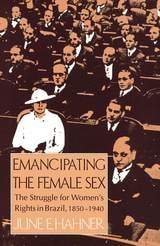
Emancipating the Female Sex
The Struggle for Women's Rights in Brazil, 1850–1940June E. Hahner
Duke University Press, 1990
Hahner traces the history of Brazilian women’s fight for emancipation from its earliest manifestations in the mid-nineteenth century to the successful conclusion of the suffrage campaign in the 1930s. Drawing on interviews with surviving Brazilian suffragists and contemporary feminists as well as manuscripts and printed documents, Hahner explores the strategies and ideological positions of Brazilian feminists. In focusing on urban upper- and middle-class women, from whose ranks the leadership for change arose, she examines the relationship between feminism and social change in Brazil’s complex and highly stratified society.
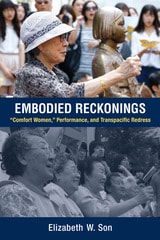
Embodied Reckonings
“Comfort Women,” Performance, and Transpacific RedressElizabeth W. Son
University of Michigan Press, 2018
Based on extensive archival and ethnographic research, the study argues for the central role of performance in how Korean survivors, activists, and artists have redressed the histories—and erasures—of this sexual violence. Merging cultural studies and performance theory with a transnational, feminist analysis, the book illuminates the actions of ordinary people, thus offering ways of reconceptualizing legal and political understandings of redress that tend to concentrate on institutionalized forms of state-based remediation.

Empowered
Popular Feminism and Popular MisogynySarah Banet-Weiser
Duke University Press, 2018
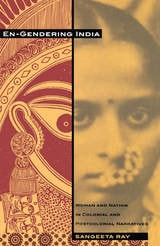
En-Gendering India
Woman and Nation in Colonial and Postcolonial NarrativesSangeeta Ray
Duke University Press, 2000
Through her readings of works by writers including Bankimchandra Chatterjee, Rabindranath Tagore, Harriet Martineau, Flora Annie Steel, Anita Desai, and Bapsi Sidhaa, Ray demonstrates that Indian women were presented as upper class and Hindu, an idealization that paradoxically served the needs of both colonial and nationalist discourses. The Indian nation’s goal of self-rule was expected to enable women’s full participation in private and public life. On the other hand, British colonial officials rendered themselves the protectors of passive Indian women against their “savage” male countrymen. Ray shows how the native woman thus became a symbol for both an incipient Indian nation and a fading British Empire. In addition, she reveals how the figure of the upper-class Hindu woman created divisions with the nationalist movement itself by underscoring caste, communal, and religious differences within the newly emerging state. As such, Ray’s study has important implications for discussions about nationalism, particularly those that address the concepts of identity and nationalism.
Building on recent scholarship in feminism and postcolonial studies, En-Gendering India will be of interest to scholars in those fields as well as to specialists in nationalism and nation-building and in Victorian, colonial, and postcolonial literature and culture.

End of Equality
Beatrix Campbell
Seagull Books, 2013
In TheEnd of Equality, renowned feminist Beatrix Campbell argues that even as the patriarchy has lost some of its legitimacy, new inequalities are emerging in our culture. We are living, Campbell writes, in an era of neo-patriarchy in which violence has proliferated; body anxiety and self-hatred have flourished; rape is committed with impunity; sex trafficking thrives, and the struggle for equal pay is at an end. After four decades observing society, Campbell still speaks of the long-sought goal of gender equality. But now she calls for a new revolution.
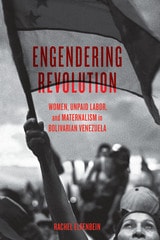
Engendering Revolution
Women, Unpaid Labor, and Maternalism in Bolivarian VenezuelaBy Rachel Elfenbein
University of Texas Press, 2019
In 1999, Venezuela became the first country in the world to constitutionally recognize the socioeconomic value of housework and enshrine homemakers’ social security. This landmark provision was part of a larger project to transform the state and expand social inclusion during Hugo Chávez’s presidency. The Bolivarian revolution opened new opportunities for poor and working-class—or popular—women’s organizing. The state recognized their unpaid labor and maternal gender role as central to the revolution. Yet even as state recognition enabled some popular women to receive public assistance, it also made their unpaid labor and organizing vulnerable to state appropriation.
Offering the first comprehensive analysis of this phenomenon, Engendering Revolution demonstrates that the Bolivarian revolution cannot be understood without comprehending the gendered nature of its state-society relations. Showcasing field research that comprises archival analysis, observation, and extensive interviews, these thought-provoking findings underscore the ways in which popular women sustained a movement purported to exalt them, even while many could not access social security and remained socially, economically, and politically vulnerable.
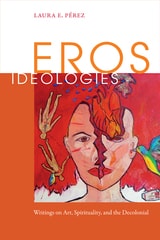
Eros Ideologies
Writings on Art, Spirituality, and the DecolonialLaura E. Pérez
Duke University Press, 2018

Evolutionary Rhetoric
Sex, Science, and Free Love in Nineteenth-Century FeminismWendy Hayden
Southern Illinois University Press, 2013
In Evolutionary Rhetoric, scholar Wendy Hayden provides a comprehensive examination of the relationship between scientific and feminist rhetorics in free-love feminism, studying the movement from its inception in the 1850s to its dark turn toward eugenics in the early 1900s. Hayden organizes her provocative study by scientific discipline—evolution, physiology, bacteriology, embryology, and heredity. Each chapter explores how free-love feminists adopted the evidence of that discipline in their arguments for increased sex education, women’s sexual rights, reproductive freedom, and the abolition of a marriage system that repressed the rights and the sexuality of women.
Hayden takes our conventional understanding of the relationship between nineteenth-century feminism and science and expands it. The author provides examples of the powerful words of free-love feminists to show exactly how these exceptional women used science as a rhetorical platform to promote feminist, and often radical, social reforms.
Considering why the free-love movement has not yet been studied, Hayden also discusses how the recovery of this movement may impact larger goals in the recovery of women’s rhetoric. This important and timely study of a long-forgotten movement adds to our understanding of the complexities of the history of feminism.

Expanding the Palace of Torah
Orthodoxy and FeminismTamar Ross
Brandeis University Press, 2004
This new edition brings this acclaimed and classic text back into print with a new essay by Tamar Ross which examines new developments in feminist thought since the book was first published in 2004.
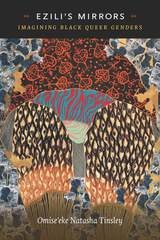
Ezili's Mirrors
Imagining Black Queer GendersOmise'eke Natasha Tinsley
Duke University Press, 2018