Results by title
81 books match the query 'French literature' and 5 start with e
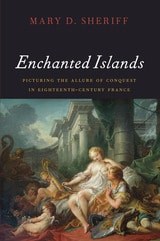
Enchanted Islands
Picturing the Allure of Conquest in Eighteenth-Century FranceMary D. Sheriff
University of Chicago Press, 2018
In Enchanted Islands, renowned art historian Mary D. Sheriff explores the legendary, fictional, and real islands that filled the French imagination during the ancien regime as they appeared in royal ballets and festivals, epic literature, paintings, engravings, book illustrations, and other objects. Some of the islands were mythical and found in the most popular literary texts of the day—islands featured prominently, for instance, in Ariosto’s Orlando furioso,Tasso’s Gerusalemme liberata, and Fénelon’s, Telemachus. Other islands—real ones, such as Tahiti and St. Domingue—the French learned about from the writings of travelers and colonists. All of them were imagined to be the home of enchantresses who used magic to conquer heroes by promising sensual and sexual pleasure. As Sheriff shows, the theme of the enchanted island was put to many uses. Kings deployed enchanted-island mythology to strengthen monarchical authority, as Louis XIV did in his famous Versailles festival Les Plaisirs de l’île enchantée. Writers such as Fénelon used it to tell morality tales that taught virtue, duty, and the need for male strength to triumph over female weakness and seduction. Yet at the same time, artists like Boucher painted enchanted islands to portray art’s purpose as the giving of pleasure. In all these ways and more, Sheriff demonstrates for the first time the centrality of enchanted islands to ancient regime culture in a book that will enchant all readers interested in the art, literature, and history of the time.
[more]
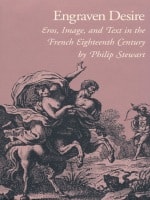
Engraven Desire
Eros, Image, and Text in the French Eighteenth CenturyPhilip Stewart
Duke University Press, 1992
How do literary illustrations affect the way we read—or more subtly, what we read? Through a critical investigation of the role of engraving played in eighteenth-century French literature, Philip Stewart grapples with this question. In both its approach and its conclusions, his project marks a provocative departure from the tradition of viewing illustrations as merely pictures, rather than as texts to be interpreted themselves.
Focusing on the objectification of women by the “male gaze,” Stewart analyzes the varous ways in which this masculine power is simultaneously represented and veiled: the fascination with women playing “male” roles, such as soldiers; the preponderance of voyeuristic images of the naked female body; the transformation of male power into hostile forces of nature that render women helpless. Further, Stewart shows how “indecent” engravings that purported to test the limits of eighteenth-century morality often merely reinforced prevailing images of women.
Addressing critical concerns about the societal enforcement of gender roles in literature along with essential questions about the function of illustration, Engraven Desire provides surprising insight into the culturally conditioned act of reading. Stewart’s work, itself richly illustrated with hundreds of arresting reproductions, makes a significant contribution to our understanding of the interplay of art, literature, and society.
[more]
Etymologies and Genealogies
A Literary Anthropology of the French Middle AgesR. Howard Bloch
University of Chicago Press, 1983
"Mr. Bloch has attempted to establish what he calls a 'literary anthropology.' The project is important and ambitious. It seems to me that Mr. Bloch has completely achieved this ambition." –Michel Foucault
"Bloch's Study is a genuinely interdisciplinary one, bringing together elements of history, ethnology, philology, philosophy, economics and literature, with the undoubted ambition of generating a new synthesis which will enable us to read the Middle Ages in a different light.
Stated simply, and in terms which do justice neither to the density nor the subtlety of his argument, Bloch's thesis is this: that medieval society perceived itself in terms of a vertical mode of descent from origins. This model is articulated etymologically in medieval theories of grammar and language, and is consequently reflected in historical and theological writings; it is also latent in the genealogical structure of the aristocratic family as it began to be organized in France in the twelfth century, and is made manifest in such systems of signs as heraldry and the adoption of patronymns. . . .
It is an ingenious and compelling synthesis which no medievalist, even on this side of the Atlantic, can afford to ignore." –Nicholas Mann, Times Literary Supplement
[more]
Experiments with Empire
Anthropology and Fiction in the French AtlanticJustin Izzo
Duke University Press, 2019
In Experiments with Empire Justin Izzo examines how twentieth-century writers, artists, and anthropologists from France, West Africa, and the Caribbean experimented with ethnography and fiction in order to explore new ways of knowing the colonial and postcolonial world. Focusing on novels, films, and ethnographies that combine fictive elements and anthropological methods and modes of thought, Izzo shows how empire gives ethnographic fictions the raw materials for thinking beyond empire's political and epistemological boundaries. In works by French surrealist writer Michel Leiris and filmmaker Jean Rouch, Malian writer Amadou Hampâté Bâ, Martinican author Patrick Chamoiseau, and others, anthropology no longer functions on behalf of imperialism as a way to understand and administer colonized peoples; its relationship with imperialism gives writers and artists the opportunity for textual experimentation and political provocation. It also, Izzo contends, helps readers to better make sense of the complicated legacy of imperialism and to imagine new democratic futures.
[more]
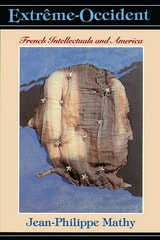
Extreme-Occident
French Intellectuals and AmericaJean-Philippe Mathy
University of Chicago Press, 1993
What does "America" mean to French intellectuals? Is it a postmodern ideal situated beyond history and metaphysics? A source of spiritual decadence that threatens the European tradition? Or is it "Extrême-Occident," the Far
Western site that gives historical reality to the utopias of the Renaissance and the Enlightenment?
Jean-Philippe Mathy offers the first systematic examination of French texts that address the question of America. He shows how prominent French intellectuals have represented America as myth and metaphor, covering the entire ideological spectrum from Maurras to Duhamel, and from Sartre to Aron. The texts themselves range from novels and poems to travel narratives and philosophical essays by Claudel, Sartre, de Beauvoir, Lyotard, Baudrillard, Kristeva, and many others.
Mathy deftly situates these discourses on America against the background of French intellectual and political history since 1789. The judgments on American culture that originate in France, he contends, are also statements about France itself. Widespread condemnation of American
materialism and pragmatism cuts across deep ideological and political divides in France, primarily because French intellectuals still operate within a framework of critical and aesthetic models born in the late Middle Ages and the Renaissance and elaborated in the age of French classicism.
Mathy engages issues central to interpreting the American experience, such as the current controversies over multiculturalism and Eurocentrism. Although Mathy deals mainly with French authors, he does not limit himself to them. Rather, he uses a comparative, cross-cultural approach that also takes in accounts of America by Nietzsche, Heidegger, Junger, Gramsci, and other Europeans, as well as American self-interpretations from Emerson and Dewey to Cornel West and Christopher Lasch.
Because debates on American modernity have played a crucial intellectual role in France, Extrême-Occident is a major contribution to modern French cultural
history. It will be essential reading for anyone wishing to understand the main currents of twentieth-century French thought.
[more]