Results by title
252 books match the query 'Future' and 8 start with e
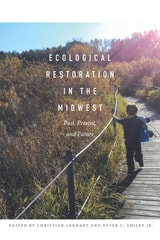
Ecological Restoration in the Midwest
Past, Present, and FutureChristian Lenhard and Peter C. Smiley, Jr.
University of Iowa Press, 2018
Most people do not realize it, but the Midwest has been at the forefront of ecological restoration longer than perhaps any other region in the United States, dating back to the 1930s. Because of its industrial history, agricultural productivity, and natural features such as the Great Lakes, the Midwest has always faced a unique set of ecological challenges.
Focusing on six cutting-edge case studies that highlight thirty restoration efforts and research sites throughout the region— Iowa, Indiana, Illinois, Wisconsin, Michigan, Minnesota, and Ohio— editors Christian Lenhart and Peter “Rocky” Smiley Jr. bring together a group of scholars and practitioners to show how midwestern restoration efforts have developed, as well as where they are headed. Whether cleaning up contamination from auto plants in Ohio, or restoring native prairie grasses along the Iowa highway, the contributors uncover a vast network of interested citizens and volunteer groups committed to preserving the region’s environment.
This study, intended for researchers, students, and practitioners, also provides an updated synthesis of restoration theory and practice, and pinpoints emerging issues of importance in the Midwest, such as climate change and the increase in invasive species it will bring to the region. Though focusing exclusively on the Midwest, the contributors demonstrate how these case studies apply to restoration efforts across the globe.
Contributors: Luther Aadland, David P. Benson, Andrew F. Casper, Hua Chen, Joe DiMisa, Steve Glass, Heath M. Hagy, John A. Harrington, Neil Haugerud, Constance Hausman, Michael J. Lemke, Christian Lenhart, Jen Lyndall, Dan Shaw, John A. Shuey, Peter C. Smiley Jr., Daryl Smith
Economy and the Future
A Crisis of FaithJean-Pierre Dupuy
Michigan State University Press, 2014

Educating Artists for the Future
Learning at the Intersections of Art, Science, Technology, and CultureEdited by Mel Alexenberg
Intellect Books, 2008
Educating Film-Makers
Past, Present and FutureDuncan Petrie and Rod Stoneman
Intellect Books, 2014
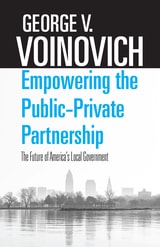
Empowering the Public-Private Partnership
The Future of America’s Local GovernmentGeorge V. Voinovich
Ohio University Press, 2017
America’s cities are increasingly acknowledged as sites of renewal and economic opportunity—but how can city leaders facing physical and financial constraints harness this positive energy to create sustainable development? The story of Cleveland in the early 1980s provides the necessary roadmap. Mayor George V. Voinovich, by drawing on the combined strengths of the public and private sectors, took Cleveland from financial default to becoming “America’s Comeback City,” and he later used the best practices he developed there to tackle state-level challenges as governor of Ohio. The public-private partnership model that Voinovich pioneered has since become the gold standard for cities seeking to maximize resources.
Using lessons from Cleveland, Voinovich developed this handbook for governments and private entities seeking a mutually enriching partnership. It is his legacy to those who will guide America’s cities to new growth and vitality.
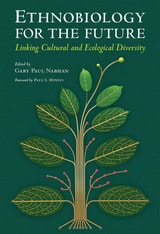
Ethnobiology for the Future
Linking Cultural and Ecological DiversityEdited by Gary Paul Nabhan; Foreword by Paul E. Minnis
University of Arizona Press, 2016
In this important new collection, Gary Paul Nabhan puts forth a call for the future not only of ethnobiology but for the entire planet. He articulates and broadens the portfolio of ethnobiological principles and amplifies the tool kit for anyone engaged in the ethnobiosphere, those vital spaces of intense interaction among cultures, habitats, and creatures.
The essays are grouped into a trio of themes. The first group presents the big questions facing humanity, the second profiles tools and methodologies that may help to answer those questions, and the third ponders how to best communicate these issues not merely to other scholars, but to society at large. The essays attest to the ways humans establish and circumscribe their identities not only through their thoughts and actions, but also with their physical, emotional, and spiritual attachments to place, flora, fauna, fungi, and feasts.
Nabhan and his colleagues from across disciplines and cultures encourage us to be courageous enough to include ethical, moral, and even spiritual dimensions in work regarding the fate of biocultural diversity. The essays serve as cairns on the critical path toward an ethnobiology that is provocative, problem-driven, and, above all, inspiring.
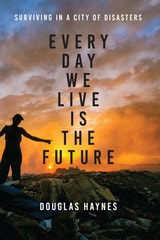
Every Day We Live Is the Future
Surviving in a City of DisastersBy Douglas Haynes
University of Texas Press, 2017
When she was only nine, Dayani Baldelomar left her Nicaraguan village with nothing more than a change of clothes. She was among tens of thousands of rural migrants to Managua in the 1980s and 1990s. After years of homelessness, Dayani landed in a shantytown called The Widows, squeezed between a drainage ditch and putrid Lake Managua. Her neighbor, Yadira Castellón, also migrated from the mountains. Driven by hope for a better future for their children, Dayani, Yadira, and their husbands invent jobs in Managua’s spreading markets and dumps, joining the planet’s burgeoning informal economy. But a swelling tide of family crises and environmental calamities threaten to break their toehold in the city.
Dayani’s and Yadira’s struggles reveal one of the world’s biggest challenges: by 2050, almost one-third of all people will likely live in slums without basic services, vulnerable to disasters caused by the convergence of climate change and breakneck urbanization. To tell their stories, Douglas Haynes followed Dayani’s and Yadira’s families for five years, learning firsthand how their lives in the city are a tightrope walk between new opportunities and chronic insecurity. Every Day We Live Is the Future is a gripping, unforgettable account of two women’s herculean efforts to persevere and educate their children. It sounds a powerful call for understanding the growing risks to new urbanites, how to help them prosper, and why their lives matter for us all.
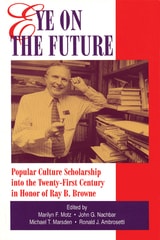
Eye on the Future
Popular Culture Scholarship into the Twenty-First Century in Honor of Ray B. BrowneMarilyn F. Motz
University of Wisconsin Press, 1994
This collection includes essays by scholars from around the world and five of Ray Browne's essays which he considers signal. The purpose of this book is to chart Popular Culture Studies into the next century.