570 books match the query 'Gay Studies' and 11 start with e
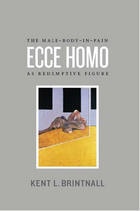
cover of Ecce Homo: The Male-Body-in-Pain as Redemptive Figure

Ecce Homo

The Male-Body-in-Pain as Redemptive Figure

Kent L. Brintnall

University of Chicago Press, 2011

Images of suffering male bodies permeate Western culture, from Francis Bacon’s paintings and Robert Mapplethorpe’s photographs to the battered heroes of action movies. Drawing on perspectives from a range of disciplines—including religious studies, gender and queer studies, psychoanalysis, art history, and film theory—Ecce Homo explores the complex, ambiguous meanings of the enduring figure of the male-body-in-pain.

Acknowledging that representations of men confronting violence and pain can reinforce ideas of manly tenacity, Kent L. Brintnall also argues that they reveal the vulnerability of men’s bodies and open them up to eroticization. Locating the roots of our cultural fascination with male pain in the crucifixion, he analyzes the way narratives of Christ’s death and resurrection both support and subvert cultural fantasies of masculine power and privilege. Through stimulating readings of works by Georges Bataille, Kaja Silverman, and more, Brintnall delineates the redemptive power of representations of male suffering and violence.
[more]
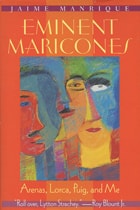
cover of Eminent Maricones: Arenas, Lorca, Puig, and Me

Eminent Maricones

Arenas, Lorca, Puig, and Me

Jaime Manrique

University of Wisconsin Press, 2001

Jaime Manrique weaves into his own memoir the lives of three important twentieth-century Hispanic writers: the Argentine Manuel Puig, author of Kiss of the Spider Woman; the Cuban Reinaldo Arenas, author of Before Night Falls; and Spanish poet and playwright Federico García Lorca. Manrique celebrates the lives of these heroic writers who were made outcasts for both their homosexuality and their politics.

"Manrique's double vision yields insights into Puig, Arenas, and Lorca unavailable to a writer less attuned to the complex interplay of culture and sexuality, as well as that of race and class in Latino and Anglo societies."—George DeStefano, The Nation


"A splendid memoir of Manuel Puig. It evokes him—how he really was—better than anything I've read."—Susan Sontag


"Where Manrique's tale differs from others is in its unabashed and sensitive treatment of sexuality. One reads his autobiographical account with pleasure and fascination."—Jose Quiroga, George Washington University


"Manrique's voice is wise, brave, and wholly original. This chronicle of self-discovery and literary encounters is heartening and deep."—Kennedy Fraser


"In this charmingly indiscreet memoir, Jaime Manrique writes with his customary humor and warm sympathy, engaging our delighted interest on every page. He has the rare gift of invoking and inviting intimacy, in this case a triangulated intimacy between himself, his readers, and his memories. These are rich double portraits."—Phillip Lopate
[more]
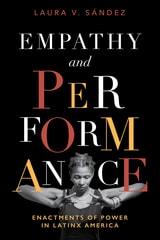
cover of Empathy and Performance: Enactments of Power in Latinx America

Empathy and Performance

Enactments of Power in Latinx America

Laura V. Sández

Vanderbilt University Press, 2024

Empathy and Performance advances a study of empathy and enactments of power by examining works from author-actors whose performances explore the boundaries between two kinship positions. Author Laura V. Sández studies the dramatized dilemma of cultural understanding in “Our America,” a notion that refers first to a collective political identity marking a common belonging in the Spanish-speaking America but also alludes to current struggles in the contemporary US. This book sees empathy as an affective response grounded in subjectivity and kinship. Sández argues that to conceptualize empathy one needs to understand how subjects organize, classify, and limit themselves, not only as agents, but also as interpreters. What sort of affiliations do these performances promote? How do they break, reinforce, or queer societal expectations about the Latinx body, the white body, or simply, the staged body?

To survey different answers to these queries, Sández studies Indigurrito (Nao Bustamante); Dominicanish (Josefina Báez); ¡Bienvenidos Blancos! or Welcome White People! (Alex Torra); the apology delivered by the group Veterans Stand with Standing Rock during protests against the Dakota Access Pipeline; and Kukuli Velarde’s body of work, from We, the Colonized Ones to A Mi Vida. In these artistic enactments, which range from 1992 to 2021, the historical construct of boundaries and bodies becomes evident. Following recent work on empathy by Lanzoni, Maibom, Calloway-Thomas, Bloom, Hogan, and Matravers, among others, Sández examines in-group/out-group divisions, the establishment of identity categories through performance, and the exploration of subaltern identities.
[more]
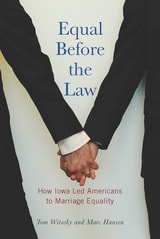
cover of Equal Before the Law: How Iowa Led Americans to Marriage Equality

Equal Before the Law

How Iowa Led Americans to Marriage Equality

Tom Witosky, Marc Hansen

University of Iowa Press, 2015

“We’ve been together in sickness and in health, through the death of his mother, through the adoption of our children, through four long years of this legal battle,” Jason Morgan told reporters of himself and his partner, Chuck Swaggerty. “And if being together through all of that isn’t love and commitment or isn’t family or isn’t marriage, then I don’t know what is.” Just minutes earlier on that day, April 3, 2009, the justices of the Iowa Supreme Court had agreed.

The court’s decision in Varnum v. Brien made Iowa only the third state in the nation to permit same-sex couples to wed—moderate, midwestern Iowa, years before such left-leaning coastal states as California and New York. And unlike the earlier decisions in Massachusetts and Connecticut, Varnum v. Brien was unanimous and unequivocal. It catalyzed the unprecedented and rapid shift in law and public opinion that continues today.

Equal Before the Law tells the stories behind this critical battle in the fight for marriage equality and traces the decision’s impact. The struggle began in 1998 with the easy passage of Iowa’s Defense of Marriage Act and took a turn, surprising to many, in 2005, when six ordinary Iowa couples signed on to Lambda Legal’s suit against the law. Their triumph in 2009 sparked a conservative backlash against the supreme court justices, three of whom faced tough retention elections that fall.
Longtime, award-winning reporters Tom Witosky and Marc Hansen talked with and researched dozens of key figures, including opponent Bob Vander Plaats, proponents Janelle Rettig and Sharon Malheiro, attorneys Roger Kuhle, Dennis Johnson, and Camilla Taylor, and politicians Matt McCoy, Mary Lundby, and Tom Vilsack, who had to weigh their careers against their convictions. Justice Mark Cady, who wrote the decision, explains why the court had to rule in favor of the plaintiffs. At the center of the story are the six couples who sacrificed their privacy to demand public respect for their families.

Through these voices, Witosky and Hansen show that no one should have been surprised by the 2009 decision. Iowans have a long history of leadership on civil rights. Just a year after Iowa became a state, its citizens adopted as their motto the phrase, “Our liberties we prize and our rights we will maintain.” And they still do today.
[more]
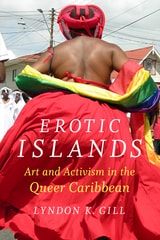
cover of Erotic Islands: Art and Activism in the Queer Caribbean

Erotic Islands

Art and Activism in the Queer Caribbean

Lyndon K. Gill

Duke University Press, 2018
In Erotic Islands, Lyndon K. Gill maps a long queer presence at a crossroads of the Caribbean. This transdisciplinary book foregrounds the queer histories of Carnival, calypso, and HIV/AIDS in the Republic of Trinidad and Tobago. At its heart is an extension of Audre Lorde's use of the erotic as theory and methodology. Gill turns to lesbian/gay artistry and activism to insist on eros as an intertwined political-sensual-spiritual lens through which to see self and society more clearly. This analysis juxtaposes revered musician Calypso Rose, renowned mas man Peter Minshall, and resilient HIV/AIDS organization Friends For Life. Erotic Islands traverses black studies, queer studies, and anthropology toward an emergent black queer diaspora studies.
[more]
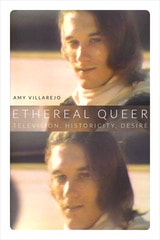
cover of Ethereal Queer: Television, Historicity, Desire

Ethereal Queer

Television, Historicity, Desire

Amy Villarejo

Duke University Press, 2013
In Ethereal Queer, Amy Villarejo offers a historically engaged, theoretically sophisticated, and often personal account of how TV representations of queer life have changed as the medium has evolved since the 1950s. Challenging the widespread view that LGBT characters did not make a sustained appearance on television until the 1980s, she draws on innovative readings of TV shows and network archives to reveal queer television’s lengthy, rich, and varied history. Villarejo goes beyond concerns about representational accuracy. She tracks how changing depictions of queer life, in programs from Our Miss Brooks to The L Word, relate to transformations in business models and technologies, including modes of delivery and reception such as cable, digital video recording, and online streaming. In so doing, she provides a bold new way to understand the history of television.
[more]
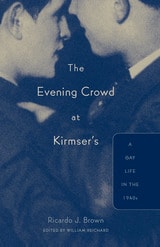
cover of Evening Crowd at Kirmser’s: A Gay Life In The 1940S

Evening Crowd at Kirmser’s

A Gay Life In The 1940S

Ricardo J. Brown

University of Minnesota Press, 2003

A surprising and vivid remembrance of gay life in the wake of World War II

It is often difficult to imagine gay gathering places in the decades before the Stonewall riots of the 1960s, and nearly impossible to think of such communities outside the nation’s largest cities. Yet such places did exist, and their histories tell amazing stories of survival and the struggle for acceptance and self-respect.

Kirmser’s was such a place. In the 1940s, this bar in downtown St. Paul was popular with blue-collar customers during the day, then became an unofficial home to working-class gay men and lesbians at night. After Ricardo J. Brown was discharged from the navy for revealing his sexual orientation in 1945, he returned home to Minnesota and discovered in Kirmser’s a space where he could develop his new self-awareness and fulfill his desire to find people like himself.The Evening Crowd at Kirmser’s is Brown’s compelling memoir of his experiences as a young gay man in St. Paul. In an engaging and open writing style, and through stories both humorous and tragic, Brown introduces us to his family, companions, and friends, such as Flaming Youth, a homely, sardonic man who carried the nickname from his youth ironically into middle age; Dale, who suddenly loses his job of six years after an anonymous note informed his employer that he was gay; and Bud York, an attractive and confident man with a fondness for young boys.
[more]
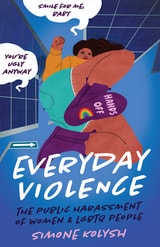
cover of Everyday Violence: The Public Harassment of Women and LGBTQ People

Everyday Violence

The Public Harassment of Women and LGBTQ People

Simone Kolysh

Rutgers University Press, 2021
Everyday Violence is based on ten years of scholarly rage against catcalling and aggression directed at women and Lesbian, Gay, Bisexual, Transgender and Queer (LGBTQ) people of New York City. Simone Kolysh recasts public harassment as everyday violence and demands an immediate end to this pervasive social problem. Analyzing interviews with initiators and recipients of everyday violence through an intersectional lens, Kolysh argues that gender and sexuality, shaped by race, class, and space, are violent processes that are reproduced through these interactions in the public sphere. They examine short and long-term impacts and make inroads in urban sociology, queer and trans geographies, and feminist thought. Kolysh also draws a connection between public harassment, gentrification, and police brutality resisting criminalizing narratives in favor of restorative justice. Through this work, they hope for a future where women and LGBTQ people can live on their own terms, free from violence.
 
[more]
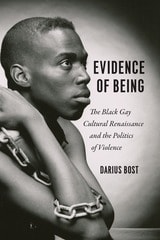
cover of Evidence of Being: The Black Gay Cultural Renaissance and the Politics of Violence

Evidence of Being

The Black Gay Cultural Renaissance and the Politics of Violence

Darius Bost

University of Chicago Press, 2018
Evidence of Being opens on a grim scene: Washington DC’s gay black community in the 1980s, ravaged by AIDS, the crack epidemic, and a series of unsolved murders, seemingly abandoned by the government and mainstream culture. Yet in this darkest of moments, a new vision of community and hope managed to emerge. Darius Bost’s account of the media, poetry, and performance of this time and place reveals a stunning confluence of activism and the arts. In Washington and New York during the 1980s and ’90s, gay black men banded together, using creative expression as a tool to challenge the widespread views that marked them as unworthy of grief. They created art that enriched and reimagined their lives in the face of pain and neglect, while at the same time forging a path toward bold new modes of existence. At once a corrective to the predominantly white male accounts of the AIDS crisis and an openhearted depiction of the possibilities of black gay life, Evidence of Being above all insists on the primacy of community over loneliness, and hope over despair.
[more]
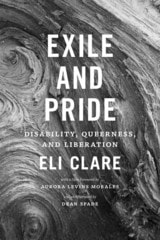
cover of Exile and Pride: Disability, Queerness, and Liberation

Exile and Pride

Disability, Queerness, and Liberation

Eli Clare

Duke University Press, 2015

First published in 1999, the groundbreaking Exile and Pride is essential to the history and future of disability politics. Eli Clare's revelatory writing about his experiences as a white disabled genderqueer activist/writer established him as one of the leading writers on the intersections of queerness and disability and permanently changed the landscape of disability politics and queer liberation. With a poet's devotion to truth and an activist's demand for justice, Clare deftly unspools the multiple histories from which our ever-evolving sense of self unfolds. His essays weave together memoir, history, and political thinking to explore meanings and experiences of home: home as place, community, bodies, identity, and activism. Here readers will find an intersectional framework for understanding how we actually live with the daily hydraulics of oppression, power, and resistance. At the root of Clare's exploration of environmental destruction and capitalism, sexuality and institutional violence, gender and the body politic, is a call for social justice movements that are truly accessible to everyone. With heart and hammer, Exile and Pride pries open a window onto a world where our whole selves, in all their complexity, can be realized, loved, and embraced.
[more]
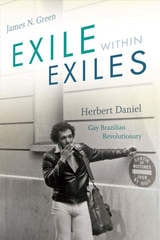
cover of Exile within Exiles: Herbert Daniel, Gay Brazilian Revolutionary

Exile within Exiles

Herbert Daniel, Gay Brazilian Revolutionary

James N. Green

Duke University Press, 2018

Herbert Daniel was a significant and complex figure in Brazilian leftist revolutionary politics and social activism from the mid-1960s until his death in 1992. As a medical student, he joined a revolutionary guerrilla organization but was forced to conceal his sexual identity from his comrades, a situation Daniel described as internal exile. After a government crackdown, he spent much of the 1970s in Europe, where his political self-education continued. He returned to Brazil in 1981, becoming engaged in electoral politics and social activism to champion gay rights, feminism, and environmental justice, achieving global recognition for fighting discrimination against those with HIV/AIDS. In Exile within Exiles, James N. Green paints a full and dynamic portrait of Daniel's deep commitment to leftist politics, using Daniel's personal and political experiences to investigate the opposition to Brazil's military dictatorship, the left's construction of a revolutionary masculinity, and the challenge that the transition to democracy posed to radical movements. Green positions Daniel as a vital bridge linking former revolutionaries to the new social movements, engendering productive dialogue between divergent perspectives in his writings and activism.
[more]