110 books match the query 'Gays' and 6 start with e
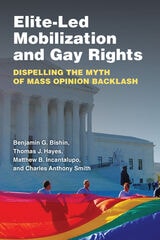
cover of Elite-Led Mobilization and Gay Rights: Dispelling the Myth of Mass Opinion Backlash

Elite-Led Mobilization and Gay Rights

Dispelling the Myth of Mass Opinion Backlash

Benjamin George Bishin, Thomas J. Hayes, Matthew B. Incantalupo, and Charles Anthony Smith

University of Michigan Press, 2021

Media and scholastic accounts describe a strong public opinion backlash—a sharply negative and enduring opinion change—against attempts to advance gay rights. Academic research, however, increasingly questions backlash as an explanation for opposition to LGBT rights. Elite-Led Mobilization and Gay Rights argues that what appears to be public opinion backlash against gay rights is more consistent with elite-led mobilization—a strategy used by anti-gay elites, primarily white evangelicals, seeking to prevent the full incorporation of LGBT Americans in the polity in order to achieve political objectives and increase political power. This book defines and tests the theory of Mass Opinion Backlash and develops and tests the theory of Elite-Led Mobilization by employing a series of online and natural experiments, surrounding the U.S. Supreme Court rulings in Obergefell v. Hodges and United States v. Windsor, and President Obama’s position change on gay marriage. To evaluate these theories, the authors employ extensive survey, voting behavior, and campaign finance data, and examine the history of the LGBT movement and its opposition by religious conservatives, from the Lavender Scare to the campaign against Trans Rights in the defeat of Houston’s 2015 HERO ordinance. Their evidence shows that opposition to LGBT rights is a top-down process incited by anti-gay elites rather than a bottom-up reaction described by public opinion backlash.

[more]
cover of Envisioning Global LGBT Human Rights: (Neo)colonialism, Neoliberalism, Resistance and Hope

Envisioning Global LGBT Human Rights

(Neo)colonialism, Neoliberalism, Resistance and Hope

Edited by Nancy Nicol, Adrian Jjuuko, Richard Lusimbo, Nick Mulé, Susan Ursel, Amar Wahab, and Phyllis Waugh

University of London Press, 2018
Customers based in the US and Canada, please order from: https://www.sas.ac.uk/envisionthisAmerica Envisioning Global LGBT Human Rights: (Neo)colonialism, Neoliberalism, Resistance and Hope is an outcome of a five-year international collaboration among partners that share a common legacy of British colonial laws that criminalise same-sex intimacy and gender identity/expression. The project sought to facilitate learning from each other and to create outcomes that would advance knowledge and social justice. The project was unique, combining research and writing with participatory documentary filmmaking. This visionary politics infuses the pages of the anthology. The chapters are bursting with invaluable first hand insights from leading activists at the forefront of some of the most fiercely fought battlegrounds of contemporary sexual politics in India, the Caribbean and Africa. As well, authors from Canada, Botswana and Kenya examine key turning points in the advancement of SOGI issues at the United Nations, and provide critical insights on LGBT asylum in Canada. Authors also speak to a need to reorient and decolonise queer studies, and turn a critical gaze northwards from the Global South. It is a book for activists and academics in a range of disciplines from postcolonial and sexualities studies to filmmaking, as well as for policy-makers and practitioners committed to envisioning, and working for, a better future. Customers in the USA and Canada can purchase the book from here: https://bit.ly/2KBk0V2
[more]
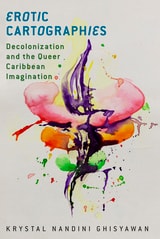
cover of Erotic Cartographies: Decolonization and the Queer Caribbean Imagination

Erotic Cartographies

Decolonization and the Queer Caribbean Imagination

Krystal Nandini Ghisyawan

Rutgers University Press, 2022
Erotic Cartographies uses subjective mapping, a participatory data collection technique, to demonstrate how Trinidadian same-sex-loving women use their gender performance, erotic autonomy, and space-making practices to reinforce and resist colonial ascriptions on subject bodies. The women strategically embody their sexual identities to challenge imposed subject categories and to contest their invisibility and exclusion from discourses of belonging. Erotic Cartographies refers to the processes of mapping territories of self-knowing and self-expression, both cognitively in the imagination and on paper during the mapping exercise, exploring how meaning is given to space, and how it is transformed. Using the women’s quotes and maps, the book focuses on the false binary of public-private, the practices of home and family, and religious nationalism and spiritual self-seeking, to demonstrate the women’s challenges to the structural, symbolic, and interpersonal violence of colonial discourses and practices related to gender, knowledge, and power in Trinidadian society.
[more]
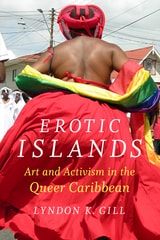
cover of Erotic Islands: Art and Activism in the Queer Caribbean

Erotic Islands

Art and Activism in the Queer Caribbean

Lyndon K. Gill

Duke University Press, 2018

In Erotic Islands, Lyndon K. Gill maps a long queer presence at a crossroads of the Caribbean. This transdisciplinary book foregrounds the queer histories of Carnival, calypso, and HIV/AIDS in the Republic of Trinidad and Tobago. At its heart is an extension of Audre Lorde's use of the erotic as theory and methodology. Gill turns to lesbian/gay artistry and activism to insist on eros as an intertwined political-sensual-spiritual lens through which to see self and society more clearly. This analysis juxtaposes revered musician Calypso Rose, renowned mas man Peter Minshall, and resilient HIV/AIDS organization Friends For Life. Erotic Islands traverses black studies, queer studies, and anthropology toward an emergent black queer diaspora studies.
[more]
cover of Evening Crowd at Kirmser’s: A Gay Life In The 1940S

Evening Crowd at Kirmser’s

A Gay Life In The 1940S

Ricardo J. Brown

University of Minnesota Press, 2003

A surprising and vivid remembrance of gay life in the wake of World War II

It is often difficult to imagine gay gathering places in the decades before the Stonewall riots of the 1960s, and nearly impossible to think of such communities outside the nation’s largest cities. Yet such places did exist, and their histories tell amazing stories of survival and the struggle for acceptance and self-respect.

Kirmser’s was such a place. In the 1940s, this bar in downtown St. Paul was popular with blue-collar customers during the day, then became an unofficial home to working-class gay men and lesbians at night. After Ricardo J. Brown was discharged from the navy for revealing his sexual orientation in 1945, he returned home to Minnesota and discovered in Kirmser’s a space where he could develop his new self-awareness and fulfill his desire to find people like himself.The Evening Crowd at Kirmser’s is Brown’s compelling memoir of his experiences as a young gay man in St. Paul. In an engaging and open writing style, and through stories both humorous and tragic, Brown introduces us to his family, companions, and friends, such as Flaming Youth, a homely, sardonic man who carried the nickname from his youth ironically into middle age; Dale, who suddenly loses his job of six years after an anonymous note informed his employer that he was gay; and Bud York, an attractive and confident man with a fondness for young boys.
[more]
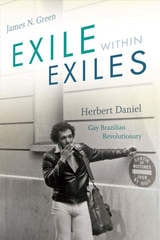
cover of Exile within Exiles: Herbert Daniel, Gay Brazilian Revolutionary

Exile within Exiles

Herbert Daniel, Gay Brazilian Revolutionary

James N. Green

Duke University Press, 2018

Herbert Daniel was a significant and complex figure in Brazilian leftist revolutionary politics and social activism from the mid-1960s until his death in 1992. As a medical student, he joined a revolutionary guerrilla organization but was forced to conceal his sexual identity from his comrades, a situation Daniel described as internal exile. After a government crackdown, he spent much of the 1970s in Europe, where his political self-education continued. He returned to Brazil in 1981, becoming engaged in electoral politics and social activism to champion gay rights, feminism, and environmental justice, achieving global recognition for fighting discrimination against those with HIV/AIDS. In Exile within Exiles, James N. Green paints a full and dynamic portrait of Daniel's deep commitment to leftist politics, using Daniel's personal and political experiences to investigate the opposition to Brazil's military dictatorship, the left's construction of a revolutionary masculinity, and the challenge that the transition to democracy posed to radical movements. Green positions Daniel as a vital bridge linking former revolutionaries to the new social movements, engendering productive dialogue between divergent perspectives in his writings and activism.
[more]