Results by title
341 books match the query 'Geography' and 10 start with e
Eccentricities of Geography
Teresa Milbrodt
University Press of Colorado, 2012
These writers reveal that the land is a character: sometimes a mother, sometimes a joker, never an enemy, though one must take care. The space can be refreshing or oppressive, as the paradox of openness is that it tends to control and confine as much as free us. The weather plans your day. Snowstorms don't negotiate.
The West makes people acutely aware of the absurdity of their smallness, and this feeling is the source of much of the humor in the anthology. The sensation of being tiny, that crazed adrenalin rush and the feeling of your heart beating in your throat, has to make you laugh out loud like a roller coaster. The twenty authors in this collection will take you for an interesting ride.
Contributors to the anthology include: Kirstin Abraham, Genevieve Betts, Shirley Brewer, David Coy, Elizabeth Creely, Mary Christine Delea, Jen Edwards, Thea Gavin, John Haggerty, Brad Johnson, Neal Lewing, Robert McBrearty, Margaret Ozemet, Francis Raven, Greg Robillard, Heather Sappenfield, Sam Smith, Laura Snyder, Caroline Sposto, and Scott Starbuck.
Elsewhere
A Journey into Our Age of IslandsAlastair Bonnett
University of Chicago Press, 2020
There are millions of islands on our planet. New islands are being built at an unprecedented rate, for tourism and territorial ambition. Many are also disappearing, besieged by rising sea levels. The story of our world’s islands is one of the great dramas of our time, and it is playing out around the planet—islands are sprouting or being submerged everywhere from the South China Sea to the Atlantic. Elsewhere is the story of this strange and mesmerizing planetary spectacle.
In this book, explorer and geographer Alastair Bonnett takes us on a thought-provoking tour of the world’s most fascinating islands. He traveled the globe to provide a firsthand look at numerous islands, sketching a vivid likeness of each one he visited. From a “crannog,” an ancient artificial island in a Scottish loch, to the militarized artificial islands China is building; from the disappearing islands that remain the home of native Central Americans to the ritzy new islands of Dubai; from Hong Kong to the Isles of Scilly—all have compelling stories to tell. As we journey around the world with Bonnett, he addresses urgent contemporary issues such as climate change, economic inequality, and the changing balance of world power as reflected in the fates of islands. Along the way, we also learn about the many ways islands rise and fall, the long and little-known history of human island-building and the prospect that the inland hills and valleys will one day be archipelagos.
Featuring Bonnett’s charming hand-drawn maps and 33 full-color photos, Elsewhere is a captivating travel book for any armchair adventurer.
Environment and Society in the Japanese Islands
From Prehistory to the PresentBruce L. Batten
Oregon State University Press, 2015
Environment and Society in the Japanese Islands attempts to answer these questions through a series of case studies by leading Japanese and Western historians, geographers, archaeologists, and climatologists. These essays, on diverse topics from all periods of Japanese history and prehistory, are unified by their focus on the key concepts of “resilience” and “risk mitigation.” Taken as a whole, they place Japan’s experience in global context and call into question the commonly presumed division between pre-modern and modern environmental history.
Primarily intended for scholars and students in fields related to Japan or environmental history, these accessibly-written essays will be valuable to anyone wishing to learn about the historical roots of today’s environmental issues or the complex relationship between human society and the natural environment.
Envisioning the City
Six Studies in Urban CartographyEdited by David Buisseret
University of Chicago Press, 1998
Whether a Chinese vertical city plan from the first millennium B.C. or a bird's-eye view appended to a fifteenth-century edition of Ptolemy's Geography, the type of plan chosen and its focus reflected the aspects of a city that the map's creators wished to highlight. For instance, maps of seventeenth-century cities emphasized impregnable fortifications as a deterrent to potential attackers. And Daniel Burnham's famous 1909 Plan of Chicago used a distinct representational style to "sell" his version of the new Chicago.
Although city plans are among the oldest maps known, few books have been devoted to them. Historians of cartography and geography, architects, and urban planners will all enjoy this profusely illustrated volume.
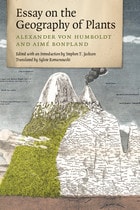
Essay on the Geography of Plants
Alexander von Humboldt and Aimé Bonpland
University of Chicago Press, 2010
The chronicles of the expedition were published in Paris after Humboldt’s return, and first among them was the 1807 “Essay on the Geography of Plants.” Among the most cited writings in natural history, after the works of Darwin and Wallace, this work appears here for the first time in a complete English-language translation. Covering far more than its title implies, it represents the first articulation of an integrative “science of the earth, ” encompassing most of today’s environmental sciences. Ecologist Stephen T. Jackson introduces the treatise and explains its enduring significance two centuries after its publication.
Evacuation
The Politics and Aesthetics of Movement in EmergencyPeter Adey
Duke University Press, 2024
Everyday Environmentalism
Creating an Urban Political EcologyAlex Loftus
University of Minnesota Press, 2012
Everyday Environmentalism develops a conversation between marxist theories of everyday life and recent work in urban political ecology, arguing for a philosophy of praxis in relation to the politics of urban environments. Grounding its theoretical debate in empirical studies of struggles to obtain water in the informal settlements of Durban, South Africa, as well as in the creative acts of insurgent art activists in London, Alex Loftus builds on the work of key marxist thinkers to redefine “environmental politics.”
A marxist philosophy of praxis—that world-changing ideas emerge from the acts of everyday people—undergirds the book. Our daily reality, writes Loftus, is woven out of the entanglements of social and natural relations, and as such a kind of environmental politics is automatically incorporated into our lives. Nevertheless, one effect of the public recognition of global environmental change, asserts Loftus, has been a resurgence of dualistic understandings of the world: for example, that nature is inflicting revenge on arrogant human societies.
This ambitious work reformulates—with the assistance of such philosophers as Lukács, Gramsci, Lefebvre, and others—a politics of the environment in which everyday subjectivity is at the heart of a revolutionary politics.
Everyday Las Vegas
Local Life in a Tourist TownRex J. Rowley
University of Nevada Press, 2014
Rowley considers such topics as why people move to Las Vegas, the nature of their work and personal lives, the impact of growth and rapid change, and interaction with the overwhelmingly touristic side of the city. He also considers the benefits and perils of living in a nonstop twenty-four-hour city rich in entertainment options and easy access to gambling, drugs, and other addictions. His examination includes the previously unstudied role of neighborhood casinos patronized by locals rather than tourists and the impact that a very mobile population has on schools, churches, and community life.
Rowley considers the very different ways people perceive a place as insiders or outsiders, a dichotomy that arises when tourism is a mainstay of the local economy. His work offers insights into what Las Vegas can teach us about other cities and American culture in general. It also contributes to our understanding of how people relate to places and how the personality of a place influences the lives of people who live there.
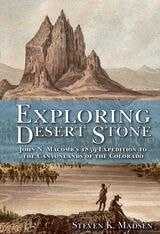
Exploring Desert Stone
John N. Macomb's 1859 Expedition to the Canyonlands of the ColoradoSteven K. Madsen
Utah State University Press, 2022
The soldiers and scientists followed in part the Old Spanish Trail, whose location they documented and verified. Seeking to find the confluence of the Colorado and the Green and looking for alternative routes into Utah, which was of particular interest in the wake of the Utah War, they produced a substantial documentary record, most of which is published for the first time in this volume. Theirs is also the first detailed map of the region, and it is published in Exploring Desert Stone, as well.
Exploring The Beloved Country
American Society And CultureWilbur Zelinsky
University of Iowa Press, 1994
For fifty years geographer Wilbur Zelinsky has charted the social, cultural, and historical map of the American experience. A self-confessed incurable landscape voyeur, he has produced order and pattern from massive amounts of data, zestfully finding societal meaning in the terra incognita of our postmodern existence. Now he has gathered his most original and exciting explorations into a volume that captures the nature and dynamics of this remarkable phenomenon we call the United States of America. Each the product of Zelinsky's joyous curiosity, these energetic essays trace the innermost contours of our bewildering American reality.