Results by title
884 books match the query 'Historical' and 31 start with e

E. Franklin Frazier Reconsidered
Platt, Anthony M
Rutgers University Press, 1991
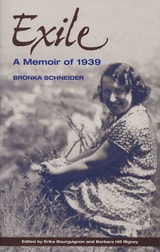
EXILE
A MEMOIR OF 1939Bronka Schneider Edited with forewords by Erika Bourguignon and Barbara Hill Rigney
The Ohio State University Press, 1998
Bronka Schneider and her husband, Joseph, were two of the thirty thousand Austrian Jews admitted as refugees to Great Britain between March 1938 and 2 September 1939. It was not until 1960, however, that Schneider wrote her memoir about the year she spent as a housekeeper, with Joseph as a butler, in a Scottish castle.
Schneider tells of daily encounters—with her employers, the English lady and her husband, a retired British civil servant who had spent many years in India; the village locals; other refugees; and a family of evacuees from the slums of Glasgow.
The editors have divided this memoir into chapters, adding headlines from the London Times as epigraphs. These headlines, reporting the escalating events of World War II, are in stark contrast to daily activities of the residents of this isolated region of Scotland. A commentary by Erika Bourguignon provides historical, political, and cultural background of this period.
Eadfrith
Scribe of LindisfarneMichelle Treeve
Arizona Center for Medieval and Renaissance Studies, 2014
Earth Abideth
George Dell
The Ohio State University Press, 1999
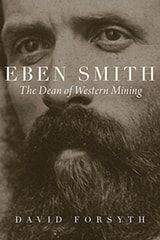
Eben Smith
The Dean of Western MiningDavid Forsyth
University Press of Colorado, 2021
The mining teams Smith formed with Chaffee and with industrialist David Moffat were among the most successful and respected in Colorado, and many in the state held Smith in high regard. Yet despite the credit he received during his lifetime for establishing Colorado’s mining industry, Smith has not received much attention from historians, perhaps because he was content to leave public-facing duties to his partners while he concerned himself with managing mine operations.
From Smith’s early years and his labor in the mines to his rise to prominence as an investor and developer, Forsyth shows how Smith used the mining and milling knowledge he acquired in California to become a leader in technological innovation in Colorado’s mining industry.
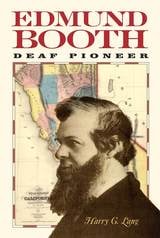
Edmund Booth
Deaf PioneerHarry G. Lang
Gallaudet University Press, 2004
Edmund Booth was born in 1810 and died in 1905, and during the 94 years of his life, he epitomized virtually everything that characterized an American legend of that century. In his prime, Booth stood 6 feet, 3 inches tall, weighed in at 210 pounds, and wore a long, full beard. He taught school in Hartford, CT, then followed his wife-to-be Mary Ann Walworth west to Anamosa, Iowa, where in 1840, he built the area’s first frame house. He pulled up stakes nine years later to travel the Overland Trail on his way to join the California Gold Rush. After he returned to Iowa in 1854, he became the editor of the Anamosa Eureka, the local newspaper. Edmund Booth fit perfectly the mold of the ingenious pioneer of 19th-century America, except for one unusual difference — he was deaf.
Edmund Booth: Deaf Pioneer follows the amazing career of this American original and his equally amazing wife in fascinating detail. Author Harry G. Lang vividly portrays Booth and his wife by drawing from a remarkable array of original material. A prolific writer, Booth corresponded with his fiancé from the American School for the Deaf in Hartford, and he kept a journal during his days on the California trail, parts of which have been reproduced here. He also wrote an autobiographical essay when he was 75, and his many newspaper articles through the years bore first-hand witness to the history of his times, from the Civil War to the advent of the 20th century.
Edmund Booth depicts a larger-than-life man in larger-than-life times, but perhaps its greatest contribution derives from its narrative about pioneer days as seen through Deaf eyes. Booth became a respected senior statesman of the American Deaf community, and blended with his stories of the era’s events are anecdotes and issues vital to Deaf people and their families. His story proves again that extraordinary people vary in many ways, but they often possess a common motive in acting to enhance their own communities.
Edward Stanly
Whiggerys Tarheel ConquerNorman Brown
University of Alabama Press, 1974
A Southern Whig, a Unionist firebrand—Edward Stanly’s fight for principle in a fractured nation.
This biography of Edward Stanly relates the major political events of his life: his emergence, while still in his twenties, as a fiery and controversial leader of the Whig Party in North Carolina, his role as one of the ablest champions of Whiggery in the United States House of Representatives, 1837–1843; his candidacy for governor of California on the Republican ticket in 1857; his appointment by President Abraham Lincoln as military governor of North Carolina in 1862; and his support in California of President Andrew Johnson’s Reconstruction policy.
Raised under the “Ancient Standard of Federalism,” Edward Stanly was a southern nationalist in the tradition of the two great Virginia Federalists, George Washington and John Marshall. An outspoken opponent of the nullification and secession doctrines of party of section in national politics.
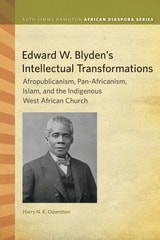
Edward W. Blyden's Intellectual Transformations
Afropublicanism, Pan-Africanism, Islam, and the Indigenous West African ChurchHarry N. K. Odamtten
Michigan State University Press, 2019
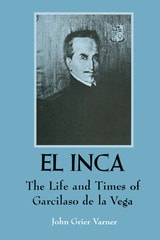
El Inca
The Life and Times of Garcilaso de la VegaBy John Grier Varner
University of Texas Press, 1968
Garcilaso de la Vega, the great chronicler of the Incas and the conquistadors, was born in Cuzco in 1539. At the age of twenty, he sailed to Spain to acquire an education, and he remained there until his death at Córdoba in 1616. As the natural son of a noble conquistador and an Indian woman of royal blood, he took immense pride in both his Spanish and Inca heritage, and, living as he did during a bewildering but stimulating epoch, he personally witnessed the last gasp of the dying Inca empire, the fratricidal conflicts that accompanied the Conquest, and the literary growth as well as the political decline of the Spain of Philip II and Philip III.
Garcilaso left for posterity one of the earliest accounts of the ancient Incas, a reliable though admittedly biased chronicle of Spanish conquests in Andean America and a glowing story of Hernando de Soto’s exploration of North America. Though he never lost pride in his Spanish heritage, continued rebuffs in caste-conscious Spain strengthened his pride in his Indian heritage and his sympathy for his mother’s people. Thus his histories, while ennobling Spaniards, also ennobled the Incas, and eventually were to have some influence in the struggle of South Americans for political independence from Spain. In both blood and character El Inca Garcilaso was a true mestizo. He is generally considered to have been the first native-born American to attain the honor of publication.
This was the life, and these were the times, that Varner has evoked so richly in his narrative. It rings and glitters with the sounds and colors of festivals, pageantry, and battle; it listens to the murmur of prayers, the defeated mutter of the Incas, the scratch of the scholar’s quill; it pictures both highlights and shadows. For the reader already acquainted with Garcilaso’s chronicles, this book will be a welcome complement; for those who are meeting El Inca here for the first time, it will be a rewarding and satisfying introduction.
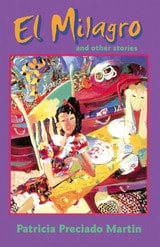
El Milagro and Other Stories
Patricia Preciado Martin
University of Arizona Press, 1996
Reminiscent of Like Water for Chocolate, the book is a rich mix of the simplest ingredients—food, family, tradition. We see Silviana striding to her chicken coop, triggering the "feathered pandemonium" of chickens who smell death in the air. We meet Elena, standing before the mirror in her wedding dress, and Teodoro Sánchez, who sleeps under the sky and smells of “chaparral and mesquite pollen and the stream bottom and the bone dust of generations. There’s the monsignor sitting on the edge of a sofa, sipping Nescafé from a china cup, and here is Sister Francisca "with her warm, minty breath" warning us away from impure thoughts. Be on your best behavior, too, in Tía Petra’s Edwardian parlor—la Doña Petrita, descended from conquistadores, might just deliver a tap on your head with her silver-handled walking stick. Then, with Mamacita, spend a summer afternoon bent over your embroidery with trembling hand and sweaty upper lip, and all the while wondering what in the world it feels like to be kissed.
Intermingled with the author’s stories are collective memories of the barrio, tales halfway between heaven and earth that seem to connect barrio residents to each other and to their past. These cuentos are mystical and dreamy, peopled with ghosts and miracles and Aztec princesses dressed in feathers and gold. Come, sit down and have some salsa and a tortilla—fresh and homemade, it goes without saying; people who buy tortillas at the market "might as well move to Los Angeles, for they have already lost their souls." Then open the pages of this book. Help yourself to another feast of food and flowers, music and dancing, sunshine and moonlight—everything glorious and mundane, serious and humorous, earthly and spiritual, poignant and joyful, in la vida mexicoamericana.
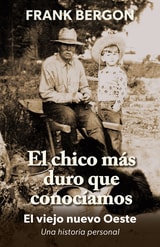
El chico más duro que conocimos
El viejo nuevo Oeste: Una historia personalFrank Bergon
University of Nevada Press, 2027
Del autor aclamado por la crítica Frank Bergon llega una nueva narración personal sobre el Valle de San Joaquín en California. Este libro que acompaña a Two-Buck Chuck & The Marlboro Man nos devuelve a un viejo Oeste que se funde con las realidades del nuevo Oeste, donde el cambio rápido es un rasgo común y los recuerdos son de belleza rural. A pesar de las transformaciones físicas provocadas por la tecnología y la modernidad en el siglo XXI, siguen existiendo elementos de una forma de pensar más antigua, y Bergon rastrea su presencia utilizando experiencias de su propia familia y amigos.
La camaradería comunitaria, el amor por la tierra y sus alimentos, y la alegría por el trabajo duro bien hecho describen las vidas occidentales ignoradas o mal representadas en la mayoría de las historias sobre California y el Oeste. Sin embargo, la nostalgia no impulsa el regreso intelectual de Frank Bergon a ese mundo. También prevalecía una cultura de la lucha, la ignorancia sobre la adicción al alcohol, el trabajo brutal, y una mentalidad feudal que creaba un dolor que era mejor perder y dar por perdido.
A través de todo ello, lo que emerge de sus retratos y ensayos es una revelación de la vida en los pueblos y ranchos rurales del Oeste. Un lugar en el que se acelera la forma americana de extirpar el pasado y alterar violentamente la tierra. Lo que Bergon ha escrito es el retrato de un pasado y unas gentes que dieron forma al país que él llamó hogar.
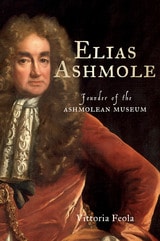
Elias Ashmole
Founder of the Ashmolean MuseumVittoria Feola
Bodleian Library Publishing, 0
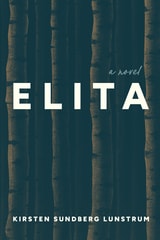
Elita
A NovelKirsten Sundberg Lunstrum
Northwestern University Press, 2025
An American literary take on the Nordic noir genre
Unfolding during the moody Pacific Northwest winter of 1951, we follow Bernadette Baston, scholar of child development and language acquisition, as she travels to a penitentiary on the remote island Elita in the Puget Sound to consult on a curious case: two guards have discovered an animal-like adolescent girl living alone in the cold woods beyond the prison’s walls. There are few answers, but many people who know more than they are saying. According to official reports, the girl, dubbed Atalanta, does not speak. Is her silence protecting someone? The prison warden, court-appointed guardian, and police detective embroil Bernadette in resolving a secret that the tight-knit island community has long held, and her investment in the girl’s case soon becomes more personal than professional. As a mother, wife, and woman bound by mid-twentieth-century expectations, Bernadette strategizes to retain the fragile control she has over her own freedom, identity, and future, which becomes inextricably tied to solving Atalanta’s case.
Emergence of Life on Earth
A Historical and Scientific OverviewFry, Iris
Rutgers University Press, 2000
Topics include:
- Aristotle and the Greek atomists' conceptions of the organism
- Alexander Oparin and J.B.S. Haldane's 1920s breakthrough papers
- Possible life on Mars?
Emergence of Life on Earth
A Historical and Scientific OverviewFry, Iris
Rutgers University Press, 2000
--Michael Ruse, author of Mystery of Mysteries: Is Evolution a Social Construction?
"Fry has fashioned a masterful account of the history, philosophy, and science of the origin of life and the possibility of extraterrestrial life. Her story weaves profound Western ideas of who we are and where we came from, from Aristotle to Gould, from Kant to NASA."
--Woodruff Sullivan, University of Washington
"A rich source for the specialist and thought-provoking reading for the lay person."
--Gunter Wachtershauser, University of Regensburg, Germany
How did life emerge on Earth? Is there life on other worlds? These questions, until recently confined to the pages of speculative essays and tabloid headlines, are now the subject of legitimate scientific research. This book presents a unique perspective--a combined historical, scientific, and philosophical anaylsis, which does justice to the complex nature of the subject. The book's first part offers an overview of the main ideas on the origin of life as they developed from antiquity until the twentieth century. The second, more detailed part of the book examines contemporary theories and major debates within the origin-of-life scientific community.
Topics include:
- Aristotle and the Greek atomists' conceptions of the organism
- Alexander Oparin and J.B.S. Haldane's 1920s breakthrough papers
- Possible life on Mars?
Emmanuel Appadocca; or, Blighted Life
A Tale of the BoucaneersMaxwell Philip
University of Massachusetts Press, 1997
This 1854 novel traces a mulatto son's quest for vengeance against his white father, a sugar planter who abandoned him and his mother. Intent on redeeming his mother's honor and outraged by the cruelty and greed that slavery has engendered Appadocca sails the seas with a band of ruthless pirates on a ship named the Black Schooner. The novel, written by the important activist and intellectual Michel Maxwell Philip (1829–1888) deals with themes, symbols, and literary techniques that are reminiscent of other major authors such as Melville, Douglass, and Stowe. This new edition with scholarly commentaries and annotations will reorient our understanding of the development of Caribbean literature in relation to English and American literary production.
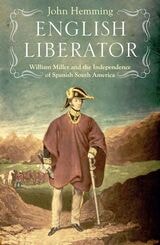
English Liberator
William Miller and the Independence of Spanish South AmericaJohn Hemming
Haus Publishing, 2025
During Admiral Thomas Cochrane’s demolition of imperial Spain’s naval presence in the Pacific amid the revolutionary wars for Spanish South America, all the raids were carried out by his marines under a young officer called William Miller. One of three sons of a baker in a small village in Kent, with no family influence, money, or even secondary education, he came from nowhere, but he went on to have a meteoric rise in the armies that liberated the nations of Chile and Peru. By the time of Ayacucho in 1824, the large battle that ended Spanish rule in South America, there were seven generals in the royalist Spanish army and five on the patriot side. Eleven of these generals were Hispanic; Miller was the only foreigner.
Set in the context of the great European powers’ weakening grip over their global empires and the ensuing wars of independence in Spanish South America, John Hemming’s gripping narrative spans Miller’s time as a teenage soldier in Wellington’s Peninsular War, his contribution to the liberation of the new nations Chile and Peru, and his years in diplomacy thereafter. Drawing on written accounts by many of Miller’s contemporaries in addition to a wealth of modern research, Hemming casts the anti-imperialist, anti-slavery soldier as highly regarded by all the leaders of independence and popular with ordinary people and peasant farmers due to his own humble origins—a legacy evidenced by his burial in the Pantheon of founding fathers of Peru decades after the battles in which he made his name.
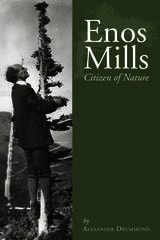
Enos Mills
Citizen of NatureAlexander Drummond
University Press of Colorado, 1995
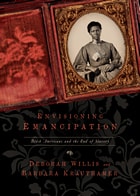
Envisioning Emancipation
Black Americans and the End of SlaveryDeborah Willis
Temple University Press, 2017
The Emancipation Proclamation is one of the most important documents in American history. As we commemorate its 150th anniversary, what do we really know about those who experienced slavery?
In their pioneering book, Envisioning Emancipation, renowned photographic historian Deborah Willis and historian of slavery Barbara Krauthamer have amassed 150 photographs—some never before published—from the antebellum days of the 1850s through the New Deal era of the 1930s. The authors vividly display the seismic impact of emancipation on African Americans born before and after the Proclamation, providing a perspective on freedom and slavery and a way to understand the photos as documents of engagement, action, struggle, and aspiration.
Envisioning Emancipation illustrates what freedom looked like for black Americans in the Civil War era. From photos of the enslaved on plantations and African American soldiers and camp workers in the Union Army to Juneteenth celebrations, slave reunions, and portraits of black families and workers in the American South, the images in this book challenge perceptions of slavery. They show not only what the subjects emphasized about themselves but also the ways Americans of all colors and genders opposed slavery and marked its end.
Filled with powerful images of lives too often ignored or erased from historical records, Envisioning Emancipation provides a new perspective on American culture.
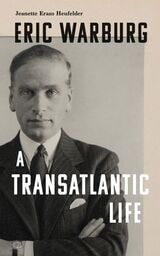
Eric Warburg
A Transatlantic LifeJeanette Erazo Heufelder
Haus Publishing, 2025
In Eric Warburg, Jeanette Erazo Heufelder tells the story of the nephew of the art historian Aby Warburg, whose world-famous library Eric saved from the Nazis. He was a Jew, a banker, a helper of escapees, an intelligence officer in the US Army, a transatlantic bridge builder, and a Cold Warrior. With the help of the cooperation channels he set up, West German and US social groups were aligned with the West amidst the turmoil of postwar Europe.
The history of the transatlantic partnership has become highly topical; since the Russian invasion of Ukraine on February 24, 2022, it has been invoked in Europe as a key reassurance. Eric Warburg’s life, and that of Aby Warburg’s library, tells the story of Europe's twentieth century, the legacy of which continues to inform and inspire the transatlantic partnership today.
Escape Betwixt Two Suns
A True Tale of the Underground Railroad in IllinoisCarol Pirtle. Foreword by Rodney O. Davis
Southern Illinois University Press, 2000
Although the northern Illinois chapters of the story of Susan “Sukey” Richardson’s escape from slavery on the Underground Railroad are documented, the part played by southern Illinois in that historic episode has remained obscure. Carol Pirtle changes that with her investigation into the 1843 suit Andrew Borders lodged against William Hayes, charging his neighbor with helping slaves from the Borders estate escape to Galesburg. In conjunction with her probe into the past, Pirtle also discovered the Hayes correspondence.
Pirtle documents Hayes’s involvement in the Illinois Underground Railroad through approximately two hundred letters received by Hayes from the early 1820s until his death in 1849. Many of these letters specifically corroborate his participation in the escape of slaves from the Borders estate. One such letter came from T. A. Jones in 1843: “You Dear Sir are to me an unknown friend, yet I believe you are a friend to the poor down trodden Slave. This is as good an introduction as I want from any man. My brother, our cause is a holy one.” Letters written by Galesburg residents show that several prominent citizens of that community also assisted in the affair, proving that Knox College administrators and trustees were active in the Underground Railroad.
Pirtle also includes excerpts from the trial transcript from the 1844 civil case against Hayes, which was tried in Pinckneyville, Illinois. She researched newspaper accounts of the event, most notably those in the Western Citizen and the Sparta Herald. Records of the Covenanter Presbyterian church of which Hayes was a member provide partial explanations of Hayes’s motives.
Telling the story of Hayes and his involvement with Susan Richardson and the Underground Railroad, Pirtle provides insight into the work of abolitionists in Illinois. Escape Betwixt Two Suns, in fact, is one of the few books to substantiate the legends of the Underground Railroad. She tells the story of a quiet man who made a difference, of a man deserving the accolades of a hero.
Escape Through the Pyrenees
Lisa Fittko
Northwestern University Press, 2000
Estonian Life Stories
Tiina Kirss
Central European University Press, 2009
After a short period of independence, Estonia was occupied in World War II by the Red Army, then Nazi Germany, and again, for a lasting occupation, by the Soviets. No wonder that a greater part of the roughly one million Estonians had harshly eventful lives.
This anthology contains 25 selected life stories collected from Estonians who lived through the tribulations of the 20th century, and describe the travails of ordinary people under numerous regimes. The autobiographical accounts provide authentic perspectives on events of this period, where time is placed in the context of life-spans, and subjects grounded in personal experience. Most of the life stories reveal sufferings under foreign (Russian) oppression.
The volume is the product of a large-scale national project to record history by collecting autobiographical accounts, and a process of engaged selection for publication which followed. The variety of life-experiences recorded offers comparison across cultures, as well as an overview of the powerful neighbors as they relinquish and strengthen their hold on Estonia.
Eternal People
A NovelDavid Milofsky
University Press of Colorado, 1998
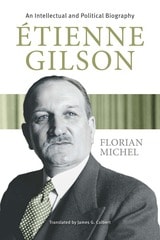
Etienne Gilson
An Intellectual and Political BiographyFlorian Michel
Catholic University of America Press, 2023
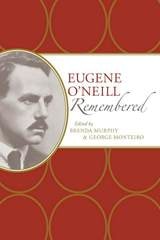
Eugene O'Neill Remembered
Edited by Brenda Murphy and George Monteiro
University of Alabama Press, 2017
A primary-source portrait of Eugene O’Neill through the voices that knew him.
Known principally as the author of some of the most significant plays in the American dramatic canon and as one of America’s Nobel Laureates in literature, O'Neill rarely gave interviews and offered few details about himself. As a consequence, his life has long been shrouded in myth. He also abetted some of the misconceptions about his youth by, for example, advocating the story that he was expelled from Princeton for throwing a rock through Woodrow Wilson's window or by exaggerating the amount of time he had spent at sea. The legend of the hard-drinking, tormented playwright with a grim view of life was further reinforced when Long Day's Journey into Night was produced in 1956, three years after his death instead of the twenty-five years he had insisted on.
The portrayal of O’Neill as a tragic figure has been solidified in a number of biographies. The purpose of this collection, however, is to present O'Neill as others saw him and described him in their first-person accounts. In the course of these reminiscences, many of the vast and various narrators conflict with and contradict each other. Unlike other accounts of O’Neill’s life, much of the focus is on impressions instead of facts. The result is a revealing composite portrait of a key figure in twentieth-century American literary history.
This extensive collection offers insights unavailable in any other book and will hold massive appeal for scholars and students interested in American literature, Eugene O’Neill, and theater history, as well as anyone keen to uncover intimate details of the life of one of America’s greatest writers.
Eulogy for the Living
Taking FlightChrista Wolf
Seagull Books, 2018
Christa Wolf tried for years to find a way to write about her childhood in Nazi Germany. In her 1976 book Patterns of Childhood, she explained why it was so difficult: “Gradually, over a period of months, the dilemma has emerged: to remain speechless or to live in the third person, these seem to be the options. One is impossible, the other sinister.” During 1971 and 1972 she made thirty-three attempts to start the novel, abandoning each manuscript only pages in. Eulogy for the Living, written over the course of four weeks, is the longest of those fragments. In its pages, Wolf recalls with crystalline precision the everyday details of her life as a middle-class grocer’s daughter, and the struggles within the family—struggles common to most families, but exacerbated by the rise of Nazism. And as Nazism fell, the Wolfs fled west, trying to stay ahead of the rampaging Red Army.
Eutaw
A Sequel to The Forayers, or The Raid of the Dog DaysWilliam Gilmore Simms
University of Arkansas Press, 2006
Eutaw was a sequel to his very successful 1855 novel, The Forayers, and thus completed the most comprehensive saga of the war in our literary history. It focuses on the battle of Eutaw Springs in 1781, which ended British domination of South Carolina. Prominent in this significant battle were Nathanael Greene, Light-Horse Harry Lee, and Francis Marion, about whom Simms would later write a biography. As with other volumes in the Arkansas Edition of Simms’s work, this volume includes a critical introduction by the editor and a Simms chronology, as well as appendices dealing with textual matters.
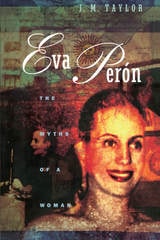
Eva Perón
The Myths of a WomanJulie Taylor
University of Chicago Press, 1981
"Taylor shows that she is remembered by different classes and political factions as saint, a revolutionary, or a whore, depending on whether she was interpreted as an embodiment or as a violation of the Argentine feminine ideal."—Booklist
"Highly commendable . . . it deliberately eschews the sensationalism that characterizes earlier [biographies]. . . . Taylor instead concentrates on the myths that have lingered since her death. . . . [This book] transcends biography."—Gentlemen's Quarterly
"[A] concise and brilliant examination of the legends that arose in Argentina during the lifetime . . . of a woman who broke with Argentine tradition and became a political figure in her own right."—New Yorker
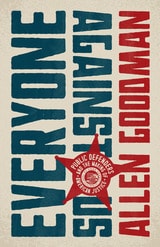
Everyone against Us
Public Defenders and the Making of American JusticeAllen Goodman
University of Chicago Press, 2023
As a public defender, Allen Goodman faced cross-examination from family and friends every day: How could he work to help criminals? How could he live with himself? Presumed guilty by association, Goodman quickly learned that people didn’t really want an answer; they wanted a justification, perhaps even an apology. Ever the idealist, Goodman answered anyway: Everyone deserves justice.
Everyone against Us is Goodman’s testimony of his life as a public defender. In it, he documents his efforts to defend clients, both guilty and innocent, against routine police abuse, prosecutorial misconduct, and unjust sentencing. To work in criminal justice, Goodman shows, is to confront and combat vivid human suffering, of both victims and perpetrators. From sex trafficking, murder, and abuse to false conviction, torture, and systemic racism, Goodman describes the daily experiences that both rattled his worldview and motivated him to work ever harder. Part memoir, part exposé, Everyone against Us is the moving story of an embattled civil servant who staves off the worst abuses of the criminal justice system, at great personal cost.
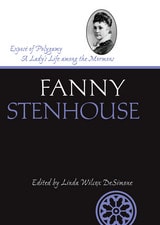
Exposé of Polygamy
A Lady's Life Among the MormonsFanny Stenhouse
Utah State University Press, 2008
After the 1872 publication of Exposé,Fanny Stenhouse became a celebrity in the cultural wars between Mormons and much of America. An English convert, she had grown disillusioned with the Mormon Church and polygamy, which her husband practiced before associating with a circle of dissident Utah intellectuals and merchants. Stenhouse’s critique of plural marriage, Brigham Young, and Mormonism was also a sympathetic look at Utah’s people and honest recounting of her life. She later created a new edition, titled "Tell It All," which ensured her notoriety in Utah and popularity elsewhere but turned her thoughtful memoir into a more polemical, true exposé of Polygamy. Since 1874, it has stayed in print, in multiple, varying editions. The original book, meanwhile, is less known, though more readable. Tracing the literary history of Stenhouse’s important piece of Americana, Linda DeSimone rescues an important autobiographical and historical record from the baggage notoriety brought to it.