Results by title
83 books match the query 'Inclusive Education' and 4 start with e
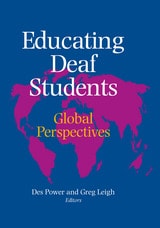
Educating Deaf Students
Global PerspectivesDes Power
Gallaudet University Press, 2005
The 19th International Congress on Education of the Deaf (ICED) in 2000, held in Sydney, Australia, brought together 1,067 teachers, administrators and researchers from 46 countries to address an extremely wide selection of topics. Experts from around the world discussed inclusion of deaf students in regular educational environments, literacy, audiology, auditory development and listening programs, hearing aids, programming for children with cochlear implants, signed communication in education, bilingual education, early intervention (including the rapidly emerging area of newborn hearing screening), education in developing countries, deaf students with multiple disabilities, and deaf students in post-secondary school education.
The 19 chapters of Educating Deaf Students: Global Perspectives present a select cross-section of the issues addressed at the 19th ICED. Divided into four distinct parts – Contemporary Issues for all Learners, The Early Years, The School Years, and Contemporary Issues in Postsecondary Education – the themes considered here span the entire student age range. Authored by 27 different researchers and practitioners from six different countries, this book can be seen as a valuable description of the zeitgeist in the field of education of the deaf at the turn of the 21st century and the millennium.

Educational and Developmental Aspects of Deafness
Donald F. Moores
Gallaudet University Press, 1990
Educational and Developmental Aspects of Deafness details the ongoing revolution in the education of deaf children. More than 20 researchers contributed their discoveries in anthropology, education, linguistics, psychology, sociology, and other major disciplines, with special concentration upon the education of deaf children.
Divided into two parts on education at home and in school, this incisive book documents breakthroughs such as the public's interest in sign language, the increasing availability of interpreters, the growing perception of deafness as a social condition, not a pathology, and other positive trends. It is unique as the first purely research-based text and reference point for further study of the education of deaf children.
Embracing Queer Students’ Diverse Identities at Historically Black Colleges and Universities
A Primer for Presidents, Administrators, and FacultySteve D. Mobley Jr.
Rutgers University Press, 2025
Equity and Inclusion in Higher Education
Strategies for TeachingEdited by Rita Kumar and Brenda Refaei
University of Minnesota Press, 2020
Americans’ perception of college students does not correlate with the reality of the rich diversity seen on university campuses. Over 60% of Americans believe the average age of a college student is 20 years old but, in fact, it’s 26.4 years old. Demographics in the classroom are shifting and instructors bear a responsibility to adjust their teaching style and curriculum to be inclusive for all students.
Equity and Inclusion for Higher Education Strategies for Teaching, edited by Rita Kumar and Brenda Refaei, details the necessity for an inclusive curriculum with examples of discipline-specific activities and modules. The intersectionality of race, age, socioeconomic status, and ability all embody the diversity college instructors encounter in their classrooms. Through the chapters in this book, the contributors make apparent the "hidden curriculum," which is taught implicitly instead of explicitly. The editors focus on learner-centered environments and accessibility of classroom materials for traditionally marginalized students; a critical part of the labor needed to create an inclusive curriculum.
This text provides instructors with resources to create equity-based learning environments. It challenges instructors to see beyond Eurocentric curriculums and expand their pedagogy to include intercultural competence. The contributors challenge the student/instructor dichotomy and embrace collaboration between the two to construct a curriculum that fits all students' needs. The resources and examples in this book demonstrate the importance of inclusion and equity in the classroom. A companion community page provides examples and tools from the editors and contributing authors, which allows for readers to add materials from their own classrooms. This book and collaborative toolkit allow instructors to begin intentional practice of an inclusive curriculum and implement changes to promote respect for diversity.