Results by title
991 books match the query 'Writing' and 71 start with a
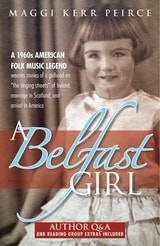
A Belfast Girl
A 1960s American folk music legend weaves stories of a girlhood on “the singing streets” of Ireland, marriage in Scotland, and arrival in AmericaMaggi Kerr Peirce
Parkhurst Brothers, Inc., 2013
A 1960s American folk music legend weaves stories of a girlhood on “the singing streets” of Ireland, marriage in Scotland, and arrival in America
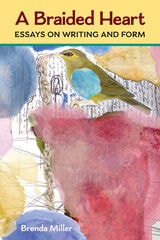
A Braided Heart
Essays on Writing and FormBrenda Miller
University of Michigan Press, 2021
A Braided Heart provides a friendly, personal, and smart guide to the writing life. It also offers clear and original instruction on craft elements at the forefront of today’s emerging forms in creative nonfiction: from the short-short, to the braided form, to the hermit crab essay. An acknowledged expert in these forms, Brenda Miller gives writers practical advice on how to sustain and invigorate their writing practice, while also encouraging readers to explore their own writing lives.
A Communion of Friendship
Literacy, Spiritual Practice, and Women in RecoveryBeth Daniell
Southern Illinois University Press, 2003
Drawing on interviews and an array of scholarly work, Beth Daniell maps out the relations of literacy and spirituality in A Communion of Friendship: Literacy, Spiritual Practice, and Women in Recovery. Daniell tells the story of a group of women in “Mountain City” who use reading and writing in their search for spiritual growth. Diverse in socioeconomic status, the Mountain City women are, or have been, married to alcoholics. In Al-Anon, they use literacy to practice the Twelve Steps of Alcoholics Anonymous in order to find spiritual solutions to their problems.
In addition, Daniell demonstrates that in the lives of these women, reading, writing, and speaking are intertwined, embedded in one another in rich and complex ways. For the women, private literate practice is of the utmost importance because it aids the development and empowerment of the self. These women engage in literate practices in order to grow spiritually and emotionally, to live more self-aware lives, to attain personal power, to find or make meaning for themselves, and to create community. By looking at the changes in the women’s reading, Daniell shows that Al-Anon doctrine, particularly its oral instruction, serves as an interpretive tool. This discussion points out the subtle but profound transformations in these women’s lives in order to call for an inclusive notion of politics.
Foregrounding the women’s voices, A Communion of Friendship addresses a number of issues important in composition studies and reading instruction. This study examines the meaning of literacy within one specific community, with implications both for pedagogy and for empirical research in composition inside and outside the academy.
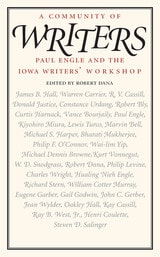
A Community of Writers
Paul Engle and the Iowa Writers' WorkshopDana, Robert
University of Iowa Press, 1999
With these words, written long before his Iowa Writers' Workshop became world famous, much imitated, and academically rich, Paul Engle captured the spirit behind his beloved workshop. Now, in this collection of essays by and about those writers who shared the energetic early years, Robert Dana presents a dynamic, informative tribute to Engle and his world.
The book's three sections mingle myth and history with style and grace and no small amount of humor. The beginning essays are given over to memories of Paul Engle in his heyday. The second group focuses particularly on those teachers—Robert Lowell, John Berryman, Kurt Vonnegut, for example—who made the workshop hum on a day-to-day basis. Finally, the third section is devoted to storytelling: tall tales, vignettes, surprises, sober and not-so-sober moments. Engle's own essay, "The Writer and the Place," describes his "simple, and yet how reckless" conviction that "the creative imagination in all of the arts is as important, as congenial, and as necessary, as the historical study of all the arts."
Today, of course, there are hundreds of writers' workshops, many of them founded and directed by graduates of the original Iowa workshop. But when Paul Engle arrived in Iowa there were exactly two. His indomitable nature and great persuasive powers, combined with his distinguished reputation as a poet, loomed large behind the enhancement of the Iowa Writers' Workshop. This volume of fine and witty essays reveals the enthusiasm and drive and sheer pleasure that went into Iowa's renowned workshop.
A Constructing Experience
Charles Bazerman
Southern Illinois University Press, 1994
Charles Bazerman’s newest book, a selection of both his published and unpublished essays from recent years, ranges from pedagogy to research to theory, exploring how all three levels are motivated by common concerns and how they are integrated through similar concepts and approaches. From this integrative perspective, Bazerman reveals his life-long inquiry into the nature of language—why it exists and what place it holds in the social world.
Presenting a powerful, action-oriented view of language that finds meaning in local circumstances and local uses, Bazerman divides his essays into four parts, beginning with an examination of the classroom experience. In describing the dynamics of the classroom and the relationship of the classroom to surrounding social arrangements, Bazerman notes how reading relates to writing, how interpersonal relations influence and structure acts of reading and writing, and how reading and writing are themselves forms of social action.
Bazerman, in parts 2 and 3, explains how larger forms of social structure are in dialectic with local acts of literacy, how experience of the world influences both everyday writing and empirically driven research, and how individuals conceive of social situations and actions to think about and plan activities. As he admittedly puzzles through conceptual obstacles, Bazerman explores many of the terms and theories evoked in rhetorical studies and provides a critical examination of the theories of James Kinneavy as well as more general thoughts on the nature of rhetorical study.
In part 4, Bazerman reinterprets the classical rhetorical concept of kairos in the light of theory and research in the social sciences, analyzes intertextuality in a scientific text, and offers a rereading of the writings of Adam Smith.
Throughout this book, Bazerman maintains that research into writing is the examination of what people do and have done, what influences what they do, and what texts do to people who write and read them. In addition, he reiterates the importance of literacy as a connecting device, essential to survival, growth, and change. Lack of literacy cuts people off from the institutions and means of life in a society.
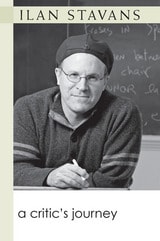
A Critic's Journey
Ilan Stavans
University of Michigan Press, 2009
Ilan Stavans has been a lightning rod for cultural discussion and criticism his entire career. In A Critic's Journey, he takes on his own Jewish and Hispanic upbringing with an autobiographical focus and his typical flair with words, exploring the relationship between the two cultures from his own and also from others' experiences.
Stavans has been hailed as a voice for Latino culture thanks to his Hispanic upbringing, but as a Jew and a Caucasian, he's also an outsider to that culture---something that's sharpened his perspective (and some of his critics' swords). In this book of essays, he looks at the creative process from that point of view, exploring everything from the translation of Don Quixote to the Hispanic anti-Semitism and the Holocaust in Latin America.
Ilan Stavans is Lewis-Sebring Professor in Latin American and Latino Culture and Five College Fortieth Anniversary Professor at Amherst College. A native of Mexico, he received his doctorate in Latin American Literature from Columbia University. Stavans's books include The Hispanic Condition, On Borrowed Words, Spanglish, Dictionary Days, The Disappearance, Love & Language (with Verónica Albin), Resurrecting Hebrew, and Mr. Spic Goes to Washington, and he has edited books including The Oxford Book of Jewish Stories and the upcoming Norton Anthology of Latino Literature. His story "Morirse está en Hebreo" was made into the award-winning movie My Mexican Shivah.
Stavans has received numerous awards, among them a Guggenheim Fellowship, the National Jewish Book Award, an Emmy nomination, the Latino Book Award, Chile's Presidential Medal, the Rubén Darío Distinction, and the Cátedra Roberto Bolaño. His work has been translated into a dozen languages.

A Desire for Women
Relational Psychoanalysis, Writing, and Relationships between WomenJuhasz, Suzanne
Rutgers University Press, 2003
Uniquely weaving together psychoanalytic, feminist, queer, and literary theory as well as memoir to examine the value and meaning of relationships between women, Juhasz explores the writings of adult daughters, mothers, and lovers to consider how language both traces and shapes the contours of experience. She emphasizes the initial bond between mother and infant as the bedrock of identity formation, a process involving love, recognition, desire, and language, and shows how that relationship serves as source and model for all future loves.
Juhasz's lucid prose unravels the meaningful yet overlooked intricacies of the relationships that inflect much of women's writing in the twentieth century.

A Frank Waters Reader
A Southwestern Life In WritingFrank Waters
Ohio University Press, 2000
Over the course of his life, Frank Waters amassed a body of work that has few equals in the literature of the American West. Because his was a writing that touched every facet of the Western experience, his voice still echoes throughout that region’s literary world.
Swallow Press is especially proud to present this generous sampling of Frank Waters’s writings. A Frank Waters Reader encompasses the full range of his work and draws from both his nonfiction and his many novels. It stands as a testament to his singular achievement and proof of the talent that established him as the foremost writer in the Southwest.
This collection spanning forty years of writing provides an excellent introduction for the uninitiated as well as a retrospective for those already familiar with this giant talent. His gift for achieving a delicate balance among the many contrary forces at work in the land and the people who inhabit it is as true and enduring as the region that inspired him.
A Frank Waters Reader
A Southwestern Life in WritingFrank Waters
Ohio University Press, 2000
Over the course of his life, Frank Waters amassed a body of work that has few equals in the literature of the American West. Because his was a writing that touched every facet of the Western experience, his voice still echoes throughout that region’s literary world.
Swallow Press is especially proud to present this generous sampling of Frank Waters’s writings. A Frank Waters Reader encompasses the full range of his work and draws from both his nonfiction and his many novels. It stands as a testament to his singular achievement and proof of the talent that established him as the foremost writer in the Southwest.
This collection spanning forty years of writing provides an excellent introduction for the uninitiated as well as a retrospective for those already familiar with this giant talent. His gift for achieving a delicate balance among the many contrary forces at work in the land and the people who inhabit it is as true and enduring as the region that inspired him.
A Literary History of Iowa
Clarence A. Andrews
University of Iowa Press, 1972

A Manual for Writers of Research Papers, Theses, and Dissertations, Tenth Edition
"The Chicago Manual of Style" for Student ResearchersKate L. Turabian
University of Chicago Press, 2026
The gold standard for generations of college and graduate students writing research papers, now thoroughly updated to reflect today’s expectations.
Whether you are writing your first college research paper or your dissertation, A Manual for Writers of Research Papers, Theses, and Dissertations—also known as “Turabian”—remains a classic resource because of its timeless focus on the fundamentals of good research writing. For more than eight decades, it has offered comprehensive guidance on current expectations for academic writing. Based on the idea that writing a paper means engaging in a conversation with others in your field, it shows you how to conduct research, craft an argument, and produce an original work based on evidence and reasoning that responds to and builds on what others have previously written. Along the way, it also serves as a reference for cultivating consistent and respectful practices toward your readers in citations, language choices, and paper format.
This new edition reflects the continuing evolution in academic writing conventions. It has been updated to reflect the most current editions of The Craft of Research and The Chicago Manual of Style and features the following additional changes:
- A redesign for easier navigation
- Extensive coverage of the appropriate use of generative AI
- A rewritten chapter on visual communication
- Greater attention to writing centers and tutors
- New notes for students and instructors on how to use the book
- Refreshed examples throughout
Further, new ancillary written and video materials to support your use of the book are available online at Turabian.org.
With nearly 10 million copies sold, A Manual for Writers remains the most trusted and time-tested reference for writing research papers. Authoritative, clear, and easy to read with plenty of examples, it is the essential guide for any student or teacher concerned with research and good writing.
A Minefield of Dreams
Triumphs and Travails of Independent Writing ProgramsJustin Everett
University Press of Colorado, 2017
A Pedagogy of Possibility
Bakhtinian Perspectives on Composition StudiesKay Halasek
Southern Illinois University Press, 1999
In a book that itself exemplifies the dialogic scholarship it proposes, Kay Halasek reconceives composition studies from a Bakhtinian perspective, focusing on both the discipline's theoretical assumptions and its pedagogies.
Framing her discussions at every level of the discipline—theoretical, historical, pedagogical—Halasek provides an overview of portions of the Bakhtinian canon relevant to composition studies, explores the implications of Mikhail Bakhtin's work in the teaching of writing and for current debates about the role of theory in composition studies, and provides a model of scholarship that strives to maintain dialogic balance between practice and theory, between composition studies and Bakhtinian thought.
Halasek's study ranges broadly across the field of composition, painting in wide strokes a new picture of the discipline, focusing on the finer details of the rhetorical situation, and teasing out the implications of Bakhtinian thought for classroom practice by examining the nature of critical reading and writing, the efficacy and ethics of academic discourse, student resistance, and critical and conflict pedagogy. The book ends by setting out a pedagogy of possibility, what Halasek terms elsewhere a "post-critical pedagogy" that redefines and redirects current discussions of home versus academic literacies and discourses.
A Poet's Guide to Poetry, Second Edition
Mary Kinzie
University of Chicago Press, 2013
The three parts of A Poet’s Guide to Poetry lead the reader through a carefully planned introduction to the ways we understand poetry. The first section provides careful, step-by-step instruction to familiarize students with the formal elements of poems, from the most obvious feature through the most subtle. The second part carefully examines meter and rhythm, as well as providing a theoretical and practical overview of free verse. The final section offers helpful chapters on writing in form. Rounding out the volume are writing exercises for beginning and advanced writers, a dictionary of poetic terms, and a bibliography of further reading.
For this new edition, Kinzie has carefully reworked the introductory material and first chapter, as well as amended the annotated bibliography to include the most recent works of criticism. The updated guide also contains revised exercises and adjustments throughout the text to make the work as lucid and accessible as possible.
A Shared History
Writing in the High School, College, and University, 1856-1886Amy J. Lueck
Southern Illinois University Press, 2020
Lueck explores Civil War- and Reconstruction-era challenges to the University of Louisville and nearby local high schools, their curricular transformations, and their fate in regard to national education reform efforts. These institutions reflect many of the educational trends and developments of the day: college and university building, the emergence of English education as the dominant curriculum for higher learning, student-centered pedagogies and educational theories, the development and transformation of normal schools, the introduction of manual education and its mutation into vocational education, and the extension of advanced education to women, African American, and working-class students.
Lueck demonstrates a complex genealogy of interconnections among high schools, colleges, and universities that demands we rethink our categories and standards of assessment and our field’s history. A shift in our historical narrative would promote a move away from an emphasis on the preparation, transition, and movement of student writers from high school to college or university and instead allow a greater focus on the fostering of rich rhetorical practices and pedagogies at all educational levels. As the definition of college-level writing becomes increasingly contested once again, Lueck invites a reassessment of the discipline’s understanding of contemporary programs based in high schools like dual-credit and concurrent enrollment.
A Teaching Subject
Composition Since 1966, New EditionJoseph Harris
Utah State University Press, 2012
In this classic text, Joseph Harris traces the evolution of college writing instruction since the Dartmouth Seminar of 1966. A Teaching Subject offers a brilliant interpretive history of the first decades during which writing studies came to be imagined as a discipline separable from its partners in English studies. Postscripts to each chapter in this new edition bring the history of composition up to the present.
Reviewing the development of the field through five key ideas, Harris unfolds a set of issues and tensions that continue to shape the teaching of writing today. Ultimately, he builds a case, now deeply influential in its own right, that composition defines itself through its interest and investment in the literacy work that students and teachers do together. Unique among English studies fields, composition is, Harris contends, a teaching subject.
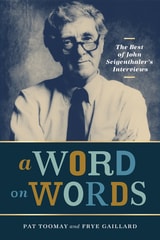
A Word on Words
The Best of John Seigenthaler's InterviewsEdited by Pat Toomay and Frye Gaillard; Epilogue by Andrew Maraniss
Vanderbilt University Press, 2023
Featuring interviews with:
Arna Bontemps • Marshall Chapman • Pat Conroy • Rodney Crowell • John Egerton • Jesse Hill Ford • Charles Fountain • William Price Fox • Kinky Friedman • Frye Gaillard • Nikki Giovanni • Doris Kearns Goodwin • David Halberstam • Waylon Jennings • John Lewis • David Maraniss • William Marshall • Jon Meacham • Ann Patchett • Alice Randall • Dori Sanders • John Seigenthaler Sr. • Marty Stuart • Pat Toomay
A Working Model for Contingent Faculty
Robert Samuels
University Press of Colorado, 2023
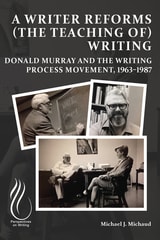
A Writer Reforms (the Teaching of) Writing
Donald Murray and the Writing Process Movement, 1963–1987Michael J. Michaud
University Press of Colorado, 2024
A Writer's Guide to Mindful Reading
Ellen C. Carillo
University Press of Colorado, 2017
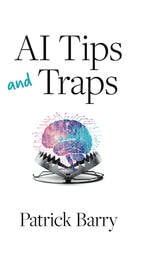
AI Tips and Traps
Patrick Barry
Michigan Publishing Services, 2026
Based on a series of popular courses and workshops that Professor Patrick Barry has created for students, professionals, and anyone else interested in taking a skills-based approach to artificial intelligence, this book gives you a chance to engage with important AI concepts, experiment with exploratory AI exercises, and then ultimately develop your own customized list of AI traps to try as well as AI traps to avoid.
Abducting Writing Studies
Edited by Sidney I. Dobrin and Kyle Jensen
Southern Illinois University Press, 2017
Each of the twelve essays that comprise this collection sparks new insights about the phenomenon of writing. A must-read for rhetoric and composition scholars and students, Abducting Writing Studies is sure to foster vibrant discussions about what is possible in writing research and instruction.
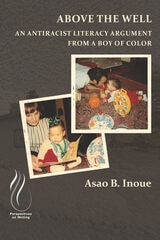
Above the Well
An Antiracist Literacy Argument from a Boy of ColorAsao B. Inoue
University Press of Colorado, 2021
Abstracts and the Writing of Abstracts
John M. Swales and Christine B. Feak
University of Michigan Press, 2009
Today's research world demands a variety of different abstracts to serve different purposes. As a result, writing abstracts can be a difficult task for graduate and international students, researchers, and even practiced authors. Abstracts and the Writing of Abstracts is designed to demystify the construction of this essential writing form and to equip scholars with the skills to summarize their work in clear and compelling ways.
This volume represents a revision and expansion of the material on writing abstracts that appeared in English in Today's Research World.
The Abstracts volume focuses on abstracts for research articles before addressing abstracts for short communications, conferences, and PhD dissertations. It also covers keywords, titles, and author names. Wherever appropriate within the text, Language Focus sections discuss options and provide tips for meeting specific linguistic challenges posed by the writing of different types of abstracts.
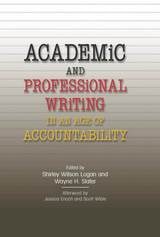
Academic and Professional Writing in an Age of Accountability
Edited by Shirley Wilson Logan and Wayne H. Slater, with an Afterword by Jessica Enoch and Scott Wible
Southern Illinois University Press, 2018
The first two essays in the book provide a history of the academic and professional writing program at the University of Maryland. Subsequent essays explore successes and challenges in the establishment and development of writing programs at four other major institutions, identify the features of language that facilitate academic and professional communication, look at the ways digital practices in academic and professional writing have shaped how writers compose and respond to texts, and examine the role of assessment in curriculum and pedagogy. An afterword by distinguished rhetoric and composition scholars Jessica Enoch and Scott Wible offers perspectives on the future of academic and professional writing.
This collection takes stock of the historical, rhetorical, linguistic, digital, and evaluative aspects of the teaching of writing in higher education. Among the critical issues addressed are how university writing programs were first established and what early challenges they faced, where writing programs were housed and who administered them, how the language backgrounds of composition students inform the way writing is taught, the ways in which current writing technologies create new digital environments, and how student learning and programmatic outcomes should be assessed.
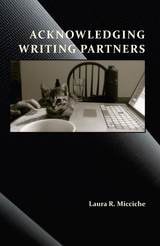
Acknowledging Writing Partners
Laura Micciche
University Press of Colorado, 2017
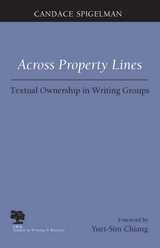
Across Property Lines
Textual Ownership in Writing GroupsCandace Spigelman
Southern Illinois University Press, 2000
Candace Spigelman investigates the dynamics of ownership in small group writing workshops, basing her findings on case studies involving two groups: a five-member creative writing group meeting monthly at a local Philadelphia coffee bar and a four-member college-level writing group meeting in their composition classroom. She explores the relationship between particular notions of intellectual property within each group as well as the effectiveness of writing groups that embrace these notions. Addressing the negotiations between the public and private domains of writing within these groups, she discovers that for both the committed writers and the novices, “values associated with textual ownership play a crucial role in writing group performance.”
Spigelman discusses textual ownership, intellectual property, and writing group processes and then reviews theories relating to authorship and knowledge making. After introducing the participants in each group, discussing their texts, and describing their workshop sessions, she examines the writers’ avowed and implied beliefs about exchanging ideas and protecting individual property rights.
Spigelman stresses the necessary tension between individual and social aspects of writing practices: She argues for the need to foster more collaborative activity among student writers by replicating the processes of writers working in nonacademic settings but also contends that all writers must be allowed to imagine their individual agency and authority as they compose.
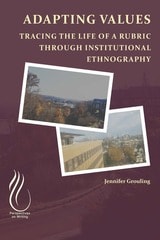
Adapting VALUEs
Tracing the Life of a Rubric through Institutional EthnographyJennifer Grouling
University Press of Colorado, 2023
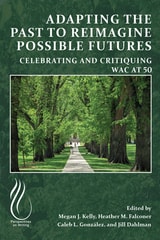
Adapting the Past to Reimagine Possible Futures
Celebrating and Critiquing WAC at 50Megan J. Kelly
University Press of Colorado, 2024
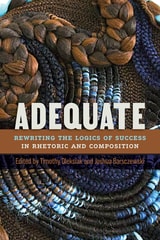
Adequate
Rewriting the Logics of Success in Rhetoric and CompositionTimothy Oleksiak
Utah State University Press, 2025
Fourteen essays from established scholars, ranging from deeply personal, to darkly humorous, to impassioned and blunt, offer theoretical and pragmatic resources for responding to unjust labor extraction and the discipline’s demands that teachers do it all. Drawing on an array of intellectual traditions including labor studies, feminist rhetoric, disability studies, Jewish rhetoric, and theories of writing program administrations, authors assert the reasonable position of being enough and thriving outside of work in the face of growing demands for professional excellence and even perfection.
Adequate reimagines what the concept of adequacy holds for the future of academic work. An invaluable resource for scholars, graduate students, and advanced undergraduate students in the rhetoric and composition field, this volume covers the realities of teaching rhetoric and composition in the modern college environment, as well as potential paths forward for educators in need of a better work-life balance.
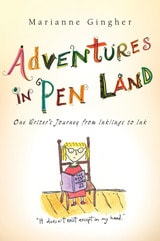
Adventures in Pen Land
One Writer's Journey from Inklings to InkMarianne Gingher
University of Missouri Press, 2008
Featuring guest appearances by other writers such as Fred Chappell, Max Steele, and Annie Dillard plus cameos by the likes of Patty Hearst, Richard Nixon, and Bon Jovi, Adventures in Pen Land celebrates writing as a form of play that Gingher has never outgrown. The lighthearted illustrations by novelist Daniel Wallace (author of Big Fish) serve to reinforce this refreshing message as they depict one writer and her imagination growing up together.
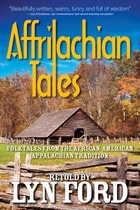
Affrilachian Tales
Folktales from the African-American Appalachian TraditionLynette Ford
Parkhurst Brothers, Inc., 2012
Folktales from the African American Appalachian tradition. Told by Lyn Ford, one of America’s busiest touring storytellers. The power of Lyn's storytelling comes straight out of her family heritage, which is the content of this, her first book. Here she tells how she learned stories from her father and grandfather—and she includes many of the stories they told her.
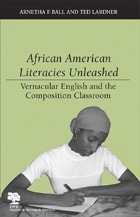
African American Literacies Unleashed
Vernacular English and the Composition ClassroomArnetha F. Ball and Ted Lardner
Southern Illinois University Press, 2005
This pioneering study of African American students in the composition classroom lays the groundwork for reversing the cycle of underachievement that plagues linguistically diverse students. African American Literacies Unleashed: Vernacular English and the Composition Classroom approaches the issue of African American Vernacular English (AAVE) in terms of teacher knowledge and prevailing attitudes, and it attempts to change current pedagogical approaches with a highly readable combination of traditional academic discourse and personal narratives.
Realizing that composition is a particular form of social practice that validates some students and excludes others, Arnetha Ball and Ted Lardner acknowledge that many African American students come to writing and composition classrooms with talents that are not appreciated. To empower and inform practitioners, administrators, teacher educators, and researchers, Ball and Lardner provide knowledge and strategies that will help unleash the potential of African American students and help them imagine new possibilities for their successes as writers.
African American Literacies Unleashed asserts that necessary changes in theory and practice can be addressed by refocusing attention from teachers’ knowledge deficits to the processes through which teachers engage information relevant to culturally informed pedagogy. Providing strategies for unlearning racism in the classroom and changing the status quo, this volume stresses the development and maintenance of a real sense of teaching efficacy—teachers’ beliefs in their abilities to connect with and work effectively with all students—and reflective optimism—teachers’ informed expectations that all students have the potential to succeed.
After Plato
Rhetoric, Ethics, and the Teaching of WritingJohn Duffy
Utah State University Press, 2020
After Plato redefines the relationships of rhetoric for scholars, teachers, and students of rhetoric and writing in the twenty-first century. Featuring essays by some of the most accomplished scholars in the field, the book explores the diversity of ethical perspectives animating contemporary writing studies—including feminist, postmodern, transnational, non-Western, and virtue ethics—and examines the place of ethics in writing classrooms, writing centers, writing across the curriculum programs, prison education classes, and other settings.
When truth is subverted, reason is mocked, racism is promoted, and nationalism takes center stage, teachers and scholars of writing are challenged to articulate the place of rhetorical ethics in the writing classroom and throughout the field more broadly. After Plato demonstrates the integral place of ethics in writing studies and provides a roadmap for future conversations about ethical rhetoric that will play an essential role in the vitality of the field.
Contributors: Fred Antczak, Patrick W. Berry, Vicki Tolar Burton, Rasha Diab, William Duffy, Norbert Elliot, Gesa E. Kirsch, Don J. Kraemer, Paula Mathieu, Robert J. Mislevy, Michael A. Pemberton, James E. Porter, Jacqueline Jones Royster, Xiaoye You, Bo Wang
After the Public Turn
Composition, Counterpublics, and the Citizen BricoleurFrank Farmer
Utah State University Press, 2013
Farmer examines two very different kinds of publics, cultural and disciplinary, and discusses two counterpublics within those broad categories: zine discourses and certain academic discourses. By juxtaposing these two significantly different kinds of publics, Farmer suggests that each discursive world can be seen, in its own distinct way, as a counterpublic, an oppositional social formation that has a stake in widening or altering public life as we know it.
Drawing on major figures in rhetoric and cultural theory, Farmer builds his argument about composition teaching and its relation to the public sphere, leading to a more sophisticated understanding of public life and a deeper sense of what democratic citizenship means for our time.
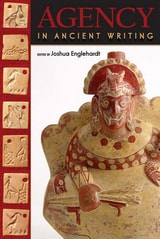
Agency in Ancient Writing
Joshua Englehardt
University Press of Colorado, 2012
Individual agents are frequently evident in early writing and notational systems, yet these systems have rarely been subjected to the concept of agency as it is traceable in archeology. Agency in Ancient Writing addresses this oversight, allowing archeologists to identify and discuss real, observable actors and actions in the archaeological record.
Embracing myriad ways in which agency can be interpreted, ancient writing systems from Mesoamerica, Mesopotamia, Egypt, Crete, China, and Greece are examined from a textual perspective as both archaeological objects and nascent historical documents. This allows for distinction among intentions, consequences, meanings, and motivations, increasing understanding and aiding interpretation of the subjectivity of social actors. Chapters focusing on acts of writing and public recitation overlap with those addressing the materiality of texts, interweaving archaeology, epigraphy, and the study of visual symbol systems.
Agency in Ancient Writing leads to a more thorough and meaningful discussion of agency as an archaeological concept and will be of interest to anyone interested in ancient texts, including archaeologists, historians, linguists, epigraphers, and art historians, as well as scholars studying agency and structuration theory.
Agents of Integration
Understanding Transfer as a Rhetorical ActRebecca S. Nowacek
Southern Illinois University Press, 2011
While many studies of transfer are longitudinal, with data collected over several years, Nowacek’s is synchronous, a rich cross-section of the writing and classroom discussions produced by a team-taught learning community—three professors and eighteen students enrolled in a one-semester general education interdisciplinary humanities seminar that consisted of three linked courses in history, literature, and religious studies. With extensive field notes, carefully selected student and teacher self-reports in the form of interviews and focus groups, and thorough examinations of recorded classroom discussions, student papers with professor comments, and student notebooks, Nowacek presents a nuanced and engaging analysis that outlines how transfer is not simply a cognitive act but a rhetorical one that involves both seeing connections and presenting them to the instructors who are institutionally positioned to recognize and value them.
Considering the challenges facing instructors teaching for transfer and the transfer of writing-related knowledge, Nowacek develops and outlines a new theoretical framework and methodological model of transfer and illustrates the practical implications through case studies and other classroom examples. She proposes transfer is best understood as an act of recontextualization, and she builds on this premise throughout the book by drawing from previous work in cognitive psychology, activity theory, and rhetorical genre theory, as well as her own analyses of student work.
This focused examination complements existing longitudinal studies and will help readers better understand not only the opportunities and challenges confronting students as they work to become agents of integration but also the challenges facing instructors as they seek to support that student work.
Alive in the Writing
Crafting Ethnography in the Company of ChekhovKirin Narayan
University of Chicago Press, 2012
Anton Chekhov is revered as a boldly innovative playwright and short story writer—but he wrote more than just plays and stories. In Alive in the Writing—an intriguing hybrid of writing guide, biography, and literary analysis—anthropologist and novelist Kirin Narayan introduces readers to some other sides of Chekhov: his pithy, witty observations on the writing process, his life as a writer through accounts by his friends, family, and lovers, and his venture into nonfiction through his book Sakhalin Island. By closely attending to the people who lived under the appalling conditions of the Russian penal colony on Sakhalin, Chekhov showed how empirical details combined with a literary flair can bring readers face to face with distant, different lives, enlarging a sense of human responsibility.
Highlighting this balance of the empirical and the literary, Narayan calls on Chekhov to bring new energy to the writing of ethnography and creative nonfiction alike. Weaving together selections from writing by and about him with examples from other talented ethnographers and memoirists, she offers practical exercises and advice on topics such as story, theory, place, person, voice, and self. A new and lively exploration of ethnography, Alive in the Writing shows how the genre’s attentive, sustained connection with the lives of others can become a powerful tool for any writer.
All the Fun’s in How You Say a Thing
An Explanation of Meter and VersificationTimothy Steele
Ohio University Press, 1999
All the Fun’s in How You Say a Thing
An Explanation of Meter and VersificationTimothy Steele
Ohio University Press, 2024
American Magnitude
Hemispheric Vision and Public Feeling in the United StatesChrista J. Olson
The Ohio State University Press, 2021
Winner, 2023 Rhetoric Society of America Book Award
Winner, 2022 Marie Hochmuth Nichols Award from the National Communication Association
At a moment in US politics when racially motivated nationalism, shifting relations with Latin America, and anxiety over national futures intertwine, understanding the long history of American preoccupation with magnitude and how it underpins national identity is vitally important. In American Magnitude, Christa J. Olson tracks the visual history of US appeals to grandeur, import, and consequence (megethos), focusing on images that use the wider Americas to establish US character. Her sources—including lithographs from the US-Mexican War, pre–Civil War paintings of the Andes, photo essays of Machu Picchu, and WWII-era films promoting hemispheric unity—span from 1845 to 1950 but resonate into the present.
Olson demonstrates how those crafting the appeals that feed the US national imaginary—artists, scientists, journalists, diplomats, and others—have invited US audiences to view Latin America as a foil for the greatness of their own nation and encouraged white US publics in particular to see themselves as especially American among Americans. She reveals how each instance of visual rhetoric relies upon the eyes of others to instantiate its magnitude—and falters as some viewers look askance instead. The result is the possibility of a post-magnitude United States: neither great nor failed, but modest, partial, and imperfect.
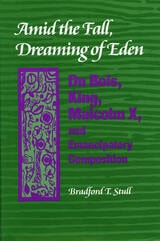
Amid the Fall, Dreaming of Eden
Du Bois, King, Malcolm X, and Emancipatory CompositionBradford T. Stull
Southern Illinois University Press, 1999
Whom, or what, does composition—defined here as an intentional process of study, either oral or written—serve? Bradford T. Stull contends that composition would do well to articulate, in theory and practice, what could be called "emancipatory composition." He argues that emancipatory composition is radically theopolitical: it roots itself in the foundational theological and political language of the American experience while it subverts this language in order to emancipate the oppressed and, thereby, the oppressors.
To articulate this vision, Stull looks to those who compose from an oppressed place, finding in the works of W. E. B. Du Bois, Martin Luther King Jr., and Malcolm X radical theopolitical practices that can serve as a model for emancipatory composition. While Stull acknowledges that there are many sites of oppression, he focuses on what Du Bois has called the problem of the twentieth century: the color line, positing that the unique and foundational nature of the color line provides a fecund place in which, from which, a theory and practice of emancipatory composition might be elucidated.
By focusing on four key theopolitical tropes—The Fall, The Orient, Africa, and Eden—that inform the work of Du Bois, King, and Malcolm X, Stull discovers the ways in which these civil rights leaders root themselves in the vocabulary of the American experience in order to subvert it so that they might promote emancipation for African Americans, and thus all Americans.
In drawing on the work of Paulo Freire, Kenneth Burke, Edward Said, Christopher Miller, Ernst Bloch, and others, Stull also locates this study within the larger cultural context. By reading Du Bois, King, and Malcolm X together in a way that they have never before been read, Stull presents a new vision of composition practice to the African American studies community and a reading of African American emancipatory composition to the rhetoric and composition community, thus extending the question of emancipatory composition into new territory.
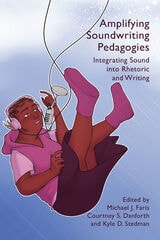
Amplifying Soundwriting Pedagogies
Integrating Sound into Rhetoric and WritingMichael J. Faris
University Press of Colorado, 2022
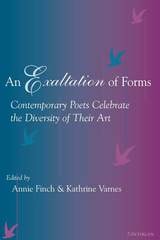
An Exaltation of Forms
Contemporary Poets Celebrate the Diversity of Their ArtAnnie Finch and Kathrine Varnes, Editors
University of Michigan Press, 2002
The forms range from hendecasyllabics to prose poetry, haiku to procedural poetry, sonnets to blues, rap to fractal verse. The range of poets included is equally impressive--from Amiri Baraka to John Frederick Nims, from Maxine Kumin to Marilyn Hacker, from Agha Shahid Ali to Pat Mora, from W. D. Snodgrass to Charles Bernstein. Achieving this level of eclecticism is a remarkable feat, especially given the strong opinions held by members of the various camps (e.g., the New Formalists, LANGUAGE poets, feminist and multicultural poets) that exist within today's poetry community. Poets who might never occupy the same room here occupy the same pages, perhaps for the first time. The net effect is a book that will surprise, inform, and delight a wide range of readers, whether as reference book, pleasure reading, or classroom text.
Poet, translator, and critic Annie Finch is director of the Stonecoast low-residency MFA program at the University of Southern Maine. She is author of The Ghost of Meter: Culture and Prosody in American Free Verse, Eve, and Calendars. She is the winner of the eleventh annual Robert Fitzgerald Prosody Award for scholars who have made a lasting contribution to the art and science of versification.
Kathrine Varnes teaches English at the University of Missouri-Columbia. She is the author of the book of poems, The Paragon. Her poems and essays have appeared in many books and journals.
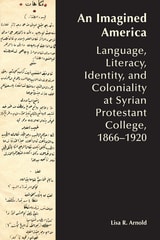
An Imagined America
Language, Literacy, Identity, and Coloniality at Syrian Protestant College, 1866–1920Lisa Arnold
University Press of Colorado, 2026
An Imagined America presents a historical, transnational, translingual, and decolonial perspective on questions of identity, literacy, language, culture, and citizenship. In examining a variety of English- and Arabic-language archival documents from the founding of Syrian Protestant College in 1866 (today the American University of Beirut) until the fall of the Ottoman Empire in 1920, Lisa R. Arnold shows how transnational and translingual negotiations among faculty, students, and administrators, as well as the local and regional community, produced a tenuous and sometimes unsettling vision of America for foreigners and locals alike. As her account shows, transnational and translingual discourses provide the backdrop and motive for the assertion of coloniality in contexts of literacy education such as that of Syrian Protestant College. An Imagined America allows scholars and educators in rhetoric and writing studies, education, and related fields to consider how literacy education in English has, and often continues to, construct an imagined America that is both grounded on and reproduces colonial epistemology. Such constructions work to uphold exclusionary practices that are all too vivid in our world today.
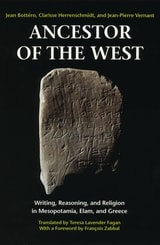
Ancestor of the West
Writing, Reasoning, and Religion in Mesopotamia, Elam, and GreeceJean Bottéro, Clarisse Herrenschmidt, and Jean-Pierre Vernant
University of Chicago Press, 2000
"Full of matter for anyone interested in language, religion, and politics in the ancient world."—R. T. Ridley, Journal of Religious History
"In this accessible introduction to the ancient world, three leading French scholars explore the emergence of rationality and writing in the West, tracing its development and its survival in our own traditions. . . . Jean Bottero focuses on writing and religion in ancient Mesopotamia, Clarisse Herrenschmidt considers a broader history of ancient writing, and Jean-Pierre Vernant examines classical Greek civilization in the context of Near Eastern history."—Translation Review
Anticapitalist Technology Design
Equitable Futures for Technology in Rhetoric and CompositionAngela Glotfelter
Utah State University Press, 2026
Under capitalism, every key we press, search we conduct, and prompt we write implicates us within a global web of exploitation that has created vast economic disparities. How, then, are we to understand and use technologies to write, think, argue, and teach about equitable futures for our world?
In response to this question, Anticapitalist Technology Design explores technology usage in writing programs as a site for equity work within a political-economic frame. Using an approach that combines classical Marxist ideas about political economy with contemporary advances in social justice theory, this book presents an intersectional approach to conducting anticapitalist work in rhetoric and composition around technology use.
Angela Glotfelter explores this work through the lens of anticapitalist technology design, a method that considers how inequitable ideologies are rhetorically encoded into new technologies and perpetuated through their usage. She applies this method to the case study of prototyping an equity dashboard for a first-year composition program, demonstrating the potential of anticapitalist technology design in practice.
Anticapitalist Technology Design brings together work from across the Marxist tradition, critical race theory, user experience, and transnational feminism, and will resonate with any one who wants to navigate new technologies in economically and socially just ways.
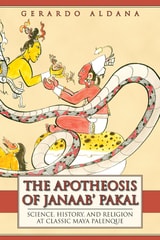
Apotheosis Of Janaab
G Aldana
University Press of Colorado, 2007
Applied Pedagogies
Strategies for Online Writing InstructionDaniel Ruefman
Utah State University Press, 2016
This is a practical text, providing ways to employ the best instructional strategies possible for today’s diverse and dynamic digital writing courses. Organized into three sections—Course Conceptualization and Support, Fostering Student Engagement, and MOOCs—chapters explore principles of rhetorically savvy writing crossed with examples of effective digital teaching contexts and genres of digital text. Contributors consider not only pedagogy but also the demographics of online students and the special constraints of the online environments for common writing assignments.
The scope of online learning and its place within higher education is continually evolving. Applied Pedagogies offers tools for the online writing classrooms of today and anticipates the needs of students in digital contexts yet to come. This book is a valuable resource for established and emerging writing instructors as they continue to transition to the digital learning environment.
Contributors: Kristine L. Blair, Jessie C. Borgman, Mary-Lynn Chambers, Katherine Ericsson, Chris Friend, Tamara Girardi, Heidi Skurat Harris, Kimberley M. Holloway, Angela Laflen, Leni Marshall, Sean Michael Morris, Danielle Nielsen, Dani Nier-Weber, Daniel Ruefman, Abigail G. Scheg, Jesse Stommel
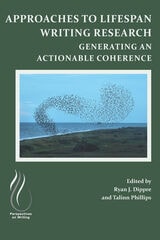
Approaches to Lifespan Writing Research
Generating an Actionable CoherenceRyan J. Dippre
University Press of Colorado, 2020
Copublished with CSU Open Press
This edited collection builds on the three themes that emerged from the 2018 inaugural lifespan writing conference—identity, society, and theory—to further the study of writing through the lifespan. The contributors to this collection provide a framework within which the reader can develop a dynamic, interdisciplinary, multifaceted understanding of the limits and possibilities of studying lifespan writing. Recognizing that such research requires methodological rigor and flexibility as well as theoretical precision and adaptability, Approaches to Lifespan Writing Research draws on a range of methodological and theoretical approaches, from autoethnography to longitudinal structural equation modeling. This methodological and theoretical flexibility reflects the challenges inherent in studying lifespan writing—in particular, the need to develop an integrated framework that enables the “translation” of research findings for use by other lifespan writing researchers. Approaches to Lifespan Writing Research begins that process.
This book is also available as an open access ebook through the WAC Clearinghouse