Results by title
99 books match the query 'Knowledge, Theory of' and 8 start with e

Einstein, Polanyi, and the Laws of Nature
Lydia Jaeger
Templeton Press, 2010
What is the relationship between religious belief and the study of nature, between theology and science? This is the fundamental preoccupation of the three different studies in Einstein, Polanyi, and the Laws of Nature.
By exploring the highly original yet little-known thought of Michael Polanyi, Jaeger highlights the inherent personal investment in any quest for knowledge, including the scientific enterprise, thus raising the question of the objectivity of human knowledge. Considered to be the most incredible mind of the twentieth century, Albert Einstein saw scientific research as the fruit of the “cosmic religion.” His response to the question of the relationship between faith and science also receives the close analysis it deserves. Finally, Jaeger is interested in science’s propensity to use the concept of laws of nature, an idea also found in the Bible. She paves the way for interdisciplinary dialogue by examining the similarities and differences.
The synthesis of these three complementary studies brings out the collaboration between belief and knowledge, thus establishing a bridge between two noble human activities: faith and scientific research. It will interest all serious followers of the ongoing science and religion dialogue.
Elements of Knowledge
Pragmatism, Logic, and InquiryArthur Franklin Stewart
Vanderbilt University Press, 1997
Elements of Knowledge is an engaging introductory text, effectively and imaginatively designed to bring a working understanding and appreciation of the fundamental tenets and methods of the American school of philosophy known as pragmatism, as articulated by its founder C. S. Peirce, to undergraduates and general readers. It presents and explains the basic pragmatic tools that are the common thread in our acquisition and development of knowledge, whether in an academic, vocational, or professional setting, or in life at large. Pragmatism guides, without dictating, examinations of ordinary human experience, creative learning in all fields, and progress in academic disciplines.
This book is intended for use by both general readers and students, particularly those in introductory logic or related philosophy courses. It will also fit well in the design of many "core curriculum" or "general education" course requirements. It is ultimately meant to be accessible and beneficial to anyone seeking a clearer understanding of the unifying principles for acquiring and assessing the soundness of all knowledge.

Epistemology and Inference
Henry E. Kyburg, Jr.
University of Minnesota Press, 1983
Epistemology and Inference was first published in 1983. Minnesota Archive Editions uses digital technology to make long-unavailable books once again accessible, and are published unaltered from the original University of Minnesota Press editions.
Henry Kyburg has developed an original and important perspective on probabilistic and statistical inference. Unlike much contemporary writing by philosophers on these topics, Kyburg's work is informed by issues that have arisen in statistical theory and practice as well as issues familiar to professional philosophers. In two major books and many articles, Kyberg has elaborated his technical proposals and explained their ramifications for epistemology, decision-making, and scientific inquiry. In this collection of published and unpublished essays, Kyburg presents his novel ideas and their applications in a manner that makes them accessible to philosophers and provides specialists in probability and induction with a concise exposition of his system.
Eternal Possibilities
A Neutral Ground for Meaning and ExistenceDavid Weissman
Southern Illinois University Press, 1977
Eternal Possibilities: A Neutral Ground for Meaning and Existence builds on David Weissman's earlier Dispositional Properties and makes a signal contribution to the study of metaphysics. Here, broadening and enriching the point of view adopted in his earlier work, Weissman cites and criticizes a large number of theories proposed by authors from Plato to Wittgenstein and others exploring language theory and metaphysics.
Students of Wittgenstein will be especially interested in Mr. Weissman's critical examination of Wittgenstein's claim in the Tractatus that possibilities are the facts for logic. Weissman proposes a modal theory of properties: they exist in the first instance as possibilities. He argues that a sentence is meaningful if it signifies a property or complex of properties existing as a possible, and true if that possible is instantiated. The status of possibilities and their relation to actual states of affairs are considered in detail.
Ethics of Liberation
In the Age of Globalization and ExclusionEnrique Dussel
Duke University Press, 2012
Throughout his career, Dussel has sought to open a space for articulating new possibilities for humanity out of, and in light of, the suffering, dignity, and creative drive of those who have been excluded from Western Modernity and neoliberal rationalism. Grounded in engagement with the oppressed, his thinking has figured prominently in philosophy, political theory, and liberation movements around the world.
In Ethics of Liberation, Dussel provides a comprehensive world history of ethics, demonstrating that our most fundamental moral and ethical traditions did not emerge in ancient Greece and develop through modern European and North American thought. The obscured and ignored origins of Modernity lie outside the Western tradition. Ethics of Liberation is a monumental rethinking of the history, origins, and aims of ethics. It is a critical reorientation of ethical theory.

Exiles and Expatriates in the History of Knowledge, 1500–2000
Peter Burke
Brandeis University Press, 2017

Existential Cognition
Computational Minds in the WorldRon McClamrock
University of Chicago Press, 1995
Arguing that the mind is essentially embedded in the external world, Ron McClamrock provides a schema that allows cognitive scientists to address such long-standing problems in artificial intelligence as the "frame" problem and the issue of "bounded" rationality. Extending this schema to cover progress in other studies of behavior, including language, vision, and action, McClamrock reinterprets the importance of the organism/environment distinction. McClamrock also considers the broader philosophical question of the place of mind in the world, particularly with regard to questions of intentionality, subjectivity, and phenomenology.
With implications for philosophy, cognitive and computer science, AI, and psychology, this book synthesizes state-of-the-art work in philosophy and cognitive science on how the mind interacts with the world to produce thoughts, ideas, and actions.
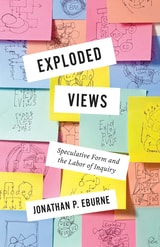
Exploded Views
Speculative Form and the Labor of InquiryJonathan Eburne
University of Minnesota Press, 2025
Idiosyncratic essays use their “exploded” forms to examine how inquiry functions
Insect galls, time, memory systems, orgone energy, and a bookstore that doesn’t yet exist. These disparate topics have persistently fascinated scholar Jonathan P. Eburne, yet each defied his previous efforts at classification through scholarly writing, resulting in five essays suspended in process. In Exploded Views, Eburne returns to these essays with the metaphorical tool of the exploded-view diagram, expanding them into entirely new, hybrid forms that unpack their inspirations and trace the wayward paths they followed.
An experiment into the nature of inquiry that spelunks, rather than shies from, the rabbit holes of scholarly curiosity, each essay gives way to sidelights and dilations to reveal the palimpsest of knowledge hiding beneath the surface of the academic form. A book about process—the process of turning ideas into things, and vice versa, as well as the particular tendency for research, scholarly inquiry, and critical writing to come apart and go awry—Exploded Views is a refreshing exploration of how the tools of creative critical thinking work at their most basic level.
Reflecting on the methods of scholarly knowledge production and the contextual factors that shape new ideas, Eburne boldly replaces the seamlessness of the finished manuscript with the friction and even messiness of the incomplete, inviting readers to think in new and invigorating ways.