108 books match the query 'Knowledge and learning' and 10 start with e

cover of Edna Ferber's Hollywood: American Fictions of Gender, Race, and History

Edna Ferber's Hollywood

American Fictions of Gender, Race, and History

By J. E. Smyth

University of Texas Press, 2009

Edna Ferber's Hollywood reveals one of the most influential artistic relationships of the twentieth century—the four-decade partnership between historical novelist Edna Ferber and the Hollywood studios. Ferber was one of America's most controversial popular historians, a writer whose uniquely feminist, multiracial view of the national past deliberately clashed with traditional narratives of white masculine power. Hollywood paid premium sums to adapt her novels, creating some of the most memorable films of the studio era—among them Show Boat, Cimarron, and Giant. Her historical fiction resonated with Hollywood's interest in prestigious historical filmmaking aimed principally, but not exclusively, at female audiences.

In Edna Ferber's Hollywood, J. E. Smyth explores the research, writing, marketing, reception, and production histories of Hollywood's Ferber franchise. Smyth tracks Ferber's working relationships with Samuel Goldwyn, Leland Hayward, George Stevens, and James Dean; her landmark contract negotiations with Warner Bros.; and the controversies surrounding Giant's critique of Jim-Crow Texas. But Edna Ferber's Hollywood is also the study of the historical vision of an American outsider—a woman, a Jew, a novelist with few literary pretensions, an unashamed middlebrow who challenged the prescribed boundaries among gender, race, history, and fiction. In a masterful film and literary history, Smyth explores how Ferber's work helped shape Hollywood's attitude toward the American past.
[more]
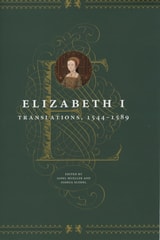
cover of Elizabeth I: Translations, 1544-1589

Elizabeth I

Translations, 1544-1589

Elizabeth I

University of Chicago Press, 2008

England’s Virgin Queen, Elizabeth Tudor, had a reputation for proficiency in foreign languages, repeatedly demonstrated in multilingual exchanges with foreign emissaries at court and in the extemporized Latin she spoke on formal visits to Cambridge and Oxford. But the supreme proof of her mastery of other tongues is the sizable body of translations she made over the course of her lifetime. This two-volume set is the first complete collection of Elizabeth’s translations from and into Latin, French, and Italian.

Presenting original and modernized spellings in a facing-page format, these two volumes will answer the call to make all of Elizabeth’s writings available. They include her renderings of epistles of Cicero and Seneca, religious writings of John Calvin and Marguerite de Navarre, and Horace’s Ars poetica, as well as Elizabeth’s Latin Sententiae drawn from diverse sources, on the responsibilities of sovereign rule and her own perspectives on the monarchy.  Editors Janel Mueller and Joshua Scodel offer introduction to each of the translated selections, describing the source text, its cultural significance, and the historical context in which Elizabeth translated it. Their annotations identify obscure meanings, biblical and classical references, and Elizabeth’s actual or apparent deviations from her sources.

The translations collected here trace Elizabeth’s steady progression from youthful evangelical piety to more mature reflections on morality, royal responsibility, public and private forms of grief, and the right way to rule.  Elizabeth I: Translations is the queen’s personal legacy, an example of the very best that a humanist education can bring to the conduct of sovereign rule.
[more]
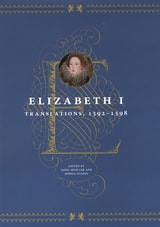
cover of Elizabeth I: Translations, 1592-1598

Elizabeth I

Translations, 1592-1598

Elizabeth I

University of Chicago Press, 2009

England’s Virgin Queen, Elizabeth Tudor, had a reputation for proficiency in foreign languages, repeatedly demonstrated in multilingual exchanges with foreign emissaries at court and in the extemporized Latin she spoke on formal visits to Cambridge and Oxford. But the supreme proof of her mastery of other tongues is the sizable body of translations she made over the course of her lifetime. This two-volume set is the first complete collection of Elizabeth’s translations from and into Latin, French, and Italian.
            Presenting original and modernized spellings in a facing-page format, these two volumes will answer the call to make all of Elizabeth’s writings available. They include her renderings of epistles of Cicero and Seneca, religious writings of John Calvin and Marguerite de Navarre, and Horace’s Ars poetica, as well as Elizabeth’s Latin Sententiae drawn from diverse sources, on the responsibilities of sovereign rule and her own perspectives on the monarchy.  Editors Janel Mueller and Joshua Scodel offer introduction to each of the translated selections, describing the source text, its cultural significance, and the historical context in which Elizabeth translated it. Their annotations identify obscure meanings, biblical and classical references, and Elizabeth’s actual or apparent deviations from her sources. 
            The translations collected here trace Elizabeth’s steady progression from youthful evangelical piety to more mature reflections on morality, royal responsibility, public and private forms of grief, and the right way to rule.  Elizabeth I: Translations is the queen’s personal legacy, an example of the very best that a humanist education can bring to the conduct of sovereign rule. 
 
 
[more]
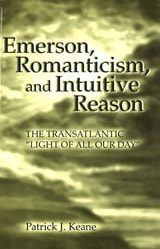
cover of Emerson, Romanticism, and Intuitive Reason: The Transatlantic "Light of All Our Day"

Emerson, Romanticism, and Intuitive Reason

The Transatlantic "Light of All Our Day"

Patrick J. Keane

University of Missouri Press, 2005

Emerson, Romanticism, and Intuitive Reason is a comparative study in transatlantic Romanticism, focusing on Emerson’s part in the American dialogue with British Romanticism and, as filtered through Coleridge, German Idealist philosophy. The book’s guiding theme is the concept of intuitive Reason, which Emerson derived from Coleridge’s distinction between Understanding and Reason and which Emerson associated with that “light of all our day” in his favorite stanza of Wordsworth’s “Ode: Intimations of Immortality.” Intuitive Reason became the intellectual and emotional foundation of American Transcendentalism. That light radiated out to illuminate Emerson’s life and work, as well as the complex and often covert relationship of a writer who, however fiercely “self-reliant” and “original,” was deeply indebted to his transatlantic precursors.
            The debt is intellectual and personal. Emerson’s supposed indifference to, or triumph over, repeated familial tragedy is often attributed to his Idealism—a complacent optimism that blinded him to any vision of the tragic. His “art of losing” may be better understood as a tribute to the “healing power,” the consolation in distress, which Emerson considered Wordsworth’s principal value. The second part of this book traces Emerson’s struggle—with the help of the “benignant influence” shed by that “light of all our day”—to confront and overcome personal tragedy, to attain the equilibrium epitomized in Wordsworth’s “Elegiac Stanzas”: “Not without hope we suffer and we mourn.”
            As a study in what has been called “the paradox of originality,” the book should appeal to those interested in the Anglo-American Romantic tradition and the innovations of the individual talent—especially in the capacity of a writer such as Emerson not only to absorb his precursors but also to use them as a stimulus to his own creative power.
[more]
cover of Emily Dickinson and the Labor of Clothing

Emily Dickinson and the Labor of Clothing

Daneen Wardrop

University of New Hampshire Press, 2009
Daneen Wardrop's Emily Dickinson and the Labor of Clothing begins by identifying and using the dating tools of fashion to place the references to clothing in Dickinson's letters and poems, and to locate her social standing through examining her fashion choices in the iconic daguerreotype. In addition to detailing the poetics of fashion in Dickinson's work, the author argues that close examination of Dickinson and fashion cannot be separated from the changing ways that garments were produced during the nineteenth century, embracing issues of domestic labor, the Lowell textile mills, and the Amherst industry of the Hills Hat Factory located almost next door to Dickinson's Homestead. The recent retrieval of clothing from approximately thirty trunks found in the attic of the Evergreens house, which formerly belonged to Dickinson's brother and sister-in-law, further enhances this remarkable and original interdisciplinary work.
[more]
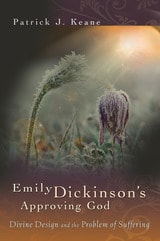
cover of Emily Dickinson's Approving God: Divine Design and the Problem of Suffering

Emily Dickinson's Approving God

Divine Design and the Problem of Suffering

Patrick J. Keane

University of Missouri Press, 2008
As much a doubter as a believer, Emily Dickinson often expressed views about God in general—and God with respect to suffering in particular. In many of her poems, she contemplates the question posed by countless theologians and poets before her: how can one reconcile a benevolent deity with evil in the world?
            Examining Dickinson’s perspectives on the role played by a supposedly omnipotent and all-loving God in a world marked by violence and pain, Patrick Keane initially focuses on her poem “Apparently with no surprise,” in which frost, a “blonde Assassin,” beheads a “happy Flower,” a spectacle presided over by “an Approving God.” This tiny lyric,Keane shows, epitomizes the poet’s embattled relationship with the deity of her Calvinist tradition.
            Although the problem of sufferingis usually couched in terms of natural disasters or human injustice, Dickinson found new ways of considering it. By choosing a flower as her innocent “victim,” she bypassed standard “answers” to the dilemma (suffering as justified punishment for wickedness, or as attributable to the assertion of free will) in order to focus on the problem in its purest symbolic form. Keane goes on toprovide close readings of many of Dickinson’s poems and letters engaging God, showing how she addressed the challenges posed—by her own experience and by an innate skepticism reinforced by a nascent Darwinism—to the argument from design and the concept of a benevolent deity.
            More than a dissection of a single poem, Keane’s book is a sweeping personal reflection on literature and religion, faith and skepticism, theology and science. He traces the evolving history of the Problem of Suffering from the Hebrew Scriptures (Job and Ecclesiastes), through the writings of Paul, Augustine, and Aquinas, to the most recent theological and philosophical studies of the problem. Keane is interested in how readers today respond to Emily Dickinson’s often combative poems about God; at the same time, she is located as a poet whose creative life coincided with the momentous changes and challenges to religious faith associated with Darwin andNietzsche.Keane also considers Dickinson’s poems and letters in the context of the great Romantic tradition, as it runs fromMilton throughWordsworth, demonstrating how thework of these poets (perhaps surprisingly in the case of the latter)helps illuminate Dickinson’s poetry and thought.  
            Because Dickinson the poet was also Emily the gardener, her love of flowers was an appropriate vehicle for her observations on mortality and her expressions of doubt. Emily Dickinson’s Approving God is a graceful study that reveals not only the audacity of Dickinson’s thought but also its relevance to modern readers. In light of ongoing confrontations between Darwinism and design, science and literal conceptions of a divine Creator, it is an equally provocative read for students of literature and students of life.
[more]
cover of Emily Dickinson's Music Book and the Musical Life of an American Poet

Emily Dickinson's Music Book and the Musical Life of an American Poet

George Boziwick

University of Massachusetts Press, 2022

After years of studying piano as a young woman in her family home in Amherst, Massachusetts, Emily Dickinson curated her music book, a common practice at the time. Now part of the Dickinson Collection in the Houghton Library of Harvard University, this bound volume of 107 pieces of published sheet music includes the poet’s favorite instrumental piano music and vocal music, ranging from theme and variation sets to vernacular music, which was also enjoyed by the family’s servants.

Offering a fresh historical perspective on a poetic voice that has become canonical in American literature, this original study brings this artifact to life, documenting Dickinson’s early years of musical study through the time her music was bound in the early 1850s, which tellingly coincided with the writing of her first poems. Using Dickinson’s letters and poems alongside newspapers and other archival sources, George Boziwick explores the various composers, music sellers, and publishers behind this music and Dickinson’s attendance at performances, presenting new insights into the multiple layers of meaning that music held for her.
[more]
cover of Ezra Pound among the Poets

Ezra Pound among the Poets

Edited by George Bornstein

University of Chicago Press, 1985
"Be influenced by as many great writers as you can," said Ezra Pound. Pound was an "assimilative poet" par excellence, as George Bornstein calls him, a writer who more often "adhered to a . . . classical conception of influence as benign and strengthening" than to an anxiety model of influence. To study Pound means to study also his precursors—Homer, Ovid, Li Po, Dante, Whitman, Browning—as well as his contemporaries—Yeats, Williams, and Eliot. These poets, discussed here by ten distinguished critics, stimulated Pound's most important poetic encounters with the literature of Greece, Rome, China, Tuscany, England, and the United States. Fully half of these essays draw on previously unpublished manuscripts.
[more]
cover of Ezra Pound and China

Ezra Pound and China

Zhaoming Qian, Editor

University of Michigan Press, 2003

Ezra Pound and China, the first collection to explore the American poet's career-long relationship with China, considers how Pound's engagement with the Orient broadens the textual, cultural, and political boundaries of his modernism. The book's contributors discuss, among other topics, issues of cultural transmission; the influence of Pound's Chinese studies on twentieth-century poetics; the importance of his work to contemporary theories of translation; and the effects of Confucianism, Buddhism, and Taoism on Pound's political and economic thought.
Richly illustrated, the book draws readers closer to the heart of Pound's vision. Ezra Pound and China will become an invaluable resource to students and scholars of Pound, cultural studies, translation theory, poetics, Confucianism, and literary transmission and reception.
Zhaoming Qian is Professor of English, the University of New Orleans.
[more]
cover of Ezra Pound's Confucian Translations

Ezra Pound's Confucian Translations

Mary Paterson Cheadle

University of Michigan Press, 1997

Ezra Pound professed a "belief" in Confucianism from the early 1930s till the end of his life. His interpretation of Confucianism, however, changed over time, and those changes are reflected in the four translations of Confucian texts he produced between 1928 and 1954. Based on painstaking new research, Ezra Pound's Confucian Translations for the first time traces the evolution of Pound's Confucianism during the historical and personal turmoil of this period. Pound's Confucian translations are less correct "philology" than the "re-creation" of works that he hoped would have a potent influence on the twentieth-century West. What Pound first admired in Confucianism was a respect for individuality simultaneous with a concern for social order. From the late 1930s through the Second World War, Pound developed a "totalitarian" Confucianism whose consummation would be a "harmony" of man, earth, and heaven. After the defeat of the Axis powers in 1945 and Pound's arrest on charges of treason against the United States for his activities in Italy during the war, his Confucianism reverted to an emphasis on verbal precision and the importance of individual integrity. In addition to tracing the evolution of Pound's beliefs, Ezra Pound's Confucian Translations elucidates the Confucian elements in The Cantos and suggests a reading of that epic from the point of view of Pound's Confucianism. Ezra Pound's Confucian Translations will be crucial to students of Pound and will also be read by sinologists, scholars of comparative literature, and anyone studying translation.
[more]