Results by title
622 books match the query 'Language Study' and 25 start with e

East-West Divan
In Memory of Werner Mark LinzEdited by Aran Byrne
Gingko, 2014
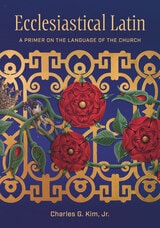
Ecclesiastical Latin
A Primer on the Language of the ChurchCharles G. Kim, Jr.
Catholic University of America Press, 2024

Ecclesiastical Latin
An Answer Key and CommentaryCharles G. Kim Jr.
Catholic University of America Press, 2026
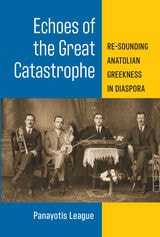
Echoes of the Great Catastrophe
Re-Sounding Anatolian Greekness in DiasporaPanayotis League
University of Michigan Press, 2021
Echoes of the Great Catastrophe: Re-sounding Anatolian Greekness in Diaspora explores the legacy of the Great Catastrophe—the death and expulsion from Turkey of 1.5 million Greek Christians following the Greco-Turkish War of 1919–1922—through the music and dance practices of Greek refugees and their descendants over the last one hundred years. The book draws extensively on original ethnographic research conducted in Greece (on the island of Lesvos in particular) and in the Greater Boston area, as well as on the author’s lifetime immersion in the North American Greek diaspora. Through analysis of handwritten music manuscripts, homemade audio recordings, and contemporary live performances, the book traces the routes of repertoire and style over generations and back and forth across the Atlantic Ocean, investigating the ways that the particular musical traditions of the Anatolian Greek community have contributed to their understanding of their place in the global Greek diaspora and the wider post-Ottoman world. Alternating between fine-grained musicological analysis and engaging narrative prose, it fills a lacuna in scholarship on the transnational Greek experience.

Ecology and the Environment
A Look at Ecosystems of the WorldAmy L. Tickle
University of Michigan Press, 1996

Ecology and the Environment
A Look at Ecosystems of the World: Teacher's ManualAmy L. Tickle
University of Michigan Press, 1996
Elementary Classical Greek, Revised Edition
Frederick Williams
Southern Illinois University Press, 2004
Now in paperback for the first time, Elementary Classical Greek is a trusted handbook for learning the language that does not presuppose a knowledge of Latin. Based on the premise that average American students can learn the language, the lessons are thorough but not pedantic, simple but not superficial, and the textbook has been proven in the classroom and for independent learners.
Elementary Classical Greek stresses a clear and orderly presentation of the language, accompanied by individual sentences or short passages that illustrate grammar, give practice in reading, and help build vocabulary. Drawing on decades of experience teaching classical Greek, Frederick Williams presents a text in which grammatical explanations are clear, succinct, and correct and the selected readings are varied, interesting, and useful. Included in the nearly one-hundred reading passages are excerpts from Plato’s Ion and Republic, Aristophanes’s Clouds, and Paul’s first letter to the Corinthians.
The popular textbook is designed for a course meeting for two semesters. There are twenty-four lessons in all, with appendixes on prepositions, Greek numbers, and the Greek verb, plus Greek-English and English-Greek vocabularies, a grammatical index of subjects, and a list of Greek authors cited. Selected readings are presented first in simple, then more complex, language until the reader is led to the actual words of the ancient author—all within the same lesson. This elementary device helps bridge many of the difficult gaps between modern English and ancient Greek.
Elements of German
Phonology and MorphologyElmer H. Antonsen
University of Alabama Press, 2007
Elements of German fills a gap in advanced undergraduate and beginning graduate levels of German language study by presenting more advanced concepts of the language in a light intended for practical use rather than theoretical discourse. This text provides a means to improve knowledge and command of grammatically correct German as it is spoken and written. It also introduces methods and tools of linguistic analysis in the areas of phonology and morphology. Unlike books that treat phonology in a cursory way, this text delves into the problems of word formation and the intricacies of inflection and derivation. Exercises are included throughout to help better absorb the rules for real-world language use. This volume provides an in-depth look at the German language from the ground up. Its detailed approach makes this book an excellent complement to the work of less specific grammar textbooks and reviews.
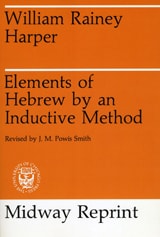
Elements of Hebrew by an Inductive Method
William Rainey Harper
University of Chicago Press, 1974
"This inductive method in the teaching of grammar is educationally sound, and in employing it in this text some eighty years ago, the author was certainly far ahead of his time."—William Chomsky, Jewish Bookland
"A treatment of much that is essential in Hebrew grammar. . . .useful tools to the divinity student and instructor in biblical Hebrew."—David Weinstein, Jewish Education
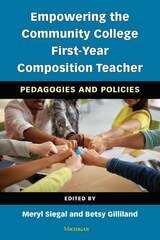
Empowering the Community College First-Year Composition Teacher
Pedagogies and PoliciesMeryl Siegal and Betsy Gilliland
University of Michigan Press, 2021
This volume is an inquiry into community college first-year pedagogy and policy at a time when change has not only been called for but also mandated by state lawmakers who financially control public education. It also acknowledges new policies that are eliminating developmental and remedial writing courses while keeping mind that, for most community college students, first-year composition serves as the last course they will take in the English department toward their associate’s degree.
Chapters focusing on pedagogy and policy are integrated within cohesively themed parts: (1) refining pedagogy; (2) teaching toward acceleration; (3) considering programmatic change; and (4) exploring curriculum through research and policy. The volume concludes with the editors’ reflections regarding future work; a glossary and reflection questions are included.
This volume also serves as a call to action to change the way community colleges attend to faculty concerns. Only by listening to teachers can the concerns discussed in the volume be addressed; it is the teachers who see how societal changes intersect with campus policies and students’ lives on a daily basis.
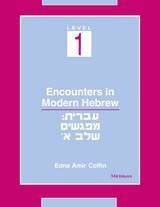
Encounters in Modern Hebrew
Level 1Edna Amir Coffin
University of Michigan Press, 1992

Encounters in Modern Hebrew
Level 2Edna Amir Coffin
University of Michigan Press, 1993

Encounters in Modern Hebrew
Level 3Edna Amir Coffin
University of Michigan Press, 1997
This volume shows students a wider range of Hebrew-speaking cultural activities in a larger human context, from materials about holidays, including a Jewish holiday celebrated only in North Africa, to discussions of the roles of women that raise the issue of gender equality. Other chapters examine ethnic jokes and their problematic qualities, geography, and the differences between popular and literary language registers. Encounters in Modern Hebrew, Level 3 ushers the Hebrew student through a wide domain of the human community.
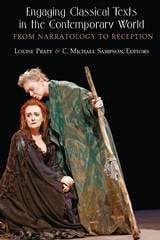
Engaging Classical Texts in the Contemporary World
From Narratology to ReceptionLouise Pratt and C. Michael Sampson, Editors
University of Michigan Press, 2018
This volume considers perennial favorites of classical literature—the Iliad and Odyssey, Greek tragedy, Roman comedy, the Argonautica, and Ovid’s Metamorphoses—and their influence on popular entertainment from Shakespeare’s plays to Hollywood’s toga films. It also engages with unusual and intriguing texts across the centuries, including a curious group of epigrams by Artemidorus found on the island sanctuary of Thera, mysterious fragments of two Aeschylean tragedies, and modern-day North African novels. These essays engage an array of theoretical approaches from other fields—narratology, cognitive literary theory, feminist theory, New Historicist approaches to gender and sexuality, and politeness theory—without forsaking more traditional philological methods. A new look at hospitality in the Argonautica shows its roots in the changed historical circumstances of the Hellenistic world. The doubleness of Helen and her phantom in Euripides’ Helen is even more complex than previously noted. Particularly illuminating is the recurrent application of reception studies, yielding new takes on the ancient reception of Homer by Apollonius and of Aeschylus by Macrobius, the reception of Plautus by Shakespeare, and more contemporary examples from the worlds of cinema and literature.
Students and scholars of classics will find much in these new interpretations and approaches to familiar texts that will expand their intellectual horizons. Specialists in other fields, particularly English, comparative literature, film studies, and gender and sexuality studies, will also find these essays directly relevant to their work.
English Pronunciation
Excercises in Sound Segments, Intonation, and RhythmRobert Lado and Charles C. Fries
University of Michigan Press, 1954
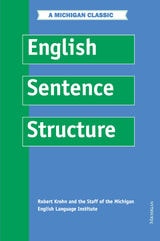
English Sentence Structure
Robert Krohn and the Staff of the Michigan English Language Institute
University of Michigan Press, 1957
English Sentence Structure presents and clarifies all facets of the sentence for beginning and intermediate students. Oral drills, examples, and written exercises form a pattern of regular review and self-evaluation. Each lesson is coordinated with English Pattern Practices.
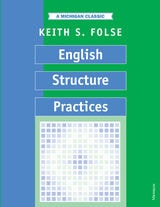
English Structure Practices
Keith S. Folse
University of Michigan Press, 1983
This is the workbook to accompany English Sentence Structure.
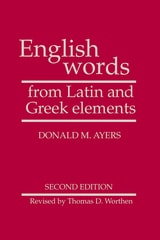
English Words from Latin and Greek Elements
Donald M. Ayers; Revised by Thomas D. Worthen
University of Arizona Press, 1986
Since its first publication in 1965, English Words from Latin and Greek Elements by Donald M. Ayers has empowered thousands of students to expand their vocabulary by uncovering the classical roots embedded in modern English. Now in its enduring second edition, this trusted resource proves that vocabulary is most effectively learned through understanding—not memorization.
Why dedicate an entire book to this approach? Because Ayers goes beyond the basics. Students are introduced to a broad spectrum of Latin and Greek roots, encounter new vocabulary in meaningful context, and reinforce their learning through targeted exercises. This method equips learners with lifelong tools to decode unfamiliar words and deepen their command of English.
Written for English learners—not classical language scholars—this book requires no prior knowledge of Latin or Greek. It’s proven effective across high school and college classrooms, and adaptable for both remedial and accelerated programs.
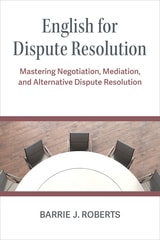
English for Dispute Resolution
Mastering Negotiation, Mediation, and Alternative Dispute ResolutionBarrie J. Roberts
University of Michigan Press, 2025
Whether they are using English for Dispute Resolution as a self-study resource or a course textbook, readers can use the book to develop their own unique negotiation and mediation styles in English and improve their professional-level English skills and soft skills for any purpose. Chapters introduce Alternative Dispute Resolution, negotiation ethics, competitive and collaborative negotiation, negotiation game theory, apologies, drafting written agreements, and mediation. After an engaging hypothetical case that introduces the chapter’s key points, each chapter provides warm-up questions, readings about dispute resolution theory and strategies, language tips, and activities and sample phrases to practice applying chapter lessons to real-world disputes. Chapters also invite readers to explore topics of interest, such as dispute resolution in their home countries, personal and professional lives, and current events, and the growing use of Artificial Intelligence (AI) in ADR. Readers will simultaneously build confidence in their English and cross-cultural dispute resolution skills.
English for Dispute Resolution offers readers:
- Lessons that explain the theories behind Alternative Dispute Resolution, negotiation ethics, competitive and collaborative negotiation, and mediation
- Activities that help them develop their own unique negotiation strategies and styles along with critical thinking, problem-solving, reading, writing, listening, and speaking.
- Step-by-step guidance, sample sentences, and practice activities for applying chapter lessons to real-world disputes.
- Opportunities to explore topics of interest, such as dispute resolution in their home countries, personal and professional lives and current events, and the growing use of Artificial Intelligence (AI) in ADR.
- Key ADR terms and idioms in plain, accessible English.
- Specific tips to improve cross-cultural communication for negotiating and mediating in English.
- A companion website with downloadable checklists, forms, and sample language that can be used for classroom role-plays and real-world negotiations and mediations.
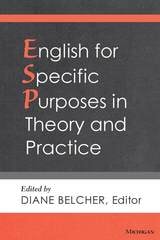
English for Specific Purposes in Theory and Practice
Diane Belcher, Editor
University of Michigan Press, 2009
The field of English for Specific Purposes (ESP) is among the richest areas of second language research and practice because increasing globalization and changing technologies spawn new modes of intercultural connection and new occasions for second language use. English for Specific Purposes in Theory and Practice compasses this burgeoning field by presenting new research and commentary from some of the field’s leading scholars.
This volume explores ESP from academic (secondary and tertiary), occupational (business, medical, and legal), and socio-cultural perspectives. Recurring motifs throughout the volume are the effects of globalization, English as a lingua franca, and the impact of migrant populations. One of the major questions this volume seeks to answer is, How can ESP instructors meet their own teacher knowledge needs? Also considered is, How have ESP practitioners succeeded in gaining control of the knowledge they need to address their students’ needs?
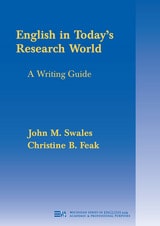
English in Today's Research World
A Writing GuideJohn M. Swales and Christine B. Feak
University of Michigan Press, 2000
In addition to instruction on writing for publication, English in Today's Research World provides needed advice on applications, recommendations, and requests--types of communications that are particularly vulnerable to influences from national cultural expectations and conventions and that, therefore, place the NNS writer at increased disadvantage.
The text is both a reference manual and a course book, so that researchers can continue to use the book after they have completed their formal education. New ESL/EFL teachers can use English in Today's Research World as a reference book for themselves or as a teaching aid in the classroom.
English-Basque Dictionary
Gorka Aulestia
University of Nevada Press, 1990
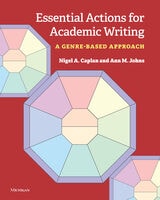
Essential Actions for Academic Writing
A Genre-Based ApproachNigel A. Caplan and Ann M. Johns
University of Michigan Press, 2022
Part I:
- Introduces students to rhetorical situation, genre, register, source use, and a framework for understanding how to approach any new writing task.
- Demonstrates that all writing responds to a context that includes the writer’s identity, the reader’s expectations, the purpose of the text, and the conventions that shape it.
- Explores the essential actions of academic writing (explain, summarize, synthesize, report and interpret data, argue, respond, and analyze).
- Provides examples of the genres and language that support each action.
- Offers four extended projects that combine the essential actions in different genres and contexts.
Evolving Paradigms in Interpreter Education
Elizabeth A. Winston
Gallaudet University Press, 2013
This volume brings together a cadre of world-renowned interpreting educators and researchers who conduct a rich exploration of paradigms, both old and new, in interpreter education. They review existing research, explicate past and current practices, and call for a fresh look at the roots of interpreter education in anticipation of the future. Expert commentary accompanies each chapter to provide a starting point for reflection on and discussion of the growing needs in this discipline.
Volume coeditor Christine Monikowski begins by considering how interpreter educators can balance their responsibilities of teaching, practice, and research. Her chapter is accompanied by commentary about the capacity to “academize” what has been thought of as a semi-profession. Helen Tebble shares research on medical interpreting from an applied linguistic perspective. Terry Janzen follows with the impact of linguistic theory on interpretation research methodology. Barbara Shaffer discusses how interpreting theory shapes the interpreter’s role. Elizabeth A. Winston, also a volume coeditor, rounds out this innovative collection with her chapter on infusing evidence-based teaching practices into interpreting education. Noted interpreter educators and researchers also provide an international range of insights in this collection, including Rico Peterson, Beppie van den Bogaerde, Karen Bontempo, Ian Mason, Ester Leung, David Quinto-Pozos, Lorraine Leeson, Jemina Napier, Christopher Stone, Debra Russell, and Claudia Angelelli.
Exploring Options in Academic Writing
Effective Vocabulary and Grammar UseJan Frodesen and Margi Wald
University of Michigan Press, 2016
Following a unit on using resources for vocabulary development, the contents are divided into three parts: Showing Relationships within Sentences, Connecting and Focusing across Sentences, and Qualifying Statements and Reporting Research. Part 1 focuses on verbs and modifiers that express increases and decreases, verbs and abstract nouns that describe change, connectors and verbs describing causal relationships, and parallel structures. Part 2 explores the words that help connect ideas and add cohesion. Part 3 discusses how to express degrees of certainty and accuracy and the use of reporting verbs.