Results by title
112 books match the query 'Languages' and 3 start with e
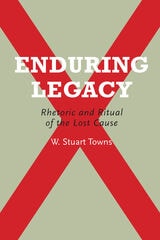
Enduring Legacy
Rhetoric and Ritual of the Lost CauseW. Stuart. Towns
University of Alabama Press, 2013
Explores the crucial role of rhetoric and oratory in creating and propagating a “Lost Cause” public memory of the American South
Enduring Legacy explores the vital place of ceremonial oratory in the oral tradition in the South and analyses how rituals such as Confederate Memorial Day, Confederate veteran reunions, and dedication of Confederate monuments have contributed to creating and sustaining a Lost Cause paradigm for Southern identity. Towns studies in detail secessionist and Civil War speeches and how they laid the groundwork for future generations, including Southern responses to the civil rights movement, and beyond.
The Lost Cause orators that came after the Civil War, Towns argues, helped to shape a lasting mythology of the brave Confederate martyr, and the Southern positions for why the Confederacy lost and who was to blame. Innumerable words were spent—in commemorative speeches, newspaper editorials, and statehouse oratory—condemning the evils of Reconstruction, redemption, reconciliation, and the new and future South. Towns concludes with an analysis of how Lost Cause myths still influence Southern and national perceptions of the region today, as evidenced in debates over the continued deployment of the Confederate flag and the popularity of Civil War reenactments.

Essay on the Origin of Languages and Writings Related to Music
Jean Jacques Rousseau
Dartmouth College Press, 2009
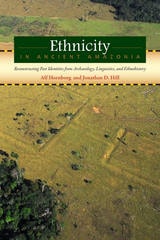
Ethnicity in Ancient Amazonia
Reconstructing Past Identities from Archaeology, Linguistics, and EthnohistoryAlf Hornborg
University Press of Colorado, 2011
Hornborg and Hill argue that the tendency to link language, culture, and biology--essentialist notions of ethnic identities--is a Eurocentric bias that has characterized largely inaccurate explanations of the distribution of ethnic groups and languages in Amazonia. The evidence, however, suggests a much more fluid relationship among geography, language use, ethnic identity, and genetics. In Ethnicity in Ancient Amazonia, leading linguists, ethnographers, ethnohistorians, and archaeologists interpret their research from a unique nonessentialist perspective to form a more accurate picture of the ethnolinguistic diversity in this area.
Revealing how ethnic identity construction is constantly in flux, contributors show how such processes can be traced through different ethnic markers such as pottery styles and languages. Scholars and students studying lowland South America will be especially interested, as will anthropologists intrigued by its cutting-edge, interdisciplinary approach.