Results by title
172 books match the query 'Legislative Branch' and 4 start with e
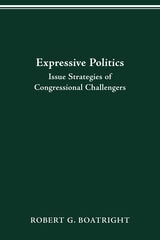
EXPRESSIVE POLITICS
ISSUE STRATEGIES OF CONGRESSIONAL CHALLENGERSROBERT G. BOATRIGHT
The Ohio State University Press, 2004
This research makes two types of contributions to existing political science literature. On a theoretical level, it argues for a reconceptualization of the motives of candidates and parties in rational choice analysis. On a practical level, it seeks to enrich our understanding of the role that challengers play in American elections and of the reason why different types of challengers emerge in different types of elections. Boatright argues that the role of challengers in the American electoral process can be understood only if we broaden our theories about rational candidate behavior.
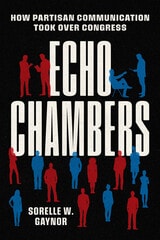
Echo Chambers
How Partisan Communication Took Over CongressSoRelle W. Gaynor
University of Chicago Press, 2027
An incisive analysis of how congressional communication with constituents has changed and what this means for representation and polarization.
Members of Congress have a duty to talk to their constituents back home about what’s going on in Washington. But today, the average politician lacks the time, resources, and knowledge necessary to coherently explain the bills and legislative actions up for debate. Therefore, they turn to those who hold the keys to the chamber: party leaders.
Consequently, Congress is now more reliant than ever on its leaders’ partisan talking points, and constituents hear more about nationalized political battles rather than the local issues affecting their districts. Drawing on large-scale text analysis, campaign expenditures, and congressional district data, as well as in-depth interviews, Echo Chambers examines how partisan communication took over Congress, the key differences in that messaging across parties and chambers, and what these combined forces mean for US citizens today.
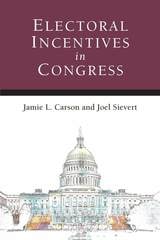
Electoral Incentives in Congress
Jamie L. Carson and Joel Sievert
University of Michigan Press, 2018
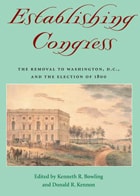
Establishing Congress
The Removal to Washington, D.C., and the Election of 1800Kenneth R. Bowling
Ohio University Press, 2005
Establishing Congress: The Removal to Washington, D.C., and the Election of 1800 focuses on the end of the 1790s, when, in rapid succession, George Washington died, the federal government moved to Washington, D.C., and the election of 1800 put Thomas Jefferson and the Democratic-Republican Party in charge of the federal government.
Establishing Congress dispels the myths and misinformation that surround the federal government’s move to Washington and demonstrates that the election of 1800 changed American party politics forever, establishing the success of the American experiment in government and completing the founding of the Republic. It also contends that the lame-duck session of Congress had far-reaching implications for the governance of the District of Columbia. Later chapters examine aspects of the political iconography of the Capitol—one illuminating Jefferson’s role in turning the building into a temple for the legislature and an instrument for nation-building, another analyzing the fascinating decades-long debate over whether to bury George Washington in the Capitol.
The book considers as well the political implications of social life in early Washington, examining the political lobbying by Washington women within a social context and detailing the social and political life in the city’s homes, hotels, boardinghouses, and eating messes. Establishing Congress is an invaluable reference work for anyone interested in these pivotal moments in American history.