Results by title
8113 books match the query 'Literary Criticism' and 280 start with e
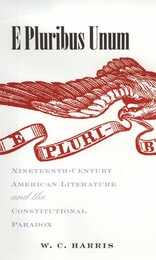
E Pluribus Unum
Nineteenth-Century American Literature and the Constitutional ParadoxHarris, W. C.
University of Iowa Press, 2005
The project of E Pluribus Unum is twofold. Its first and underlying concern is the general philosophic problem of the one and the many as it came to be understood at the time. W. C. Harris supplies a detailed account of the genealogy of the concept, exploring both its applications and its paradoxes as a basis for state and identity formation.
Harris then considers the perilous integration of the one and the many as a motive in the major literary accomplishments of 19th-century U.S. writers. Drawing upon critical as well as historical resources and upon contexts as diverse as cosmology, epistemology, poetics, politics, and Bible translation, he discusses attempts by Poe, Whitman, Melville, and William James to resolve the problems of social construction caused by the paradox of e pluribus unum by writing literary and philosophical texts that supplement the nation’s political founding documents.
Poe (Eureka), Whitman (Leaves of Grass), Melville (Billy Budd), and William James (The Varieties of Religious Experience) provide their own distinct, sometimes contradictory resolutions to the conflicting demands of diversity and unity, equality and hierarchy. Each of these texts understands literary and philosophical writing as having the potential to transform-conceptually or actually-the construction of social order.
This work will be of great interest to literary and constitutional scholars.

E.B. White
The Emergence of an EssayistRobert L., Jr. Root
University of Iowa Press, 1999
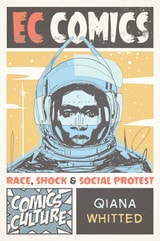
EC Comics
Race, Shock, and Social ProtestQiana Whitted
Rutgers University Press, 2019
Entertaining Comics Group (EC Comics) is perhaps best-known today for lurid horror comics like Tales from the Crypt and for a publication that long outlived the company’s other titles, Mad magazine. But during its heyday in the early 1950s, EC was also an early innovator in another genre of comics: the so-called “preachies,” socially conscious stories that boldly challenged the conservatism and conformity of Eisenhower-era America.
EC Comics examines a selection of these works—sensationally-titled comics such as “Hate!,” “The Guilty!,” and “Judgment Day!”—and explores how they grappled with the civil rights struggle, antisemitism, and other forms of prejudice in America. Putting these socially aware stories into conversation with EC’s better-known horror stories, Qiana Whitted discovers surprising similarities between their narrative, aesthetic, and marketing strategies. She also recounts the controversy that these stories inspired and the central role they played in congressional hearings about offensive content in comics.
The first serious critical study of EC’s social issues comics, this book will give readers a greater appreciation of their legacy. They not only served to inspire future comics creators, but also introduced a generation of young readers to provocative ideas and progressive ideals that pointed the way to a better America.
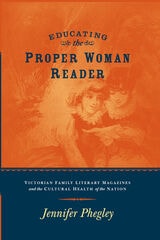
EDUCATING THE PROPER WOMAN READER
VICTORIAN FAMILY LITERARY MAGAZINES & CULTURAL HEALTH OF THE NATIONJennifer Phegley
The Ohio State University Press, 2004
Jennifer Phegley presents an examination of four mid-Victorian magazines that middle-class women read widely. Educating the Proper Woman Reader reevaluates prevailing assumptions about the vexed relationship between nineteenth-century women readers and literary critics.
While many scholars have explored the ways nineteenth-century critics expressed their anxiety about the dangers of women’s unregulated and implicitly uncritical reading practices, which were believed to threaten the sanctity of the home and the cultural status of the nation, Phegley argues that family literary magazines revolutionized the position of women as consumers of print by characterizing them as educated readers and able critics. Her analysis of images of influential women readers (in Harper’s), intellectual women readers (in The Cornhill), independent women readers (in Belgravia), and proto-feminist women readers/critics (in Victoria) indicates that women played a significant role in determining the boundaries of literary culture within these magazines. She argues that these publications supported women’s reading choices, inviting them to define literary culture rather than to consume it passively.
Not only does this book revise our understanding of nineteenth-century attitudes toward women readers, but it also takes a fresh look at the transatlantic context of literary production. Further, Phegley demonstrates the role these publications played in improving cultural literacy among women of the middle classes as well as the interplay between fiction and essays of the time by writers such as Mary Braddon, Charles Dickens, George Eliot, Elizabeth Gaskell, G. H. Lewes, Harriet Martineau, Margaret Oliphant, George Sala, William Thackeray, and Anthony Trollope.
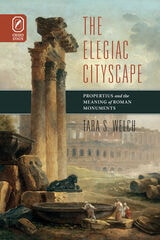
ELEGIAC CITYSCAPE
Propertius and the Meaning of Roman MonumentsTara S. Welch
The Ohio State University Press, 2005
The Elegiac Cityscape explores Propertius’ Rome and the various ways his poetry about the city illuminates the dynamic relationship between one individual and his environment. Combining the approaches of archaeology and literary criticism, Tara S. Welch examines how Propertius’ poems on Roman places scrutinize the monumentalization of various ideological positions in Rome, as they poke and prod Rome’s monuments to see what further meanings they might admit. The result is a poetic book rife with different perspectives on the eternal city, perspectives that often call into question any sleepy or complacent adherence to Rome’s traditional values.
Each Hour Redeem
Time and Justice in African American LiteratureDaylanne K. English
University of Minnesota Press, 2013
Each Hour Redeem advances a major reinterpretation of African American literature from the late eighteenth century to the present by demonstrating how its authors are centrally concerned with racially different experiences of time. Daylanne K. English argues that, from Phillis Wheatley to Suzan-Lori Parks, African American writers have depicted distinctive forms of temporality to challenge racial injustices supported by dominant ideas of time. The first book to explore the representation of time throughout the African American literary canon, Each Hour Redeem illuminates how the pervasive and potent tropes of timekeeping provide the basis for an overarching new understanding of the tradition.
Combing literary, historical, legal, and philosophical approaches, Each Hour Redeem examines a wide range of genres, including poetry, fiction, drama, slave narratives, and other forms of nonfiction. English shows that much of African American literature is characterized by “strategic anachronism,” the use of prior literary forms to investigate contemporary political realities, as seen in Walter Mosley’s recent turn to hard-boiled detective fiction. By contrast, “strategic presentism” is exemplified in the Black Arts Movement and the Harlem Renaissance and their investment in contemporary political potentialities, for example, in Langston Hughes and Amiri Baraka’s adaptation of the jazz of their eras for poetic form and content. Overall, the book effectively demonstrates how African American writers have employed multiple and complex conceptions of time not only to trace racial injustice but also to help construct a powerful literary tradition across the centuries.
Eardrums
Literary Modernism as Sonic WarfareTyler Whitney
Northwestern University Press, 2019
Eardrums is the first book-length study to explore the relationship between acoustical modernity and German modernism, charting a literary and cultural history written in and around the eardrum. The result is not only a new way of understanding the sonic impulses behind key literary texts from the period. It also outlines an entirely new approach to the study of literature as as the interaction of text and sonic practice, voice and noise, which will be of interest to scholars across literary studies, media theory, sound studies, and the history of science.
Early Modern Autobiography
Theories, Genres, PracticesRonald Bedford, Lloyd Davis and Philippa Kelly, Editors
University of Michigan Press, 2006
“The idea of the self, as seen from diverse and fascinating perspectives on sixteenth- and seventeenth-century life: this is what readers can expect from Early Modern Autobiography. A beautifully edited collection, genuinely far-reaching and insightful, Early Modern Autobiography makes known to us a great deal about how people saw themselves four hundred years ago."
—Derek Cohen, Professor of English, McLaughlin College, York University
"Acutely addressing a range of central issues from subjectivity to theatricality to religion, these essays will be of great interest to specialists in early modern studies and students of autobiographical writings from all eras."
—Heather Dubrow, Tighe-Evans Professor and John Bascom Professor, Department of English, University of Wisconsin
"The essays in this volume show where archival discoveries—memoirs, letters, account books, wills, and marginalia—can take us in understanding early modern mentalities. They document the interdependence of the abstract and the everyday, the social constructedness of self-awareness, local contexts for self-recordation, and impulses that range from legal purpose to imaginative escape. The sixteen chapters open many fascinating new perspectives on identity and personhood in Renaissance England."—Lena Cowen Orlin, Executive Director, The Shakespeare Association of America and Professor of English, University of Maryland Baltimore County
Early Modern Women Journal Volume 12.2
Edited by Mihoko Suzuki
Arizona Center for Medieval and Renaissance Studies, 2018

Early Modern Women Journal v.10.1
Anne J. Cruz
Arizona Center for Medieval and Renaissance Studies, 2000
Early Modern Women Journal v.10.2
Robert E. Bjork
Arizona Center for Medieval and Renaissance Studies, 2000
Early Modern Women Journal v.11.1
Sharonah Frederick
Arizona Center for Medieval and Renaissance Studies, 2000
Early Modern Women Journal v.11.2
Sharonah Frederick
Arizona Center for Medieval and Renaissance Studies, 2000
Early Modern Women Journal v.9.2
Sharonah Frederick
Arizona Center for Medieval and Renaissance Studies, 2000
Early Modern Women Journal v14.2
Bernadette Andrea
Arizona Center for Medieval and Renaissance Studies, 2020

Early Modern Women's Writing and Sor Juana Ines de la Cruz
Stephanie Merrim
Vanderbilt University Press, 1999
Early modern women writers whose works are explored include Marie de Gournay, Margaret Fell Fox, Catalina de Erauso, Maria de Zayas, Ana Caro, Mme de Lafayette, Anne Bradstreet, St. Teresa, and Margaret Lucas Cavendish.
Merrim's study provides a full-bodied picture of the resources that the cultural and historical climates of the seventeenth century placed at the disposal of women writers, the manners in which women writers instrumentalized them, the building blocks and concerns of early modern women's writing, and the continuities between early modern and modern women's writing.
Written in an engaging, clear manner, this innovative study will be of interest not only to Hispanists but also to scholars in early modern studies, women's studies, history, and comparative literature.
Early Modern Women
An Interdisciplinary Journal, volume 16 number 1 (Fall 2021)The University of Chicago Press
University of Chicago Press Journals, 2021
Early Modern Women
An Interdisciplinary Journal, volume 16 number 2 (Spring 2022)The University of Chicago Press
University of Chicago Press Journals, 2022
Early Modern Women
An Interdisciplinary Journal, volume 17 number 1 (Fall 2022)The University of Chicago Press
University of Chicago Press Journals, 2022
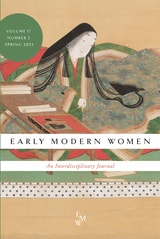
Early Modern Women
An Interdisciplinary Journal, volume 17 number 2 (Spring 2023)The University of Chicago Press
University of Chicago Press Journals, 2023
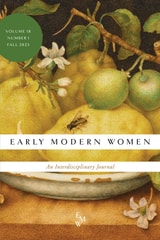
Early Modern Women
An Interdisciplinary Journal, volume 18 number 1 (Fall 2023)The University of Chicago Press
University of Chicago Press Journals, 2023
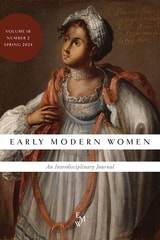
Early Modern Women
An Interdisciplinary Journal, volume 18 number 2 (Spring 2024)The University of Chicago Press
University of Chicago Press Journals, 2024
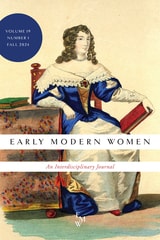
Early Modern Women
An Interdisciplinary Journal, volume 19 number 1 (Fall 2024)The University of Chicago Press
University of Chicago Press Journals, 2024
Early Modern Women
An Interdisciplinary Journal, volume 19 number 2 (Spring 2025)The University of Chicago Press
University of Chicago Press Journals, 2025
Early Modern Women
An Interdisciplinary Journal, volume 20 number 1 (Fall 2025)The University of Chicago Press
University of Chicago Press Journals, 2025
Early Modern Women
An Interdisciplinary Journal, volume 20 number 2 (Spring 2026)The University of Chicago Press
University of Chicago Press Journals, 2026
Early Modern Women
An Interdisciplinary Journal, volume 21 number 1 (Fall 2026)The University of Chicago Press
University of Chicago Press Journals, 2026
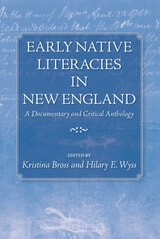
Early Native Literacies in New England
A Documentary and Critical AnthologyKristina Bross
University of Massachusetts Press, 2008
Designed as a corrective to colonial literary histories that have excluded Native voices, this anthology brings together a variety of primary texts produced by the Algonquian peoples of New England during the seventeenth, eighteenth, and very early nineteenth centuries. Included among these written materials and objects are letters, signatures, journals, baskets, pictographs, confessions, wills, and petitions, each of which represents a form of authorship. Together they demonstrate the continuing use of traditional forms of memory and communication and the lively engagement of Native peoples with alphabetic literacy during the colonial period. Each primary text is accompanied by an essay that places it in context and explores its significance.
Written by leading scholars in the field, these readings draw on recent trends in literary analysis, history, and anthropology to provide an excellent overview of the field of early Native studies. They are also intended to provoke discussion and open avenues for further exploration by students and other interested readers. Above all, the texts and commentaries gathered in this volume provide an opportunity to see Native American literature as a continuity of expression that reflects choices made long before contact and colonization, rather than as a nineteenth—or even twentieth-century invention.
Contributors include Heidi Bohaker, Heather Bouwman, Joanna Brooks, Kristina Bross, Stephanie Fitzgerald, Sandra Gustafson, Laura Arnold Leibman, Kevin McBride, David Murray, Laura Murray, Jean O'Brien, Ann Marie Plane, Philip Round, Jodi Schorb, David Silverman, and Hilary E. Wyss.
Early Postmodernism
Foundational EssaysPaul A. Bové
Duke University Press, 1995
Essays by noted cultural and literary theorists join with Bové’s contemporary preface to represent the important and unique moment in recent intellectual history when postmodernism was no longer seen primarily as an architectural term, had not yet come to describe the wide range of culture it does now, but was finding power and place in the literary realm. These essays show that the history of postmodernism and its attendant critical theories are both more complex and more deeply bound with literary criticism than often is acknowledged today. Early Postmodernism demonstrates not only the significance of these literary studies, but also the role played by literary critical postmodernism in making possible newer forms of critical and cultural studies.
Contributors. Barry Alpert, Charles Altieri, David Antin, Harold Bloom, Paul A. Bové, Hélène Cixous, Gerald Gillespie, Ihab Hassan, Joseph N. Riddel, William, V. Spanos, Catharine R. Stimpson, Cornel West
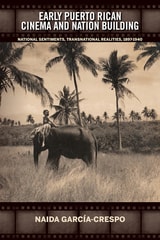
Early Puerto Rican Cinema and Nation Building
National Sentiments, Transnational Realities, 1897-1940Naida García-Crespo
Bucknell University Press, 2019
Published by Bucknell University Press. Distributed worldwide by Rutgers University Press.
Early Spanish American Narrative
By Naomi Lindstrom
University of Texas Press, 2004
The world discovered Latin American literature in the twentieth century, but the roots of this rich literary tradition reach back beyond Columbus's discovery of the New World. The great pre-Hispanic civilizations composed narrative accounts of the acts of gods and kings. Conquistadors and friars, as well as their Amerindian subjects, recorded the clash of cultures that followed the Spanish conquest. Three hundred years of colonization and the struggle for independence gave rise to a diverse body of literature—including the novel, which flourished in the second half of the nineteenth century.
To give everyone interested in contemporary Spanish American fiction a broad understanding of its literary antecedents, this book offers an authoritative survey of four centuries of Spanish American narrative. Naomi Lindstrom begins with Amerindian narratives and moves forward chronologically through the conquest and colonial eras, the wars for independence, and the nineteenth century. She focuses on the trends and movements that characterized the development of prose narrative in Spanish America, with incisive discussions of representative works from each era. Her inclusion of women and Amerindian authors who have been downplayed in other survey works, as well as her overview of recent critical assessments of early Spanish American narratives, makes this book especially useful for college students and professors.
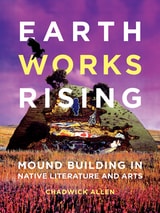
Earthworks Rising
Mound Building in Native Literature and ArtsChadwick Allen
University of Minnesota Press, 2022
A necessary reexamination of Indigenous mounds, demonstrating their sustained vitality and vibrant futurity by centering Native voices
Typically represented as unsolved mysteries or ruins of a tragic past, Indigenous mounds have long been marginalized and misunderstood. In Earthworks Rising, Chadwick Allen issues a compelling corrective, revealing a countertradition based in Indigenous worldviews. Alongside twentieth- and twenty-first-century Native writers, artists, and intellectuals, Allen rebuts colonial discourses and examines the multiple ways these remarkable structures continue to hold ancient knowledge and make new meaning—in the present and for the future.
Earthworks Rising is organized to align with key functional categories for mounds (effigies, platforms, and burials) and with key concepts within mound-building cultures. From the Great Serpent Mound in Ohio to the mound metropolis Cahokia in Illinois to the generative Mother Mound in Mississippi, Allen takes readers deep into some of the most renowned earthworks. He draws on the insights of poets Allison Hedge Coke and Margaret Noodin, novelists LeAnne Howe and Phillip Carroll Morgan, and artists Monique Mojica and Alyssa Hinton, weaving in a personal history of earthwork encounters and productive conversation with fellow researchers.
Spanning literature, art, performance, and built environments, Earthworks Rising engages Indigenous mounds as forms of “land-writing” and as conduits for connections across worlds and generations. Clear and compelling, it provokes greater understanding of the remarkable accomplishments of North America’s diverse mound-building cultures over thousands of years and brings attention to new earthworks rising in the twenty-first century.
East is West and West is East
Gender, Culture, and Interwar Encounters between Asia and AmericaKaren Kuo
Temple University Press, 2012
Between 1919-1938, contact between Asia and America forced a reassessment of the normative boundaries of race, sex, gender, class, home, and nation. Karen Kuo’s provocative East Is West and West Is East looks closely at these global shifts to modernity.
In her analysis of five forgotten texts—the 1930 film East Is West, Frank Capra’s 1937 version of Lost Horizon and its 1973 remake, Younghill Kang's novel East Goes West, and Baroness Ishimoto’s memoir/manifesto, Facing Both Ways—Kuo elucidates how “Asia” played a role in shaping American gender and racial identities and how Asian authors understood modern America and its social, political, and cultural influence on Asia.
Kuo asserts that while notions of white and Asian racial difference remain salient, sexual and gendered constructions of Asians and whites were at times about similarity and intersections as much as they were about establishing differences.
East-West Literary Imagination
Cultural Exchanges from Yeats to MorrisonYoshinobu Hakutani
University of Missouri Press, 2017
This study traces the shaping presence of cultural interactions, arguing that American literature has become a hybridization of Eastern and Western literary traditions. Cultural exchanges between the East and West began in the early decades of the nineteenth century as American transcendentalists explored Eastern philosophies and arts. Hakutani examines this influence through the works of Emerson, Thoreau, and Whitman. He further demonstrates the East-West exchange through discussions of the interactions by modernists such as Yone Noguchi, Yeats, Pound, Camus, and Kerouac.
Finally, he argues that African American literature, represented by Richard Wright, Ralph Ellison, Alice Walker, Toni Morrison, and James Emanuel, is postmodern. Their works exhibit their concerted efforts to abolish marginality and extend referentiality, exemplifying the postmodern East-West crossroads of cultures. A fuller understanding of their work is gained by situating them within this cultural conversation. The writings of Wright, for example, take on their full significance only when they are read, not as part of a national literature, but as an index to an evolving literature of cultural exchanges.
Eating of the Gods
Jan Kott
Northwestern University Press, 1973

Echoes from the Hills
Critical Essays on Ozarks LiteratureJohn J. Han
University of Arkansas Press, 2027
Echoes from the Hills: Critical Essays on Ozarks Literature offers a sustained critical examination of Ozarks writing through literary, ecological, cultural, and theoretical perspectives. Bringing together sixteen essays, the collection marks a shift in Ozarks studies from archival recovery and author-focused scholarship toward more self-aware literary criticism, showing that Ozarks literature is a dynamic field capable of serious interpretive work.
Organized around themes such as Arcadian myth, ecocriticism, postcolonialism, feminist criticism, and noir, the essays place Ozarks texts in conversation with broader debates in American literary studies and the environmental humanities. Discussions of writers such as Daniel Woodrell and Sue Hubbell, along with attention to film and visual culture including Minari, highlight how regional stories engage issues of land use, environmental strain, economic precarity, and cultural displacement.
The collection also broadens the field by addressing gaps in representation and including a wider range of voices and perspectives. By bringing together scholars from within and beyond the region, the book encourages dialogue across disciplinary and geographic boundaries. Overall, it presents Ozarks literature as an evolving part of American literary scholarship, one that reflects the complex intersections of place, memory, identity, and cultural change.
Echoes of Emerson
Rethinking Realism in Twain, James, Wharton, and CatherDiana Hope Polley
University of Alabama Press, 2017
Probes the ways in which two major periods in nineteenth-century American literature—Romanticism and Realism—have come to be understood and defined.
Echoes of Emerson: Rethinking Realism in Twain, James, Wharton, and Cather traces the complex and unexplored relationship between American realism and the philosophy of Ralph Waldo Emerson. Critics often read American realism as a clear disavowal of earlier American romantic philosophy and as a commitment to recognizing the stark realities of a new postbellum order. Diana Hope Polley’s study complicates these traditional assumptions by reading American realism as an ongoing dialogue with the ideas—often idealisms—of America’s greatest romantic philosopher, Ralph Waldo Emerson.
In this illuminating work, Polley offers detailed readings of Mark Twain’s Adventures of Huckleberry Finn, Henry James’s The Portrait of a Lady, Edith Wharton’s The House of Mirth, and Willa Cather’s My Ántonia—all through the lens of Emersonian philosophy and discourse. This unique contribution to nineteenth- and early twentieth-century literary studies shows how these texts revisit Emerson’s antebellum “republic of the spirit” philosophy, specifically the trope of the Emersonian hero/heroine navigating the harsh contingencies of the modern world.
Romanticism and realism are often seen as opposing binaries, with romanticism celebrating the individual, self-reliance, and nature and realism emphasizing the weight of socio-historical forces. Realism is often characterized as rejecting the transcendent principles of Emersonian thought. Rather than accept those distinct boundaries between romance and realism, Polley argues that American realists struggled between celebrating Emerson’s core philosophies of individual possibility and acknowledging the stark “realities” of American social and historical life. In short, this study recognizes within realism a divided loyalty between two historical trends and explores how these seemingly contradictory notions—Emerson’s romantic philosophy and later nineteenth-century visions of historical reality—exist, simultaneously, within the literature of the period.
Echoes
A Dramatic BagatelleEmma Gad, Translated by Lynn R. Wilkinson
University of Wisconsin Press, 2021
Although it was labeled a “bagatelle,” Echoes, like most of Gad’s other plays, is quite funny. The play brings together three individuals in the out-of-the-way cottage of an old servant. Countess Clara takes refuge with Maren, her former nursemaid, during a sudden downpour and is soon joined by Niels, her former tutor, who claims to be passing by on his way to a church, where he hopes to find important historical documents. During Clara’s conversations with the two, it comes out that she is considering marriage to a count who lives nearby, even though she finds him and his way of life unattractive, and that she and Niels had been in love years before.
Gad’s graceful dialogue manages to touch on questions hotly debated in the last decades of the nineteenth century, such as the ability of individuals to break with the past or with outmoded or repressive conventions, while also making audiences laugh. Despite the play’s lighthearted wittiness, Echoes is an inventive example of turn-of-the-century avant-garde theater.
Echoing Hylas
A Study in Hellenistic and Roman MetapoeticsMark Heerink
University of Wisconsin Press, 2015
In Echoing Hylas, Mark Heerink argues that the story of Hylas—a famous episode of the Argonauts' voyage—was used by poets throughout classical antiquity to reflect symbolically on the position of their poetry in the literary tradition. Certain elements of the story, including the characters of Hylas and Hercules themselves, functioned as metaphors of the art of poetry. In the Hellenistic age, for example, the poet Theocritus employed Hylas as an emblem of his innovative
bucolic verse, contrasting the boy with Hercules, who symbolized an older, heroic-epic tradition. The Roman poet Propertius further developed and transformed Theocritus's metapoetical allegory by turning Heracles into an elegiac lover in pursuit of an unattainable object of affection. In this way, the myth of Hylas became the subject of a dialogue among poets across time, from the Hellenistic age to the Flavian era. Each poet, Heerink demonstrates, used elements of the myth to claim his own place in a developing literary tradition.
With this innovative diachronic approach, Heerink opens a new dimension of ancient metapoetics and offers many insights into the works of Apollonius of Rhodes, Theocritus, Virgil, Ovid, Valerius Flaccus, and Statius.
Eclipse of Action
Tragedy and Political EconomyRichard Halpern
University of Chicago Press, 2017
Since Aristotle, tragedy has been seen as uniquely exhibiting the importance of action for human happiness. Beginning with Adam Smith, however, political economy has claimed that the source of happiness is primarily production. Eclipse of Action examines the tense relations between action and production, doing and making, in playwrights from Aeschylus, Marlowe, Shakespeare, and Milton to Beckett, Arthur Miller, and Sarah Kane. Richard Halpern places these figures in conversation with works by Aristotle, Smith, Hegel, Marx, Hannah Arendt, Georges Bataille, and others in order to trace the long history of the ways in which economic thought and tragic drama interact.
Eclipse of Empires
World History in Nineteenth-Century U.S. Literature and CulturePatricia Jane Roylance
University of Alabama Press, 2013
Patricia Jane Roylance’s central claim in Eclipse of Empires is that historical episodes of imperial eclipse, for example Incan Peru yielding to Spain or the Ojibway to the French, heightened the concerns of many American writers about specific intranational social problems plaguing the nation at the time—race, class, gender, religion, economics. Given the eventual dissolution of great civilizations previously plagued by these very same problems, many writers, unlike those who confidently emphasized U.S. exceptionalism, exhibited both an anxiety about the stability of American society and a consistent practice of self-scrutiny in identifying the national defects that they felt could precipitate America’s decline.
Roylance studies, among other texts, James Fenimore Cooper’s The Water-Witch (1830) and The Bravo (1831), which address the eclipse of Venice by New York City as a maritime power in the eighteenth century; William Hickling Prescott’s Conquest of Peru (1847), which responds to widespread anxiety about communist and abolitionist threats to the U.S. system of personal property by depicting Incan culture as a protocommunist society doomed to failure; and Henry Wadsworth Longfellow’s The Song of Hiawatha (1855), which resists the total eclipse of Ojibwa culture by incorporating Ojibway terms and stories into his poem and by depicting the land as permanently marked by their occupation.
Ecoambiguity
Environmental Crises and East Asian LiteraturesKaren Laura Thornber
University of Michigan Press, 2012
Ecoambiguity is the first book in any language to analyze Chinese, Japanese, Korean, and Taiwanese literary treatments of damaged ecosystems. Thornber closely examines East Asian creative portrayals of inconsistent human attitudes, behaviors, and information concerning the environment and takes up texts by East Asians who have been translated and celebrated around the world, including Gao Xingjian, Ishimure Michiko, Jiang Rong, and Ko Un, as well as fiction and poetry by authors little known even in their homelands. Ecoambiguity addresses such environmental crises as deforesting, damming, pollution, overpopulation, species eradication, climate change, and nuclear apocalypse. This book opens new portals of inquiry in both East Asian literatures and ecocriticism (literature and environment studies), as well as in comparative and world literature.

Ecofeminist Literary Criticism
Theory, Interpretation, PedagogyEdited by Greta Gaard and Patrick D. Murphy
University of Illinois Press, 1998
Ecofeminism is a practical movement for social change that discerns interconnections among all forms of oppression: the exploitation of nature, the oppression of women, class exploitation, racism, colonialism. Against binary divisions such as self/other, culture/nature, man/woman, humans/animals, and white/non-white, ecofeminist theory asserts that human identity is shaped by more fluid relationships and by an acknowledgment of both connection and difference.
Once considered the province of philosophy and women's studies, ecofeminism in recent years has been incorporated into a broader spectrum of academic discourse. Ecofeminist Literary Criticism assembles some of the most insightful advocates of this perspective to illuminate ecofeminism as a valuable component of literary criticism.
Ecological Poetics; or, Wallace Stevens’s Birds
Cary Wolfe
University of Chicago Press, 2020
Stevens, Wolfe argues, is an ecological poet in the sense that his places, worlds, and environments are co-created by the life forms that inhabit them. Wolfe argues for a “nonrepresentational” conception of ecopoetics, showing how Stevens’s poems reward study alongside theories of system, environment, and observation derived from a multitude of sources, from Ralph Waldo Emerson and Niklas Luhmann to Jacques Derrida and Stuart Kauffman. Ecological Poetics is an ambitious interdisciplinary undertaking involving literary criticism, contemporary philosophy, and theoretical biology.
Ecologies of a Storied Planet in the Anthropocene
Serpil Oppermann
West Virginia University Press, 2023
Ecologies of a Storied Planet in the Anthropocene is a tour de force. With transdisciplinarity and theoretical lucidity, it rethinks the Anthropocene from a material ecocritical perspective, envisioning innovative modes of knowledge for deeper understandings of Anthropocene ecologies. Focusing on nonhuman agencies, Serpil Oppermann shows in fascinating detail how to better imagine an ecological future on our storied planet that has suffered enormously from an anthropocentric mindset.
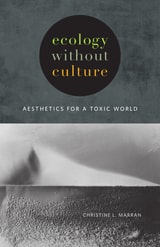
Ecology without Culture
Aesthetics for a Toxic WorldChristine L. Marran
University of Minnesota Press, 2017
Cultures have long defined themselves through biological elements to prove their strength and longevity, from cherry blossoms in Japan to amber waves of grain in the United States. In Ecology without Culture, Christine L. Marran introduces the concept of biotropes—material and semiotic figures that exist for human perception—to navigate how and why the material world has proven to be such an effective medium for representing culture. A bold and timely reconsideration of ecocriticism, Ecology without Culture insists on decentering questions of culture to highlight the materiality of poetry, film, and prose fiction.
Marran argues that ecocriticism can critique ecological realities more effectively from outside the frame of human exceptionalism. Through discussions of primarily non-Anglophone literature, poetry, and cinema about toxic events in contemporary history— from the depiction of slow violence in documentary by Tsuchimoto Noriaki to the powerful poetry of Ishimure Michiko—Marran argues that ecocriticism must find a way to engage culture without making the perpetuation of ethnos and anthropos the endgame of ecopolitics.
Using the biological foundations and geological time scales of textual worlds to more deeply critique cultural humanism, Marran ultimately contends that the chief stumbling block to ecological thinking is not the image of nature, but the image of culture.
Economic Citizens
A Narrative of Asian American VisibilityChristine So
Temple University Press, 2009
In the past fifty years, according to Christine So, the narratives of many popular Asian American books have been dominated by economic questions-what money can buy, how money is lost, how money is circulated, and what labor or objects are worth. Focusing on books that have achieved mainstream popularity, Economic Citizens unveils the logic of economic exchange that determined Asian Americans’ transnational migrations and national belonging.
With penetrating insight, So examines literary works that have been successful in the U.S. marketplace but have been read previously by critics largely as narratives of alienation or assimilation, including Fifth Chinese Daughter, Flower Drum Song, Falling Leaves and Turning Japanese. In contrast to other studies that have focused on the marginalization of Asian Americans, Economic Citizens examines how Asian Americans have entered into the public sphere.
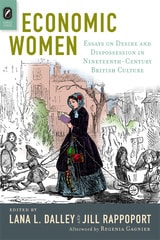
Economic Women
Essays on Desire and Dispossession in Nineteenth-Century British CultureEdited by Lana L. Dalley and Jill Rappoport
The Ohio State University Press, 2013
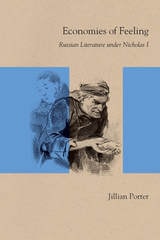
Economies of Feeling
Russian Literature under Nicholas IJillian Porter
Northwestern University Press, 2017
Porter shows how, for Pushkin, Gogol, Dostoevsky, and Faddei Bulgarin, ambition became a staging ground for experiments with transnational literary exchange. In its encounters with the celebrated Russian cultural value of hospitality and the age-old vice of miserliness, ambition appears both timely and anachronistic, suspiciously foreign and disturbingly Russian—it challenges readers to question the equivalence of local and imported words, feelings, and forms.
Economies of Feeling examines founding texts of nineteenth-century Russian prose alongside nonliterary materials from which they drew energy—from French clinical diagnoses of “ambitious monomania” to the various types of currency that proliferated under Nicholas I. It thus contributes fresh and fascinating insights into Russian characters’ impulses to attain rank and to squander, counterfeit, and hoard. Porter’s interdisciplinary approach will appeal to scholars of comparative as well as Russian literature.
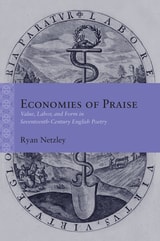
Economies of Praise
Value, Labor, and Form in Seventeenth-Century English PoetryRyan Netzley
Northwestern University Press, 2024
Reevaluates early modern poems of praise as, paradoxically, challenging an artistic economy that values exchange and productivity
Early modern poems of praise typically insist that they do not have a purpose or enact real labor beyond their effortless listing of laudable qualities. And yet the poets discussed in this study, including Ben Jonson, Andrew Marvell, Anne Bradstreet, Lucy Hutchinson, and John Milton, hint at an alternative aesthetic economy at work in their verse. Poetic praise, it turns out, might show us a social world outside the organizing principle of exchange.
In Economies of Praise: Value, Labor, and Form in Seventeenth‑Century English Poetry, Ryan Netzley explores how poems of praise imagine alternatives to market and gift economies and point instead to a self-contained aesthetic economy that works against a more expansive and productivist understanding of literary art. By depicting exchange as inconsequential, unproductive, and redundant rather than a necessary constituent of social order, these poems model for modern readers a world without the imperative to create, appraise, and repeatedly demonstrate one’s own value.