Results by title
328 books match the query 'Literature and society' and 10 start with e
E Pluribus Unum
Nineteenth-Century American Literature and the Constitutional ParadoxHarris, W. C.
University of Iowa Press, 2005
The project of E Pluribus Unum is twofold. Its first and underlying concern is the general philosophic problem of the one and the many as it came to be understood at the time. W. C. Harris supplies a detailed account of the genealogy of the concept, exploring both its applications and its paradoxes as a basis for state and identity formation.
Harris then considers the perilous integration of the one and the many as a motive in the major literary accomplishments of 19th-century U.S. writers. Drawing upon critical as well as historical resources and upon contexts as diverse as cosmology, epistemology, poetics, politics, and Bible translation, he discusses attempts by Poe, Whitman, Melville, and William James to resolve the problems of social construction caused by the paradox of e pluribus unum by writing literary and philosophical texts that supplement the nation’s political founding documents.
Poe (Eureka), Whitman (Leaves of Grass), Melville (Billy Budd), and William James (The Varieties of Religious Experience) provide their own distinct, sometimes contradictory resolutions to the conflicting demands of diversity and unity, equality and hierarchy. Each of these texts understands literary and philosophical writing as having the potential to transform-conceptually or actually-the construction of social order.
This work will be of great interest to literary and constitutional scholars.
EC Comics
Race, Shock, and Social ProtestQiana Whitted
Rutgers University Press, 2019
Entertaining Comics Group (EC Comics) is perhaps best-known today for lurid horror comics like Tales from the Crypt and for a publication that long outlived the company’s other titles, Mad magazine. But during its heyday in the early 1950s, EC was also an early innovator in another genre of comics: the so-called “preachies,” socially conscious stories that boldly challenged the conservatism and conformity of Eisenhower-era America.
EC Comics examines a selection of these works—sensationally-titled comics such as “Hate!,” “The Guilty!,” and “Judgment Day!”—and explores how they grappled with the civil rights struggle, antisemitism, and other forms of prejudice in America. Putting these socially aware stories into conversation with EC’s better-known horror stories, Qiana Whitted discovers surprising similarities between their narrative, aesthetic, and marketing strategies. She also recounts the controversy that these stories inspired and the central role they played in congressional hearings about offensive content in comics.
The first serious critical study of EC’s social issues comics, this book will give readers a greater appreciation of their legacy. They not only served to inspire future comics creators, but also introduced a generation of young readers to provocative ideas and progressive ideals that pointed the way to a better America.
ELEGIAC CITYSCAPE
Propertius and the Meaning of Roman MonumentsTara S. Welch
The Ohio State University Press, 2005
The Elegiac Cityscape explores Propertius’ Rome and the various ways his poetry about the city illuminates the dynamic relationship between one individual and his environment. Combining the approaches of archaeology and literary criticism, Tara S. Welch examines how Propertius’ poems on Roman places scrutinize the monumentalization of various ideological positions in Rome, as they poke and prod Rome’s monuments to see what further meanings they might admit. The result is a poetic book rife with different perspectives on the eternal city, perspectives that often call into question any sleepy or complacent adherence to Rome’s traditional values.

Edwardian Stories of Divorce
Janice Hubbard Harris
Rutgers University Press, 1996
Much as abortion in the United States today is a contentious issue used for scripting women's roles and potential into the national agenda, divorce was an issue dividing England in the Edwardian era. According to Janice Harris, anything and everything, from illicit sex and family values to the Garden of Eden, wrath of children, poverty of women, nature of cruelty, scandal of America, threat of Germany, and future of England were part of the debate over divorce. Living under marriage laws far more restrictive than those of their Protestant neighbors, Edwardian women and men campaigned for reform with a barrage of compelling stories. Organizing her analysis around three major sources of narrative on divorce––the Sunday papers, the Report of the Royal Commission on Divorce and Matrimonial causes, and the novel––Harris uncovers a war of words and a competition of tales. In raising questions about the winners, losers, and spoils, Harris expands our understanding of the history of divorce, the wars between the sexes, and the political import of those wars.
In the end, she presents a complex and lively story herself, one that illuminates battles over marriage and divorce taking place in our own era as well. This humane book on a long-neglected subject marks an important contribution to narrative studies and Edwardian history.
Engaging the Age of Jane Austen
Public Humanities in PracticeBridget Draxler and Danielle Spratt
University of Iowa Press, 2018
Humanities scholars, in general, often have a difficult time explaining to others why their work matters, and eighteenth-century literary scholars are certainly no exception. To help remedy this problem, literary scholars Bridget Draxler and Danielle Spratt offer this collection of essays to defend the field’s relevance and demonstrate its ability to help us better understand current events, from the proliferation of media to ongoing social justice battles.
The result is a book that offers a range of approaches to engaging with undergraduates, non-professionals, and broader publics into an appreciation of eighteenth-century literature. Essays draw on innovative projects ranging from a Jane Austen reading group held at the public library to students working with an archive to digitize an overlooked writer’s novel.
Reminding us that the eighteenth century was an exhilarating age of lively political culture—marked by the rise of libraries and museums, the explosion of the press, and other platforms for public intellectual debates—Draxler and Spratt provide a book that will not only be useful to eighteenth-century scholars, but can also serve as a model for other periods as well. This book will appeal to librarians, archivists, museum directors, scholars, and others interested in digital humanities in the public life.
Contributors: Gabriela Almendarez, Jessica Bybee, Nora Chatchoomsai, Gillian Dow, Bridget Draxler, Joan Gillespie, Larisa Good, Elizabeth K. Goodhue, Susan Celia Greenfield, Liz Grumbach, Kellen Hinrichsen, Ellen Jarosz, Hannah Jorgenson, John C. Keller, Naz Keynejad, Stephen Kutay, Chuck Lewis, Nicole Linton, Devoney Looser, Whitney Mannies, Ai Miller, Tiffany Ouellette, Carol Parrish, Paul Schuytema, David Spadafora, Danielle Spratt, Anne McKee Stapleton, Jessica Stewart, Colleen Tripp, Susan Twomey, Nikki JD White, Amy Weldon
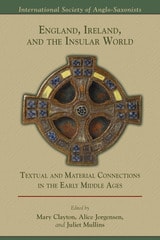
England, Ireland, and the Insular World
Textual and Material Connections in the Early Middle AgesMary Clayton
Arizona Center for Medieval and Renaissance Studies, 2017
ISAS Dublin 2013. England, Ireland and the Insular World: Textual and Material Connections in the Early Middle Ages is a collection of twelve essays related to the theme of the 2013 conference of the International Society of Anglo-Saxonists, ‘Insular Cultures’. Contributors cover a broad range of topics, from early medieval agriculture in Ireland and England, to sculpture, manuscript illumination and script, homilies, hagiography, aristocratic gift-giving, relics, calendars, Beowulf, and Anglo-Saxon perceptions of the Celtic peoples, considering connections, parallels and differences between Anglo-Saxon England and its insular neighbors. The volume will be of interest to all those working on Early Medieval history, literature, archaeology, liturgy, art, and manuscripts.
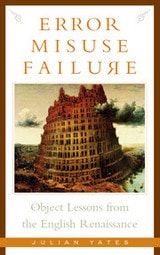
Error, Misuse, Failure
Object Lessons From The English RenaissanceJulian Yates
University of Minnesota Press, 2002
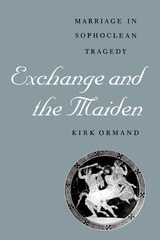
Exchange and the Maiden
Marriage in Sophoclean TragedyBy Kirk Ormand
University of Texas Press, 1999
Marriage is a central concern in five of the seven extant plays of the Greek tragedian Sophocles. In this pathfinding study, Kirk Ormand delves into the ways in which these plays represent and problematize marriage, thus offering insights into how Athenians thought about the institution of marriage.
Ormand takes a two-fold approach. He first explores the legal and economic underpinnings of Athenian marriage, an institution designed to guarantee the legitimate continuation of patrilineal households. He then shows how Sophocles' plays Trachiniae, Electra, Antigone, Ajax, and Oedipus Tyrannus both reinforce and critique this ideology by representing marriage as a homosocial exchange between men, in which women are objects who may attempt—but always fail—to become self-acting subjects.
These fresh readings provide the first systematic study of marriage in Sophocles. They draw important connections between drama and marriage as rituals concerned with controlling potentially disruptive female subjectivities.
Exiling the Poets
The Production of Censorship in Plato's RepublicRamona A. Naddaff
University of Chicago Press, 2002
Censorship, Nadaff argues, is not merely a mechanism of silencing but also provokes new ways of speaking about controversial and crucial cultural and artistic events. It functions philosophically in the Republic to subvert Plato's most crucial arguments about politics, epistemology, metaphysics, and ethics. Naddaff develops this stunning argument through an extraordinary reading of Plato's work. In books 2 and 3, the first censorship of poetry, she finds that Plato constitutes the poet as a rival with whom the philosopher must vie agonistically. In other words, philosophy does not replace poetry, as most commentators have suggested; rather, the philosopher becomes a worthy and ultimately victorious poetic competitor. In book 10's second censorship, Plato exiles the poets as a mode of self-subversion, rethinking and revising his theory of mimesis, of the immortality of the soul, and, most important, the first censorship of poetry. Finally, in a subtle and sophisticated analysis of the myth of Er, Naddaff explains how Plato himself censors his own censorships of poetry, thus producing the unexpected result of a poetically animated and open-ended dialectical philosophy.
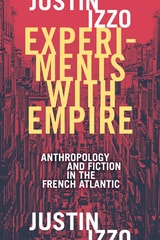
Experiments with Empire
Anthropology and Fiction in the French AtlanticJustin Izzo
Duke University Press, 2019