Results by title
161 books match the query 'Material culture' and 11 start with e
Early Native Literacies in New England
A Documentary and Critical AnthologyKristina Bross
University of Massachusetts Press, 2008
Designed as a corrective to colonial literary histories that have excluded Native voices, this anthology brings together a variety of primary texts produced by the Algonquian peoples of New England during the seventeenth, eighteenth, and very early nineteenth centuries. Included among these written materials and objects are letters, signatures, journals, baskets, pictographs, confessions, wills, and petitions, each of which represents a form of authorship. Together they demonstrate the continuing use of traditional forms of memory and communication and the lively engagement of Native peoples with alphabetic literacy during the colonial period. Each primary text is accompanied by an essay that places it in context and explores its significance.
Written by leading scholars in the field, these readings draw on recent trends in literary analysis, history, and anthropology to provide an excellent overview of the field of early Native studies. They are also intended to provoke discussion and open avenues for further exploration by students and other interested readers. Above all, the texts and commentaries gathered in this volume provide an opportunity to see Native American literature as a continuity of expression that reflects choices made long before contact and colonization, rather than as a nineteenth—or even twentieth-century invention.
Contributors include Heidi Bohaker, Heather Bouwman, Joanna Brooks, Kristina Bross, Stephanie Fitzgerald, Sandra Gustafson, Laura Arnold Leibman, Kevin McBride, David Murray, Laura Murray, Jean O'Brien, Ann Marie Plane, Philip Round, Jodi Schorb, David Silverman, and Hilary E. Wyss.
Eastern Cherokee Fishing
Heidi M. Altman
University of Alabama Press, 2006
Interviewees include a great range of informants, from native speakers of Cherokee with extensive knowledge of traditional fishing methods to Euro-American English speakers whose families have lived in North Carolina for many generations and know about contemporary fishing practices in the area. The topic of fishing thus offers perspective on the Cherokee language, the vigor of the Cherokee system of native knowledge, and the history of the relationship between Cherokee people and the local environment. Heidi Altman also examines the role of fishing as a tourist enterprise and how fishing practices affect tribal waters.
Elusive Archives
Material Culture in FormationMartin Brückner
University of Delaware Press, 2021
The essays that comprise Elusive Archives raise a common question: how do we study material culture when the objects of study are transient, evanescent, dispersed or subjective? Such things resist the taxonomic protocols that institutions, such as museums and archives, rely on to channel their acquisitions into meaningful collections. What holds these disparate things together here are the questions authors ask of them. Each essay creates by means of its method a provisional collection of things, an elusive archive. Scattered matter then becomes fixed within each author’s analytical framework rather than within the walls of an archive’s reading room or in cases along a museum corridor.
This book follows the ways in which objects may be identified, gathered, arranged, conceptualized and even displayed rather than by “discovering” artifacts in an archive and then asking how they came to be there. The authors approach material culture outside the traditional bounds of learning about the past. Their essays are varied not only in subject matter but also in narrative format and conceptual reach, making the volume accessible and easy to navigate for a quick reference or, if read straight through, build toward a new way to think about material culture.
Engaging Modernity
Asante in the Twenty-First CenturyKwasi Ampene. Nana Kwadwo Nyantakyi III
Michigan Publishing Services, 2016
Error, Misuse, Failure
Object Lessons From The English RenaissanceJulian Yates
University of Minnesota Press, 2002
Espíritu Santo de Zúñiga
A Frontier Mission in South TexasBy Tamra Lynn Walter
University of Texas Press, 2007
San Antonio Conservation Society Citation, 2009
In the early part of the eighteenth century, the Spanish colonial mission Espíritu Santo de Zúñiga was relocated from far south Texas to a site along the Guadalupe River in Mission Valley, Victoria County. This mission, along with a handful of others in south Texas, was established by the Spaniards in an effort to Christianize and civilize the local Native American tribes in the hopes that they would become loyal Spanish citizens who would protect this new frontier from foreign incursions.
With written historical records scarce for Espíritu Santo, Tamra Walter relies heavily on material culture recovered at this site through a series of recent archaeological investigations to present a compelling portrait of the Franciscan mission system. By examining findings from the entire mission site, including the compound, irrigation system, quarry, and kiln, she focuses on questions that are rarely, if ever, answered through historical records alone: What was daily life at the mission like? What effect did the mission routine have on the traditional lifeways of the mission Indians? How were both the Indians and the colonizers changed by their frontier experiences, and what does this say about the missionization process?
Walter goes beyond simple descriptions of artifacts and mission architecture to address the role these elements played in the lives of the mission residents, demonstrating how archaeology is able to address issues that are not typically addressed by historians. In doing so, she presents an accurate portrait of life in South Texas at this time. This study of Mission Espíritu Santo will serve as a model for research at similar early colonial sites in Texas and elsewhere.
Eternal Sovereigns
Indigenous Artists, Activists, and Travelers Reframing RomeGloria Jane Bell
Duke University Press, 2024
Excavations at Snaketown
Material CultureHarold S. Gladwin, Emil W. Haury, E. B. Sayles, and Nora Gladwin
University of Arizona Press, 1965
"The reprint will come as a blessing to many archaeologists who have sought in vain to obtain a copy of the original volume. It now stands as a body of data easily accessible to all workers, and we look forward to a new phase of synthesis of Hohokam archaeology."—American Antiquity

Excavations at Tel Nebi Mend, Syria Volume I
Peter J. Parr
Council for British Research in the Levant, 2015
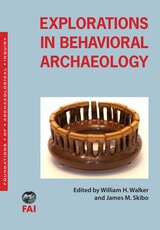
Explorations in Behavioral Archaeology
William H. Walker and James M. Skibo
University of Utah Press, 2015
Behavioral archaeology, defined as the study of people-object interactions in all times and places, emerged in the 1970s, in large part because of the innovative work of Michael Schiffer and colleagues. This volume provides an overview of how behavioral archaeology has evolved and how it has affected the field of archaeology at large.
The contributors to this volume are Schiffer’s former students, from his first doctoral student to his most recent. This generational span has allowed for chapters that reflect Schiffer’s research from the 1970s to 2012. They are iconoclastic and creative and approach behavioral archaeology from varied perspectives, including archaeological inference and chronology, site formation processes, prehistoric cultures and migration, modern material culture variability, the study of technology, object agency, and art and cultural resources. Broader questions addressed include models of inference and definitions of behavior, study of technology and the causal performances of artifacts, and the implications of artifact causality in human communication and the flow of behavioral history.
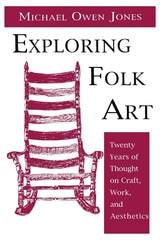
Exploring Folk Art
Michael Owen Jones
Utah State University Press, 1993
Jones explores the human impulse to create, the necessity for having aesthetically satisfying experiences, and the craving for tradition. He also considers topics such as making chairs, remodeling houses, using and preserving soda-fountain slang, preparing and eating food, and sculpting lifelike figures out of cement.