100 books match the query 'Microeconomics' and 5 start with e

cover of Economic Dimensions of Personalized and Precision Medicine

Economic Dimensions of Personalized and Precision Medicine

Edited by Ernst R. Berndt, Dana P. Goldman, and John Rowe

University of Chicago Press, 2019

Personalized and precision medicine (PPM)—the targeting of therapies according to an individual’s genetic, environmental, or lifestyle characteristics—is becoming an increasingly important approach in health care treatment and prevention. The advancement of PPM is a challenge in traditional clinical, reimbursement, and regulatory landscapes because it is costly to develop and introduces a wide range of scientific, clinical, ethical, and socioeconomic issues. PPM raises a multitude of economic issues, including how information on accurate diagnosis and treatment success will be disseminated and who will bear the cost; changes to physician training to incorporate genetics, probability and statistics, and economic considerations; questions about whether the benefits of PPM will be confined to developed countries or will diffuse to emerging economies with less developed health care systems; the effects of patient heterogeneity on cost-effectiveness analysis; and opportunities for PPM’s growth beyond treatment of acute illness, such as prevention and reversal of chronic conditions.
 
This volume explores the intersection of the scientific, clinical, and economic factors affecting the development of PPM, including its effects on the drug pipeline, on reimbursement of PPM diagnostics and treatments, and on funding of the requisite underlying research; and it examines recent empirical applications of PPM.   
 
[more]
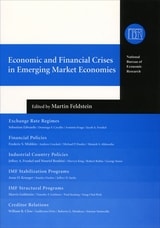
cover of Economic and Financial Crises in Emerging Market Economies

Economic and Financial Crises in Emerging Market Economies

Edited by Martin Feldstein

University of Chicago Press, 2003

In the late 1990s, economic and financial crises raged through East Asia, devastating economies that had previously been considered among the strongest in the developing world. The crises eventually spread to Russia, Turkey, and Latin America, and impacted the economies of many industrialized nations as well. In today's increasingly interdependent world, finding ways to reduce the risk of future crises—and to improve the management of crises when they occur—has become an international policy challenge of paramount importance.

This book rises to that challenge, presenting accessible papers and commentaries on the topic not only from leading academic economists, but also from high-ranking government officials (in both industrial and developing nations), senior policymakers at international institutions, and major financial investors. Six non-technical papers, each written by a specialist in the topic, provide essential economic background, introducing sections on exchange rate regimes, financial policies, industrial country policies, IMF stabilization policies, IMF structural programs, and creditor relations. Next, personal statements from the major players give firsthand accounts of what really went on behind the scenes during the crises, giving us a rare glimpse into how international economic policy decisions are actually made. Finally, wide-ranging discussions and debates sparked by these papers and statements are summarized at the end of each section.

The result is an indispensable overview of the key issues at work in these crises, written by the people who move markets and reshape economies, and accessible to not just economists and policymakers, but also to educated general readers.

Contributors:
Montek S. Ahluwalia, Domingo F. Cavallo, William R. Cline, Andrew Crockett, Michael P. Dooley, Sebastian Edwards, Stanley Fischer, Arminio Fraga, Jeffrey Frankel, Jacob Frenkel, Timothy F. Geithner, Morris Goldstein, Paul Keating, Mervyn King, Anne O. Krueger, Roberto Mendoza, Frederic S. Mishkin, Guillermo Ortiz, Yung Chul Park, Nouriel Roubini, Robert Rubin, Jeffrey Sachs, Ammar Siamwalla, George Soros
[more]
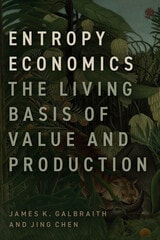
cover of Entropy Economics: The Living Basis of Value and Production

Entropy Economics

The Living Basis of Value and Production

James K. Galbraith and Jing Chen

University of Chicago Press, 2025

Economists dream of equilibrium. It’s time to wake up.

In mainstream economics, markets are ideal if competition is perfect. When supply balances demand, economic maturity is orderly and disturbed only by shocks. These ideas are rooted in doctrines going back thousands of years, yet, as James K. Galbraith and Jing Chen show, they contradict the foundations of our scientific understanding of the physical and biological worlds.

Entropy Economics discards the conventions of equilibrium and presents a new basis for thinking about economic issues, one rooted in life processes—an unequal world of unceasing change in which boundaries, plans, and regulations are essential. Galbraith and Chen’s theory of value is based on scarcity, and it accounts for the power of monopoly. Their theory of production covers increasing and decreasing returns, uncertainty, fixed investments over time, and the impact of rising resource costs. Together, their models illuminate key problems such as trade, finance, energy, climate, conflict, and demography.

Entropy Economics is a thrilling framework for understanding the world as it is and will be keenly relevant to the economic challenges of a world threatened with disorder.

[more]
cover of Envy Up, Scorn Down: How Status Divides Us

Envy Up, Scorn Down

How Status Divides Us

Susan T. Fiske

Russell Sage Foundation, 2011
An insightful examination of why we compare ourselves to those above and below us. The United States was founded on the principle of equal opportunity for all, and this ethos continues to inform the nation's collective identity. In reality, however, absolute equality is elusive. The gap between rich and poor has widened in recent decades, and the United States has the highest level of economic inequality of any developed country. Social class and other differences in status reverberate throughout American life, and prejudice based on another's perceived status persists among individuals and groups. In Envy Up, Scorn Down, noted social psychologist Susan Fiske examines the psychological underpinnings of interpersonal and intergroup comparisons, exploring why we compare ourselves to those both above and below us and analyzing the social consequences of such comparisons in day-to-day life. What motivates individuals, groups, and cultures to envy the status of some and scorn the status of others? Who experiences envy and scorn most? Envy Up, Scorn Down marshals a wealth of recent psychological studies as well as findings based on years of Fiske's own research to address such questions. She shows that both envy and scorn have distinctive biological, emotional, cognitive, and behavioral characteristics. And though we are all "wired" for comparison, some individuals are more vulnerable to these motives than others. Dominant personalities, for example, express envy toward high-status groups such as the wealthy and well-educated, and insecurity can lead others to scorn those perceived to have lower status, such as women, minorities, or the disabled. Fiske shows that one's race or ethnicity, gender, and education all correlate with perceived status. Regardless of whether one is accorded higher or lower status, however, all groups rank their members, and all societies rank the various groups within them. We rate each group as either friend or foe, able or unable, and accordingly assign them the traits of warmth or competence. The majority of groups in the United States are ranked either warm or competent but not both, with extreme exceptions: the homeless or the very poor are considered neither warm nor competent. Societies across the globe view older people as warm but incompetent. Conversely, the very rich are generally considered cold but highly competent. Envy Up, Scorn Down explores the nuances of status hierarchies and their consequences and shows that such prejudice in its most virulent form dehumanizes and can lead to devastating outcomes—from the scornful neglect of the homeless to the envious anger historically directed at Tutsis in Rwanda or Jews in Europe. Individuals, groups, and even cultures will always make comparisons between and among themselves. Envy Up, Scorn Down is an accessible and insightful examination of drives we all share and the prejudice that can accompany comparison. The book deftly shows that understanding envy and scorn—and seeking to mitigate their effects—can prove invaluable to our lives, our relationships, and our society.
[more]
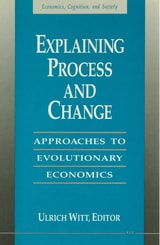
cover of Explaining Process and Change: Approaches to Evolutionary Economics

Explaining Process and Change

Approaches to Evolutionary Economics

Ulrich Witt, Editor

University of Michigan Press, 1992

Recently, many economists have advocated the adoption of an evolutionary perspective to better understand the permanent flux of the economy. So far, most of the work in this budding field has been confined to industrial organization research in the Schumpeterian tradition. In Explaining Process and Change, Ulrich Witt presents for the first time the potential uses of the evolutionary approach in a broad range of other fields. Witt, a leading expert in evolutionary economics, assembles essays by a number of economists whose findings might otherwise remain unavailable to North American economists. Their work offers insights into the application of evolutionary thinking to consumer theory, price theory, growth theory, industrial policy, game theory, and computer science. All of the essays focus on change and transition and the forces that create variability in the economy, as opposed to equilibrium states and the quest for optimality. Economists interested in the emerging evolutionary paradigm in economics will find Explaining Process and Change an invaluable and insightful guide to this new field. The many interdisciplinary relationships pointed out in each chapter make the book appealing to other social scientists as well.
[more]