Results by title
355 books match the query 'Middle Atlantic (DC, DE, MD, NJ, NY, PA)' and 9 start with e
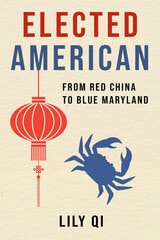
Elected American
From Red China to Blue MarylandLily Qi
Temple University Press, 2026
“Only in America can you run for office and get elected by people who can’t even pronounce your name.”—Lily Qi
Thirty years after her solo journey to America, Chinese-born Lily Qi became a Maryland state delegate. It was a gratifying moment she did not take for granted. Qi had overcome a viral WeChat disinformation campaign from her Chinese community and was met with skepticism from the Democratic establishment before being elected.
Elected American tells the inspirational story of Qi’s dreams, setbacks, and achievements with candor and humility. Growing up in Mao’s Shanghai, when “politics meant danger,” she never imagined running for public office. However, living in America, Qi came to see political participation as a missed opportunity for immigrants. As she campaigned to energize her cultural base, Qi realized she had to teach first-time voters how to make their votes count in a system not designed for them.
As the only U.S. state legislator who lived through China’s Cultural Revolution, Qi brings a rare cross-system perspective to American politics and modern-day Asian American identity. Elected American is a political memoir and an immigrant story that emphasizes that democracy doesn’t wait on the sidelines—it favors those who participate.
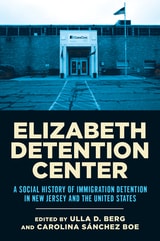
Elizabeth Detention Center
A Social History of Immigration Detention in New Jersey and the United StatesUlla D. Berg
Rutgers University Press, 2026
The United States detains and deports several hundred thousand migrants every year. Many spend significant amounts of time in immigration detention as they await adjudication of their immigration cases. The Elizabeth Detention Center in New Jersey is located in a converted warehouse, managed by a private, for-profit prison company. Over three decades, migrants and asylum seekers have been brought to EDC directly from Newark Airport or have been transferred to the site from elsewhere in the United States, including from the US-Mexico border region.
Through a longitudinal, site-specific study unique in its kind, this volume unites the voices and perspectives of formerly detained migrants, scholars, journalists, lawyers, and social and faith movement leaders, who share their experiences of Elizabeth Detention Center and reconstruct its social history and its location in New Jersey's political economy and in the changing legal landscapes of immigration detention in the United States.
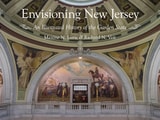
Envisioning New Jersey
An Illustrated History of the Garden StateLurie, Maxine N
Rutgers University Press, 2016
Winner of the 2017 New Jersey Studies Academic Alliance Author Award
See New Jersey history as you read about it! Envisioning New Jersey brings together 650 spectacular images that illuminate the course of the state’s history, from prehistoric times to the present. Readers may think they know New Jersey’s history—the state’s increasing diversity, industrialization, and suburbanization—but the visual record presented here dramatically deepens and enriches that knowledge.
Compiled by the authors of New Jersey: A History of the Garden State, this volume is intended as an illustrated companion to that earlier volume. Envisioning New Jersey also stands on its own because essays synthesizing each era accompany the illustrations. A fascinating gold mine of images from the state’s past, Envisioning New Jersey is the first illustrated book on the Garden State that covers its complete history, capturing the amazing transformation of New Jersey over time.
View sample pages (http://issuu.com/rutgersuniversitypress/docs/lurie_veit_envisioning_sample)
Thanks to the New Jersey Historical Commission, the New Jersey Council for the Humanities, and generous individual donors for making this project possible.
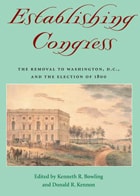
Establishing Congress
The Removal to Washington, D.C., and the Election of 1800Kenneth R. Bowling
Ohio University Press, 2005
Establishing Congress: The Removal to Washington, D.C., and the Election of 1800 focuses on the end of the 1790s, when, in rapid succession, George Washington died, the federal government moved to Washington, D.C., and the election of 1800 put Thomas Jefferson and the Democratic-Republican Party in charge of the federal government.
Establishing Congress dispels the myths and misinformation that surround the federal government’s move to Washington and demonstrates that the election of 1800 changed American party politics forever, establishing the success of the American experiment in government and completing the founding of the Republic. It also contends that the lame-duck session of Congress had far-reaching implications for the governance of the District of Columbia. Later chapters examine aspects of the political iconography of the Capitol—one illuminating Jefferson’s role in turning the building into a temple for the legislature and an instrument for nation-building, another analyzing the fascinating decades-long debate over whether to bury George Washington in the Capitol.
The book considers as well the political implications of social life in early Washington, examining the political lobbying by Washington women within a social context and detailing the social and political life in the city’s homes, hotels, boardinghouses, and eating messes. Establishing Congress is an invaluable reference work for anyone interested in these pivotal moments in American history.
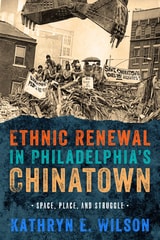
Ethnic Renewal in Philadelphia's Chinatown
Space, Place, and StruggleKathryn Wilson
Temple University Press, 2015
In Ethnic Renewal in Philadelphia’s Chinatown. Kathryn Wilson charts the unique history of this neighborhood. After 1945, a new generation of families began to shape Chinatown’s future. As plans for urban renewal—ranging from a cross-town expressway and commuter rail in the 1960s to a downtown baseball stadium in 2000—were proposed and developed, “Save Chinatown” activists rose up and fought for social justice.
Wilson chronicles the community’s efforts to save and renew itself through urban planning, territorial claims, and culturally specific rebuilding. She shows how these efforts led to Chinatown’s growth and its continued ability to serve as a living community for subsequent waves of new immigration.
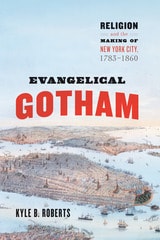
Evangelical Gotham
Religion and the Making of New York City, 1783–1860Kyle B. Roberts
University of Chicago Press, 2016
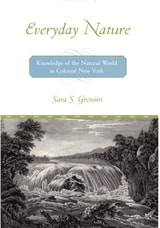
Everyday Nature
Knowledge of the Natural World in Colonial New YorkGronim, Sara S
Rutgers University Press, 2007
In the modern world, the public looks to scientists and scholars for their expertise on issues ranging from the effectiveness of vaccines to the causes of natural disasters. But for early Americans, whose relationship to nature was more intimate and perilous than our own, personal experience, political allegiances, and faith in God took precedence over the experiments of the learned.
In Everyday Nature, Sara Gronim shows how scientific advances were received in the early modern world, from the time Europeans settled in America until just before the American Revolution. Settlers approached a wide range of innovations, such as smallpox inoculation, maps and surveys, Copernican cosmology, and Ben Franklin’s experiments with electricity, with great skepticism. New Yorkers in particular were distrustful because of the chronic political and religious factionalism in the colony. Those discoveries that could be easily reconciled with existing beliefs about healing the sick, agricultural practices, and the revolution of the planets were more readily embraced.
A fascinating portrait of colonial life, this book traces a series of innovations that were disseminated throughout the Atlantic world during the Enlightenment, and shows how colonial New Yorkers integrated new knowledge into their lives.
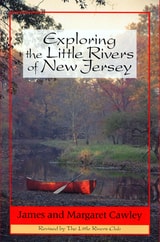
Exploring the Little Rivers of New Jersey
James and Margaret Cawley
Rutgers University Press, 1993
In this fourth edition, the Little Rivers Club has brought the Cawleys' work up to date. This group of experienced canoeists dedicated themselves to re-exploring familiar waterways and adding new ones. Faithful to the Cawley spirit, this edition includes new maps, many new photographs, a directory of canoe liveries, tips of planning a trip, a loving portrait of the Cawleys, and, best of all, twenty-four beautiful waterways to discover.
Featuring 166 photos, 22 maps, and these rivers:
- Batsto
- Cedar Creek
- Delaware and Raritan Canal
- Great Egg Harbor River
- Hackensack
- Manasquan River and Inlet
- Maurice
- Millstone
- Mullica
- Musconetcong
- Oswego River and Lake
- Passaic
- Paulins Kill
- Pequest
- Ramapo-Pompton
- Rancocas
- South and North Branches of the Raritan
- Toms
- Wading
- Black-Lamington
- Cohansey River, Raceway, and Sunset Lake
- Crosswicks Creek
- Metedeconk
- Stony Brook