Results by title
72 books match the query 'Museums' and 6 start with e
Engaging Diverse Communities
A Guide to Museum Public RelationsMelissa A. Johnson
University of Massachusetts Press, 2020
Melissa A. Johnson interviews communicators at cultural heritage museums to understand the challenges of representing communities based on racial and ethnic, generational, immigrant, and language identities. Exploring how communications professionals function as cultural intermediaries by negotiating competing and intersecting identities and mastering linguistic and visual code-switching, she presents an analysis of the communication tactics of more than two hundred art, history, African American, American Indian, and other diverse museums. Engaging Diverse Communities illuminates best public relations practices, especially in media relations, digital press relations, website content production, social media, and event planning. This essential text for museum professionals also addresses visual aesthetics, cultural expression, and counter-stereotypes, and offers guidance on how to communicate cultural attractiveness.
Engaging Museums
Rhetorical Education and Social JusticeLauren E. Obermark
Southern Illinois University Press, 2022
Museums offer an opportunity to reenvision rhetorical education through their address of hard, discomforting histories that challenge visitors to confront traumatic events and work toward a better future. While both museum studies and rhetoric center the audience in their scholarship and practices, this volume engages across and between these disciplines, allowing for a fuller theorization and enactment of rhetorical education’s connections to social justice. Engaging Museums works to fill gaps between the fields of rhetoric and social justice by going beyond classrooms to sites of public memory represented in museums.
This volume presents three distinct, diverse case studies of recently established historical museums taking on the rhetorically complex tasks of representing traumatic events: the National Underground Railroad Freedom Center, the National World War I Museum, and the Oklahoma City National Memorial Museum. Through rhetorical and comparative analysis of data collected from the museums and intersectional transdisciplinary frameworks, each chapter theorizes aspects of rhetoric—namely identification, collectivity, and memory—bringing rhetorical theory more firmly into current conversations surrounding civic engagement and social justice.
Obermark’s weave of voices and perspectives concludes with a critical focus on how memory may serve as a generative pedagogical topos for both public rhetoric and university-based rhetoric and writing classrooms. This book helps scholars, students, and teachers bring what museums do—difficult, complicated pedagogical work representing hard history—back inside the classroom and further into our civic discourse.
Eternal Sovereigns
Indigenous Artists, Activists, and Travelers Reframing RomeGloria Jane Bell
Duke University Press, 2024
Exhibiting Atrocity
Memorial Museums and the Politics of Past ViolenceSodaro, Amy
Rutgers University Press, 2018
Today, nearly any group or nation with violence in its past has constructed or is planning a memorial museum as a mechanism for confronting past trauma, often together with truth commissions, trials, and/or other symbolic or material reparations. Exhibiting Atrocity documents the emergence of the memorial museum as a new cultural form of commemoration, and analyzes its use in efforts to come to terms with past political violence and to promote democracy and human rights.
Through a global comparative approach, Amy Sodaro uses in-depth case studies of five exemplary memorial museums that commemorate a range of violent pasts and allow for a chronological and global examination of the trend: the U.S. Holocaust Memorial Museum in Washington, DC; the House of Terror in Budapest, Hungary; the Kigali Genocide Memorial Centre in Rwanda; the Museum of Memory and Human Rights in Santiago, Chile; and the National September 11 Memorial Museum in New York. Together, these case studies illustrate the historical emergence and global spread of the memorial museum and show how this new cultural form of commemoration is intended to be used in contemporary societies around the world.
Download open access ebook.
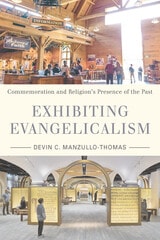
Exhibiting Evangelicalism
Commemoration and Religion’s Presence of the PastDevin C. Manzullo-Thomas
University of Massachusetts Press, 2022
Religion is a subject often overlooked or ignored by public historians. Whether they are worried about inadvertent proselytizing or fearful of contributing to America’s ongoing culture wars, many heritage professionals steer clear of discussing religion’s formative role in the past when they build collections, mount exhibits, and develop educational programming. Yet religious communities have long been active contributors to the nation’s commemorative landscape.
Exhibiting Evangelicalism provides the first account of the growth and development of historical museums created by white evangelical Christians in the United States over the twentieth and twenty-first centuries. Exploring the histories of the Museum of the Bible, the Billy Graham Center Museum, the Billy Sunday Home, and Park Street Church, Devin C. Manzullo-Thomas illustrates how these sites enabled religious leaders to develop a coherent identity for their fractious religious movement and to claim the centrality of evangelicalism to American history. In their zeal to craft a particular vision of the national past, evangelicals engaged with a variety of public history practices and techniques that made them major players in the field—including becoming early adopters of public history’s experiential turn.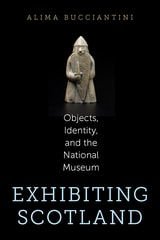
Exhibiting Scotland
Objects, Identity, and the National MuseumAlima Bucciantini
University of Massachusetts Press, 2018
In Exhibiting Scotland, Alima Bucciantini traces how these collections have helped tell the changing stories of this country for centuries and how the museum reflects the Scots' continuing negotiation of their place within modern Britain.