Results by title
175 books match the query 'Narration (Rhetoric)' and 8 start with e

Echo Chambers
Figuring Voice In NarrativePatrick O'Donnell
University of Iowa Press, 1992
Echo Chambers provides an illuminating discussion of the representation of “voice” in novels by Dickens, Joyce, Faulkner, Lowry, and Gaddis. Focusing on the paradoxes of “voice” as an indication of how different authors understand the contradictions of “identity,” O'Donnell charts the recent history of subjectivity as reflected in the development of modern fiction. With strong theoretical underpinning—O'Donnell skillfully utilizes the theories formulated by Bakhtin, Derrida, Bersani, De Man, Deleuze, and Guattari, among others, and the semiotics of voice put forth by Julia Kristeva—Echo Chambers shows how identity is inherently contradictory, conflicted, and multiple.
This insightful volume compellingly demonstrates that “voice” is a revealing (because contradictory and heterogeneous) site where language, the body, culture, and subjectivity meet. Echo Chambers makes an important contribution to the study of modern literature, the semiotics of identity, and cultural poetics as they are informed by the projections of voice in modern narrativ
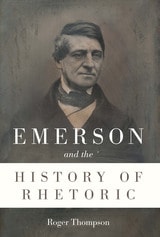
Emerson and the History of Rhetoric
Roger Thompson
Southern Illinois University Press, 2017
Moving beyond dominant literary critical thinking, Thompson argues that for Emerson, rhetoric was both imaginative and nonsystematic. This book covers the influences of rhetoricians from a range of periods on Emerson’s model of rhetoric. Drawing on Emerson’s manuscript notes, journal entries, and some of his rarely discussed essays and lectures as well as his more famous works, the author bridges the divide between literary and rhetorical studies, expanding our understanding of this iconic nineteenth-century man of letters.
Environment and Narrative
New Directions in EconarratologyEdited by Erin James and Eric Morel
The Ohio State University Press, 2020
To explore the methodological possibilities within “econarratology,” the contributors evaluate the mechanics of how narratives convey environmental understanding via building blocks such as the organization of time and space, characterization, focalization, description, and narration. They also query how readers emotionally and cognitively engage with such representations and how the process of encountering different environments in narratives stands to affect real-world attitudes and behaviors. By positioning narratives as important repositories of values, political and ethical ideas, and behaviors that determine how we engage with our ecological homes, the authors in this volume suggest that to change the way that we interact with the environment requires not only new stories but also a better understanding of the ones that have long been in circulation.
Ethics and the Dynamic Observer Narrator
Reckoning with Past and Present in German LiteratureKatra A. Byram
The Ohio State University Press, 2015
Ethics and the Dynamic Observer Narrator contributes to scholarship on both narrative theory and the historical and cultural context of German and Austrian literary studies. Narrative theory, according to Byram, should understand this form to register complex interactions between history and narrative form. Byram also juxtaposes new readings of works by Textor, Storm, and Raabe from the nineteenth century with analyses of twentieth-century works by Grass, Handke, and Sebald, ultimately reframing our understanding of literary Vergangenheitsbewältigung, or the struggle to come to terms with the past. Overall, Byram shows that neither the problem of reckoning with the past nor the dynamic observer form is unique to Germany’s post-WWII era. Both are products of the dynamics of modern identity, surfacing whenever critical change separates what was from what is.
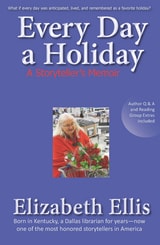
Every Day A Holiday
A storyteller's memoirElizabeth Ellis
Parkhurst Brothers, Inc., 2014
--Robin Bady, Storyteller, Arts Educator, Brooklyn, New York
Experiencing Fiction
Judgments, Progressions, and the Rhetorical Theory of NarrativeJames Phelan
The Ohio State University Press, 2007
Experiencing Visual Storyworlds
Focalization in ComicsSilke Horstkotte and Nancy Pedri
The Ohio State University Press, 2022
Extinct Lands, Temporal Geographies
Chicana Literature and the Urgency of SpaceMary Pat Brady
Duke University Press, 2002
The history of the American Southwest in large part entails the transformation of lived, embodied space into zones of police surveillance, warehouse districts, highway interchanges, and shopping malls—a movement that Chicana writers have contested from its inception. Brady examines this long-standing engagement with space, first in the work of early newspaper essayists and fiction writers who opposed Anglo characterizations of Northern Sonora that were highly detrimental to Mexican Americans, and then in the work of authors who explore border crossing. Through the writing of Sandra Cisneros, Cherríe Moraga, Terri de la Peña, Norma Cantú, Monserrat Fontes, Gloria Anzaldúa, and others, Brady shows how categories such as race, gender, and sexuality are spatially enacted and created—and made to appear natural and unyielding. In a spatial critique of the war on drugs, she reveals how scale—the process by which space is divided, organized, and categorized—has become a crucial tool in the management and policing of the narcotics economy.