Results by title
141 books match the query 'Oregon' and 8 start with e
Eden Within Eden
Oregon's Utopian HeritageJames J. Kopp
Oregon State University Press, 2009
[more]

Edge Effects
Notes From An Oregon ForestChris Anderson
University of Iowa Press, 1993
Buying his dream house several years ago on the forest's edge near Corvallis, Oregon, essayist Chris Anderson hoped to find the joys of rural living. Despite interminable Mr. Blandings experiences, he lived embowered by 12,000 acres of seemingly endless fir trees. But not for long. The McDonald-Dunn Forest was about to become the site of a disturbing research project. Little did Anderson know when he bought his house that, in addition to studying the ecological effects of clear-cutting, the researchers wanted to see how urban fringe dwellers might be affected too. The shock of that harvest compelled the essays in this vibrant, graceful record of the relationship between the forest and Anderson's life on its boundary.
[more]
Edge of Awe
Experiences of the Malheur-Steens CountryAlan L. Contreras
Oregon State University Press, 2019
This compelling anthology gathers together personal impressions of the Malheur-Steens country of southeastern Oregon, known for its birding opportunities, its natural beauty and remoteness, and, more recently, for the 2016 armed takeover of the Malheur National Wildlife Refuge. Contributors of poetry and narrative nonfiction include biologists, students, tourists, birders, and local residents, thus reflecting the perspectives of both visitors and residents.
Edge of Awe celebrates the immense variety of human experience in the Malheur-Steens region. This high-desert marsh country has long been a place of human habitation, work, and recreation, but this compendium is weighted toward the writing of visitors over the past one hundred years. It encompasses a wide range of experiences, such as fishing the Blitzen River, attending the Steens Running Camp, leading a mule train on Steens mountain, looking for rare migrant birds, boating on the great marshes, and much more.
Anyone who has visited the awe-inspiring Malheur-Steens country or plans to do so, and anyone with an interest in the region, will find inspiration in this literary companion.
CONTRIBUTORS
Chas Biederman
Charles E. Bendire
Greg Bryant
Sean Burns
Alan L. Contreras
Harry Fuller
Ira N. Gabrielson
Quinton Hallett
Ada Hastings Hedges
David Hedges
Hendrik Herlyn
Meli Hull
William Kittredge
Ursula K. Le Guin
Maitreya
David B. Marshall
John F. Marshall
Tom McAllister
Thomas C. Meinzen
Peter Pearsall
Dallas Lore Sharp
William Stafford
Noah K. Strycker
Peter Walker
Ellen Waterston
C.E.S. Wood
[more]
Eleanor Baldwin and the Woman's Point of View
New Thought Radicalism in Portland’s Progressive EraLawrence M. Lipin
Oregon State University Press, 2017
Eleanor Baldwin and the Woman’s Point of View is an intellectual biography of a long-forgotten radical female journalist in Portland, whose daily women’s columns provide a window into the breadth of intellectual radicalism in Progressive Era journalism. Baldwin was one of an early generation of female journalists who were hired to lure female readers to the daily newspaper’s department store advertisements. Instead of catering to the demands of consumerism, Baldwin quickly brought an anti-capitalist, antiracist agenda to her column, “The Woman’s Point of View." She eschewed household hints and instead focused on the immorality of capitalists and imperialists while emphasizing the need for women to become independent and productive citizens.
A century before the Occupy movement and the Women’s March, Baldwin spoke truth to power. Imbued with a New Thought spirituality that presumed progressive thought could directly affect material reality, she wrote to move history forward. And yet, the trajectory of history proved as hard to forecast then as now. While her personal story seems to embody a modern progressivism, blending abolition with labor reform and anti-banker activism—positions from which she never wavered—her path grew more complicated as times changed in the aftermath of World War I, when she would advocate on behalf of both the Bolsheviks and the Ku Klux Klan.
In this deeply researched and nuanced account of Eleanor Baldwin’s intellectual journey, historian Larry Lipin reveals how even the most dedicated radical can be overcome by unforeseen events. Eleanor Baldwin and the Woman’s Point of View restores a missing chapter in Portland’s Progressive Era history and rescues this passionate, intriguing, and quixotic character from undeserved obscurity.
[more]
Ellie's Strand
Exploring the Edge of the PacificM. L. Herring
Oregon State University Press, 2018
Sigrud Olson Nature Writing Award, Notable Children’s Book
Green Earth Book Award, Honor Book
There are days in late winter when the Pacific coast enjoys a brief spell of clear, warm weather. Most of the winter storms have passed and the summer fog has not yet settled in. This is when some coastal communities plan their annual beach clean-ups.
In this sequel to Ellie’s Log and Ricky’s Atlas, Ellie and Ricky travel to the Oregon coast from their home in the Cascade Mountains to help with a one-day beach clean-up. Hoping to find a prized Japanese glass float, they instead find more important natural treasures, and evidence of an ocean that needs its own global-scale clean-up.
Ellie and Ricky are amazed by their discoveries at the edge of the world’s largest ocean. Together, they realize the power of volunteering and grapple with the challenges of ocean conservation. In her journal Ellie records her observations of their adventures in her own words and pictures.
With charming pen-and-ink drawings and a compelling story, Ellie's Strand makes coastal science exciting for upper elementary school students. It will be a treasured companion for young beach explorers everywhere.
[more]
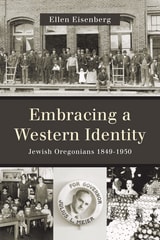
Embracing a Western Identity
Jewish Oregonians, 1849-1950Ellen Eisenberg
Oregon State University Press, 2015
Not all of Oregon’s pioneers were Christian farmers or bachelor prospectors. Indeed, many of the first brick buildings on Oregon’s newly platted Main Streets were built by Jewish merchants whose services were essential to town founding and growth.
In Embracing a Western Identity, Ellen Eisenberg places Jewish history in the larger context of western narratives, challenging the traditional view that the “authentic” North American Jewish experience stems from New York. The westward paths of Jewish Oregonians and their experiences of place shaped the communities, institutions, and identities they created, distinguishing them from other American Jewish communities. Eisenberg traces the Oregon Jewish experience from its pioneer beginnings in the mid-nineteenth century to the highly concentrated Portland communities of the mid-twentieth century.
Drawing on extensive archival resources at the Oregon Jewish Museum, this historical commentary explores patterns of migration and settlement, the place of Jews in the state’s ethnic landscape, their engagement in politics, the development of institutions, and their relationship to Zionism. Departing from familiar treatments of the Jewish experience, Embracing a Western Identity provides a critical look at the impact of place and opportunity upon the identities of migrants both as Oregonians and as American Jews. Readers and scholars interested in western history—religious, ethnic, expansionist, and otherwise—will enjoy Eisenberg’s accessible writing style and rich photograph collection.
[more]

Empty Nets, 2nd ed
Indians, Dams, and the Columbia RiverRoberta Ulrich
Oregon State University Press, 2007
[more]
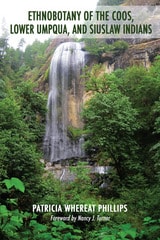
Ethnobotany of the Coos, Lower Umpqua, and Siuslaw Indians
Patricia Whereat-Phillips
Oregon State University Press, 2016
Myrtlewood is most often thought of as beautiful wood for woodworking, but to Native people on the southern Oregon coast it was an important source of food. The roasted nuts taste like bitter chocolate, coffee, and burnt popcorn. The roots of Skunk Cabbage provided another traditional food source, while also serving as a medicine for colds. In tribal mythology, the leaves of Skunk Cabbage were thought to be tents where the Little People sheltered.
Very little has been published until now on the ethnobotany of western Oregon indigenous peoples. Ethnobotany of the Coos, Lower Umpqua, and Siuslaw Indians documents the use of plants by these closely-related coastal tribes, covering a geographical area that extends roughly from Cape Perpetua on the central coast, south to the Coquille River, and from the Coast Range west to the Pacific shore. With a focus on native plants and their traditional uses, it also includes mention of farming crops, as well as the highly invasive Himalayan blackberry, which some Oregon coast Indians called the "white man's berry."
The cultures of the Coos Bay, Lower Umpqua and Siuslaw are distinct from the Athabaskan speaking people to the south, and the Alsea to the north. Today, many tribal members are reviving ancient arts of basket weaving and woodworking, and many now participate in annual intertribal canoe events. Ethnobotany of the Coos, Lower Umpqua, and Siuslaw Indians contributes to this cultural renaissance by filling an important gap in the historical record. It is an invaluable resource for anyone who wishes to learn about the indigenous cultures of the central and southern Oregon coast, as well as those who are interested in Pacific Northwest plants and their cultural uses.
[more]