138 books match the query 'Postcolonialism' and 7 start with e
cover of Embers of the Past: Essays in Times of Decolonization

Embers of the Past

Essays in Times of Decolonization

Javier Sanjinés C.

Duke University Press, 2013
Embers of the Past is a powerful critique of historicism and modernity. Javier Sanjinés C. analyzes the conflict between the cultures and movements of indigenous peoples and attention to the modern nation-state in its contemporary Latin American manifestations. He contends that indigenous movements have introduced doubt into the linear course of modernity, reopening the gap between the symbolic and the real. Addressing this rupture, Sanjines argues that scholars must rethink their temporal categories. Toward that end, he engages with recent events in Latin America, particularly in Bolivia, and with Latin American intellectuals, as well as European thinkers disenchanted with modernity. Sanjinés dissects the concepts of the homogeneous nation and linear time, and insists on the need to reclaim the indigenous subjectivities still labeled "premodern" and excluded from the production, distribution, and organization of knowledge.
[more]
cover of Empires of Vision: A Reader

Empires of Vision

A Reader

Martin Jay and Sumathi Ramaswamy, eds.

Duke University Press, 2014

Empires of Vision brings together pieces by some of the most influential scholars working at the intersection of visual culture studies and the history of European imperialism. The essays and excerpts focus on the paintings, maps, geographical surveys, postcards, photographs, and other media that comprise the visual milieu of colonization, struggles for decolonization, and the lingering effects of empire. Taken together, they demonstrate that an appreciation of the role of visual experience is necessary for understanding the functioning of hegemonic imperial power and the ways that the colonized subjects spoke, and looked, back at their imperial rulers. Empires of Vision also makes a vital point about the complexity of image culture in the modern world: We must comprehend how regimes of visuality emerged globally, not only in the metropole but also in relation to the putative margins of a world that increasingly came to question the very distinction between center and periphery.


Contributors. Jordanna Bailkin, Roger Benjamin, Daniela Bleichmar, Zeynep Çelik, David Ciarlo, Natasha Eaton, Simon Gikandi, Serge Gruzinski, James L. Hevia, Martin Jay, Brian Larkin, Olu Oguibe, Ricardo Padrón, Christopher Pinney, Sumathi Ramaswamy, Benjamin Schmidt, Terry Smith, Robert Stam, Eric A. Stein, Nicholas Thomas, Krista A. Thompson
[more]
cover of Entanglements, or Transmedial Thinking about Capture

Entanglements, or Transmedial Thinking about Capture

Rey Chow

Duke University Press, 2012

How might the pornographic be associated with Brecht's and Benjamin's media theories? How are Foucault's and Deleuze's writings on visibilities "postcolonial"? What happens when Rancière's discussions of art are juxtaposed with cultural anthropology? What does a story by Lao She about collecting reveal about political collectivism in modern China? How does Girard's notion of mimetic violence speak to identity politics? How might Arendt's and Derrida's reflections on forgiveness be supplemented by a film by Lee Chang-dong? What can Akira Kurosawa's films about Japan say about American Studies? How is Asia framed transnationally, with what consequences for those who self-identify as Asian?

These questions are dispersively heterologous yet mutually implicated. This paradoxical character of their discursive relations is what Rey Chow intends with the word "entanglements," by which she means, first, an enmeshment of topics: the mediatized image in modernist reflexivity; captivation and identification; victimhood; the place of East Asia in globalized Western academic study. Beyond enmeshment, she asks, can entanglements be phenomena that are not defined by affinity or proximity? Might entanglements be about partition and disparity rather than about conjunction and similarity?
Across medial forms (including theater, film, narrative, digitization, and photographic art), and against more popular trends of declaring things and people to be in flux, Chow proposes conceptual frames that foreground instead aesthetic, ontological, and sentient experiences of force, dominance, submission, fidelity, antagonism, masochism, letting-go, and the attraction to self-annihilation. Boundary, trap, capture, captivation, sacrifice, and mimesis: these riveting terms serve as analytic pressure points in her readings, articulating perversity, madness, and terror to pursuits of freedom.
[more]
cover of Ethnographies of U.S. Empire

Ethnographies of U.S. Empire

Carole McGranahan and John F. Collins, editors

Duke University Press, 2018

How do we live in and with empire? The contributors to Ethnographies of U.S. Empire pursue this question by examining empire as an unequally shared present. Here empire stands as an entrenched, if often invisible, part of everyday life central to making and remaking a world in which it is too often presented as an aberration rather than as a structuring condition. This volume presents scholarship from across U.S. imperial formations: settler colonialism, overseas territories, communities impacted by U.S. military action or political intervention, Cold War alliances and fissures, and, most recently, new forms of U.S. empire after 9/11. From the Mohawk Nation, Korea, and the Philippines to Iraq and the hills of New Jersey, the contributors show how a methodological and theoretical commitment to ethnography sharpens all of our understandings of the novel and timeworn ways people live, thrive, and resist in the imperial present.

Contributors: Kevin K. Birth, Joe Bryan, John F. Collins, Jean Dennison, Erin Fitz-Henry, Adriana María Garriga-López, Olívia Maria Gomes da Cunha, Matthew Gutmann, Ju Hui Judy Han, J. Kēhaulani Kauanui, Eleana Kim, Heonik Kwon, Soo Ah Kwon, Darryl Li, Catherine Lutz, Sunaina Maira, Carole McGranahan, Sean T. Mitchell, Jan M. Padios, Melissa Rosario, Audra Simpson, Ann Laura Stoler, Lisa Uperesa, David Vine
[more]
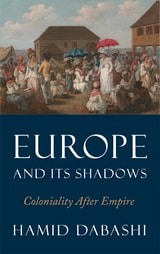
cover of Europe and Its Shadows: Coloniality after Empire

Europe and Its Shadows

Coloniality after Empire

Hamid Dabashi

Pluto Press, 2019

Europe has long imagined itself as the centre of the universe, although its precise geographical, cultural and social terrains have always been amorphous. Exploring the fear and fascination associated with the continent as an allegory, Hamid Dabashi considers Europe to be a historically formed barricade against the world.

Frantz Fanon’s assessment that 'Europe is literally the creation of the Third World' is still true today; but in more than one sense for the colonial has always been embedded in the capital, and the capital within the colonial. As the condition of coloniality shifts, so have the dividing lines between coloniser and colonised, and this shift calls for a reappraisal of our understanding of nationalism, xenophobia and sectarianism as the dangerous indices of the emerging worlds.

As the far-right populists captivate minds across Europe and Brexit upsets the balance of power in the European Union, this book, from a major scholar of postcolonial thought, is a timely and transformative intervention.
[more]
cover of Europe in Black and White: Immigration, Race, and Identity in the ‘Old Continent'

Europe in Black and White

Immigration, Race, and Identity in the ‘Old Continent'

Edited by Manuela Ribeiro Sanches, Fernando Clara, João Ferreira Duarte, and Leonor Pires Martins

Intellect Books, 2011

The essays in Europe in Black and White offer new critical perspectives on race, immigration, and identity on the Old Continent. In reconsidering the various forms of encounters with difference, such as multiculturalism and hybridity, the contributors address a number of issues, including the cartography of postcolonial Europe, its relation to the production of "difference" and "race," and national and identity politics and their dependence on linguistic practices inherited from imperial times. Featuring scholars from a wide variety of nationalities and disciplinary areas, this collection will speak to an equally wide readership.
[more]
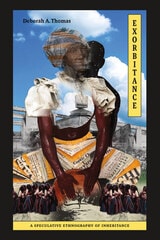
cover of Exorbitance: A Speculative Ethnography of Inheritance

Exorbitance

A Speculative Ethnography of Inheritance

Deborah A. Thomas

Duke University Press, 2025

In Exorbitance, Deborah A. Thomas calls for new approaches to political sovereignty grounded in the embodied forms of autonomy and relation created in daily life. Rather than rooting sovereignty in the violence of the state and its institutions, Thomas conceives of sovereignty as the embodied refusal of law and dominion. Drawing on the insights of Caribbeanist thought and studies of Jamaican social, political, and spiritual life, Thomas proposes an exorbitant sovereignty enacted through a phenomenological notion of inheritance. Such a sovereignty emerges from alternative genealogies of governance, community, and ceremony that exceed Enlightenment expectations of political life. Thomas contends that the articulations of exorbitant sovereignty are emergent, ephemeral, and ultimately, relational. By outlining the perils and promises of our inheritance of colonial logics and the tools to refuse them, Thomas models a collaborative and collective anthropology oriented toward improvisational experimentation rather than ethnographic extraction.
[more]