Results by title
137 books match the query 'Poverty' and 6 start with e
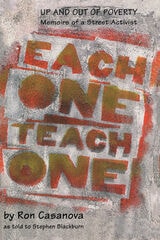
Each One Teach One
Up and Out of Poverty, Memoirs of a Street ActivistRon Casanova and Stephen Blackburn
Northwestern University Press, 2010
Underlying Each One Teach One, with its vivid cast of characters and intimate descriptions of Harlem and other urban areas, is the profound sense that no matter what your circumstance, you can use your past experience to help others. Ultimately, Casanova's story is a message of hope for the future and for the possibility of self-sufficiency and self-empowerment for each individual.
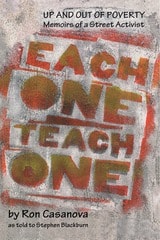
Each One Teach One
Up and Out of Poverty; Memoirs of a Street ActivistRon Casanova as told to Stephen Blackburn
Northwestern University Press, 1996
Each One Teach One recounts Ron Casanova’s struggle out of poverty, homelessness, and drug addiction to find dignity and purpose in life. Through his own awakening, this Black Puerto Rican activist ultimately finds his salvation in helping other people. Placed in an orphanage on Staten Island at the age of three, Casanova faced overwhelming odds. His story illuminates significant twentieth-century protests, including the 1988 riot at Tompkins Square Park in Manhattan, the “Housing Now” march of the homeless on Washington, DC, in 1989, and community takeovers of housing in Kansas City, New York, and Philadelphia.
Underlying Each One Teach One, with its vivid cast of characters and intimate descriptions of Harlem, the Lower East Side, and Tent City, is the profound sense that, no matter what your circumstance, you can use your experience to help others. Ultimately, Casanova’s story demonstrates the possibility of self-sufficiency and self-empowerment. Amid today’s economic crisis and rising homelessness, Casanova’s story brings a message of hope.
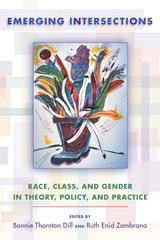
Emerging Intersections
Race, Class, and Gender in Theory, Policy, and PracticeDill, Bonnie Thornton
Rutgers University Press, 2009
Emerging Intersections, an anthology of ten previously unpublished essays, looks at the problems of inequality and oppression from new angles and promotes intersectionality as an interpretive tool that can be utilized to better understand the ways in which race, class, gender, ethnicity, and other dimensions of difference shape our lives today. The book showcases innovative contributions that expand our understanding of how inequality affects people of color, demonstrates the ways public policies reinforce existing systems of inequality, and shows how research and teaching using an intersectional perspective compels scholars to become agents of change within institutions. By offering practical applications for using intersectional knowledge, Emerging Intersections will help bring us one step closer to achieving positive institutional change and social justice.

Empire State-Building
War and Welfare in Kenya, 1925–1952Joanna Lewis
Ohio University Press, 2001
This history of administrative thought and practice in colonial Kenya looks at the ways in which white people tried to engineer social change.
It asks four questions:
- Why was Kenya’s welfare operation so idiosyncratic and spartan compared with that of other British colonies?
- Why did a transformation from social welfare to community development produce further neglect of the very poor?
- Why was there no equivalent to the French tradition of community medicine?
- If there was a transformatory element of colonial rule that sought to address poverty, where and why did it fall down?
The answers offer revealing insight into the dynamics of rule in the late colonial period in Kenya.
Ending Poverty As We Know It
Guaranteeing A Right To A JobWilliam P. Quigley
Temple University Press, 2003

Eradicating Extreme Poverty
Democracy, Globalisation and Human RightsEdited by Xavier Godinot
Pluto Press, 2012
The failure of attempts to tackle global poverty have bred cynicism and 'compassion fatigue'. Eradicating Extreme Poverty provides an urgently needed fresh approach which will re-energise action on this issue.
Rejecting traditional 'top-down' approaches, Xavier Godinot and his colleagues start from the experiences, capabilities and strategies of the poor themselves. They argue that the first step is a close connection with poor communities followed by a commitment to take action alongside them. Life-stories from Burkina Faso, France, Peru and the Philippines are used to show that the poor must be involved in their own liberation.
After decades of failed development policies, this book outlines a radical new approach which will enliven debate amongst policy-makers, researchers, students and academics.